Tag: assessment

  • Reform ‘high stakes’ primary tests, MPs urge

    As we look to the future of education in this country, why is it that we are following the trend and examples from the UK? Yet our Education Minister(s) head over there to see their awesome examples of how to destroy public education…


    Children’s education in England is being skewed by the use of high-stakes tests taken by 11-year-olds as a school league table measure, say MPs.

    Annual test results should be replaced in the tables by a three-year rolling average to “lower the stakes”, says the Commons Education Select Committee.

    The current system has led to a narrow curriculum and “unnecessary stress” on pupils and teachers, argues the report.

    Last year, new tougher tests for 11-year-olds saw passes drop sharply.

    Ministers maintain that parents have a right to expect testing in schools to show whether their children are gaining the right skills in maths and literacy.

    But the committee says the close link between the tests at 11 and school accountability can “lead to a narrowing of the curriculum and ‘teaching to the test’, as well as affecting teacher and pupil well-being”.

    It wants the current system scrapped, with three-year rolling averages for schools published instead of the results of individual year groups.

    ‘Held to account’

    The report also calls for greater emphasis in Ofsted inspections on a broad and balanced curriculum.

    Committee chairman Neil Carmichael said too much emphasis on test results had led to too much “focus on English and maths at the expense of other subjects like science, humanities and the arts”.

    “It is right that schools are held to account for their performance but the government should act to lower the stakes and help teachers to deliver a broad, balanced and fulfilling curriculum for primary school children.”

    The report says poor implementation of the new system last year, with “guidance delayed and test papers leaked online”, caused significant disruption in schools.

    The MPs want ministers to reconsider the new writing assessment which emphasises “technical aspects like grammar and spelling, over creativity and composition”.

    “The balance of evidence we received did not support the proposition that focusing on specific grammatical techniques improved the overall quality of writing.”

    They also want spelling, punctuation and grammar tests for 11-year-olds to become non-statutory.

    Ministers recently announced proposals to scrap tests for seven-year-olds, following years of pressure from teachers, parents and educationalists.

    The Department for Education is consulting on a new assessment for pupils when they first start school – but the report urges caution when introducing a “baseline” measure.

    “It should be designed as a diagnostic tool to help teachers identify pupils’ needs and must avoid shifting negative consequences of high-stakes accountability to early years,” they warn.

    Read more here.

    Source: http://www.bbc.com/news/education-39745884

  • National Standards Plus

    Seriously. How ridiculous?

    Mum is running late for work, driving over the hill to her 9 til 5 job in the city centre. A notification comes through on her phone at 9:01am, and although she knows she shouldn’t, she checks her phone anyway. The message preview reads “Sally Burgess*: Reading – Below, Writing – Below, Mathematics – Wel…” before it gets truncated to fit on the screen. Opening it up to see the $45 million dollar app in all it’s glory, Mum forgets about the upcoming corner and drives off the road into the fence of the unfortunate homeowner. This instantly lands her in hospital. It could have been so much worse though. She probably counts herself lucky not to have plowed through multiple crowds of children at the local school 300 metres down the road.

    That’s right. The government would have parents being updated in real time every and any progress their child is making in National Standards throughout the school day.

    They’re calling this ‘National Standards Plus’, largely because of the additional time and energy that is going to be chewing into teachers already busy schedule. The additional testing, the additional data gathering, the additional reporting and notifying and uploading to the app’s system. All this PLUS actually teaching the children.

    National Standards Plus would allow parents to track their child’s progress in more detail online.

    “We will show you your child’s progress on your mobile phone, English said. “Some schools have already rolled out tools that support this approach.

    – Stuff, 28 August 2017


    The benefit to this will be of course that parents are kept up to date with their child’s progress as it happens.

    Of course, to get this, teachers will be required to input data as it happens. Which will have to be regularly for it to be a worthwhile app to keep on your phone. So now instead of teaching, teachers will be in a constant state of testing, assessing, marking and upload results to the app, for each and every child in their class, each and every day.

    What the government is forgetting however, is the cost of equipping each classroom in the country with one of these:

    Osbourne:  Portable Scale, Wide, Digital.

    Whether you are weighing market hogs to capture packer premiums or weighing show pigs, goats, or lambs, the Osborne ACCU-ARM Portable Scale offers the most “rock solid” portable weighing system available. The solid, animal-friendly scale uses precision levers to reduce sway and bounce and is completely cable free! With Osborne, the entire weighing operation is more efficient and less stressful for both you and your livestock!

    This scale features standard side panels, side-opening gates, a wheel kit for easy transportation, and a weighing meter with digital read out. The scale platform is 20 in. (51 cm) wide and the scale weighs animals up to 500 lbs. (227 kg).

    Find out more here.

    Using these scales to weigh the pigs is one thing, but teaching children so that there is progress to notify parents about is another.

    Labour education spokesman Chris Hipkins said National was ‘”doubling down” on its National Standards system which was not improving student achievement.

    “Kids in New Zealand are over assessed. What we need is less reporting, more teaching.”

    And he questioned how teachers would find the time to update assessment records for continual online access.

    Education union the NZEI said plans to spend millions building a computer tool to track children’s progress as it happened,” based on shonky National Standards, is an obsession with data gone mad”.

    “Requiring teachers to input standardised assessment data across a range of subjects in real time for 30 or more students in a class will reduce the time teachers have with children and increase children’s anxiety about learning,” NZEI Te Riu Roa President Lynda Stuart says.

    “No parent wants their child’s teacher sitting entering data for hours when they need to be face to face with kids.”

    Seriously. How ridiculous?

    Oink.


    In relation to – Stuff – National launches official campaign with education bid

  • Primary schools to measure student progress

    In response to https://beehive.govt.nz/release/primary-schools-measure-student-progress – August 26, 2017.

    Measure. Measure. Measure. Weigh. Weigh. Weigh. Data. Data. Data.

    “The Government has made a decision to shift towards a system that measures student progress, alongside National Standards / Ngā Whanaketanga Rumaki Māori, to help ensure every student gets the support they need to achieve…
    Monitoring student progress gives teachers more data on which to tailor learning plans for their students – and we want to roll this out to all primary schools and kura.”

    says Education Minister Nikki Kaye.

    More data. More weighing. More testing. More assessment.

    Guess what. Teacher’s already monitor progress. I can show you the progress each of my students are making (or not making) in each of the three big subjects that now dominate the New Zealand Curriculum. Obviously not enough though.

    “Measuring progression means teachers will be able to see how far children have come in the specific learning areas that make up National Standards.”

    In some regards, it is good that the Minister has acknowledged what teachers have been saying for a while. Some students make incredible progress within a year, but are still below or well below the expected standard set by the Standards.

    “The change also reflects the education sector’s observation that we don’t adequately show a student’s progress over time, particularly for students who may be below the standard, and this will help address that.”

    This is all well and good, but as schools have come to know through the berading from ERO and senior advisers, progress don’t mean jack when it comes to achievement, which is all ‘the Ministry’ and ERO actually care about. 85% At or Above. 85%. 85%. 85%.

    Ultimately however, this will actually just lead to the mandatory use of PaCT.

    To support teachers the Ministry of Education has developed progress tools, such as Learning Progression Frameworks, the Progress and Consistency Tool and Whakatupuranga, that help show how children are doing and how they can progress. These have been developed in a number of areas including reading, writing, maths and digital technologies.

    The Government wants to roll out tools like these to all primary schools and kura as evidence shows they deliver real benefits for teachers and kaiako, by streamlining paperwork and reducing their reporting workload.

    There has been copious amounts written about PaCT and it’s potential. Just have a look at the following

    Education continues down this reform, with National determined on making National Standards legitimate.


  • Academic or Mechanic?

    The old smell of oil, diesel and grease fills the nose. The hunched over worker looks sideways from under the hood of a new Mercedes Benz and sighs with disappointment at the new arrival to his workshop. As I get out from behind the wheel of my pride and joy, my very first car, he wipes off his hands on a rag and comes over, somewhat disapprovingly. My light yellow, 1980 Daihatsu Charade coughs to a stop as the ignition switches off. The mechanic folds his arms.

    “It’s not quite up to standard.” I begin. “It needs a few new bits and pieces. I have the original owners manual, it’s in the back. The spare tire is inflated enough, and there air freshener inside has just been replaced.”

    “So what’s wrong with it?” muttered the mechanic, not at all impressed that I’d chosen his workshop to drop into. Usually cars like this go down to the wreckers.

    “Well, the Ministry of Environmental improvements have release New Standards for all cars, and this one seems to fail in most areas. It runs rich, costing lots more when I go to the pump. The emissions are through the roof evidently, and the steam coming from the bonnet after I run it flat out is a bit concerning. Also, I can’t remember the last time I changed the oil. I haven’t had time to get it serviced on any regular basis. The standards suggest that all cars need to be tuned to the optimal running speed of the Ferrari 458 Italia, which I assume won’t be too much to ask for?”.

    “Of course. The good ol MoE and their NS BS.” the mechanic replies in some sort of mixed up code.

    “So can you help me?” I ask, almost pleadingly.

    “Well, I’ll give it my best shot. But it’s going to take me quite a bit of time, effort, and of course, money.”

    “How about, if you just get paid your standard hourly rate. You can pay for some of the materials yourself, and after 5pm, you’ll be able to keep on working on it in your own time, I’m sure. I will need it back for the MoE by the end of the week.”

    “You’ve got to be joking?” laughed the mechanic, though obviously not in response to anything that would be considered humourous.

    “Well, that’s what the New Standards say customers should expect.” I reply. I’d done my research.

    “Like I say. I’ll give it my best shot.” retorted the mechanic, resigned to the fact that all he could do was try his hardest, knowing full well that getting the best out of this machine was one thing, getting it up to these New Standards was another.


    The mechanic returned to work on the Merc. It wasn’t far off the standard. It was new, and had obviously been looked after. The records showed regular servicing, and the fresh leather seat smell still lingered in the air. It was well fed too, with 98 octane premium fuel, and the best of synthetic oils. The engine ticked over into a gentle purr. It didn’t need much work to meet these new standards.

    Needless to say the Daihatsu never made it anywhere close to the speed of the 458. Not for lack of trying though. The mechanic worked night and day, and every working hour he had was poured into it and the other 29 cars in his workshop that week.

    In fact, the mechanic worked on it for a year, each and every day.

    By the end of that year, he had the little Charade up and running smoothly. The steam had gone, as had the oil leak. It got up to speed of around 100km/hr with little more than a sigh, and the coughing and spluttering that happened when ignition ceased was a thing of the past.

    Unfortunately, the mechanic was labeled a failure by the MoE because the 1980 Charade did not meet the expected level that they had set for all cars.


    Why is a short story about a mechanic and cars featuring on my education website?

    Well, as I’m sure you’ve worked out by now, this is a very simple analogy using comparison. In this particular example, the mechanic is a teacher, the selection of cars; students. Each and every year, teachers are expected to work miracles with some students, who face a range of challenges to meeting the standard, none of which are their fault. Some have had good support and upbringing, and others have had to face poverty, hunger, anger, and violence. Some have the essentials required to learn in a efficient way, others lack the basics to face the day.

    There is little doubt that the current Ministry of Education (MoE) and their National Standards (NS) seem ridiculous when applied to cars. But on many levels, the correlation in this analogy rings true, and holds firm.

    Maybe, just maybe, we should be educating students differently. Rather than getting each and every child up to a somewhat unattainable level, maybe we should focus on just getting from A to B, just like a good car should.

  • Gold medals for all

    Global (Bulk) Funding

    In the weekend just been, I caught up with Ms Parata’s latest palava regarding schooling and in particular, the funding of it. Needless to say, there was lots of conjecture, and I found it hard (yet again) to agree with much of what she has to say.

    Olympics

    At the same time, we saw the wind down of the 31st Olympiad in Rio De Janerio. I was able to make some links between the two. I’ve tried to get my head around the idea of what success is, and what it looks like; both in education, as well as in life, and using the Olympics as a starting point On what success looks like for New Zealanders.

    Assessment

    Ms. Parata signalled the intention to have a never-ending assessment system throughout every year of a child’s schooling, so that we can track and monitor student achievement, and thus be able to allocate funding more accurately to children who need it as soon as we begin seeing them to fall behind.

    But how robust are these assessment systems? The National Standards are full of holes and have long been criticised for their lack of National moderation and lack of Standard measurement. Yet, as we know, the Government continues to set the expectation that 85% of students will be At or Above their corresponding level across the country according to those National Standards.

    To University and Beyond

    In her statements, Hekia also mentioned that the aspiration for her assessment and data driven school system is to monitor students at each and every level so that they can go on to finish school, go to university and get employed.

    I have a series of problems with this.

    Don’t get me wrong; University definitely expanded my worldview, my knowledge and skills as an artist, as a photographer, and as a teacher. I met my wife at University.
    However, my personal view on this point is that if everyone has a degree, then that degree becomes less valuable, or even meaningless. The more people that get it, the less rare it is, and the more people are expected to get it or achieve it, and therefore starts on a never ending downward spiral in worth or value. Even take, for example, the status a Ph D. It still holds a lot of value because it’s a whole heap of hard work and not everyone can achieve that level of study or knowledge. If they started handing out Ph D’s to any Joe Bloggs who shows up, then the value of it decreases.

    The Value of Gold

    Much like at the Olympics, if we were to hand out gold medals to all who attended, then the value, the meaning, and the hard work that is represented in the gold medal would become completely meaningless. Gold medals become worthless, and suddenly don’t mean anything to anyone. They may as well be medals for participation.

    The New Zealand Olympic committee seemed to have a more realistic view on success rates. At no point did they expect everyone to get a Gold medal. In fact, some weren’t expected to medal at all. Some achieved that Gold medal who were expected to achieve it (Bond & Murray, Drysdale, Burling & Tuke, Carrington). Some missed out who we expected to get it (Adams, All Black Sevens), but we certainly don’t see them as failures. We also had some athletes get medals with non-gold shades on them who we expected to do so (Ko, Willis). And then we had others who we never expected to medal, but who shone on the world stage to get a medal around their necks (Walsh, McCartney, Rooney).

    There’s more to Education

    Like I say; don’t get me wrong; University is great and is a huge expectation and motivator for many of our students. The high expectations of teachers these days assist students to surge on to extend their learning at university; and somehow we manage to correlate this with success.
    However, that’s not a good picture to paint, especially if you look at the employment depletion in the area of trades. You see; some students might not be wired to go on to university. Some students would and will make great road workers, builders, plumbers and electricians without having to attend University. Some students show great natural talent in sports and university simply gets in the way of them making the most of their younger fit years. Are they any less successful, just because they don’t go on to university?
    No.
    So why are we making university the be-all-and-end-all of our education system? Surely it should be aimed towards making each student the best they can be to make the most of what is before them and give them the skills they need to be successful in life, regardless of what that life may be?

    Failure or Success?

    What’s more, just because you go to university it does not mean you will succeed. I know of many people who have got a degree and haven’t been able to use it to gain employment at multi national companies making lots of money or otherwise being deemed as successful. They’ve ended up pushing trollies at the local New World, or working retail on the city mall.

    In addition to this, I know of cases where folk who have never set foot in university are having an incredibly successful life. My brother is one of them. Never been to University. Got a job pumping petrol for a year while he studied automotive electrical at polytechnic, and at 26 was owner operator of his own workshop in that industry. In more, seemingly substantial terms, the likes of Steve Jobs, Richard Branson, Mark Zuckerberg, and Bill Gates all dropped out of University. One could not say that these people were not successful.

    Success Never Looked So Good

    Nikki Hamblin made international headlines these Olympics, not because she won a race or achieved a Gold Medal in her time at Rio, but because she stopped and assisted an injured runner who had toppled over Nikki only moments earlier. Both runners finished stone cold last. No medal. No glory. But both women went on to achieve sporting greatness and success in a different way – in Olympic spirit (as opposed to worldwide trending – just type Nikki into Google and see what shows up! ).


    Likewise, take the story of nineteen year old Eliza McCartney, who against all odds, found herself in medal contention with a few jumps remaining. In the following moments, the look of success, the sense of achievement could not be hidden from McCartney’s face as she took out the Bronze medal.

    A massive achievement for the 19 year-old, and a successful Olympic campaign, even though it wasn’t a gold medal.

    Success at the Olympics is not just about getting a gold medal. It’s about so much more than that. Likewise, being successful in education isn’t just about heading off to university after you’ve finished high-school.

    In Conclusion

    We need to broaden our definition of what we consider success. I’ve said it all before. This continuing narrow view that all students should go to University as a measure of success is stifling the entire education system of this country as we measure and measure again the weight of the pig at every opportunity. To use an Olympic analogy; a runner, rower, pole-vaulter won’t get any better by continually going for personal bests and trying to set records. Strength training, fitness, endurance, mental coaching, and more is needed for any athlete to perform at their best when it matters – on the world stage, at the Olympics.

    Students need to see that they can be successful in life without that pressure of having to go to University. Going to polytechnic, learning a trade, or even going to work in retail can all be successful pursuits in life. Let us not forget, that just because the All Blacks were not at the Olympics, doesn’t mean they are not the world champions who can embarrass Australia given the other sporting event on this weekend just been. We can hardly call them failures just because they do not have a Gold medal around their necks.

  • Student achievement to be used to fund schools under new model

    How well students perform in the classroom will soon play a part in how much funding a school gets.

    Source: Student achievement to be used to fund schools under new model | Stuff.co.nz

    Here we go. All the haters out there get ready. This isn’t going to be pretty.

    Essentially this has been on the tables for a while.

    Now, before all the scaremongerers get going; this is not Teacher Performance Pay, so we’re safe for now. As soon as Teacher pay is based on student achievement, we will see a both mass exodus of teachers, and a massive push of teachers towards ‘successful’ schools with ‘successful’ students. It will also lead to a complete demolition of the National Standards, as teachers will be forced to resist temptation to inflate their own results. What teacher in their right mind is going to mark students as well below, when that could affect your pay?

    An interesting side note, as I check out the glorious photo of the Minister in mid speech, I can’t help but notice the Public Achievement Information (PAI) in the background. These have been recently released, and I have it on relatively good authority from someone in the profession who has gone through the data with a fine tooth comb, that the data in the PAI are inaccurate with that which schools have sent in. Go figure!

    Credibility long gone…

    As has come to be expected from the Minister’s office; a big contradiction 18 months after making this statement:

    “This morning, Parata said there was no shift to performance-based funding, instead it would be a “recalibration” of the decile system.” – 17 March 2014

    I’m guessing, by “no shift” she meant “no shift today”, and “recalibration” should have been “complete removal”. Can we believe anything the Minister says, if in 18 months time she’s going to renege on any decision she’s made?

    Are you listening?

    There is an incredibly beautiful editorial in the Listener that was written around the last time the idea of performance pay came about, back in March last year.

    It puts forward the arguments much better than I could ever hope to. So I’ve picked and chosen some of the key points below:

    With the changes still hypothetical, it’s important not to lose sight of the brick wall such a policy would have to hurdle: the dearth of appropriate data. As Treasury warned Bill English in 2011, if we want to go down the performance-pay route, we need to collect a different sort of data. At present, “the ministry cannot identify which schools add the most value to their students”.

    Unless Parata has some secret assessment system waiting in the wings, she will be relying on NCEA and National Standards.

    Both are unusual in that they are largely set and marked by teachers. The OECD’s highly influential education frontman, Andreas Schleicher, whom Parata bounced the last performance-pay policy off before it was publicly announced, has flat-out said they can’t be used for anything resembling performance pay. Doing so would “distort” the assessments, he warns.

    There’s a good reason why police, lawyers and judges, for example, are not incentivised on the basis of securing convictions: it would make a mockery of the justice system. The same precautions need to apply in education.

    Stumbling blocks abound. How to compare a school where all the students sit NCEA with one in which half the kids opt for Cambridge or the International Baccalaureate exams? How to compare a school where a large proportion of NCEA credits come from exams and traditional academic subjects with one that leans heavily on less-demanding vocational courses?

    It is possible that this is what PaCT will essentially become for the Ministry – a way of quantifying National Standards and the “OTJ” to make it an “OCJ” – or Overall Computer Judgement. This might be the “secret assessment system waiting in the wings”.

    Poorer Performance needs the help

    One gets the impression from Ms. Parata’s statements today, that the “Performance Pay” she is hinting at is to give greater support to the schools that need it. This is actually one thing that I as a teacher can agree with; possibly the first thing she’s alluded to that I can say that since she has been in office. But the Minister did not come out and actually say it. But by reading between the lines, she alludes to how they can support students to do better.

    “You can’t have a funding review of a New Zealand education system where how well kids are or aren’t doing wouldn’t be a part of it,” she said following the conference on Thursday.

    “Obviously where we end up might be a very different place but my desire absolutely is to take count of how well our students are doing in the system and how we might support them to do better.”- 1 October 2015

    It is definitely interesting times in education. We all need to be aware of the decisions being made, (or not being made) and be careful not to assume too much. As Parata says, it is still in it’s infant stage of being developed.

    Who knows, in 18 months she might change her mind again.

  • The Other Side of the PaCT Coin

    Last time I was here

    Last year I wrote an article about the Progress and Consistency Tool. I tried to take a fairly positive approach to it, and tried to advocate as best I could for schools getting involved.

    This time, however, I follow NZEI’s warning against getting involved with it, after recent discussions with other professionals in education.

    My statement still stands when I said

    “I think that if the government wanted to align student achievement with teacher salaries (i.e. performance pay), that they would already be able to do so without using the PaCT tool anyway.”

    However, the PaCT will just make this more streamlined, more direct, and easier to access and/or distribute.

    How it works

    From the workshops that I have attended, ‘The Tool’ works as a bank of illustrations in different areas of Mathematics, Reading, and Writing. Mathematics was developed first, and so most of the examples are based around this. The teacher matches up their student with the illustrations and, after adding all of the different aspects together, the Tool will recommend an Overall Teacher Judgement for the teacher to use. More info on this can be found here.

    The recommended judgement is not set in stone however; but is just a recommendation. If teacher’s are unhappy with this judgement, they can ‘override’ the Tool’s recommendation, and insert a different OTJ, before saving it off to their School Management System (SMS) and the Ministry.

    How it REALLY works…

    I am very much used to working with databases, such as in MySQL. Many website utilise such a database, and I have used both pre-packaged databases such as WordPress, as well as building my own. Building your own is quite an involved process, but very worthwhile when you get all the functionality that can come from using them.
    Putting my IT skills to use, I can see how PaCT will become a threat, and how it will be used beyond what it is heralded to be.

    Firstly, every student will have their NSN as a unique ID in the database. This will ensure that the right student always has their OTJ made against them, and not another student.

    Each of the aspects in Maths for example, will have a dedicated column, for each year of the student’s schooling. For example: lets say there were only 3 aspects, it would be: aspect1-firstyear, aspect2-firstyear, aspect3-firstyear, followed by – aspect1-secondyear, aspect2-secondyear, aspect3-secondyear etcetera.
    When a judgement against an aspect is made, it will be noted in these columns. Then there will be a calculation made from these values, and based on that calculation, the recommendation will be made.

    This is where I’m going to stop for now, because this is when it gets interesting.

    At this point, the data is in the database, and is accessible by two parties – the teacher, and the Ministry. With this data, the Ministry can access both the assessment that the teacher has made, as well as the values, calculation, and the recommendation. Collate all the student’s under this teacher’s care for the year, and you have yourself a picture of that teacher’s class, and their achievement (or non achievement). They also have the recommendation that the Tool has made.

    The more devious of us will then take this to the next step. The Ministry, now that they have this data, will be able to produce a picture of the school from all its students. These will undoubtedly be published in the likes of Public Achievement Information before you can blink. They will then be able to target under-performing schools, and begin their next round of teacher bashing. Because as we all know, poor student results is not a reflection on the student, their environment, their home life, poverty, culture, family priority; instead it is definitely the quality of the teacher that these students are struggling. This will be the case until all the teachers get tired of the treatment, and vote with their feet. These schools are more than likely become charter schools, run by private companies with their own agendas which extend beyond just education.

    To add to the case on the ‘poor teacher’ policy, there is a direct link back to the database that will be quite startling for some.
    You see, whilst there is the opportunity for the teacher to ‘override’ the Tool’s OTJ, the original recommended OTJ will still exist in a column inside the database. The calculations made will automatically do this. The database will then also record a) that the teacher overrode the recommendation, and b) what they changed it to.
    This data is the startling bit. Not only do they have the “original” OTJ, but they have whether the teacher changed it (and let’s face it, it will always be to make it better – because no one in their right mind would disagree with the tool and mark students down – they would go, “Oh okay, maybe I’m being too harsh…”). This will give the Ministry the original OTJ which they would just use anyway, and they have records of teachers that change results; and can pick trends of teachers, or purely select individuals that that regularly change results, and label them as poor teachers. It thus will make it difficult for any teacher wanting to keep their job to change the OTJ recommendations that the tool makes, even if they are inaccurate. Suddenly the professional opinion of teachers means nothing, and instead, a computer programme is making the call on the overall achievement of students in the class, as opposed to the teacher. Yes, the teacher still has to align their student with the illustration, and this is a professional judgement call in itself, but its not the final call on where the student is at.

    Trialing

    I have been rather annoyed at the lack of trialing by this government, and have mentioned this in the past as well. First it was National Standards which were rolled out on the country without any trial or input from the teachers who had to be running it. Novopay is another issue all together.

    However, the Government is now trialing PaCT, ironing out the creases, and getting schools involved in using it. As mentioned, it has started with just Maths, with Reading and Writing coming in later on. This will eventually mean that there can be no complaint on the way it was trialed and implemented, and so making it compulsory for schools will become a lot easier for the Government to do. This of course was their intention back in 2013 when the PaCT was announced, but they had to backtrack on that when principals around the country rejected it.

    In Conclusion

    So regardless of what my previous post said in terms of “you may as well get involved”; I’d like to make an amendment. You may as well get involved because they’re going to make it compulsory eventually. You may as well get involved if you’re sick of making your own OTJ’s and would like a computer program to do it for you.

    Just saying!

  • Assessment Assessment Assessment

    In the current education climate, teachers are finding themselves with the responsibility of making OTJ’s (Overall Teacher Judgements) to report to parents about their child’s academic achievements, but the requirement to have evidence for these judgements. These are rarely school imposed, but instead come from the likes of the Ministry of Education or ERO, who continually ask “How do you know that?” type questions in relation to National Standards data, with schools only being able to say “because of the test results” as a viable and measurable response. Therefore schools are asking teachers to assess their students using a range of different school-set assessments.

    When I think of assessment, I usually can’t get pass the first three letters. It’s tedious, a bore, and whilst I enjoy analysing data from them, they are generally a waste of time when I consider what I could be doing – working alongside students, engaging with them, insipring them, and unleashing them.

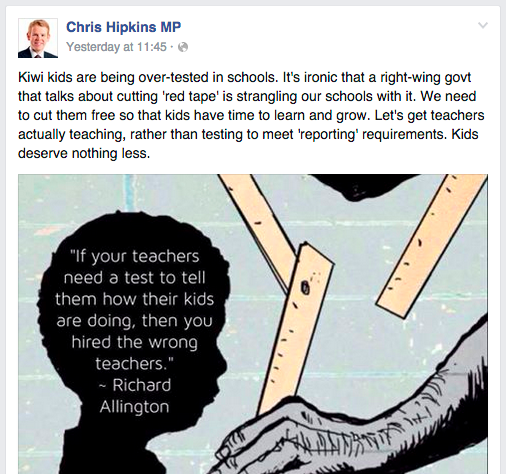
    Chris Hipkins wrote an interesting post about Kiwi kids being over tested. He says:

    Kiwi kids are being over-tested in schools… Let’s get teachers actually teaching, rather than testing to meet ‘reporting’ requirements. Kids deserve nothing less.

    It has been an issue I’ve noticed increasingly in my career. Whether it’s because I’m male, or because it’s genuinely difficult to do, I find that to test the entire class, I have to shut down the learning programme and go into ‘Assessment Mode’. I find I don’t do any actual “Teaching” during this time, more just provide suitable ‘practise’ type activities for students to work on independently while I repeat 1-on-1 testing. I can’t do both ‘assessment’ and ‘teaching’ at the same time. As a school, we are now moving away from whole-class testing because it gives a very limited view of the student’s abilities. But this means that more 1-on-1 testing is required. This can take 3 to 4 days to complete with a class of 28.

    I wrote a reply to Chris’s post that expressed my ideas:

    Thanks Chris for this! I’m a primary teacher and I’m constantly going into “assessment mode” to get through the entire class, that sometimes I wonder if I’m actually teaching them anything! By the time I’ve finished one lot of assessment, the next lot is on my desk!
    I feel that if I were able to work constantly alongside my students; encourage, inform, correct, show, teach, and build genuine learning relationships with them that I’d have a much better understanding of them as individuals and thus understand what they need in their learning. Any assessment should only be to confirm what teachers already know about their students.

    And that’s just it. If teachers were given the trust that a) they deserve, and b) that is required to make OTJ’s in the first place, then I’m sure that there would be better outcomes for all students. We are told constantly that teaching and learning is all about relationships, but I fail to see how sitting tests and being assessed builds any kind of meaningful learning relationship between student and teacher. Secondly – spending time working with these students and teaching them will only enhance my ability to make a judgement.
    We are showed the assessment pyramid regularly in P.L.D (Professional Learning & Development), and it still staggers me that things remain the same. The assessment pyramid works a lot like the food pyramid, with the top tier representing assessment that, whilst is usable, should not make up the bulk of assessment used in the classroom. The bottom tier represents assessments like teacher observations, anecdotal notes, conversations, discussions, behaviours, troubles, problem solving, which should be use more frequently. Yet the rate of importance placed on assessments is opposite. Those that fit down the bottom of the pyramid which should happen daily and make up the majority of our assessment as teachers, is given the least importance, while those at the top which happen once or twice a year, are relied heavily on when schools are asked to “prove it” by Ministry or ERO officials.

    Chris finished up his post by replying with a disclaimer that he in no way intends for there to be NO form of assessment, just that “…there is too much testing for ‘compliance’ rather than to genuinely inform the next steps in a child’s learning.”. And I wholeheartedly agree. If all we are doing is relying on test results, weighing the pig time and time again, it’s not going to help the students. Further to this is the issues happening in education overseas.

    Teachers in the U.S. have the common core to teach and to contend with where the success of the students in their class directly relates to their school image. What has ended up happening? Teachers preparing students for the test; not actually teaching them.

    My old Principal was so enamored by an awarded Title I school for bringing up test scores. Their formula? Test prep. We copied and plummeted.” – @TeacherReality

    It is highly tempting to give students practise at sitting tests, or answering similar questions over and over again, in order to boost their test score by being able to answer similar questions. But this in no way is why we became teachers. We didn’t become teachers to give test-like questions, show helpful formulas to solve test-like problems, or show them practise tests to help them pass a ‘real’ one. No. We became teachers because we wanted to impart knowledge, to inspire and to encourage, to challenge and watch students struggle in the hope that one day, one day, they would be able to apply themselves in life and succeed.

    As I write this, I find myself thinking; “I know all this, and say all this, but hypocritically find myself in class administering tests. Why!?”. Well, mostly this is because of the school having certain requirements (from external or internal pressures) of the teachers, as most schools around the country will have. So what can be done? What can I do as a teacher?

    These are genuine questions. I don’t have the answers. I have the ideal – which is to make observations and notes the most important and reliable source of information about student learning available. It means teaching and working alongside students. And so I must do that. I must make that a priority. I won’t be able to avoid the summative tests at all, but I can certainly try to maximise the time I do have to assess informally, and use these with more prominence than a one off test.

    How do you manage the balance of testing vs. teaching? What restrictions are placed on you by school or external sources in terms of assessment? How do you deal with that? What suggestions do you have for others? Please leave your comments below.