Tag: budget

  • A Twitter Conversation: May 2019

    A Twitter Conversation: May 2019

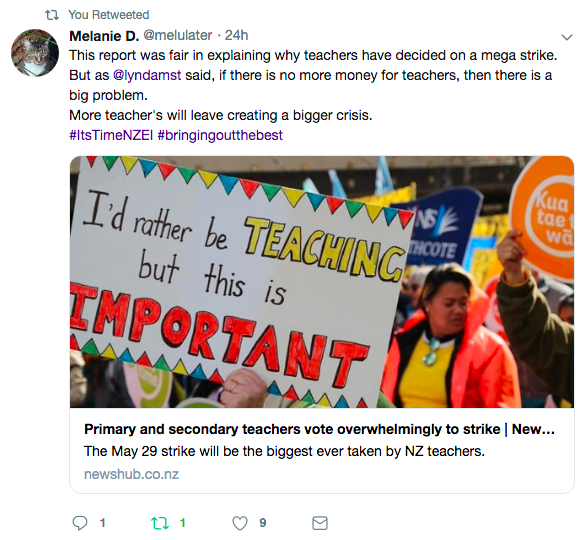
    ​School teachers and principals across the country have agreed to stage New Zealand’s largest-ever strike as negotiations with the Ministry of Education continue to stall.

    The Post Primary Teachers’ Association (PPTA) and New Zealand Educational Institute (NZEI) Te Rui Roa announced the move on Sunday, and said rolling strike action was also possible.

    Ths strike, on May 29, will involve almost 50,000 primary and secondary teachers and primary principals, and will affect hundreds of thousands of students in more than 2000 schools.

    https://www.stuff.co.nz/national/education/112655087/teachers-have-voted-to-strike-on-may-29


    The Conversation

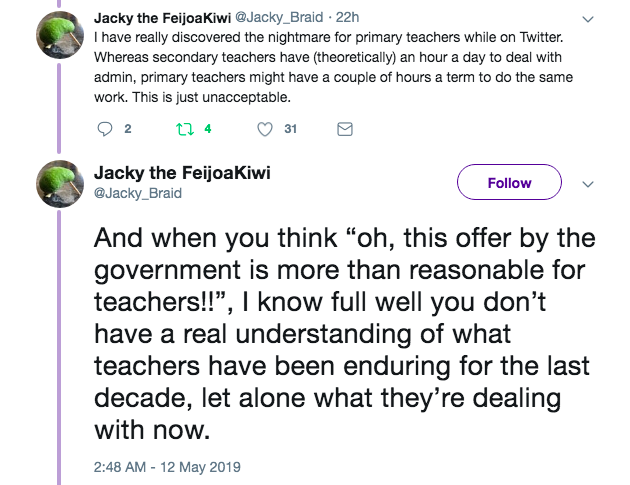
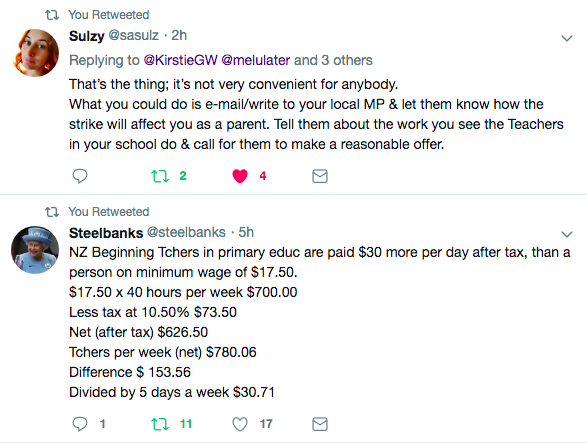
    Obviously there has been a lot of reaction to the recent vote to hold a mega strike, and a lot of this reaction has been documented on Twitter. I wanted to collect this reaction and keep a record of it in our blog. I have come to realise that I value the posts on this site, but often a lot of conversation happens on Twitter and then falls off into the Twittersphere.


    • The crisis is real, and it’s spreading. And the more who leave, the more work has to be picked up by other all-ready-stressed teachers. And thus the crisis is exponentially growing. And all the government is prepared to do is start training replacements!?
    • In all of these pay negotiations, not once have teachers been asking for anything that is unreasonable… It’s not like we’re asking for a slushy machine in every school!
    • Come on … Make history. Be the one MP to stand up for teachers and get them what they deserve. Show the public the importance of education in this country. Go on. I dare you!
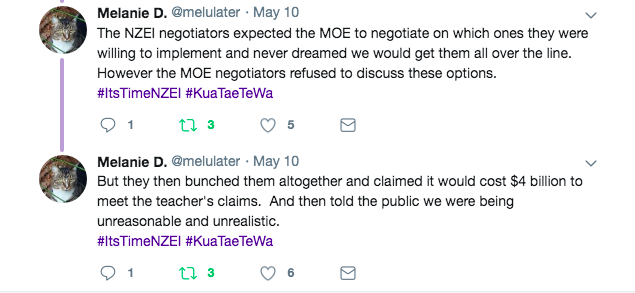
    • So it’s not that the government CAN’T meet what we’re asking for…. it’s that they WON’T.
    • Kinda think that the Teacher Unions need to start playing hardball. Indefinite strike would soon get some results. Look at the bus drivers….

    • Started putting my thoughts down about teacher workload into a tweet…. ran out of characters and lost all energy and enthusiasm for continuing. A story all too common for lots of teachers at the moment!
    • Essentially here’s what would solve a lot of problems: • Pay Teachers more, because we’re worth it and we deserve it. • Shrink class sizes, because with less students comes less work but more teaching. • More SENCO resourcing, because there are more needs than ever before.
    • Shrinking class sizes is key. Less reports to write, less assessments to do, less paperwork to compile. More time for each student. More genuine relationships. More teaching. More jobs available for the additional teachers that come back into the workforce!
    • For me; class size plays a huge role on the teacher. For the last few years I’ve consistently had over 31 students in my class. Believe me; when there are 6 away and the class is only 25; it makes a HUGE difference in the way the classroom feels, acts, and learns.
    • For me, having more time in itself doesn’t sort anything out; it means time out of class if anything. What I need is less students in front of me which will in turn give me more time for each one. It also lessens the time I need for assessments, reports, planning etc…. win win!

    • I left the union at the end of last year. Not regretting it. They should be doing a LOT more given the circumstances, and a clear plan seems to be lacking. Seem to be floundering in too many ideas rather than laying out a “game” plan for teachers and the government to follow!
    • So why did the Ministry turn up to the last round of negotiations with NZEI with no new offer? Took active teachers and leaders out of their classrooms, made them organise relievers, sort out transport… for what!? No new offer!? How disrespectful.

    • Let’s face it. I am a teacher. No government is ever going to be able to pay me what I’m worth. I knew this going into the profession. But come on… at least you could try and show me I’m valued
    • Quick question … Why has class size not been a major negotiating point as a way of reducing workload? Teachers are definitely asking for this!!!

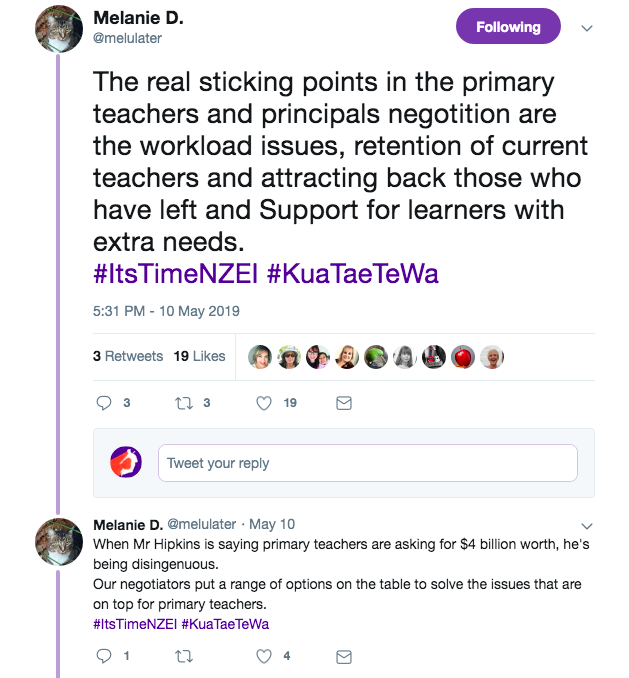
    • So … the first strike in 24 years didn’t work… so you decide to strike again but on different days… then… when that failed to make a dent… let’s do another one day strike… do we really think that’s going to make a blind bit of difference?
    • Multiple days. Cause some proper disruption. Half day strikes. Go slow days. Play hardball. MoE need a kicking too I admit.
    • Lay out a plan of attack: If you don’t accept our terms then this is what we will be asking our members to do, and if that doesn’t work, then THIS is what we’ll do… and then…. at the moment it feels like they’re just making it up as they go.
     

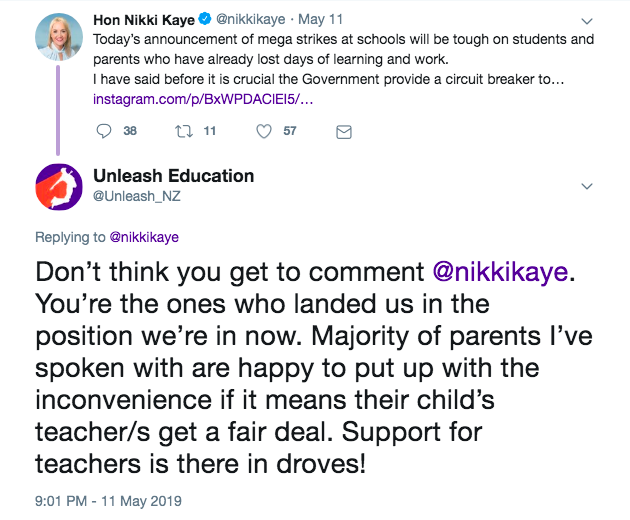
    • Don’t think you get to comment . You’re the ones who landed us in the position we’re in now. Majority of parents I’ve spoken with are happy to put up with the inconvenience if it means their child’s teacher/s get a fair deal. Support for teachers is there in droves!
    • But seeing as you do get to comment; what would National’s offer be if you were still in Govt?
    • I also find your teacher ratio comments hard to believe, given Hekia wanted to raise them through the roof. If I were you I’d be offering apologies and then begin making things right rather than trying to blame the ones who came after you for the monster you created.
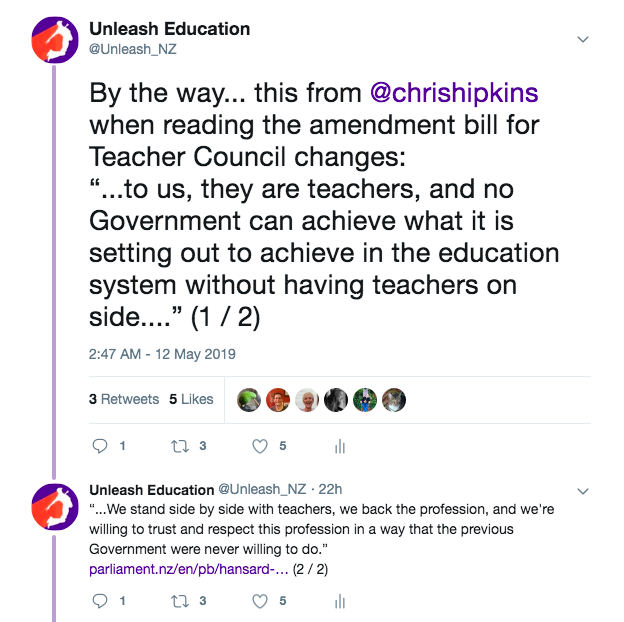
    • By the way… this from when reading the amendment bill for Teacher Council changes: “…to us, they are teachers, and no Government can achieve what it is setting out to achieve in the education system without having teachers on side….” (1 / 2)
    • “…We stand side by side with teachers, we back the profession, and we’re willing to trust and respect this profession in a way that the previous Government were never willing to do.” (2 / 2)


  • School Donations: Rich get Richer…

    Original Article: https://www.stuff.co.nz/national/education/109937537/rich-school-poor-school-top-schools-get-millions-in-donations-while-others-get-0

    About $140 million was donated to New Zealand schools in 2017 – and more than half of that went to just 10 per cent of schools.

    Wellington College received the most money of any state school, banking almost $5.7m.

    Coming in second was St Peter’s College in the Auckland suburb of Epsom, which received more than $3m in donations.

    At Auckland Grammar School, just 350 metres down the road, donations topped $2.2m.

    And a three-minute drive away at Epsom Girls’ Grammar School, the figure was almost $1.8m.

    Between them, the three Epsom schools received just shy of $7m.

    By contrast, 37 schools recorded no donations for 2017, and a further 79 received $1000 or less.

    The data, supplied by the Ministry of Education, included all donations to a school, whether from parents or other sources.

    Wellington College had a bumper year for donations in 2017 because donors contributed to a new performing arts centre, principal Gregor Fountain said.

    Some schools have scrapped parental donations to ease the financial burden on families.

    In its election manifesto, Labour pledged an additional $150 per student for schools that did not ask parents for donations.

    Little has been said about the policy since, with Education Minister Chris Hipkins saying it was “Budget sensitive”, so he could not talk about it.

    Capping the amount schools could ask for was one of the suggestions to come out of the Tomorrow’s Schools review.

    The taskforce heard some families could be “put off” sending their children to a particular school due to high donation levels.

    Limiting the amount schools could request would mean all families had equity of choice, the report said.

    A donation was, by definition, voluntary. However, Post-Primary Teachers’ Association (PPTA) president Jack Boyle said there were many schools where it “isn’t voluntary, nor is it a donation. It’s a compulsory fee”.

    Read Original Article Here

  • A Rainy Day

    In relation to:

  • Future of education in NZ for National freightrain

    In response to NZ Herald – Every child’s chance to learn second language: National’s education policy – 27 August 2017.

    Whilst some schools are struggling to get students to learn a first language, we’ll be teaching them coding and a second language as well should National get through to it’s fourth consecutive term.

    National Standards will be extended.

    And low and behold, surprise, surprise, they will be pumping money into improving the teaching of maths to primary schools.

    Seriously. When will they get the message?

    The second part of the package was a $126 million investment to raise maths achievement for primary school students. English said National Standards showed New Zealand needed to lift its game in maths. “So we’ll provide our students and teachers with the tools they need to do that… We’ll help 1200 teachers a year complete extra university papers targeted at teaching maths to primary students… We’ll also provide intensive classroom support for students, where schools have identified the need to improve their maths.”
    Obviously teachers are the reason students aren’t achieving in Mathematics. Rubbish teachers and ineffective teaching. Ignore the fact that there are other factors at play for many students, it MUST be the useless teachers we have that are failing our students.

    So to fix this problem, we’ll send teachers back to university to learn how to teach Mathematics more effectively by ex-teachers-turn-lecturers who couldn’t hack it in the classroom 15 years ago with some kind of trendy fad way of teaching. Probably after school, in teacher’s own time.

    Teachers work out of their skin. Anyone who has visited schools that are supposedly ‘struggling’ knows that there are other factors in any underachievement.

    It’s made even more a joke when you begin to look at the reason behind such a policy. A simple search on our favourite search engine shows that Education Counts has the data for National Standards Results, 2016 (PDF). On the very first graph of this document we see that Reading sits at 77.8%, Maths at 75.4% and 71.2% for Writing. So why are we targeting Maths?

    Quite simple actually.

    Maths is the easiest to address. It has a ‘right’ and a ‘wrong’. It’s measurable. It’s quantifiable. It’s the easiest to show progress. It’s assessments are stable and data rich. This is something that Reading and Writing don’t have, being largely subjective – especially Writing. The government want to ride on some success. By investing in Mathematics and measuring the future success of their education budget, they can prove that National Standards work, and legitimise all three subjects.

    However, what teachers really want, and really need, are some resources, assessments, and some structure around how Writing is assessed and taught, and to see how this can impact on all other subjects (including Mathematics). Pumping more money into Mathematics is an easy out for the Government, whilst appearing that they are putting in resources and funding into education before an election, whilst in reality, they are plugging a hole that isn’t leaking (or not leaking as much).

    Are any teacher’s actually excited about this? About having more money put into Mathematics, even after ALiM and other initiatives? About the prospect of having to go back to complete some additional university papers?

  • Prison Beds or Educated Society

    Two point five billion dollars.

    $2.5 billion dollars.

    $2,500,000,000.00

    That’s a lot of dollar coins.

    Let me tell you what they will spend it on.

    No. Not fixing the poverty problem sweeping the country. No. Not assisting children living in impoverished situations. No. Not sorting out the public health situation with junior doctors striking today. No. Not addressing the lack of funding in mental health with suicide prevention and support.

    So, after earlier this week scrutinising that crime is caused by poverty, rather than address the poverty situation that is staring everyone in the face (and not likely to go away just because you keep staring back), Judith Collins and her cronies announce that $1 billion of that cash injection will be used to create living arrangements for an additional 1800 inmates.

    To put those numbers into perspective; that’s $555,555.55 per bed. Five hundred and fifty five and a half THOUSAND dollars per room with a bed and a pan. To contain another criminal.

    Backwards

    For me, it’s non-sensical. It’s backwards. It’s purely responsive, rather than proactive.

    EVERY piece of research out there suggests that there is strong links between poverty and crime, as well as, education and crime. Surely (or is it just me) crime PREVENTION is a better use of money than catering for an increase of criminals into the system?

    You can’t prevent crime; but with strong links between poverty, education and the outcome of crime, then surely dealing with poverty and education is where the focus needs to be?

    If you are educated, then you know to read and write, you’re more likely to be able to get a job, you are more likely to be able to hold down a job, and the less likely you are to find yourself needing to get into trouble.

    And I’m not even an expert in the field. I haven’t had to research this. It is pure, bloody common sense. and logical thinking.

    There are currently 9,798 inmates in the current corrections system (Sept 2016).

    Let’s divide that spending out per inmate (I’ll even include the additional 1,800 inmates that these extra beds will allow for!)

    $2,500,000,000 / 11,598 = $215,554.40NZD per inmate

    Now, that is spread out over ‘about 5 years’.

    $215,554.40 / 5 = $43,110.88NZD per inmate, per year.

    That’s an ADDITIONAL forty three thousand dollars per inmate each year for the next five years, including the extra 1,800 inmates that they are supposedly catering for.

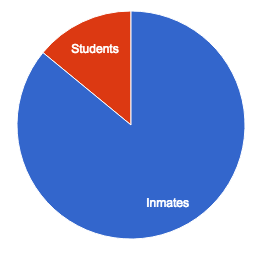
    Currently, in education, spending on each student is $7,046.00.

    Let’s see those numbers next to each other.

    Inmates Students
    $43,110 $7,046

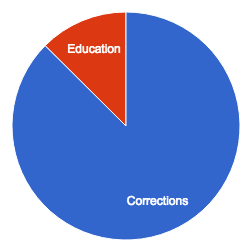
    What an absolute joke. Remember, the blue area in the graphs is what the corrections system is getting ON TOP OF the additional funding provided in the current budget already.

    Earlier in 2015, the Government announced a generous $359 million boost into the Education sector, but in a very restrictive way of schools being cajoled into CoL’s (Communities of Learning). To compare this with the $2.5 billion it’s just embarrassing. Here’s the graph for that as a comparison between what the Government is prepared to spend as ‘extra’. As a picture, it’s ridiculously similar to the current funding for students compared with the additional funding Corrections is getting.
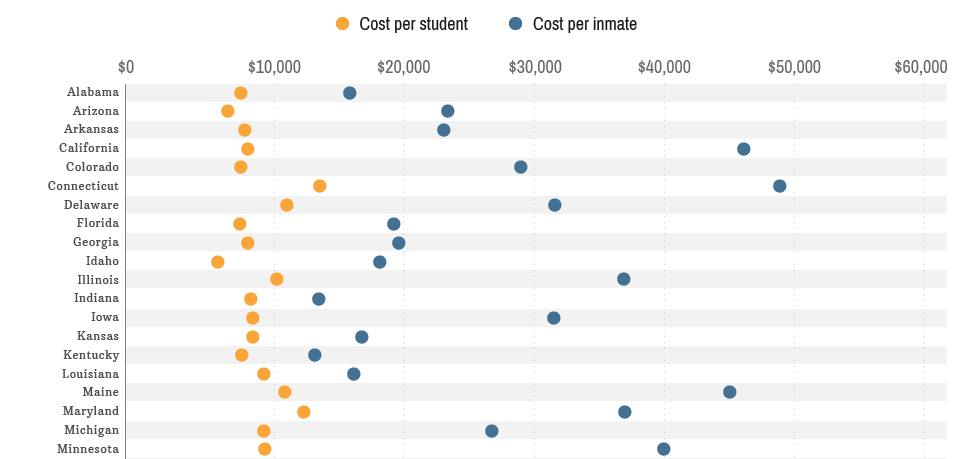


    United States has this problem: Not one State spends more on student education than it does for incarceration.

    Source: http://money.cnn.com/infographic/economy/education-vs-prison-costs/


    Now; don’t get me wrong. I am not here for a second suggesting that corrections does not need support; nor am I saying anything about how or where they spend their money. They have a job to do, and certain criminals do need “restricting in their day-to-day activities”, but lets start to look at solutions for the problem, rather than just catering for it.

    Let’s buy sunscreen rather than melanoma treatments.

    Let’s fix the hole in the bucket rather than filling it up time and time again.

    Let’s put a fence at the top of the cliff rather than an ambulance at the bottom.

    Let’s start investing in children, the next generation, the education of people, poverty, and homelessness rather than catering for the criminals that they will likely become because we continue to ignore the impact education and poverty are having on society today.

  • The True Cost of Charter Schools

    Its time to face some facts here. There is something terribly wrong with the current government’s focus for its funding, especially when it comes to education.

    I decided to do some comparisons on money spent (or not spent) and see if any of it makes sense. I wanted to compare the budget they approve for some initiatives, and deny for others. In particular, the comparison between keeping charter schools open, verses the Feed the Kids bill that was denied in March earlier this year.

    Embattled Charter School

    At the end of July, the Minister announced that she would keep a failing charter school open, even though she stated it would face closure, and even though clear evidence showed inappropriate use of funds and suspicious achievement results.

    “The Ministry of Education has directed a Northland charter school to replace its current principal with someone more “appropriate and experienced” or face closure. The beleaguered Te Pūmanawa o Te Wairua School in Whangaruru opened last year at a cost of $3million and has suffered a falling roll, truancy and low achievement levels in the year since.” – Feb 2015 – Māori TV

    Previously the Government could only confirm it would negotiate with the trust should it close. The Northern Advocate can reveal $4.4million has been spent on the kura, which opened last year, including a recent one-off payment of $129,000 to help remedy the ongoing issues. – July 2015 – Northern Advocate

    By keeping the school open, the ongoing cost of this school will have reached astronomical figures. By the end of this year, the cost of the school on the government will have surpassed $5.2million. It is important to note that this is the cost from its opening in 2014.
    The cost of this school to the government for it to remain open each year is only a mere $1.65million.

    There are 39 students at Te Pumanawa o te Wairua.

    That’s a cost of $42,271 per student each year (assuming the roll remains at 39).

    Feed the Kids Bill

    Let’s compare this cost with a recent bill that has been defeated by a mere 2 votes. This bill was nicknamed  the “Feed the Kids Bill”. It sought to provide breakfast and lunch for every student in Decile 1 and 2 schools across the country.

    Mrs Turei said the National-led Government is failing New Zealand children, as more are going without food than ever before.

    “They are funding some programmes, but not enough, so they accept that there’s a problem, why won’t they fix it?

    “It’s not that expensive either, it costs something between $10 million and $14 million to feed every hungry kid, every day in their school. What’s so hard about that?” – 19 March – Radio NZ

    Education Counts lists the July 2014 roll returns, which shows that the number of students in Decile 1 and 2 schools across the country; some 111,069 pupils.

    Doing some quick maths, I’ve worked out that using Mrs Turei higher estimate of $14 million, when spit among the number of students in Decile 1 and 2 schools, comes out at a staggering $120.

    One hundred and twenty dollars and five cents.

    That doesn’t sound right.

    According to FeedtheKids.org.nz, the full cost of the programme would be $100 million a year – including food, staffing, administration, monitoring and evaluation. That sounds a lot more than $14 million, but the reality is, that not every child at decile one and two schools will need breakfast or lunch. At the school I work out, I’d say close to 85% of the students come with suitable lunch each day. The 15% that don’t, would benefit from this service. This also works out with Mrs Turei says around the $14 million mark, being that it is 15% of the stated $100 million on the Feed the Kids website.

    Regardless, I did a little bit more maths calculations, and using the $100 million as the figures, the cost per student is a whopping $900.34

    Nine hundred and thirty four cents.

    Let’s just compare that to the one charter school that is being kept open for 39 students.

    Charter School: $42,271 per student
    Feeding Kids   :      $900 per student

    That simply cannot be right. Can it?

    Oh wait. Of course! The $900 per student is on top of their education cost, where as the $42,271 is the cost of their entire education for the year. We will have to account for the decile one and two student’s education.

    Taking an average decile two school, such as the one I currently work at, our figures per student work out at approximately $6,884.61 per student. Add on $900 to that, takes it to $7,784.61.

    Comparing this to the forty two thousand, two hundred and seventy one dollars spent per student at the embattled charter school, it puts some clear messages out there as to what is fair, what is equal, and what is right out there. It also shows us exactly where the focus is for this government – and it’s not for those that are struggling.

    What’s more concerning is that this is just one charter school. There are more in the pipeline. More that will take money away from the kids who, through no fault of their own, are going hungry this year.