Tag: charter schools

  • Two Auckland charter schools still have no idea if they will be open next year | Stuff.co.nz

    It amazes me the arrogance and ignorance of some people.

    Just read the comments to see the myriad of people all wondering what Labour’s problem with charter schools are.

    If they’re making a difference, and they’re meeting the needs of some kids, then surely that’s a good thing, regardless of how they get there? Right?

    Sure.

    Except, how do they get there.

    Entire schools, using tax payer money to be set up and run, with ‘special character’, which in this case includes class sizes of no more than 15.

    Okay. Let’s break it down.

    Let’s say that the Ministry of Education has $10,000 dollars to give to all schools to run for the year. Realistically it’s much more than this, but my ‘0’ key is starting to wear out…

    From this pool of money, $7,000 is given to the state sector to teach and to raise achievement and pay the teachers and try to make educational outcomes in the positive. $3,000 is given to charter schools to do what they want with it.

    However. There are 14 state schools using the $7,000, and only 2 charter schools using the $3,000. Let’s break this down. Each state school gets $500, and each charter school gets 3 times that.

    Now… Because the state schools are given a class size of 28 students, this works out to be $17 per student.

    Because the charter schools can state that their class sizes be no bigger than 15, this works out to be $100 per student.

    Now… This isn’t the issue that those of us in the state sector have an issue with. The issue is that there is an unfair playing field being created between the public sector and charter schools which are a mish-mash of private/public. The trouble being that not every student can go to a charter school and access that amazing resource.

    And in the meantime, that $3000 could have been going into the state system to provide similar benefits of smaller class sizes to every school, to every student, not just the few that manage to live near or get accepted into charter schools.

    I guess it comes down to one thing…

    Don’t read the comments!

    Source: Two Auckland charter schools still have no idea if they will be open next year | Stuff.co.nz

  • I wish David would see more…

    Today Chris Hipkins’ bill was drawn out of a hat in parliament to undergo vigorous debate as to the abolishment of the charter school policy brought in by ACT, even though all historic evidence and international examples of this have all been failures.

    It’s interesting that at the same time the Labour bill to abolish charter schools comes out, that the education world in the UK prepares for EVERY public school to become a charter school (called ‘academies’ over there).

    So, this comes with welcome news. The abhorrent dealings of charter schools in this country have been well documented. It has been an utter disaster despite what the politicians who want it to succeed will say.

    Needless to say, I was pretty disgusted with this tweet from the ACT party.

    Needless to say, it received a pretty swift response:

    Well, that’s awesome. Nice one.

    What’s more, and as has been pointed out, Chris Hipkins also gained more support from his electorate than the entire ACT party did around the country. Chris Hipkins: 19,286. ACT Party: 16,689. Just saying!

    As I went deeper into the conversation I suddenly found one DBSeymour piping up into the conversation.

    If I was unimpressed before, my impressions are now severely lacking. The lack of actual intelligence begins to show that the puppet in front of us running the country as Undersecretary of Education is little more than a the blubbering buffoon that we all thought was an act. Turns out no; its actually true. We may have just found the long tail of underachievement in this country.

    The conversation that precedes this screenshot is all centred around the privatisation of education, the choice of integrated schools for those that want choice, and the question of why tax payers should be paying for charter schools where there is no accountability and that any land, property, resources, etc… are all kept by the company behind the particular charter school.

    However, despite this all being in clear view on Twitter, and being written in basic English, and as grammatically correct as one can be in 140 characters, DBSeymour seems to think that this particular question doesn’t make sense.

    Sorry David. The question makes perfect sense. The problem isn’t the question. It is you. Obviously it’s well above your level of understanding.

    Then to make things worse; the Member of Parliament; a person who should be holding the public with some kind of respect and regard because they are the ones who may vote for you, instead of continuing to attack the question, turns personal and now says that the person asking the question doesn’t make sense.

    And this is the person entrusted with implementing changes within our Education system.

    Maybe David actually needs to go back to school and learn how to comprehend basic sentences. I’m sure that this will no doubt hold him in good stead to begin entering into the public sector such as Twitter. Ah – I mean, parliament.


    There is a very small chance that DBSeymour actually only wanted to reply to @actparty with “You just don’t make any sense”. In which case; it’s about time someone brought that question up!


  • Post-Mortem: UK Public Schooling

    Post Mortem: UK public schooling.

    Family: UK Government – related to: US, NZ.

    Death: Terminated by family.

    Age: 100 years of publicly funded education

    References: http://www.bbc.com/news/education-35814215

    General Body Condition: Diminished frame with minimal experts. Main organs shut down. Donors needed.

    CLINICAL HISTORY:

    The patient had undergone a variety of surgeries recently, and had come under attack from GERM(s) in quite a severe way. The use of GERM had become quite pronounced and at this time, the although the doctors recommended further diagnosis be undertaken from specialists, the family has asked that the life support be switched off and the body be laid to rest.

    POST-MORTEM FINDINGS:

    • Poor academic results according to nationalised testing
    • Poor performing teachers at schools with poor results. (Unconfirmed)
    • Large quantities of GERM infecting the hosts (Department of Education)
    • MGD (Michael Gove Disease) present in host from 2010.
    • Morgan-Nicky Virus spread throughout workforce from 2011.
    • Strong discomfort from Local Authorities.
    • Records show that GERM had affected only 14.5% of the 16,766 Public Schools. It was based on this data that lead family to believe that terminating public schools was a good idea.

    It is with regret that Public Schooling in the UK will be terminated, as of Thursday 17 March, 2016.

  • Updating the Education Act 1989

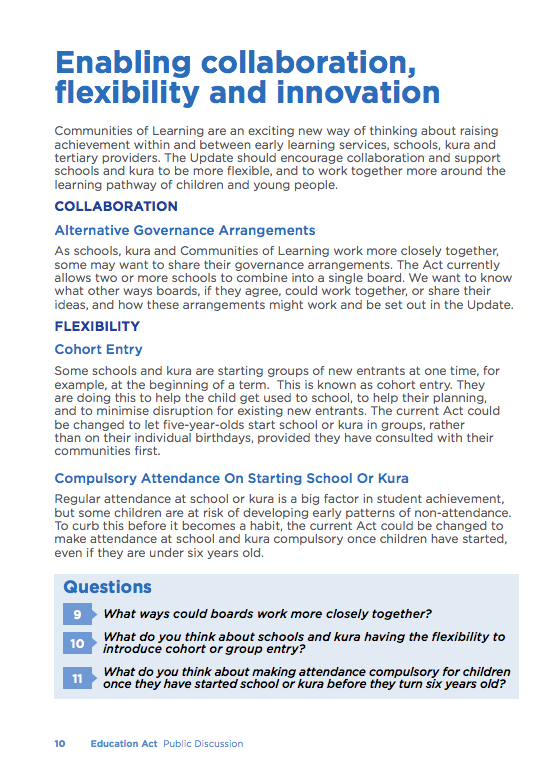
    Earlier this month, the Minister released a public document surrounding the public having their say on the updates this government are wanting to make to the Education Act. In it, they outline what they need to do to change the landscape of the education sector in this country. It is worded in an incredibly positive way, and they have been more than inclusive by ensuring the use of the word “may” throughout the document (which is at least an improvement on how they made changes with National Standards, Class Sizes, Christchurch School Closures, and Novopay!) However, there are some issues within it. Quite concerning things, that if passed, will allow for a lot of changes that we may or may not be interested in, but our chance to have a say will have gone. I’ve gone through and highlighted some of these things to hopefully shed some light on what is really being said.

    Achievement and Accountability

    The Education Act changes all centre around supposed “child’s pathway” through school, and focuses on “raising their achievement”. While a growth mindset is healthy for every classroom, at some point, there is a ceiling on what can be achieved. By having a law written that says that raising achievement levels is paramount, it means that there could be issues if a child HAS achieved, or schools already raise the achievement levels beyond any reasonable expectation. As will be an issue that comes up all through this, there is the ongoing issue around how this is measured. No doubt the Government will rely on data gathered through National Standards reporting, yet we already know that this is clunky at the best of times. In the seventh paragraph, the changes suggest that it will outline in law ‘who is responsible for what’. This seeks to allow the government to lay blame on individuals should things not go to plan. This may be a board, a principal, or a teacher. Of course, they are also quite clear that any submissions that suggest changes that would increase government spending on education will not be considered. Quite clearly the government thinks that it is already doing enough in this regard.

    IMPROVING THE WAY BOARDS PLAN AND REPORT

    Improvements can be made to the way school and kura boards plan and report on how they make sure the right things are being taught, how they are informing parents, whānau and communities about what they are doing, and how well children and young people are achieving.

    Red tape around planning and reporting could be reduced so that boards are able to focus on what is important in promoting student achievement and wellbeing. There are some things that are a ‘must do’ for boards, such as developing a strategic plan, providing annual performance information, and meeting statutory reporting requirements. But there are other requirements that could be removed, and some complexity could be reduced. For example, high performing schools could move to a four-year planning cycle.

    It may also be useful to let groups of schools and kura work together when they are planning and reporting. This would help a community plan more cohesively, share expertise and reduce administration. It could particularly benefit Communities of Learning and small or isolated schools and kura.

    In Other Words…

    In this section, it mentions ‘red tape’ which is very vague in what it means. Essentially, I think, they want to get rid of some of the bureaucracy that gets in the way from making decision and making changes. But as always, they label this as a way for Boards to focus on other things, such as improving student achievement. In the example, they state that ‘high-performing schools could move to a four-year planning cycle’. By “high-performing”, we can assume that they mean “high-achieving”. In the following paragraph, it says that it ‘may also be useful to let groups of schools and kura work together…’ making reference to their Communities of Schools model. We can safely assume that the word ‘let’ could also be taken to mean “make”, especially when schools are ‘not achieving’.

    RESPONDING MORE EFFECTIVELY TO PERFORMANCE

    With better and more timely information, parents, whānau and communities can have an active role in helping to improve achievement for their children and young people. The Act could allow for a set of indicators to be established so schools and kura know what areas they need to report on.
    For example how well students are doing, and how the school or kura is managing its money.

    The Update could enable schools, kura and Communities of Learning that are doing well to get more freedom and extra decision-making rights. This would be balanced by monitoring schools, kura and Communities of Learning carefully and clearly saying what will happen if things go off track.

    Responding More Effectively to Performance

    Firstly, what does performance mean? No doubt, when the Ministry talks about performance, they mean achievement. Regardless of “better or more timely information”, parents, whanau, and the wider community can all have an active role in a child’s education. It does not have to be made into law through the Education act. It’s called parenting. It’s called raising children. It’s called childhood. A set of indicators that the change proposes are either National Standards, or a new set of KPI for schools. The suggested example of “how well students are doing” jumps up and screams “League Tables”, seeing as this is talking about reporting to parents and the community. This is public information that will be out there for everyone to see and compare, even though there is no doubt that these KPI will not show the value and worth of a school. This section goes on to include the Communities of Schools who do well will get more freedom – rewarding the “high achieving” schools once again, with more decision making rights. It then makes it clear that, in balance, poor performing schools would have such rights taken away and decisions would be made for you “if things go off track”. Which is exactly what we want as a school who’s students’ struggle, we definitely need an outsider coming in with a top down approach of “you will do better”; tongue firmly in cheek. Page 10

    Enabling Collaboration, Flexibility and Innovation

    This pare of the document just looks at the idea of Communities of Schools that the government has brought about through the IES. Under Alternative Governance Arrangements, they state that some schools who are working in a Community of Schools, “…may want to share their governance arrangements”. This is already happening with the property side of funding in some areas. Also, as is with earlier parts of this document, where it says “may want to”, it is also saying that some schools “may be forced to” share their governance. In terms of flexibility, it is interesting that the only reason why schools would be wanting to have different intakes at different parts of the year is largely to make National Standards reporting easier in Years 1 to 3. Their anniversary reports would all be at once, rather than spotted throughout the year, and it would tie in with the senior reports a lot more often. The question really is, is if your child misses out by a few weeks for the intake, they might essentially miss out on 3-6 months of schooling. What’s more, if a school down the road isn’t having intakes at set times, that family may decide to take their child elsewhere. Isn’t it already compulsory for children to attend school? What’s more, how is the Ministry going to enforce this, especially when funding for truancy officers has been cut, and the Government doesn’t want to spend any more on education? No doubt it will be one more thing that schools will have to chase up on in their own time.

    What is a “great” school?

    What makes a school great?
    How is this measured?
    There is no question, given the rest of this document, what the Minister sees as a “great school”. High achievement.

    But the word “Great” or “Greatness” surely encompasses so much more than this?
    Take for instance a local school in my area. A well recognised and renowned school, with parents and whanau driving from up to ten minutes away to send their child there. It is a decile 8 school and has about 330 students on its roll. 75% NZ/European and 17% Maori. Their ERO cycle is on a four to five year review. From the latest review it states that “Most students are achieving at or above the National Standards in reading, writing and mathematics.”
    One would say this is a great school.

    At the school I currently work at, the same can’t be said. We are about half the size, and fit in a decile 2 bracket. We have about 60% Maori students, 10% Pasifika and 20% NZ/European. We recently managed to scrape through and get a three year ERO review, which we celebrated like we just won the Rugby World Cup. Half of our students are below or well below the National Standard across all three areas.

    However, this year, both these two schools had their 50th Jubilee. Both of them started in 1965, the same time that Porirua officially became a city.
    At our school, we had close to 180 ex-students come and celebrate over the course of Labour Weekend, 2015. Old students came from all around the country, from Auckland to Timaru. We even had some fly in from overseas to come and visit their old primary school. We had a school gala which had cars parked along the street as far as the eye could see. The atmosphere was buzzing and our school was the centre of it all.

    In stark comparison, the other school had to cancel it’s celebrations due to lack of interest.

    I leave you with that question to ponder. Which is the greater school?

    Making every school and kura a great one

    Every school and every kura has to be a great one, and while most are doing well, a small number need more help to get there. Some more options could be put in the Act to help schools and kura get back on track. These could include an improvement notice, or an audit of one part of a school or kura. At the more serious end, a board could be asked to have different people on it.

    Naughty, Naughty!

    In this section, the Act turns its attention to the so-called ‘off track’ schools. The Ministry will help them get ‘back on track’, through the use of an “improvement notice” (similar to an infringement notice, I guess) or an audit (ERO visit). The serious end, the Ministry can remove a board if a school is REALLY ‘off track’, and no doubt choose (or appoint) the representatives on it.

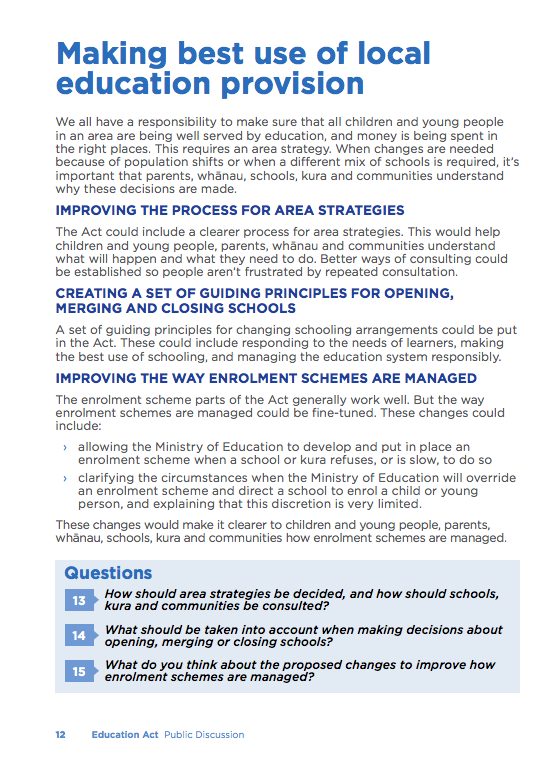
    Creating a Set of Guiding Principles for Opening, Merging and Closing Schools.

    What an interesting thing to amend within the Education Act. I wonder why this could have occurred? Maybe the Minister had too much trouble closing schools in Christchurch. Maybe she also had some difficulty merging some schools. And maybe they want to be able to open up new charter schools whenever they like. It has also made the provision for students to be forced to go to certain schools, and force certain schools to take certain students. Page 12

    In Conclusion…

    It is interesting the timing around this change. Reports are due, schools are winding down, half of the secondary schools are gone with exams, principals are drowned in end of year rollover for Novapay, and end of year activities. So it is unlikely that those who are working in the sector will have time or energy to fight the changes being proposed.

    No doubt we need to though, if we are unhappy with the proposed changes.

    Below are the details for how YOU can make a submission in answering the questions within the document.
    You need to do this. Answer, respond, challenge, debate. Talk over your ideas. The more responses they get, the more they might listen.

    Related Readings

    An easy way to make your submission is online at consultation.education.govt.nz. Here you will find an introductory video from Education Minister Hon Hekia Parata. There are questions to get you started, or you can upload a submission from your computer. You can also email your submission to education.update@education.govt.nz or write to: Education Act Update Ministry of Education PO Box 1666 Wellington 6140 New Zealand Submissions close on Monday 14 December 2015.

    PERSONAL INFORMATION AND CONFIDENTIALITY

    Submissions and documents associated with the consultation process meet the definition of official information and are therefore subject to the Official Information Act 1982. Please clearly indicate in your submission if you do not want your name to be included in any summary of submissions that we may publish.

    FURTHER INFORMATION

    If you have any questions about making a submission, or would like more information about the update of the Education Act 1989, please email education.update@education.govt.nz

  • The True Cost of Charter Schools

    Its time to face some facts here. There is something terribly wrong with the current government’s focus for its funding, especially when it comes to education.

    I decided to do some comparisons on money spent (or not spent) and see if any of it makes sense. I wanted to compare the budget they approve for some initiatives, and deny for others. In particular, the comparison between keeping charter schools open, verses the Feed the Kids bill that was denied in March earlier this year.

    Embattled Charter School

    At the end of July, the Minister announced that she would keep a failing charter school open, even though she stated it would face closure, and even though clear evidence showed inappropriate use of funds and suspicious achievement results.

    “The Ministry of Education has directed a Northland charter school to replace its current principal with someone more “appropriate and experienced” or face closure. The beleaguered Te Pūmanawa o Te Wairua School in Whangaruru opened last year at a cost of $3million and has suffered a falling roll, truancy and low achievement levels in the year since.” – Feb 2015 – Māori TV

    Previously the Government could only confirm it would negotiate with the trust should it close. The Northern Advocate can reveal $4.4million has been spent on the kura, which opened last year, including a recent one-off payment of $129,000 to help remedy the ongoing issues. – July 2015 – Northern Advocate

    By keeping the school open, the ongoing cost of this school will have reached astronomical figures. By the end of this year, the cost of the school on the government will have surpassed $5.2million. It is important to note that this is the cost from its opening in 2014.
    The cost of this school to the government for it to remain open each year is only a mere $1.65million.

    There are 39 students at Te Pumanawa o te Wairua.

    That’s a cost of $42,271 per student each year (assuming the roll remains at 39).

    Feed the Kids Bill

    Let’s compare this cost with a recent bill that has been defeated by a mere 2 votes. This bill was nicknamed  the “Feed the Kids Bill”. It sought to provide breakfast and lunch for every student in Decile 1 and 2 schools across the country.

    Mrs Turei said the National-led Government is failing New Zealand children, as more are going without food than ever before.

    “They are funding some programmes, but not enough, so they accept that there’s a problem, why won’t they fix it?

    “It’s not that expensive either, it costs something between $10 million and $14 million to feed every hungry kid, every day in their school. What’s so hard about that?” – 19 March – Radio NZ

    Education Counts lists the July 2014 roll returns, which shows that the number of students in Decile 1 and 2 schools across the country; some 111,069 pupils.

    Doing some quick maths, I’ve worked out that using Mrs Turei higher estimate of $14 million, when spit among the number of students in Decile 1 and 2 schools, comes out at a staggering $120.

    One hundred and twenty dollars and five cents.

    That doesn’t sound right.

    According to FeedtheKids.org.nz, the full cost of the programme would be $100 million a year – including food, staffing, administration, monitoring and evaluation. That sounds a lot more than $14 million, but the reality is, that not every child at decile one and two schools will need breakfast or lunch. At the school I work out, I’d say close to 85% of the students come with suitable lunch each day. The 15% that don’t, would benefit from this service. This also works out with Mrs Turei says around the $14 million mark, being that it is 15% of the stated $100 million on the Feed the Kids website.

    Regardless, I did a little bit more maths calculations, and using the $100 million as the figures, the cost per student is a whopping $900.34

    Nine hundred and thirty four cents.

    Let’s just compare that to the one charter school that is being kept open for 39 students.

    Charter School: $42,271 per student
    Feeding Kids   :      $900 per student

    That simply cannot be right. Can it?

    Oh wait. Of course! The $900 per student is on top of their education cost, where as the $42,271 is the cost of their entire education for the year. We will have to account for the decile one and two student’s education.

    Taking an average decile two school, such as the one I currently work at, our figures per student work out at approximately $6,884.61 per student. Add on $900 to that, takes it to $7,784.61.

    Comparing this to the forty two thousand, two hundred and seventy one dollars spent per student at the embattled charter school, it puts some clear messages out there as to what is fair, what is equal, and what is right out there. It also shows us exactly where the focus is for this government – and it’s not for those that are struggling.

    What’s more concerning is that this is just one charter school. There are more in the pipeline. More that will take money away from the kids who, through no fault of their own, are going hungry this year.


  • Education Changes – 2008-2015

    In the last five years there has been a dramatic shift in Education. Since this government (National) came into power in 2009, they have been non-stop in making wholesale changes across the sector.

    WELLINGTON, NEW ZEALAND - NOVEMBER 14: Education Minister Hekia Parata announces a Government partnership with New Zealand Rugby League at Westpac Stadium on November 14, 2014 in Wellington, New Zealand. The partnership has been set up to improve the education, health and wellbeing of thousands of young people and families associated with rugby league in New Zealand. (Photo by Hagen Hopkins/Getty Images)
    WELLINGTON, NEW ZEALAND – NOVEMBER 14: Education Minister Hekia Parata announces a Government partnership with New Zealand Rugby League at Westpac Stadium on November 14, 2014 in Wellington, New Zealand. The partnership has been set up to improve the education, health and wellbeing of thousands of young people and families associated with rugby league in New Zealand. (Photo by Hagen Hopkins/Getty Images)

    There is an old Māori whakataukī that says:
    Inā kei te mohio koe ko wai koe, I anga mai koe i hea, kei te mohio koe. Kei te anga atu ki hea.
    If you know who you are and where you are from, then you will know where you are going.

    What I want to do is take what changes have been made since the start of the National Government, and track these changes to their logical conclusion. By using what changes have been made, we can follow the progress of the GERM in our country.
    GERM is the Global Education Reform Movement.
    The Government is trying to create a crisis in education and impose a business model on our world class schools. This model, known as the GERM (Global Education Reform Movement) has infected other countries by introducing standardisation, competition and test-based accountability. – NZEI

    National’s Education Timeline

    2008

    • National releases their education policy.
    • National: Overhaul NCEA; introduce national literacy and numeracy standards; extend 20-hours early childhood education subsidy to playcentres and kohanga reos; teach more trades in schools and set up five “trade academies”; ensure all 16- and 17-year-olds are in school, work or approved training courses.
      ACT: Scrap Education Ministry and replace it with new Education Authority; allow state funding to public or private school of parents’ choice; deregulate schools but require them to be licensed by education authority; move curriculum “back to basics”.The key part of these policies is getting rid of the current education schemes, and replace them with more privatised versions of them. National Standards introduced to help regulate and narrow the curriculum, including going “back to basics” of reading, writing, and maths. Collect and monitor this data in primary school, and use NCEA “overhaul” to position schools against each other, including league tables. Deregulated schools, or Charter schools are to follow very soon after the election as part of ACT’s coalition.
    • National elected into government, using MMP to go into coalition with Māori Party and ACT.
    • Education (National Standards) Amendment Bill passed under urgency, allowing it to bypass the Education and Science Select Committee where the merits of National Standards could have been debated. Government sets precedence of limited to no consultation with parents or the sector.

    Visit NBR.co.nz for more information on government policies from 2008 election.

    2009

    • Anne Tolley becomes Minister of Education.
    • National makes large cuts to Teacher professional development services. This leads to a rise in private companies offering courses for teachers, and schools having to fund their own education development of its staff.
    • $35million additional funds budgeted over the next four years for independent (private) schools.
    • Education Amendment Bill 2009 introduces the idea of a ‘…body corporate or corporation sole may be appointed as a limited statutory manager or commissioner’
    • ‘Consultation’ with the public over National Standards. Data somewhat ignored (38% against, 14% for). Teachers vilified by the media for ‘not getting on board’ with the government policy.
    • Changes made to National Administration Guidelines to essentially make National Standards compulsory in all primary schools.
    • The Ministry begins promoting teaching and teacher supply initiatives and TeachNZ scholarships, informing overseas teachers of employment opportunities in key shortage areas in New Zealand, and awarding 1,023 scholarships to student teachers to study across the early childhood education, and schooling sectors.

    2010

    • Schools expected to begin using National Standards from the first day of school.
    • Schools that oppose National Standards forced to adopt them through threats of charter rejection, enforced ERO monitoring, or even closure.

    2011

    • Lesley Longstone appointed as Secretary of Education. Ms. Longstone had been a key figure in the introduction of charter schools in the UK.
    • National win general election by a landslide, and are re-elected into Government. Partnership with ACT and Māori Party continue.
    • Hekia Parata appointed as Minister of Education.


    2012

    • Minister of Education Hekia Parata announces policy to increase class sizes in order to be in-line with Treasury to save $43million each year. Continues with precedence of announcing policy with no consultation of the sector. Teachers appeal on force, and show multiple flaws in the numbers suggested by the Minister (such as making exceptions for technical teachers at intermediate schools).
    • Ms. Parata makes first mention of performance based pay for teachers as an option.
    • Minister of Education Hekia Parata backs down on class size policy, due to incorrect figures presented by Treasury, and from widespread disagreement from teachers, and more importantly, parents. “Ms Parata said the policy had caused “a disproportionate amount of anxiety” for parents and she was responding to that.”.
    • Novopay introduced for all teacher’s pay with limited to no trial or testing, despite advice given not to roll out the system which wasn’t ready. Not surprisingly, the system causes widespread issues, with some teachers not getting paid for months on end.
    • School Report launched by Fairfax Media to make National Standard data publically available. First comparisons between school’s data begins.
    • School closures and mergers in Christchurch announced following the 2010 and 2011 earthquakes. Limited to no consultation with those affected.
    • The Education Amendment Bill to allow charter schools introduced on October 15, 2012.
    • Lesley Longstone resigns after 13 months in the position, sighting a breakdown in relationship with Hekia Parata.

    2013

    2014

    • Government announces Investing in Education Success. $359million put into education through expert teachers and lead principals to oversee more than one school in an attempt to bring better practise across all schools. Initially accepted by secondary and principal unions. Primary school sector unhappy with the idea. Once again, limited to no consultation with the sector. NZEI negotiates changes with the Ministry.
    • First five charter schools open for the school year.
    • Government takes over ownership of Novopay. ‘All issues’ finally sorted out, two years after it’s release.

    2015

    • Removal of teacher elected Teacher’s Council. Rebranded as Education Council, with representatives selected by the Minister of Education.
    • Decile ratings changed for many areas around New Zealand.
    • Rules around teacher registration changed to align with the Vunerable Children Act 2014, introduced in light of child abuse and indecent assault of children, by teachers and those in authority. Examples: 1. 2. 3. 4.
    • PaCT tool being rolled out across the country for schools to ‘opt-in’ and use.
    • NZEI announces adjustments to IES proposal and seeks teacher vote.


    Where things are headed

    image-key-privatisationFirstly, your guess is as good as mine. All we can do is speculate and take what has happened and take it through to its logical conclusion. We can assume that this government what to turn schooling into a business, and privatise as many assets as it possibly can. The rich will get richer, and the poor even poorer. These are some of the natural conclusions of the moves that have been made in the reform of education in this country.

    • PaCT to become compulsory for schools to use to assess student achievement in Years 1-8, essentially becoming a Nationwide assessment.
    • PaCT data to be collected by the Ministry, and ‘failing’ students linked with their teacher so they can be monitored.
    • Teacher performance becomes linked to student achievement (or lack there of).
    • Performance pay introduced as a ‘reward’ for good teachers.
    • ‘Bad’ teachers ‘weaned’ out through lower performance pay, and increasingly difficult registration regulations and expectations. Some of these ‘bad’ teachers, however, will be ‘good’ teachers who have struggling students in their class and who aren’t getting ‘good’ results according to PaCT.
    • IES to make schools with ‘failing’ students adopt ‘successful’ school principal and lead teachers. Aligns with performance pay, and the removal of ‘bad’ teachers and principals from the school.
    • ‘Good’ principals to manage and run more than one school. Much like a CEO of a company.
    • School funding changes, along with IES, where groups of schools receive ‘bulk funding’ or ‘pooled resources time and money‘. (See 5.)
    • League tables introduced and made publically available through the media for parents to send their children to ‘successful’ schools, and avoid ‘failing’ schools; even though the quality of the teaching may be the same or even better. Schools funding also begins to be based on results of Fairfax Media’s “School Report“.
    • Failing schools to be merged into charter schools with private ‘managers’. More privatisation of the education sector.
    • Experienced teachers on highest pay packet to be replaced with young, inexperienced teachers on a lower salary, to save money in the budget.
    • Increase of class sizes to be rolled out.
    Notes

    In my opinion there are very few ‘bad’ teachers in education in New Zealand. When I make reference to ‘bad’ teachers in this post, I am making it from the perspective of the government, who would have us think that any teacher who has poor achievement results in relation to National Standards is a ‘bad’ teacher.
    In addition to this, I fail to see how teachers can be assessed in their ability to teach by the results of their students. I have had some students from struggling situations and home life who have made amazing progress in a year, but are still below where the Government reckon’s they should be according to the ‘aspirational’ National Standards. Furthermore, I have had some students who have made no progress, but I would challenge the best teacher in the country to do a better job and get that student to be At the National Standard, while still maintaining the teaching of the rest of the class as well. Therefore, this definition of ‘bad’ or ‘good’ teacher is completely flawed.

    Some may call this post ‘scare-mongering’; except it isn’t. The majority of it is laying out the facts, and then extrapolating them to their natural conclusion based on the precedence set by this government, and its desire to reform education in this country.

    Related Reading
  • Educated Statistics

    Those that know me, know I hate Maths, but love Statistics. Maybe it’s the graphs and the figures; but mostly it’s the story they tell without having to say anything. Interpreting the statistics isn’t rocket science, and generally they can speak a lot of sense into a confusing situation.

    It’s no wonder then that recently I have been looking into a range of different statistics surrounding Education in New Zealand at the moment. With the upcoming election, it’s important to have a grasp on what the current Government is trying to do, as well as what the implications are (if any) for them or the opposition hopefuls.

    Class Size vs & Quality Teaching

    Firstly, there is a perception out there that the two major parties are at odds about their policies. National are investing in IES / Quality Teaching and Labour are saying the money would be better spent being putting into lowering class sizes. This is not an either / or situation, but a fact that both are important, but each are differing as to the importance of them, and the priority they hold in the current educational climate.

    I must say that having worked in a classroom for the last five years, I would be able to better spend my time focussing on each individual child in my class if there were less of them. Not because of a time factor (although this would certainly come into it) but because of a behaviour management factor. I certainly notice a huge improvement in my students focus when there are 5 or 6 away. My class size for the lat 6 years has been:

    • 2009: 31 students
    • 2010: 28 students
    • 2011: 29 students
    • 2012: 27 students
    • 2013: 27 students
    • 2014: 27 students

    National claims to already have addressed the class size issue by employing more teachers. I’ve yet to see any impact of this at the school where I work, and certainly from the class sizes above we’re still talking a lot of students. I’m also not about to say that Labour’s proposed ratio of 1:26 is going to change much; except that if I’m operating on a ratio of 1:29 and I have 27 (2 less than the ratio size), then under Labour I should see a class of 24. Which already becomes more manageable from a teaching point of view.

    Class Sizes & Number of Teachers

    Yesterday I wrote about this in another blog post (see here):

    “I headed over to EducationCounts.govt.nz and downloaded their spreadsheet on student numbers since 1996.

    We can see that Screen Shot 2014-09-05 at 6.29.05 pmin 2008, the student numbers were 758,094 students.

    In 2013 there were 762,400 students. This is an increase of 4,306 students. That’s 0.56%. Half a percent.

    4,306 students would be spread across 149 classrooms, (based on the teacher/pupil ratio in NZ state schools of 1:29)

    That’s 149 teachers that are needed in the increase to maintain this ratio.

    In 2008, there were 52,958 teachers according to EducationCounts.govt.nz. In 2012 (which is as far as I can go from the same spreadsheet) there were 54,250 teachers.
    However, in this news release, it states that teacher numbers increased from 55,124 in 2008 to 58,707 this year. Discrepancies will exist, and some will include ECE Teachers and other teachers.
    For the first set of data from EducationCounts (which remember, is a government website), there is an increase of 1,292 teachers, or 2.4%.
    For the second set of data from the press release, there is an increase of 3,583 teachers, or 6.4%.

    Both somewhat removed from Hekia’s 15% (or ghost teachers as I call them).

    Even if we take the smaller percentage, and the increase of 1,288 teachers in 2012, it is still far, far away from the 149 new teachers that are required. That’s a surplus of 1,139 teachers.

    Obviously a lot of teachers are part time or reliever teachers. So lets take a look at FTTE teachers (Full Time Teaching Equivalent).

    With full time teachers, there has been an increase of 1,102 FTTE Teachers (2008-2012 data). Still not even close to the 149 teachers it would require to lower the class ratio to 1:29 based on the data.

    The difference between full time teachers, and the total number of teachers is just under 6,000 teachers in 2012. With 49,305 full time teachers spread across the 762,400 students (2013), this makes a teacher ratio of 1:15. This of course is an average, with a lower ratio in junior classes and senior classes, creating the 1:29 bulge in the middle.

    To change the ratio from 1:29 to 1:26 it requires a bit more mathemagic. The main reason for the difficulty is we have to work out the different ratios. For this, we go back to our first spreadsheet. I’ve put the resulting data into the table below.

    Current Teacher / Student Ratio No.of Students Required No. of Teachers Lowered Teacher / Student ratio Required No. of Teachers
    for New teacher/student ratio
    Year 1  1:15 64,208 4,280 1:12 5,350
    Year 2-3  1:23 118,549 5,154 1:20 5,927
    Year 4-8  1:29  295,858 10,202 1:26 11,379
    Year 9-10  1:23.5 117,265 4,990 1:20 5,863
    Year 11  1:23 60,805 2,643 1:20 3,040
    Year 12  1:18 55,277 3,071 1:15 3,685
    Year 13  1:17 48,905 2,876 1:14 3,493
    Total 33,216 Teachers  38,737 Teachers

    I don’t confess to being a mathmagician; and there may be a high possibility I’ve missed out some key information. At least I’m prepared to admit it if I get it wrong. If you find some issues with these numbers, can you please comment about where I’ve gone wrong so I can put it right.
    But to my knowledge, I’ve done the math correctly; and it raises some very interesting questions. Most importantly, if we lowered class size ratio by 3 students for each year bracket, we only increase the FTTE by 5,500, and we are still well within the current 49,305 current FTTE teachers.”

    The Cost

    One thing I didn’t go into in my last post is the cost associated with lowering the class size. Obviously cost is a big factor when government’s make policies, though some (including me) may ask does it matter when it comes to Education – we’re building the future generation… We do still need to be accountable.

    One thing I won’t go into arguments over is the associated costs such as building new classrooms to accommodate the extra classes needed due to the decrease of teacher:student ratio (needing a higher number of classrooms in the school”. The reason being is two fold: firstly, that the government hasn’t taking into consideration the associated costs, such as, hiring relievers, in their IES policy, and secondly, there are many, many schools with now empty classrooms, as there are also those with no extra classrooms. When we are discussing averages (such as we are here given the access to data I can find) we learn that we give and take a little either way.

    So lets have a look at the stats:

    The average teacher salary in 2012 was $71,526. The average secondary school teacher earned $73,995, while the average primary school teacher earned $69,660. Whether this figure has gone up or down since 2012 is difficult to guess as we would have to ask Novopay!

    Using these averages and multiplying them out by the increases I found yesterday, we get a table that looks like this:

    New T:Ss Ratio Number of New Teachers Req. Cost
    Year 1 1:12 1,070 $74,536,200
    Year 2-3 1:20 773 $53,847,180
    Year 4-8 1:26 1,177 $81,989,820
    Year 9-10 1:20 873 $64,597,635
    Year 11 1:20 397 $29,376,015
    Year 12 1:15 614 $45,432,930
    Year 13 1:14 617 $45,654,915
    Total 5,521 $395.5 million

    Don’t worry though. Take off 15% that the Government gets back through taxes, and the actual cost to the Government to lower class sizes to my proposed (and generous) class size model is $336.2 m. Certainly looks a lot like $359m to me. In fact, with the additional $22.8 million left over, they could put it into my personal account for having such a brilliant idea.

    What about Private & Charter Schools?

    Private Schools

    One of the most boring and overused quotes in the class size debate is: “You don’t remember your class size, but you remember when you had a good teacher.”

    I went to private schooling. I think my largest class was in Intermediate where I think we peaked at about 24 students. I certainly remember my good teachers. I also remember the bad ones. I also remember that none of my classes were with 30 other students.

    The quote is over-rated. You can say just about the same for anything. ‘You don’t remember all the meal’s you’ve had, but you remember you if you had a good chef’ or ‘You don’t remember all the kilometres you walked, but you remember your favourite pair of shoes’ or ‘You don’t remember all of the politicians names, but you remember when one used this quote’! It’s just silly nonsense they try and play with your intellect.

    The fact is, yes; I felt I was an individual in the classes. I wasn’t lost under 30 other students. I had my chance to shine.

    Incredibly interesting that John Key chooses to send his children to private schools. Hekia Parata’s own daughter attended Wellington Girls High School, the only Decile 10 state school for girls, which also consistently gets 4-5 year ERO reviews (since 2005), and boasts a 25 pupil class size.

    Charter Schools

    Based on the interview given on Q&A this morning (part 1, part 2) (Sunday 7 September 2014, 13 days out from the election), Hekia listed some hard hitting ‘facts’ about Charter Schools and their registered teacher status (Video at 5:57) . I put facts in inverted commas, because we all know how the Minister can get these wrong from time to time and has to back down from her statements. However, she was quite adamant that these were in fact true, that out of the 36 teachers at the charter schools, 32 were registered with a practising certificate.

    Unfortunately for Hekia, she also spelled out a few more interesting pieces of data along side this. She stated that there were:

    340 students in the 5 charter schools. Doing the maths, this makes the average Charter School size with a roll of 68 students. Obviously, some will be higher, some will be lower. I’m purely talking about the averages.
    In addition to this, if we take our 340 students and divide them evenly among the teachers at these charter schools (all 36 of them), it doesn’t take much to realise that there is less than 10 students per teacher. In fact it’s 9.6 students per teacher.

    Put in cold, hard, but realistic terms, it’s an average class size ratio of 1:9.6 . Which is quite low when considering my class of 27. That’s one third of the size, something I couldn’t even have a decent dream over these days.

    As a side note, I’m quite intrigued that the term ‘Partnership School’ (remember that!?) has been dropped in all political debates around this issue so far.

    In Conclusion

    Do we need lower class sizes? No.
    Do we need the Investing in Educational Success policy? No.
    Do we need to make wholesale changes to the Education system? No.

    We have world class teachers who get paid boatloads to go and work overseas.
    We have a world class curriculum which other countries only dream of and drool over.

    The reality is that as most educationalists (including Parata and Key) know that the biggest influences on a child’s upbringing happen outside of the school gates. National Standards have done nothing but show where people live. I’ve calculated in my previous posts the amount of time our children are actually in school in any given year back in 2011. The stats are hard to believe: its less than 15% of the year when broken down into hours!
    The problem for the government (and teachers) is that they cannot control those factors. And so rather than being seen to be doing nothing about ‘the tail’ of underachievement, the government is targeting teachers and schools and saying that we aren’t doing a good enough job and we have to try something different. That quote pops out from Hekia’s mouth ‘If we always do what we’ve always done, we’ll always get what we’ve always got’. Yet what if it’s not education that is the problem? We have a tail which underachieves, not because they are dumb or incompetent, but because their home-life is stressed, violent, and broken. There’s no food on the table and no money under it. Keeping warm is a luxury, let alone keeping healthy. All of these issues are BIG factors which I have written about before. My challenge for those that don’t believe these are factors is to go without food for a day or two and try studying for an exam. Seriously, after about 10 minutes of reading text, you will only be thinking about how hungry you are. And when that’s all you’re thinking about, it becomes very difficult to stay focussed and learn anything. Now make yourself a 10 year old child. You might begin to understand the ACTUAL reality behind our under achieving tail.

    Unfortunately for everyone, those issues are out of anyone’s control. There is a limit as to how much the government can control those ‘out-of-school’ influences. And so they make changes to those things they can control – the teachers. Change. Change. Change. Assess. Assess. Assess. And cross our fingers that things get better.


    Note: You may detect a degree of bias away from the National Party, and that is purely because they have made the job of teaching to be a lot more work for not much reward with National Standards (which aren’t even National, nor Standard – yes I have proof should you wish to see it), as well as a lack of confidence in Hekia Parata; backing down on increasing class sizes (which was the honourable thing to do), closing schools in Christchurch, and the ridiculous implementation of Charter Schools based on the wishes of ONE candidate who had a cup of tea with the Prime Minister once. Need I mention the balls up with Novopay, the resignation of Secretary of Education Lesley Longstone, the deformation of Teacher’s Council to be replaced by a board with no Teacher representative, and of course the new Investing in Educational Success initiative. I am in no way a Labour supporter or spokesperson, and have disagreed with many of their policies around the Mid 2000’s.
    None of the stats, facts, or figures I have had to hack into anyone’s emails or websites to obtain. These are all freely available to the public through websites that I have visited. I have no affiliation with WhaleOil.
    I must also point out and make this very clear; I write this as an individual, not as a representative of my classroom, nor my school, or Board of Trustees which I currently serve on. My views are my own, and I encourage you to talk with me should they raise any concerns for you.

  • Charter Schools: The Future of Success

    Managed to catch the encore screening of 3rd Degree (TV3) this week which had an exposé on the 5 trial Charter Schools being run in Auckland at the moment.

    3rdDegree

    3rd Degree: Charter Schools

    All in all Charter Schools have been portrayed as the greatest thing happening in our education system. We obviously think that just because they’ve failed overseas in the UK and the US, that they won’t fail here.
    There are many benefits to the charter schools; ones that the staff, parents, and children are more than aware of, and make these school incredibly popular on paper.
    Lets have a look at some of the benefits:

    Smaller Classes

    With State Schools often bursting at the seams with 30-35 students in a class, a class size of 15 is brilliant for those who are struggling with aspects of their learning. They get to work more intently with their teacher and receive help more regularly.

    Before Charter Schools, the Government wanted to save money by increasing class sizes across the country. Obviously the government is trialling small class sizes with these Charter Schools so that they can see if it works for the State sector as well…right?

    Not Just Teachers

    How much more invigorating and real would learning be if you had a skilled professional accountant running the economics class. Or heavyweight boxer David Tua running a boxing class for fitness. What amazing engagement and opportunities would be presented to the students at the school, to have people at the top of their professions giving back into the learning. They don’t have to be a registered teacher at all in order to be able to inspire the next generation of society.

    Of course, one does take a little precaution, because as it turns out, even with tight registration guidelines from the Teacher’s Council, there were a few cases of inappropriate conduct.

    But I’m sure getting rid of registration for Charter School teachers will instil a new sense of trust for employees and employers, and in turn, parents and students.

    Freedom of Curriculum

    At Charter Schools, the staff are able to offer a flexible and selective curriculum for their students. They’re able to pick and choose what they teach. So many students have failed the state system because they don’t like the prescriptive nature of the learning and all of the subjects that gets crammed in every day. At Charter Schools, you can rely on real life experiences, like going to the beach, exploring, and learning through hands on activities.
    Charter schools are also exempt from having to report against National Standards, and so will be able to focus on other areas of learning, rather than get burdened into Reading, Writing, and Maths that the State schools have to focus on, even though the National Standards, of course, have been given honorary status as raising kids achievements.

    New Zealand has one of the best curriculums in the world, and was designed over countless hours, weeks, months, years, to be flexible and to encourage creativity, to allow students to engage with a rich learning that was unprecedented anywhere else in the world. Of course, it only has that freedom if Teachers are empowered to do so, and aren’t hog-tied by the constant monitoring and assessing required of them by the National Standards in Reading, Writing, and Maths.

    In Conclusion

    Charter schools are wonderful. They take kids who dropped out of state school and re-invigorate them with learning in various different ways. They allow parents to make choices for the future of their children’s education.

    But questions linger in my mind. Why do we need to set up a new breed of schooling, with private investors running schools for a profit, or picking and choosing their students? If all of these great things are happening in these 5 trial schools, why can we not make it a reality in our current state schooling?
    If smaller class sizes is such a big draw card in raising student engagement, why not have smaller class sizes in ALL schools across New Zealand, instead of charter schools?
    If access to the wider New Zealand Curriculum (which already exists by the way) is what gets kids enthused about learning and engaging them with the big wide world, then why do we narrow teacher’s minds by getting them to focus on National Standards so much? If it’s good enough to ditch the National Standards for Charter Schools, then why not ditch it for ALL New Zealand schools, seeing as it doesn’t seem to make a difference on student’s ability to learn.

    Note: In essence, we could return education to the way it was before National implemented all these changes, and we would have a wide and rich curriculum that teachers felt empowered to choose from, and the freedom to make that choice. We would have a set of registration requirements that drive so many good teachers out, and yet somehow keeps some bad ones in. We would have less focus on Reading Writing and Mathematics that narrows and stunts the grown of learning in the classroom. And after the comments of students, parents, and staff regarding class sizes at the Charter Schools in the 3rd Degree exposé, I truely hope that one John Hattie doesn’t give this government any more advice, and that they might use the $359 million they are spending on the new career roles (IES) to put towards more classes in schools with less students in each class.