Tag: children

  • Kiwi kids are missing school rather than turn up with no lunch | Stuff.co.nz

    Children around the country are missing school rather than turn up with no lunch, because their families feel ashamed.

    People who work with food banks and schools say the problem has widened from beneficiaries to low-income families in which both parents work, sometimes more than one job, and still struggle to pay the bills.

    Representatives of the Salvation Army, Child Poverty Action Group, Public Health Association, KidsCan and NZ Educational Institute were all aware of children being kept at home by caregivers rather than go to school with no lunch.

    Jeni Cartwright of the Child Poverty Action Group says there is no reporting on the numbers of children who miss school days because they don’t have lunch, but the CPAG research paper Hunger for Learning described it as “common”.

    A Salvation Army spokesman says that when families are struggling to pay bills, the food shop is one of the first things to be trimmed.

    Every day families ask the Salvation Army’s Hamilton food bank for lunch box basics, such as muesli bars and bread, that children can take to school.

    KidsCan provides food for close to 30,000 children at decile 1 to 4 primary, intermediate and high schools each week. Chief executive Julie Chapman says the charity serves 675 schools and there are 40 more on the waiting list.

    Around 22 percent of the children at those schools would go hungry at some point during the week, up from 11 percent in 2011, she says.

    Read full article here.

  • Four in five Christchurch primary schoolers exhibit PTSD symptoms, study finds | Stuff.co.nz

    Up to 80 per cent of Christchurch 5-year-olds are showing post-traumatic stress disorder symptoms, research shows.

    Source: Four in five Christchurch primary schoolers exhibit PTSD symptoms, study finds

    As many as four in five Christchurch primary schoolers are exhibiting symptoms of post-traumatic stress disorder (PTSD), a local study has found.

    Children who started school in the years after the Canterbury earthquakes were “neurologically different” – and a city-wide focus on resilience has only deepened the crisis, researchers Kathleen Liberty and Maureen Allan found.

    The 300 children in the study were five times more likely to exhibit symptoms of PTSD than other Kiwi children. Eighty per cent had at least one symptom and a third exhibited at least six of 12 symptoms. About a third had eight or more behavioural problems.

    Strategies to address the problem suggested by Liberty and Allan have achieved a 27 per cent decrease in behavioural issues since February 2016, sparking “an explosion of interest” in their five-year project, the pair said. Since May, 11 schools and kindergartens had signed up for a duplicate study.

    University of Canterbury associate professor Liberty and Resource Teacher Learning and Behaviour (RTLB) manager Allan teamed up for the study after noticing differences in 2012’s new entrants.

    Read more…

  • Lend me your pencils

    As the new year begins, I have begun to prepare for the first day back at school, and the remainder of the term, and year.

    One thing that has always plagued my classroom has been the lack of pencils. Not colouring pencils, but your standard HB. Yes, you got it. The one you use all the time at school. For one or whatever reason, there are always a number of students who do not have one – and lots of the time it is difficult to lay blame at them for this. Their learning suffers if they don’t have one, and thus, this year, I have purchased (and will continue to purchase) stack loads of pencils for them to borrow.

    Some will argue (and this would have been me) that they should be able to provide their own else they miss out, tough love, etc. But something didn’t sit right with me doing this any more.

    I began to look for what other teachers do, and found this comprehensive look at the very problem, and helped me re-forumlate my own perception (and solution) of this problem.

    Read Full Article

    “I recently taught a university course in Seattle for graduate students seeking master’s degrees in teaching. In one lesson, our focus was on creating a psychologically safe learning environment for students. It was an issue of managing students and supplies. I posed a question:

    If a student shows up to class without a pencil, how should the teacher respond?

    Small groups collaborated for a few minutes. Ultimately, they came up with plans involving taking something (a shoe?) from the student as collateral to remind the student about the importance of having supplies, notifying parents and even assigning classroom cleanup duty or lunch detention.

    “What about you, Prof?” they asked.

    “I would give the kid a pencil,” I said.

    “You mean the first time?” someone asked.

    “Every time,” I said.

    This evidently had not occurred to them. There must be some punishment, subtle humiliation or a response that makes the kid pay for the error, right? They were concerned that my action would reinforce and reward poor behavior, possibly even help develop bad habits.

    What they failed to see is that the teacher is not the cause of the problem. Likely, the student has been doing this for years. The teacher can respond by criticizing the child in front of the class, reminding him that pencils are required at school, making her give up something as collateral or inflicting some punishment as a power move…

    …I resolve to remain a patient advocate for the child even if he is testing me. When I hand him the 50th pencil and remind him there is always one here, what will be his likely impression? Has humiliation worked so far in his educational experience? Has the status quo resolved the issue? Imagine the impact of endless advocacy. We should all be extended such grace.”

    Read Full Article


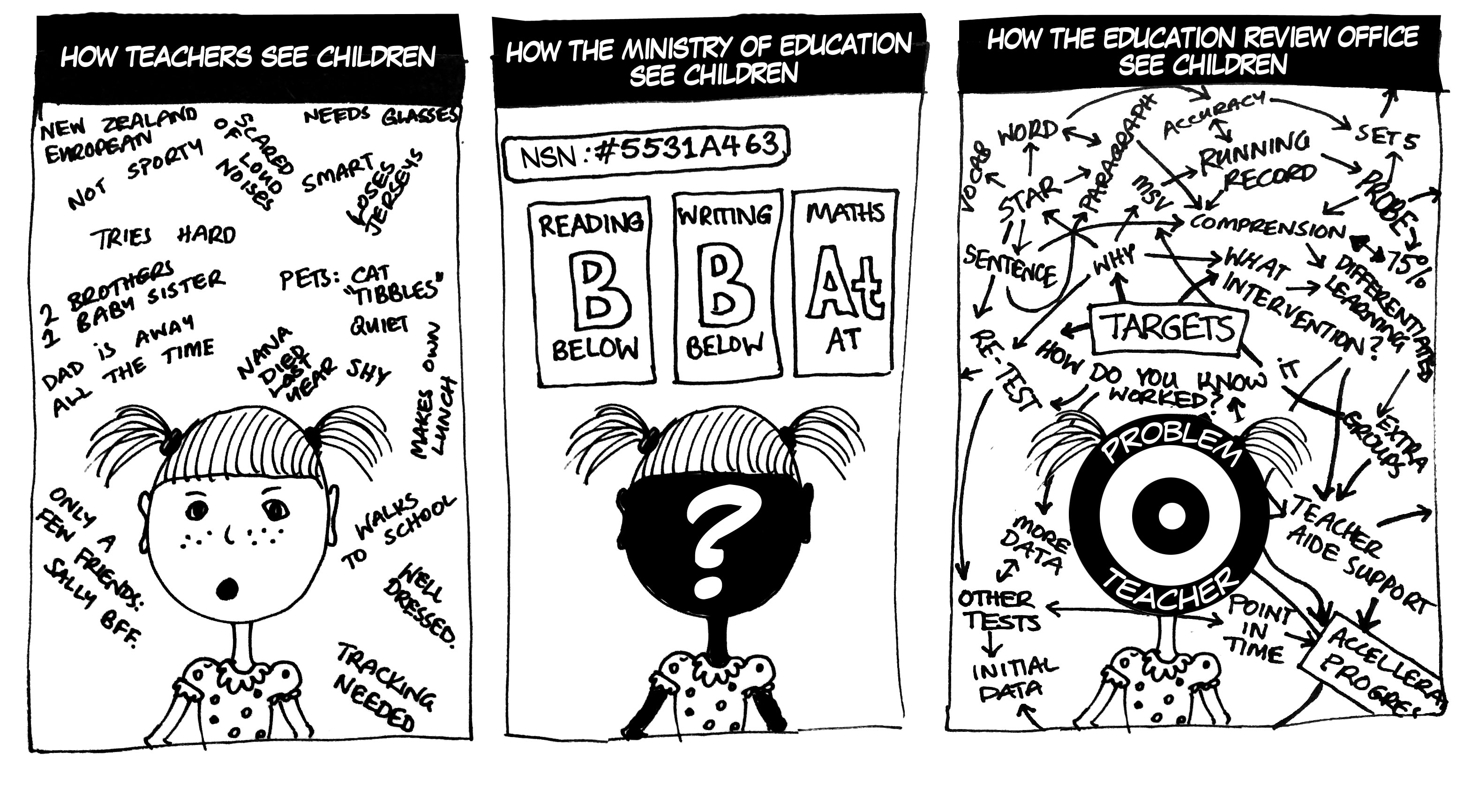
  • How Teachers See Children

    I was thinking today about the different professional views on how we should be seeing children, and how completely different that is from any kind of reality that actually faces us in the classroom.

    The only way to try and illustrate that, is in picture form.

  • Where are the kids learning?

    I was told not so long ago, that kids only spend 13% of their time at school. It was in relation to say that kids actually don’t do a lot of their learning at school. Kids will learn through all sorts of means, from what they hear, what they see, what they experience.

    Even as a teacher, I thought, that can’t be right. That can’t be right at all. Only 13%!!?

    Here’s the Maths:

    40 weeks at school. 5 days a week. 6 hours a day.
    6 x 5 = 30 hours per week.
    30 x 40 = 1200 hours at school per year.

    365 days per year. 24 hour days. 8760 hours per year total.

    (1200 ÷ 8760) x 100 = 13.7% of total time spent at school each year.

    So my question to you is “Where are the kids learning?”. Is it at school? Because only 13 percent of their time, the things they see, the things they hear, and the things they experience, is at school. So what happens in the rest of it? Is it in front of the TV? Playstation? After School Care? Internet? Where is your child learning? 87% of your child’s time is outside of school time. What are you doing to help your child learn the right things during that time? Teachers are paid to teach. That is their job. And I can say whole heartedly, that teachers work hard to ensure that every hour that the children are in their care, that they are providing learning experiences and tasks for those children. And they certainly have to maintain a strict criteria to ensure that they are teaching things suitable for the children to learn (unlike some TV channels!). But no matter how hard they work to teach effectively, and teach the right things, they still only have 13% of the child’s time.

    There are some parents doing wonderful things to provide a well rounded education for this generation of young people. They are following up homework, they are reading to their children, they are providing experiences that kids can learn life skills from, they are getting them involved in weekend sports.

    But others choose to point the finger at schools, and fail to see the three fingers pointing back at them.