Tag: education review office

  • ERO strikes again. Seriously!?

    In their latest document of propaganda, ERO have made the following recommendations for schools to work towards improving the way they deliver education for their students. It is, however, only in draft format in it’s present state, but makes pretty clear the direction that they’re heading. It’s called “Effective School Evaluation”. Within it they have a table which includes examples of shifts in practice that schools have made to improve outcomes for learners. Their words, not mine.

    In it, they have different headings and different recommendations within each one. I’ve had a quick perusal through them, and there are a few that stand out that I wish to bring to your attention.


    Educationally powerful connections and relationships

    FROM: 15% attendance by parents and whānau at interviews – TO: 85% after introducing a whānau tutor system and giving parents and whānau a 20 minute interview with one teacher.

    Shifting from 15% of parents and whānau turning up to 85% turning up is not as easy as writing it down in a statement and assigning a “whānau tutor” . I’m not sure where ERO get their 15% of parents turning up for interviews, but I can only assume that it was from a school who was REALLY struggling.

    15% of a class of 28 (the current funding ratio for class sizes) is 4.2 families. At a meeting of 10 minutes each, this impacts on a teacher of…, wait for it,  42 minutes of additional non-contact time expected of teachers.

    ERO would like to increase attendance to parent-teacher interviews to 85% through the use of ‘whānau tutors’. Who will these tutors be? You guessed it – teachers. Who else is there?
    What will we be expected to do? And how will that ensure that parents come to teacher meetings if they are busy, or can’t make it, or are sick or looking after the tamariki? Seriously. It’s almost like ERO have no touch on reality.

    ERO also mentioned that the expected length on such meetings would be 20 minutes so that discussions can be in depth and meaningful.

    85% of a class of 28 (the current funding ratio for class sizes) is 23.8 families. At a meeting of 20 minutes each, this impacts on a teacher of…, wait for it, 476 minutes. That’s a total of 7 hours and 55 minutes additional time expected of teachers.

    Now; let us assume that in an alternate universe where teachers would be paid by the hour, and the pay rate would be on par with other trades at $80 an hour. We can safely assume that this would happen after school hours, so we’d have to pay time and a half. However, let’s be generous and just charge out the usual rate (That is the usual treatment of teachers time these days anyway!).
    So at $80.00 an hour, for 8 hours, that is $640 per teacher. That’s just for the interviews. That does not take into account the “whānau tutoring” that will also be expected of teacher’s time. I’m not sure when I last had 8 hours of additional time in my already jam packed schedule. Or are we expected to come back on the weekend to meet with parents?

    This goes along the same lines as a PacT Tool Workshop that I attended, in which they said that it’d probably take 25 minutes for each child when you first start doing it. I worked that out at the meeting and it was the turning point in my support for it. It worked out to be an additional 11 hours just to create an OTJ for every student in the class; something that should take no more than 30 minutes in my opinion.


    Responsive Curriculum, effective teaching and opportunity to learn

    FROM: Teaching Writing – TO: Teaching Writers

    Move from Teaching Writing to Teaching Writers.

    They think that this is a clever statement to cause thoughts and shifts in thinking. There are a few flaws however.

    To be a writer, you need to know how to write. Many new entrants do not know how to write, and yet we probably should teach them something about writing?

    Secondly, let’s look at the language being used.

    Writing – noun. The act of writing. A subject of study.

    Writers – noun. A person who writes.

    The shift ERO want us to make is from teaching a subject, to teaching the people. However, as a teacher, what am I doing when I teach Writing? I’m teaching students how to write better. What am I doing when I teach writers? I’m teaching students how to write better.

    Well, it would seem I can tick that one off the list of things to do.


    Responsive Curriculum, effective teaching and opportunity to learn

    FROM: Deficit thinking and blaming students for poor outcomes – TO: Teachers recognising the need to improve their teaching.

    Finally (for this post anyway), the last recommendation I’ll touch on is this. ERO wish us to move from deficit thinking on why students are failing, and instead, focus on how teachers can teach better.

    Go on. Bash away. We know you don’t respect us enough to give us credit, or even acknowledge that some of us (if not all of us) are actually doing the best we can with what we’ve got. They also forget that most of the students we teach are doing the best with what they’ve got. But the truth of the matter is there are other impacts on a child’s learning beyond that of their academic ability and the teacher’s adequacy in being able to teach. Poverty, hunger, broken families, abuse, violence. Need I go on?
    No. It couldn’t possibly be any of these mitigating factors. No. It’s because we are not teaching them well enough that there are poor outcomes.  Pffft. To suddenly start blaming ourselves for why students are not progressing is just as counter-productive as saying it’s the student’s fault that they aren’t succeeding.

    It’s enough to make my blood boil.

    At least I’ll stay warm while the educational winter is setting in.

  • ERO Shrine

    ERO Publications

    Over the last few months; actually since the start of this year, I have noticed a definite increase in propaganda…I mean… publications from our beloved at the Education Review Office (the independent reviewer of schools that is run by the government – who also runs the Ministry of Education – go figure!).

    So I headed over to their website and thankfully in this technology day and age, it has been incredibly easy for people to archive their documents as PDF’s and have them available for all.

    When I got there, I wanted to see just how many publications there were. I started counting.

    As I was counting, I began to wonder a few things. Were these publications on a schedule? Were there certain months or time of the year that these are released? How long do school leaders get to peruse these wonderful documents before the next one gets sent out?

    Getting Data

    So as I often do, I started gathering data (which we now know to be the silver bullet in saving the education of Maori children). This lead me to some interesting discoveries, especially as we go back in time.

    Initially, I went back to 2010 – the year I got my first full time teaching placement. Then I realised there were certain other things that occurred that year, such as the roll out of National Standards.

    It was also soon after this, in 2011, that the Minister of Education Hekia Parata took office after Anne Tolley was somewhat swept aside (having already done the damage needed in rolling out the Standards).

    So I went back further. Let’s say, 2007, then 2008, when the current government took office. That’s a good period of time.

    Findings

    Here’s what I found:


    I wrote out the date of each publication and put it into a very simple graph.

    From this, it is quite clear to see that there is a significant increase in the number of publications ERO is sending out to schools about best practises, about leadership in schools, about review, inclusivity, inquiry, and a myriad of other pedagogical egregiousness.

    Volume & Numbers

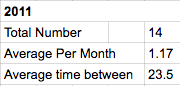
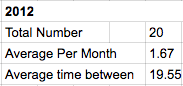
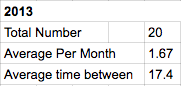
    Look at the numbers alone. Schools have gone from having 2 – 5 documents to read each year, to suddenly up around the 20 mark. Proponents for these documents will suggest that it is for the good of all schools to read, that it provides a more vigorous form of guidance and the assimilation of best practise across the country.

    However, there are many other factors that these documents bring upon the education sector.

    Firstly, time.

    Time

    In 2007 and 2008 there were five publications each year. Counting up the number of days between each of these five publications, it gave school leaders and board of trustees a whopping 55 days (approx) to read, digest, mull over, and apply the findings in these reports.

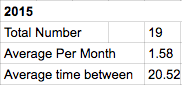
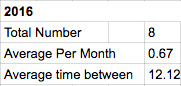
    By 2010, schools had less than a month. By 2013, schools were having just over a fortnight to read these publications, as the number of publications balloons to 20 publications in the year – four times the amount of reading to do. By March 2016, Schools have already received 8 documents from the Office, with an average of 12 days between each.

    On average, the publications range from about 25 pages in length, to about 60, with varying degrees of content. The majority are around 30 pages in length.

    In addition to this, expecting only 5 documents to be read throughout the year is not out of the realm of possibility. If we were to pay Principals their time to read these wonderful documents  the cost would be somewhat minimal. The average reading speed of 200-250 words per minute applies to non-technical material. Unfortunately, as anyone who has taken the time to flick through these ERO publications, they are full of technical terms used with education, and the editors thesaurus gets a good workout as they condense twelve easy to understand words into two obscure words that generally require deciphering. For such technical material, the average drops to 50-70 words per minute. This translates to 5-6 minutes per A4 page. If the document has 30 pages, then we can safely assume that this will take the average school principal 180 minutes to read each document. That’s 3 hours of a Principal’s time to read through each document.

    3 hours.

    Let’s put that in context. That’s half of the school day (contact time).

    You can start to see how this might start to grow exponentially, especially when a total of 15 hours per year might be spent in 2007, to suddenly 60 hours needed in 2013. In the three months to March this year, a whopping 24 hours would be needed to get through all the publications to date. That’s a whole day.

    Cost

    As we all know, time means money, and we can see how looking at the time it takes naturally moves into the cost to tax-payers that these publications might take.

    In New Zealand there are a total of 2,538 schools. Let’s assume (for ERO’s sake) that each school only gets one copy of the publication sent to them. That’s easy maths. That’s 2,538 copies. A reasonable sized print run.

    In 2007, there were 2,590 schools. Multiply this by the 5 publications printed in that year, and there’s a total of 12,950 documents.

    Postage

    Assuming that it was sent out by fast-post to schools, the cost back for postage in 2007 was $1.50.

    It’s okay. I’ll do the maths for you. Its $19K and change. Yup. $19,000.

    Now, it may not be quite that bad. Maybe government departments get discounted postage rights, especially when sending in bulk maybe. But still….

    Fast forward to 2016. Postage for one document is $3 in a foolscap size envelope. Fast-post.

    In 2016 already, there has been 8 documents sent to the 2,538 schools (20,304). We’re at $60K in postage by March.

    Printing

    Printing costs are another matter.

    I haven’t been able to find out the company that the NZ Government or ERO might use for printing these documents.

    However, going to Print.com/nz, I was able to get a rough price for an A4 portrait document. Granted, the pages are glossy (ERO’s pages are matte), and only 120gsm (ERO’s pages feel more like 300gsm) but the price is $5.42 per document.

    We have to assume that the Government would get some suitable discount on this price, but this is about as good as I could find.

    So. More maths.

    If the cost of postage has doubled since 2007, then it is possible that the cost of printing has also doubled in that time.

    So for the 12,950 copies in 2007, this would cost $35K. Adding on the postage bill, and we’re looking at $54,000.

    By March 2016, using the current printing costs described above, ERO has spent $110,000. Add on the $60K postage, and there’s a whopping 170K bill to be paid.

    At it’s peak in 2013, there were 20 documents sent to 2,539 schools. Assuming printing and postage will be somewhere in between the 2007 and 2016 prices, we can surmise that Printing would be about $4.07, and postage at $2.25.

    All up, the ERO would be fitting a 2013 bill of some $465,017.85.

    $465K for a bunch of booklets that principals would be hard pushed to find 60 hours to set aside to read, let alone implement.

    Inaccuracies

    For reference, I do realise there are a lot of assumptions being made, and not only those that I have mentioned above. I’m very aware that not every principal or school would be required to read every document put out by ERO. For example, some of the documents are for ECE, some for Primary, and some for Secondary, and it’s fairly certain that ERO would not be expecting Primary Schools to be pouring over a document about Science teaching and achievement rates in Secondary Schools – and vice versa. There are other areas where the implications have been stretched – I will admit to that.

    But the reality is, these documents do need printing, and they do need sending, and they do need reading.

    And it seems like the number of publications are only but increasing. These publications are swamping principals desks, keeping them from their core business instead of providing insight, guidance, or help. Schools are being suffocated with the sheer volume of documents clogging up the leaders and bringing them to a grinding halt, staggering and stumbling until they can breathe no more; crushed by the weight of layers and layers of 300gsm matte paged booklets.


    Happy reading everyone!