Tag: free

  • BYOD: It’s not as compulsory as you think

    As a bit of a tech guru, it saddens me to see parents trapped in the psyche that they need to not only “Keep up with the Joneses”, but need to provide their child with a $300+ device to use at school. Let alone stationery, let alone uniforms.

    The reality is that schools should be providing the devices for the students, but this runs into many issues. One is the ongoing costs to the school which many simply don’t want to budget for or have other priorities and are not funded adequately enough to provide for one-to-one devices in their school. Then there’s the requirement to maintain these devices and issues surrounding damages and repairs and whose responsibility that is, along with many others. So instead of dealing with this, schools have been farming this cost off onto their community and expectations land on the parents to provide these.

    Here’s the other reality though. If you can’t provide one, because of whatever reason (including any moralistic ones), then you do not have to. Schools cannot enforce it, and it says so in the following article. It’s against the law. Schools can’t even demand a particular kind of device – they can’t demand any device. These are only recommendations so that they have devices that are all similar and therefore easier to manage within the classroom so that unskilled teachers don’t have to learn how to use a range of device types in order to assist and help with any technological problems.
    But, as we’ve come to know, most devices are usable by the general population and are rarely so dissimilar that they become problematic. Add to this the fact most schools are running Google Apps, which operate on the big cloud in the sky and runs off the internet – therefore look, run, and work all the same regardless of the device being used (allowing for differences between tablet apps and browser based versions).
    Simply put, any device will do. Shop around, and select one that matches your budget, and then your needs, not the other way around.

    Parents who aren’t in the position to splash out for a device that will likely only last 3 years and then you’re up for another one,  should swallow their pride and go and talk to the school. If the school is worth their weight, they’ll explain, discuss, and come to some arrangement for you. It is more than likely some compensation can be made, and in most cases, schools will have a (albeit limited) supply of devices available for student use.

    If not, then it’s more a reflection on the school than you as a parent.

    Don’t just accept it and remortgage your house or go without food for a week to pay for it. It sickens me that this happens because parents don’t want to go to the school.
    Go and talk to the school. Yes they are closed at the moment, but they’ll be open soon enough. Go and have a chat and explain your position. Yes, there may be shame, but it’s not worth just going along with the list of demands, complaining about it later, and missing out on other more important things. Like school lunches.

    I’ve always said schools need to sort out BYOL before they sort out BYOD. If every student is a “Bring Your Own Lunch” student, THEN, and only then, should you start thinking about becoming a “Bring Your Own Device” school.

    Original Article: https://www.stuff.co.nz/business/money/88562690/schools-byod-or-bring-your-own-device-demands-are-a-rising-cost-to-parents?rm=m

    For many parents, preparing their children for the school year means finding ways to cope with the costs of BYOD.

    BYOD stands for “bring your own device”, and refers to pupils owning devices like laptops, iPads and Chromebooks for use in the classroom, and for homework.

    Prices quoted by electronics retailer PB Tech, which has built a “shop by school” search tool, show the costs of devices expected at schools vary from Chromebooks starting at just over $300 up laptops costing $2000 or more.

    In both cases there can be extra costs for shock-proof, waterproof cases, and accidental damage insurance.

    Schools have worked hard to negotiate deals, and affordable payment plans for families, knowing the extra pressure BYOD policies can put on hard-pressed families.

    But parents without ready cash can find themselves being steered by schools towards finance companies, or even Work and Income.

    It’s not clear exactly how many people do get government help to cope with BYOD costs, but the first three months of last year, covering the back-to-school period, saw 24,278 instances of “hardship assistance” made by Work and Income, adding up to just under $5.3 million in payments.

    DEBATE OVER

    The debate over whether devices have a place is the classroom is largely settled at intermediate and high school level.

    But some primary schools have introduced BYOD for their older pupils, and retailers like PB Tech sometimes pictures of primary-age children on their website.

    The Ministry of Education says ultrafast broadband is transforming education, and has invested heavily in helping schools and teachers to “equip students with the necessary digital skills to take part, create and thrive in a fast-evolving world”.

    Schools cannot legally force families to buy their children devices, but it’s now common practice for them to use words like “require” and “expect” in their BYOD policies and menus of devices.

    Intermediate and high school parents may feel they have no choice but to fund BYOD, and there’s even signs of pressure on some parents of primary school children.

    Primary schools often own a number of devices, but as Buckland Beach Primary School tells parents: “Parents are now offered the chance to improve the access their child has to ipads. This is offered through BYOD where students bring an ipad from home.”

    Other Articles: https://www.stuff.co.nz/business/money/88562690/schools-byod-or-bring-your-own-device-demands-are-a-rising-cost-to-parents?rm=m

  • School Donations: Rich get Richer…

    Original Article: https://www.stuff.co.nz/national/education/109937537/rich-school-poor-school-top-schools-get-millions-in-donations-while-others-get-0

    About $140 million was donated to New Zealand schools in 2017 – and more than half of that went to just 10 per cent of schools.

    Wellington College received the most money of any state school, banking almost $5.7m.

    Coming in second was St Peter’s College in the Auckland suburb of Epsom, which received more than $3m in donations.

    At Auckland Grammar School, just 350 metres down the road, donations topped $2.2m.

    And a three-minute drive away at Epsom Girls’ Grammar School, the figure was almost $1.8m.

    Between them, the three Epsom schools received just shy of $7m.

    By contrast, 37 schools recorded no donations for 2017, and a further 79 received $1000 or less.

    The data, supplied by the Ministry of Education, included all donations to a school, whether from parents or other sources.

    Wellington College had a bumper year for donations in 2017 because donors contributed to a new performing arts centre, principal Gregor Fountain said.

    Some schools have scrapped parental donations to ease the financial burden on families.

    In its election manifesto, Labour pledged an additional $150 per student for schools that did not ask parents for donations.

    Little has been said about the policy since, with Education Minister Chris Hipkins saying it was “Budget sensitive”, so he could not talk about it.

    Capping the amount schools could ask for was one of the suggestions to come out of the Tomorrow’s Schools review.

    The taskforce heard some families could be “put off” sending their children to a particular school due to high donation levels.

    Limiting the amount schools could request would mean all families had equity of choice, the report said.

    A donation was, by definition, voluntary. However, Post-Primary Teachers’ Association (PPTA) president Jack Boyle said there were many schools where it “isn’t voluntary, nor is it a donation. It’s a compulsory fee”.

    Read Original Article Here

  • Palmerston North Herald Return of Free Schooling

    Original article: Palmerston North Herald Return of Free Schooling

    A cost-free education is being trialled at a Palmerston North school – every child’s stationery, sports fees and class trips will be covered for 2018.

    Parents will be able to deliver their child to the front gate on day one and expect a uniform to be their only cost for the year, Ross Intermediate School principal Wayne Jenkins said.

    “We’ll literally be taking our till and eftpos out of the school.”

    The school is happy to accept donations, but will not ask for them.

    “We’re a decile-six school, so we have a real cross-section of society – families that are really struggling through to families that are not.

    “It’s about access and removing barriers and kids taking part. We’re not doing this by cutting anything. We’re not reducing any curriculum or other educational services.”

    It costs families about $38,000 to put a child through 13 years of school in New Zealand, the Australian Scholarship Group estimates. That’s more than $2900 a year.

    For families with more than one child, those costs can be significant.

    “It means the kids don’t have to worry about going home and asking for money. Kids shouldn’t be burdened with financial worries, they should just be able to learn,” Jenkins said.

    “Parents are saying ‘this is really great’. It’s certainly been appreciated.”

    School camp is the only cost the school does not have covered, but it was likely fundraising would for that.

    The scheme is planned as a one-year trial and has been paid for by reducing administrative costs.

    Jenkins said the school was spending more on staff time, stationery, printing and stamps to invoice parents for costs than they were receiving.

    Economies of scale were at work and no jobs were lost, but the approach might not work for smaller schools.

    Read more.

    Source: https://www.stuff.co.nz/national/education/98955099/palmerston-north-herald-return-of-free-schooling

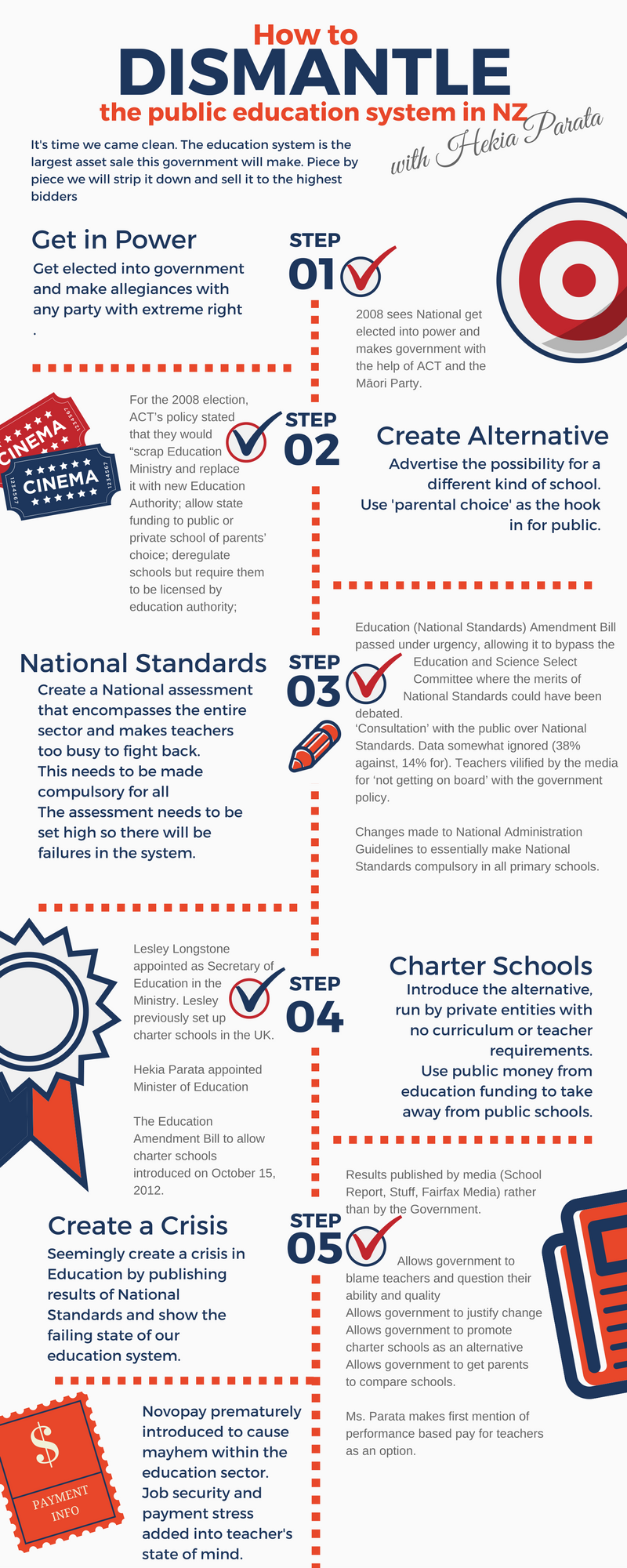
  • How to Dismantle the Public Education System in NZ

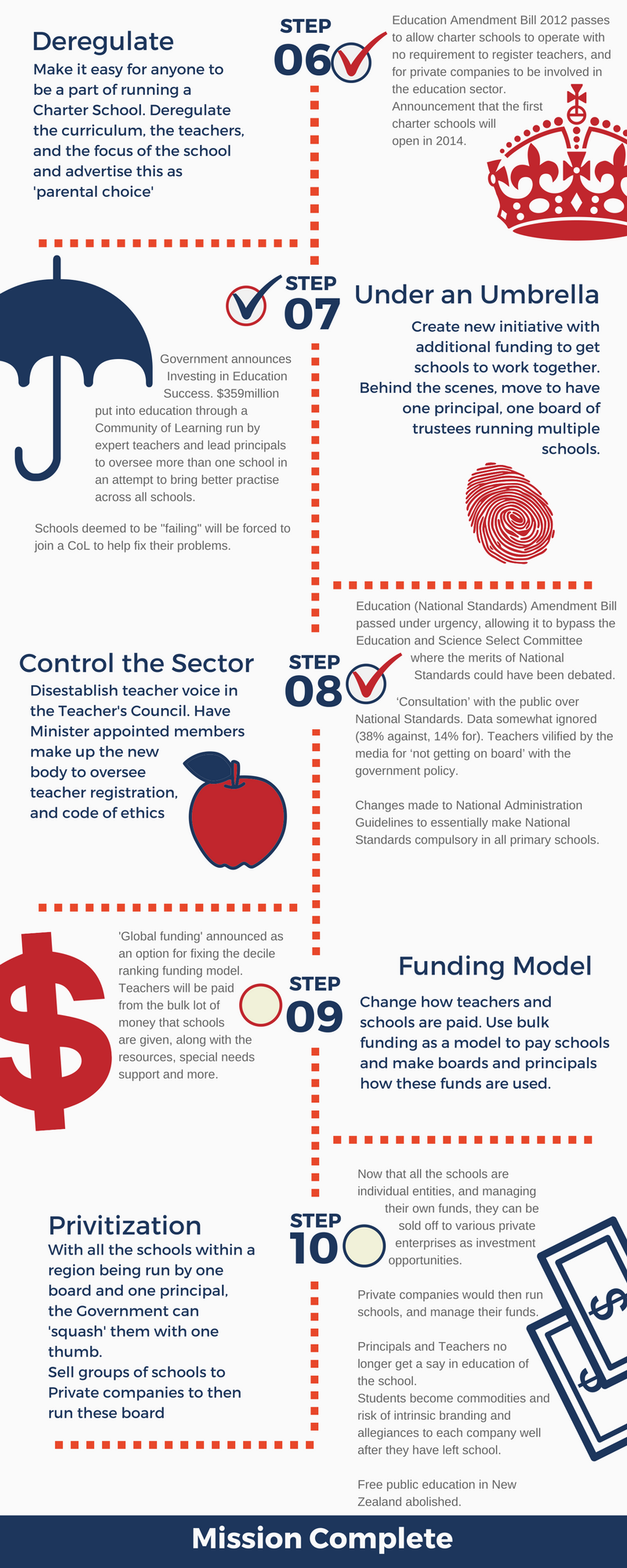
    As a follow up to my post from last year, I came across a step by step guide to how to get rid of any public education system a country has. As you look through, you can see where Hekia has ticked each step and how she managed to do it. You can also see the last remaining steps and how close she is to completely dismantling the public school system in New Zealand. How long before she’ll be able to tick those off as well?

    Enjoy!

    Below is a PDF version for you as well.

    [icon name=”file-pdf-o” class=”” unprefixed_class=””] How to Dismantle the Public Education System in NZ

    Feel free to share and spread the above infographic far and wide.

  • Open Source for Education

    I’ve been a long time advocate for open source software. It’s not just that it is freely available, but that it can be added to, modified, improved, or further developed and passed on for others that makes it appealing. In a sense, it is like education and knowledge; we pass it on to others, adding to it, developing it, and using it for our own uses, however and whenever we need to. In New Zealand, public education is free (though there is obviously a cost for this), and so following an open-source model for school technology is actually not too far removed from a possibility.


     

    Cost

    One factor that often holds schools back is the cost of technology. Usually this is related to devices and hardware, networks and infrastructure. Adding software to this cost is often unavoidable, but one way that schools can avoid paying more is by committing to using only open source software.

    Availability

    Much of today’s software is license based, and while there are various schemes to make things more affordable for schools and education institutes, paying for multiple licenses for different workstations and devices quickly adds up. Open-source software on the other hand is readily available, and is free to distribute throughout the school devices without the need for licenses or subscriptions.


    GNU.org even goes so far as to suggest that schools and education institutes have the moral obligation to exclusively use Open Source software. “The deepest reason for using free software in schools is for moral education. We expect schools to teach students basic facts and useful skills, but that is only part of their job. The most fundamental task of schools is to teach good citizenship, including the habit of helping others. In the area of computing, this means teaching people to share software. Schools, starting from nursery school, should tell their students, “If you bring software to school, you must share it with the other students. You must show the source code to the class, in case someone wants to learn. Therefore bringing nonfree software to class is not permitted, unless it is for reverse-engineering work.”

    You can read the entire article here: Why Schools Should Exclusively Use Free Software.


    Software

    There are a variety of lists out there of open source software suitable for teaching and learning. I’m not going to go into detail on all of them, but instead, begin to list some that you’re probably already using without knowing or realising it.

    Google Apps for Education

    Many of you will already be using Google Apps for Education. GMail, Google Docs, Google Drive, and Google Classroom are all becoming more and more popular and widespread throughout schools. Google have made this suite free for schools to use, with bumped up space and data for education purposes. Originally, all of these have been developed as open source software. The Google Apps API is still publically available for developers to utilise and build third-party apps on. Add to this the myriad of Apps available for free in the Google Webstore which can be added to user accounts for them to use online with Chromebooks or any Internet browser alike.

    WordPress

    WordPress is becoming more and more widespread as the CMS of choice for websites. Many schools use WordPress as the basis for their website, and with WordPress.com offering free accounts, classes and students are even developing their own blogs and sites as well. WordPress is, of course, open source, and is developed regularly, and added to through the use of plugins and other tools.

    Mozilla Firefox

    Shipped with all TELA laptops these days is the little browser known as Firefox. It’s a lightweight version of Mozilla browser, which is open-source, but Firefox seems to have taken off a lot more than its predecessor.

    Google Chrome Browser

    Much like Google Apps for Education, Chrome is Google as well as open source, and is fast becoming the most preferred browser for users around the world.

    Moodle

    Moodle is the industry standard in LMS (Learning Management System) for schools. It is proudly open-source, and provides users with all the flexibility that comes with that.

    VLC Media Player

    VLC is a well renowned media player, and is open source. The main reason I use VLC over anything else is because it’s just about guaranteed to be able to play every different kind of format there is. Videos with different codecs, DVD’s, audio; you name it, and VLC will play it. There’s nothing worse than opening up a video in front of the class and then it not work because a codec won’t load or the file won’t play. VLC seems to get around that.

    GIMP

    With it’s ridiculous prices, even the Education suite of Photoshop is out of reach for most schools. GIMP is THE open source version of Photoshop, and it does most, if not all, the major functions that you’ll need for editing images and photos in the classroom.

    There are numerous others out there. Wikipedia has an extensive list that you might want to check out. For now though, thats all from me!

    Related Links

  • The Cost of Free Education

    Families struggle to afford the rising cost of back-to-school requirements

    Free Education

    Firstly, I want to point out that this is purely my thoughts on this, and only using my view as a teacher and educator in my opinions of this. I believe education should always be free. I do not have children, and have come from a family fortunate enough to be able to afford education. I have never been in a position where I haven’t been able to make ends meet, and so this of course affects my views.

    I am, however, very aware and understand that the pressure and cost of school for some families is beyond their means at the present time, and I want to acknowledge that the beginning of the year can be an incredible hardship for them. I certainly do not intend to belittle that in any way.

    There are a number of issues that this article raises in its conscious or unconscious attack on schools. There are several inaccuracies from the outset, which are relatively clear from a schools point of view. Obviously, this article takes the side of the parents; as is much of the comments I’ve seen on social media about this. But hopefully your eyes might be opened to the reality of things for schools.

    The article begins by saying that the $35,000 spread out over each child’s years of schooling at a state school ($2.7K per year, $13.48 per school day) includes “…fees, extracurricular activities, other necessities, transport and computers, by the time they finish year 13.

    Fees

    State schools are not allowed to charge fees, yet many do. They are not compulsory to pay, and there have been several cases out there that have brought this to light. A certain school giving tags or badges out to show who has paid and who hasn’t comes to mind.

    A popular “fee” schools have introduced has been the ‘activity fee’. This often is to help cover or subsidise the cost of additional activities or programmes that the school is involved with during the year. This usually includes things like swimming, EOTC trips/activities, outside provider programmes, arts exhibitions or performances, etc. All of these activities are in aid of enriching the curriculum or learning experiences for the students. Schools cannot charge for accessing the curriculum, else it is not a free education. However, costs such as transport, instructors, tickets, or entry fees, are all too sizeable for schools to foot the bill themselves, even with an education rate or subsidy, and so schools often will ask families to help with this cost through an “activity fee”.

    Extracurricular Activities

    By its very definition, extracurricular activities are in addition to the curriculum. They are ‘above and beyond’ school time and school learning. Because of this they are, in their very nature, voluntary. Whilst I would strongly encourage such activities that are an addition to schooling; sports teams, musical instrument tuition, Kapahaka groups – they are in no way compulsory and should not be held ‘against’ a school by including them as a cost for free education.

    Other Necessities

    Other necessities is an incredibly vague term, but I assume that this relates to things like stationery and uniforms. These are not so much as part of the curriculum, but being part of a school. Unfortunately, there’s not much schools can do. Stationery is required to record, write, draw, detect, explore, share, and learn each and every school day. Unfortunately there’s no escaping this cost, and it seems unreasonable to hold this cost against a school from running a ‘free’ education. It’s almost like that free 14 day trial of the latest TV infomercial product, but you have to pay $9.95 in postage and packaging. The trial of the product itself is free, but there is still a cost to getting it to you for you to make the most of it.

    Transport

    Transport is a factor that has two sides to it. One, as mentioned, is getting students to and from activities, and buses are as cheap to charter as one would hope. The other aspect of ‘transport’ is getting to and from school. Sometimes this is by choice to send your child to another school further away than a local one, and sometimes the closest school is more than a walk away. Either way, this should not be considered a ‘cost’ on free education, in the same way that a plane ticket to a free concert in another city makes the concert any less ‘free’. You still have to get to it for it to be free!

    Computers

    Computers are an area that I am highly passionate about, especially in relation to education. Tech in classrooms has always been 10 years behind the times. And there is one reason for this.

    Cost.

    By the time a product or idea is ten years old, it’s become cheap enough for schools to get into the classrooms.

    Remember; for schools, yes there are some discounts, but in reality, the main factor is in the numbers. If each class at our school got an extra iPad for its use, the school doesn’t just have one iPad to purchase/lease. It has nine. And that’s just for one iPad between 28-30. For more usable numbers, you’d probably need at least 8 or 9 per class, making that upwards of 72 iPads. Not sure if you’ve purchased iPads before; but I can tell you that while education discounts help A LOT; 72 iPads is still a sizeable amount for a school to foot the bill for.

    Thus came the idea of schools introducing BYOD. Bring Your Own Distraction (device). By expecting each student to bring their own device, the school no longer has to pay massive amounts of money to have technology in the classroom that students can use for learning. However, this does come across as a ‘cost’ for education, but does come with the choice for students to bring any device; even ones they might already have, or that their family has.

    Once again however, schools can’t enforce this as compulsory. It is much the same as stationery in that it’s required, but comes at a cost for schools.

    Schools are pretty good at understanding situations, and will often have a selection of school devices available for students who don’t have devices to use throughout the day, should they be required for learning.

    I feel sorry for the mother who forked out for an iPad. The whole idea behind BYOD is that students should be able to bring their “own device”, regardless of brand. Enforcing that parents supply a particular brand, especially Apple products which are have a reputation of being among the most costly, is relatively insensitive of the school. It is also insensitive and bordering on illegal to put them on a stationery list as a requirement and not as an optional extra. I know some schools have put “computer usage subsidy” on stationery lists to help schools cover the cost of technology; but I’m told that this is also frowned upon by the powers that be.

    Getting Assistance

    Financial assistance is always an option in the many schools I have worked in. Schools are very aware of the cost they ask for, and are generally very understanding, especially with families with multiple children at the school, that it can be a struggle to make means meet. Many times, subsidies, reduced costs, sponsorships, scholarships, payment plans, and even waive the cost, are all possibilities that schools use to assist families. However; schools can only really help those families that they know of; and those that ask for help. Unfortunately here in lies the problem, in that there is certain social stigma, or whaka Ma around admitting to others that you dont have any money. But if schools don’t know, or aren’t told, there isn’t much they can do to help out.

    In addition to schools, there are also many other outside agencies and organisations that offer assistance, especially in the ‘back-to-school’ season. From stationery, to backpacks, to school shoes, there are a lot of options available; but once again, the stigma, shame, or pride get in the way. If they don’t know you’re struggling, then they can’t help out! I know the Social Workers in Schools has been able to assist in finding in and accessing these for people.

    Politics

    Weigh in the politicians. Chris Hipkins is right; there is an equity problem. There has become an expectation for schools to be at the forefront of technology like never before, and the idea of personal devices has increased the cost of getting technology into schools exponentially. Ms. Delahunty chimes in with overseas trips being offered as part of certain subjects, but again, these are always extra to the curriculum and while it’s “unfair” that not all families can afford to send their child on such trips, that is in-fact life. Some people are more privileged than others. Some are more blessed than others. That impedes not on the “free” education that state schools offer.

    In true Hekia form, she plays down everything and runs with a stock standard head in the sand response. She states that there is “no charge for education at state schools. “No child in New Zealand should miss out on an education because of cost.”.

    No child should. But some do. A lot do.

    She does make a factual statement I agree with in that most schools know the issues their community faces, and “…work hard to avoid imposing costs on them…”.

    “In addition, a range of support is available from the Ministry of Social Development for beneficiaries who are finding the start of the school year a particular challenge. My advice to any parent who is worried about the cost of uniforms, stationery or other school equipment such as electronic devices is to talk to their schools, who often have arrangements in place to assist families who are struggling financially.”

    I must say, this is the first and only time I have agreed with nigh on everything the Minister has to say. If cost is an issue – go and talk to the school. Meet with the teacher, principal, a board member, or even the office admin and ask. Don’t just blindly go and pay for the unaffordable if you are financially burdened, especially at this time of year.

    Every year an article like this comes out. The wonderful vibe schools get from its community heading into Christmas with the thanks and recognition of all that the teachers and staff have done throughout the year for their child is quickly forgotten and the media jumps on a bandwagon to hate on schools. For once the Minister is publicly defending schools in this case, which is a welcome change.

    The reality is this.

    Children cost money.

    An extra mouth to feed, an extra set of clothes, a extra health risk, an extra movie ticket, an extra holiday programme, and the list goes on.

    Yes, education and health care should be free. And yes, education, up until year 13 is free at all state schools.

    But yes, there are extra costs involved with schooling, like there are with having children in the first place. That’s life unfortunately; and it’s not school’s fault (not that it’s actually anyone’s fault – its just the way it is!)

    So let’s stop this back-to-school school bashing that goes on each year, and look for ways to help the situation for those who are struggling.

    To Help

    – Talk to your school. Be open and honest about your situation. Ignore the whaka ma because it is only in your head. Behind closed doors of the principals office, financial situations can be discussed and there is less judgement and more understanding than you’d expect. We always look for the worst in ourselves.
    – Education grants are often available for schools for certain projects. Some are easier to access than others; but the reality is, many schools and staff are busy and rarely have time (or energy) to go through lengthy grant application and approval processes. Maybe you could fill out the application for the grant on behalf of the school. Grants can go a long way into alleviating things like transport costs or increasing the budget for technology and devices within a school.

    – Offer to help with transport. I certainly wouldn’t recommend that every family do this to get out of paying for buses, but if you are out of pocket but have a car and license, I’m more than sure that arrangements could be made for you to transport your own child. In addition to this, it may be that the school may be able to reduce the cost of the trip if you come along with your child to supervise and support. Just an idea.

    – Education rates. Maybe you own a company, large or small. While the discounts offered to schools are sometimes sizeable and do go some way to alleviating the cost of things such as technology devices, if companies see the value in education rather than in money only, then put your money where your mouth is and offer them at import cost, so that your company isn’t taking profit from them, or even better, discount THAT rate aswell. I’m not saying make them free for schools (though I’m not going to stop you if that’s what you think you should do!), but discount them further than the 10 or 15% that schools usually get.

    – Make busses free for schools. This becomes a massive hurdle for schools to access other areas of education, such as swimming. With school pools being closed, and the local out door pool a) booked out during summer and b) closed during winter, we have about a 15-20km trip to the next closest pool. The biggest associated cost is not pool entry, nor is it the swimming instructors (both of which either the school pays for or we use grant monies for) but is the cost of the busses. Obviously bus companies have running costs to cover and driver salaries, but once again, there seems to be more than this put onto the cost for schools to offer the free education that our tamariki deserve.

    Free education is their right.

    Let us deliver on that for them.