Tag: funding

  • Secondary School Teachers to Strike

    Secondary teachers will go on strike next month after “running out of patience” with collective contract negotiations, their union’s president says.

    Thousands of teachers will walk off the job in a national day of action on April 3.

    At a Post Primary Teachers’ Association (PPTA) meeting in Rotorua on Saturday, president Jack Boyle said teachers hoped to receive “a realistic offer” from the Government before then. More talks are planned for March 7 and 8.

    “If we don’t, we will use the day to publicly protest the lack of progress,” Boyle said.

    “We have been negotiating with Government for a settlement to our collective agreement since August last year and our members are running out of patience.”

    In November, PPTA members voted against the Ministry of Education’s second offer of a 9 per cent pay rise over three years.

    Members authorised a one-day strike at that time, but were willing to call off the strike if they received a better offer.

    Read Full Article: https://www.stuff.co.nz/national/110979827/secondary-school-teachers-to-strike


  • Tomorrow Schools and the Equity Gap

    It’s interesting to see that word “review” and “reform” getting bandied about.

    At one point, reform was an issue as we fought off “GERM”…

    Now, a review is taking place of our school system, and some suggestions being made, and suddenly those that may have been encouraging GERM are now questioning this review.

    The main objection to the review is stemming from the education elite; those sizeable schools who have clawed in students and money and status through whatever means possible. The bigger the school, the more influence you’re seen to have, as the more students you have, the more parents you have, and usually, the more chances of having very rich or important parents. The sphere of influence grows and it becomes all about who you know, not what you know.

    Take the article They’ve Seen the Future for instance; Martin Thrupp has some very good points that he makes in the article. He says…

    “It is a kind of view that runs through New Zealand society; this great concern about inequality, poverty and so on, but at the same time people who are on the advantaged side of it don’t necessarily want to share their resources.

    “Because of that, we do see principals of high socio-economic schools not particularly supportive of redistribution efforts and greater equity funding for low socio-economic schools.”

    He goes on to say that parents are the same, clustering together to improve their status, keeping up with the joneses, purchasing houses in specific zones (Look at the marketing done in the season of the Block where one house was in zone for a particular Auckland school). They work together to all jostle for position, and not only demand, but provide resources to ensure, that their child gets the best possible education. This carries on at home.
    Thrupp says that this doesn’t always happen in low-socio economic communities.

    We see what money means to those schools as well.

    Wellington College Principal says that with the donations his school receives, he is able… “to make decisions around overstaffing, to pay for a teacher’s salary beyond the [roll-related] staffing. It’s enabled us to sometimes have smaller classes, start new subjects, retain high-quality staff.”

    Now, that’s all well and good, and a great luxury to have. But there is always another side of the coin.

    This kind of luxury is simply not available to schools in low socio-economic  areas – places where smaller classes and decisions on overstaffing would be very much beneficial. These schools have high-quality staff, but they often get burnt out managing classes of 30+ pupils, or leave for greener pastures at schools that might be able to offer smaller classes, better resourcing, or other incentives for them. Needless to say, this also means that any high quality staff these schools have, won’t have the same effectiveness due to their larger class sizes. I don’t really care for what Hattie’s research (however bogus or biased it is) says about class size; if you take a great teacher and put them in front of 30 students, and then put them in front of 20 students, they are going to have better success (not to mention overall better well-being) in the class of 20 students.

    Okay. Time for some maths.

    In the article, it states that Wellington College received $5.7 million in donations in 2017, the most for any school. It’s roll is around 1750 students.

    So taking that $5.7million, and calculating how much that amounts per student, we end up with a figure of $3,257 per student. PER STUDENT.

    I can guarantee, that is more for one student than most schools receive in donations for their whole school. Add to that the notion that the Government suggested during their election run that they would subsidise schools $150 per student if they dropped their school donations for parents. This has yet to happen, but I know of several schools that have waived asking for school donations from their communities, because of this, but also because they know the burden it puts on some of their families.

    Three and a quarter thousand dollars per student is a long way from a mythical $150.

    No wonder these schools don’t want the review suggestions to be implemented.

    I wonder what would happen if, just for a week, those principals in the lofty heights of the wealth and famous, got to see the otherside of the coin, and got to see that we are all here for one reason – to educate our young people, and begin seeing this as a New Zealand wide system rather than just from their ivory insulated tower. Maybe, just maybe, they’d see things in a different light, and hopefully be able to see the disparity that exists and that this taskforce are trying to address.

    How can education in New Zealand provide the same opportunities for every child when there is such a massive gap between the rich and privileged and the rest who are doing the best they can with what they’ve got?


    Original Article: https://www.stuff.co.nz/national/education/110421061/theyve-seen-future–its-not-tomorrows-schools


  • Two Auckland charter schools still have no idea if they will be open next year | Stuff.co.nz

    It amazes me the arrogance and ignorance of some people.

    Just read the comments to see the myriad of people all wondering what Labour’s problem with charter schools are.

    If they’re making a difference, and they’re meeting the needs of some kids, then surely that’s a good thing, regardless of how they get there? Right?

    Sure.

    Except, how do they get there.

    Entire schools, using tax payer money to be set up and run, with ‘special character’, which in this case includes class sizes of no more than 15.

    Okay. Let’s break it down.

    Let’s say that the Ministry of Education has $10,000 dollars to give to all schools to run for the year. Realistically it’s much more than this, but my ‘0’ key is starting to wear out…

    From this pool of money, $7,000 is given to the state sector to teach and to raise achievement and pay the teachers and try to make educational outcomes in the positive. $3,000 is given to charter schools to do what they want with it.

    However. There are 14 state schools using the $7,000, and only 2 charter schools using the $3,000. Let’s break this down. Each state school gets $500, and each charter school gets 3 times that.

    Now… Because the state schools are given a class size of 28 students, this works out to be $17 per student.

    Because the charter schools can state that their class sizes be no bigger than 15, this works out to be $100 per student.

    Now… This isn’t the issue that those of us in the state sector have an issue with. The issue is that there is an unfair playing field being created between the public sector and charter schools which are a mish-mash of private/public. The trouble being that not every student can go to a charter school and access that amazing resource.

    And in the meantime, that $3000 could have been going into the state system to provide similar benefits of smaller class sizes to every school, to every student, not just the few that manage to live near or get accepted into charter schools.

    I guess it comes down to one thing…

    Don’t read the comments!

    Source: Two Auckland charter schools still have no idea if they will be open next year | Stuff.co.nz

  • School funding not always linked to results

    Investing in education is one of the most promising ways for countries to secure their future.

    And yet, there is a surprisingly tenuous relationship between the amount of money spent per student and the results of international Pisa tests, at least when comparing relatively wealthy nations.

    South Korea is one of the highest-performing OECD countries, but spends well below the average per-student expenditure.

    Students in Poland, which spends around $68,000 (£52,000) per student between the age of six and 15, perform at the same level at age 15 as the United States which spends over $115,000 (£89,000) per student.

    That means despite spending much more money the US does not gain any advantage in results.

    More broadly, the world is no longer divided between rich and well-educated countries and poor and badly educated ones and success is no longer just about how much money is spent, but about how that money is spent.

    The teacher-pupil ratio in China and the United States is almost identical. But the Chinese chose much larger class sizes than are seen in the United States, up to twice the size. That enables the Chinese to give teachers much more preparation time, lesson-development time, time to collaborate with other teachers, time to work with parents and time to tutor students who are behind in class.

    It is the same cost, but very different approaches. Chinese policymakers traded larger class size for more professional collaboration and more favourable working conditions for teachers, while American policy-makers opted for smaller classes, lower salaries and less time to plan and collaborate.


    Read more here.

    Source: http://www.bbc.com/news/business-40511185

  • Future of education in NZ for National freightrain

    In response to NZ Herald – Every child’s chance to learn second language: National’s education policy – 27 August 2017.

    Whilst some schools are struggling to get students to learn a first language, we’ll be teaching them coding and a second language as well should National get through to it’s fourth consecutive term.

    National Standards will be extended.

    And low and behold, surprise, surprise, they will be pumping money into improving the teaching of maths to primary schools.

    Seriously. When will they get the message?

    The second part of the package was a $126 million investment to raise maths achievement for primary school students. English said National Standards showed New Zealand needed to lift its game in maths. “So we’ll provide our students and teachers with the tools they need to do that… We’ll help 1200 teachers a year complete extra university papers targeted at teaching maths to primary students… We’ll also provide intensive classroom support for students, where schools have identified the need to improve their maths.”

    Obviously teachers are the reason students aren’t achieving in Mathematics. Rubbish teachers and ineffective teaching. Ignore the fact that there are other factors at play for many students, it MUST be the useless teachers we have that are failing our students.

    So to fix this problem, we’ll send teachers back to university to learn how to teach Mathematics more effectively by ex-teachers-turn-lecturers who couldn’t hack it in the classroom 15 years ago with some kind of trendy fad way of teaching. Probably after school, in teacher’s own time.

    Teachers work out of their skin. Anyone who has visited schools that are supposedly ‘struggling’ knows that there are other factors in any underachievement.

    It’s made even more a joke when you begin to look at the reason behind such a policy. A simple search on our favourite search engine shows that Education Counts has the data for National Standards Results, 2016 (PDF). On the very first graph of this document we see that Reading sits at 77.8%, Maths at 75.4% and 71.2% for Writing. So why are we targeting Maths?

    Quite simple actually.

    Maths is the easiest to address. It has a ‘right’ and a ‘wrong’. It’s measurable. It’s quantifiable. It’s the easiest to show progress. It’s assessments are stable and data rich. This is something that Reading and Writing don’t have, being largely subjective – especially Writing. The government want to ride on some success. By investing in Mathematics and measuring the future success of their education budget, they can prove that National Standards work, and legitimise all three subjects.

    However, what teachers really want, and really need, are some resources, assessments, and some structure around how Writing is assessed and taught, and to see how this can impact on all other subjects (including Mathematics). Pumping more money into Mathematics is an easy out for the Government, whilst appearing that they are putting in resources and funding into education before an election, whilst in reality, they are plugging a hole that isn’t leaking (or not leaking as much).

    Are any teacher’s actually excited about this? About having more money put into Mathematics, even after ALiM and other initiatives? About the prospect of having to go back to complete some additional university papers?

  • Decile Ratings to be Replaced

    “A controversial risk modelling tool to guide Government spending in schools is reportedly close to being signed off as a replacement for the decile system.

    The predictive risk modelling index would replace the decile system, Newshub has reported. The Government had long been in talks with organisations including the New Zealand Education Institute (NZEI), which also wanted the decile system scrapped.”
    Decision close on controversial predictive risk

    So, now that we have moved forward from the initial outcry over this model, what has changed?

    Not a lot – otherwise you’d think they would have announced those changes to smooth over the transition with the profession.

    Like I expressed in this post, there is a bigger picture at play here. Students will begin to get linked entirely to social, poverty, and criminal factors that they have little to do with. We will begin to judge parents over their pasts, and any record that they have that contributes towards funding. The Government will then have a complete and all encompassing database of every parent and every child in the country. Chances are, that while all good intentions may be behind this, at some point, something will go wrong. Chances are, they already have said database.

    A year ago this all hit the headlines. No surprises that John Hattie was in the thick of it throwing his virtual educational powers in the Government’s favour as per usual.

    So it would seem that regardless of what the sector say, the Government will just keep on rolling on with whatever they want to do.

    I’m quite glad I live in a democracy.

  • Prison Beds or Educated Society

    Two point five billion dollars.

    $2.5 billion dollars.

    $2,500,000,000.00

    That’s a lot of dollar coins.

    Let me tell you what they will spend it on.

    No. Not fixing the poverty problem sweeping the country. No. Not assisting children living in impoverished situations. No. Not sorting out the public health situation with junior doctors striking today. No. Not addressing the lack of funding in mental health with suicide prevention and support.

    So, after earlier this week scrutinising that crime is caused by poverty, rather than address the poverty situation that is staring everyone in the face (and not likely to go away just because you keep staring back), Judith Collins and her cronies announce that $1 billion of that cash injection will be used to create living arrangements for an additional 1800 inmates.

    To put those numbers into perspective; that’s $555,555.55 per bed. Five hundred and fifty five and a half THOUSAND dollars per room with a bed and a pan. To contain another criminal.

    Backwards

    For me, it’s non-sensical. It’s backwards. It’s purely responsive, rather than proactive.

    EVERY piece of research out there suggests that there is strong links between poverty and crime, as well as, education and crime. Surely (or is it just me) crime PREVENTION is a better use of money than catering for an increase of criminals into the system?

    You can’t prevent crime; but with strong links between poverty, education and the outcome of crime, then surely dealing with poverty and education is where the focus needs to be?

    If you are educated, then you know to read and write, you’re more likely to be able to get a job, you are more likely to be able to hold down a job, and the less likely you are to find yourself needing to get into trouble.

    And I’m not even an expert in the field. I haven’t had to research this. It is pure, bloody common sense. and logical thinking.

    There are currently 9,798 inmates in the current corrections system (Sept 2016).

    Let’s divide that spending out per inmate (I’ll even include the additional 1,800 inmates that these extra beds will allow for!)

    $2,500,000,000 / 11,598 = $215,554.40NZD per inmate

    Now, that is spread out over ‘about 5 years’.

    $215,554.40 / 5 = $43,110.88NZD per inmate, per year.

    That’s an ADDITIONAL forty three thousand dollars per inmate each year for the next five years, including the extra 1,800 inmates that they are supposedly catering for.

    Currently, in education, spending on each student is $7,046.00.

    Let’s see those numbers next to each other.

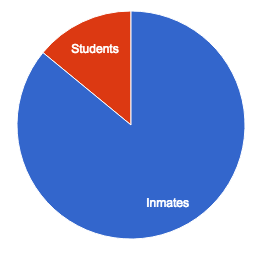
    Inmates Students
    $43,110 $7,046

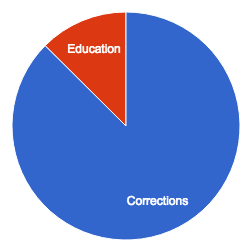
    What an absolute joke. Remember, the blue area in the graphs is what the corrections system is getting ON TOP OF the additional funding provided in the current budget already.

    Earlier in 2015, the Government announced a generous $359 million boost into the Education sector, but in a very restrictive way of schools being cajoled into CoL’s (Communities of Learning). To compare this with the $2.5 billion it’s just embarrassing. Here’s the graph for that as a comparison between what the Government is prepared to spend as ‘extra’. As a picture, it’s ridiculously similar to the current funding for students compared with the additional funding Corrections is getting.
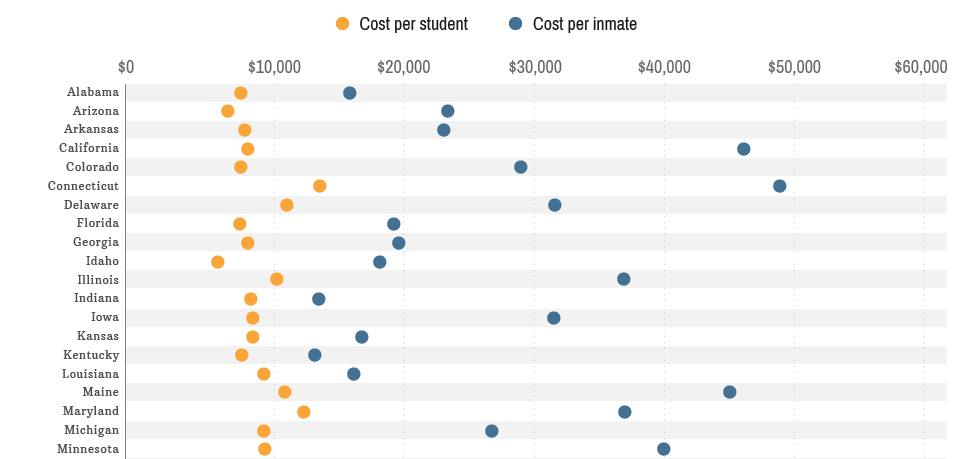


    United States has this problem: Not one State spends more on student education than it does for incarceration.

    Source: http://money.cnn.com/infographic/economy/education-vs-prison-costs/


    Now; don’t get me wrong. I am not here for a second suggesting that corrections does not need support; nor am I saying anything about how or where they spend their money. They have a job to do, and certain criminals do need “restricting in their day-to-day activities”, but lets start to look at solutions for the problem, rather than just catering for it.

    Let’s buy sunscreen rather than melanoma treatments.

    Let’s fix the hole in the bucket rather than filling it up time and time again.

    Let’s put a fence at the top of the cliff rather than an ambulance at the bottom.

    Let’s start investing in children, the next generation, the education of people, poverty, and homelessness rather than catering for the criminals that they will likely become because we continue to ignore the impact education and poverty are having on society today.

  • David Seymour’s Crying Baby

    Waaaa. Waaaa. Stop picking on my baby.

    David Seymour sure is a whiney wet fish when he comes out to defend his precious little charter schools.

    This came about as a charter school approached a nearby state school (after potentially pinching some of their kids so they could open) and asked to use their science laboratories (Essentially they just want the fume hoods, but lets face it, you’re going to end up using the whole space, not just the fume hood!).

    While the school agreed out of good will, they were quickly advised by the Secondary school union ‘PPTA’, that any such arrangement with charter schools was something that was discussed and would not be entered into by state schools.

    In steps David Seymour to fling dirt on the PPTA and try to undermine the PPTA’s credibility.

    Unfortunately (for him at least) he’s come out like a pathetic parent who has no spine “Oh pretty please stop picking on my little child. Okay, well, maybe instead of punching and kicking it, you could just punch it. Okay, but just one kick.”.

    Wet fish.

    Watch the video.

    “I think the critical thing here is that we’ve said for a long time there’s an orchestrated bullying campaign from the PPTA towards partnership schools – and it’s been particularly strong in Northland. It’s never been documented like this, it’s never been explicit.”

    He said there was a “relentless, and frankly insidious campaign” to make life uncomfortable for charter schools.

    “But what I would say is that all good, hard working teachers up and down the country might want to ask themselves if they want to be a member of an organisation that puts ideology ahead of kids like this. ”

    As both the PPTA and the Labour leader point out, Charter Schools get much more funding than state schools could ever hope for.

    “Labour leader Andrew Little says there is a legitimate question about whether charter schools should be getting help from state schools.
    Especially when charter schools have roughly five times more funding for each student than state schools.
    Mr Little says most people would say that’s pretty rough when state schools’ operational funding is being frozen.” – TVNZ

    “Roberts rejected Seymour’s comments.

    “I think it’s a bit cheeky to expect the state system to prop them up even more than they are already.

    “So our members have been very clear from the outset that charter schools – because of the way they pull resourcing away from state schools, and they make vulnerable schools and communities even more vulnerable – that we don’t support them.

    “We will not prop them up because our commitment is to the students in the state system,” she said.

    Roberts said a fume cupboard cost around a $15,000 – “I’m pretty sure that if they’re really careful about the way they cut their costs, they’ll be able to find the resourcing for it”.

    “My understanding is Mr Seymour thinks we’ve pulled out the big guns and gone up there to try and bully them, but actually I met with my members, which I’m more than entitled to do, and we’ve done this on more than one occasion.

    “I guess the issue is more broadly, charter schools have got the luxury of just thinking about the kids in their school, but we’ve got a commitment to all of the kids in the system.” – Stuff

  • John Hattie: It is time to be rid of deciles – Education – NZ Herald News

    The decile system was introduced to guide equity funding to schools and in general it has worked very well. But there are two distinct aspects of deciles that need to be looked at separately.Firstly…

    Source: John Hattie: It is time to be rid of deciles – Education – NZ Herald News


    Deciles have long been under attack. Schools complain going up and down, parents are misguided as to what they mean, and the whole system is destined for an overhaul.

    However, I tend to agree (surprisingly) with Hattie’s comments regarding it. Let’s not completely throw the baby out with the bathwater.

    “It is time to be rid of deciles, but please find a way to have equity funding without the stigma that students in poorer areas receive a poor education. It needs to be based on a “basket of measures” and not be a single measure.”

    The reality is, that the key focus is around deciles being mis-interpreted as the quality of education at that particular school.

    Surely a little bit of public education would go a long way as to expelling this myth? Maybe then the government might come to realise just how difficult teaching actually is!

  • The Property Game – Wellington Schools

    It’s been a bit of a rough start to the year for education.

    If it’s not people complaining about the amount of holiday the teachers get, then it’s the cost of education and how supposedly it is meant to be free.

    Last week there was an article in the Dominion post, announcing the property funding of $6m building upgrade for Khandallah School.

    In it, it mentions six Wellington schools that have received close to $90m dollars in property upgrades.

    Now don’t get me wrong; some of these schools have said they have been asking for these upgrades for a good long time, and there should definitely be some relief that their requests have finally been listened to.

    However, it is incredibly interesting when you start to unpack the schools, especially being aware of the types of schools these are, and the communities they belong to.

    Khandallah School has a decile rating of 10, and it’s not surprising given it is one of the richest suburbs in the Capital. They get the princely sum of $6m to upgrade 9 classrooms from leaks.

    The other schools mentioned follow a similar pattern.

    Kelburn Normal School; decile 10, Ngaio School; decile 10, and Newtown School; decile 3 get to share $20m. It will be interesting to see how much of that $20m will be distributed to the lower decile school. But benefit of the doubt gives each school $6.6m.

    Wellington East Girls College; decile 8, and right in the heart of Wellington (Mt. Victoria), gets a massive $39m upgrade to replace a demolished main building due to ‘seismic concerns’.

    And the last of the big spenders, Aotea College; decile 5, got given a massive $24m upgrade approval at the end of 2015.

    Information on school deciles were mostly gathered from here.

    In stark contrast, my own school has also been asking for an upgrade to four of our classrooms. They are old, somewhat run down, and very much still the same as they were in 1960 when it was built, aside from the furniture and possibly the carpet. In 2012 we were all but confirmed for a remodel and were even given a time estimation of end of Term 3. But, as pencil pushers began to get involved, and earthquake testing and engineers reports got involved, suddenly our budget got revised and we were unable to do anything. For three more years we were unable to do anything with our 5YA, and when repairs to some prefab roofs and upgrade leaky walls and windows in those prefab had to be carried out, the upgrade to the sturdy brick 1960’s buildings became all but a dream. The four teachers and their 30 odd students would just have to make the most of the tatty walls and rotting wooden windows with mismatched glass and colour schemes, as well as the sun bleached PVC skylights that acted like timpani drums when it rained,not to mention all the patch up repairs, non-functioning pipes for the old boiler, and bending shelves and storage from the last 50 years.

    We are a decile 2 school, although for the majority of the aforementioned time, we’ve been listed as a decile 3.

    In 2015 we finally got approval for one part of the needed upgrade. The roof. And yet we are made to feel guilty when we feel hard done by here, for not feeling incredibly grateful for what we WERE given. There is a marked difference in teaching now in that when it rains, we no longer have to compete with the “ratter tatters” on the roof, and instead just look outside and try to make out the “pitter patter” of rain drop. But in comparison to what was all but confirmed, only ¼ of the necessary work has been carried out.

    But because most of the “upgrades” we’re asking for are merely cosmetic, and not driven by health needs or leaky buildings, (and possibly because our decile suggests we’re not important!) our priority on “the list” keeps dropping down the bottom. Don’t worry though, because we will keep teaching a 21st Century curriculum, with modern technology and contemporary teaching practises within 4 mid 20th century walls and classrooms.

    I’m not even going to go into any of the troubles Christchurch schools have been facing, because I’m not there and not up to play with where things are at; but I can only suspect that there will be some very frustrated principals, staff, BOT’s, and communities.

    It does seem intriguing that a massive amount of money is being poured into the high decile schools in Wellington; communities that are more than likely in high support of this Government, and who will continue to support them as long as their schools are made a priority.

    Oh but what about Newtown and Aotea, I hear you say. Well, as mentioned, there is no figure given for Newtown; just that they get a share of $20m with two decile 10 schools.

    Aotea College is a decile 5 school, based in Porirua; an area with a low socio-economic reputation. But whose constituency does Aotea College fall under? Kris Faafoi – Labour. Who is his National counterpart?

    One Ms. Hekia Parata.

    Read into this what you will. Some, even most, might say it has nothing to do with decile, and all to do with leaky buildings or seismic strengthening.

    But the numbers speak for themselves, and any school that fits into the leaky building syndrome, was built sometime within 1994 to 2004, so has already had significant funding. My example of a low decile school still waiting for a “confirmed” upgrade from 2012, hasn’t had any classroom upgrade since the 1960’s for four of its senior classes.

    Just saying.

    If you have any stories from other examples of this, or any comments, please leave a comment in the form below. It would be really interesting to hear your views.