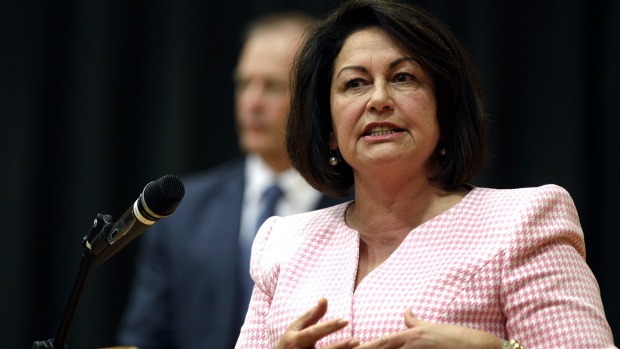
Tag: Hekia Parata

  • When Behaviour gets Brushed Off

    Thanks Minister.

    Thanks for belittling every single effort that principals, teachers, and support staff make in trying to redirect student energy away from problem behaviour and towards learning.

    Thanks for having a strong behavioural theory that is based on solid evidence based research that has been developed to work in many, if not all situations.

    Thanks for implementing this practise throughout the country so that every teacher feels safe and supported with students who have violent tendencies in their class.

    Thanks for working with principals to develop systems that can be used, words to say, and structures for parental meetings to address the rising state of behavioural problems that schools are facing in the 21st century.

    Thanks for widening the ‘wrap around service’ to include the police motto of ‘Safer Communities Together’.

    Thanks for suggesting that schools just call the police to deal with violent students.

    I’m sure that it will solve many problem schools face with behaviour. I’m sure that the police will be on board, given that they must have finished all their other work to be on call for schools.

    We will be so sad to see you go when you leave your post as Minister of Education. We’ll have to organise a farewell party.

    The invite is in the mail. It may get lost…


    In relation to:

    http://www.scoop.co.nz/stories/PA1704/S00081/questions-answers-6-april-2017.htm

  • Learning and Teaching and Learning

    This week, the Minister published a new announcement through the media. The headline: “Hekia Parata – Let’s make learning better.”

    For whatever reason, this completely grated with all sense and sensibility within me. Something just didn’t ring right grammatically.

    I’ve heard “Let’s make teaching better” before (all the time) as the powers that be whip and flog teachers who are already doing their darndest to keep a level head, and keep it above surface level (at least once in a while so they can take a breath).

    But I don’t think you can just switch the verb to learning and it make sense. Someone with

    The term switch

    Learning is defined by Merriam-Webster as “the activity or process of gaining knowledge or skill by studying, practicing, being taught, or experiencing something : the activity of someone who learns.

    Teaching is defined as “the job or profession of a teacher, and something that is taught : the ideas and beliefs that are taught by a person…”

    Learning is therefore the acquisition of knowledge, while Teaching is the imparting of knowledge. The two are direct opposites and so when used in a sentence such as “Let’s make learning better”, we start to question what is actually meant by that.

    How on earth?

    How do we make the acquisition of knowledge better? Sure – imparting knowledge in different ways is possible, but to change how knowledge or experiences is acquired – is that even possible? Are we not, as humans, limited to how we can gain knowledge, through our 5 senses? Touch, Hear, Sight, Smell, Taste? Is this not the extent of how we can learn? And how does one make this better? Obviously, vision and hearing impaired students have glasses and hearing aids to assist with these learning facets we have.
    Is the Minister asking for schools to increase the rate of so-called evolution so that we can learn better?
    Or have we now resorted to student bashing instead of teacher bashing?
    Is the emphasis shift all part of making the student at the centre?

    Is ‘ako’ to blame for this?

    For decades now, the way to make what you have to say more authentic and culturally sensitive, it has become custom to translate certain words from English into Māori. Whilst that may be a very cynical view of things, and possibly the initial use of such terms was genuine, we have built a series of terms that we now use in common New Zealand speak. Terms such as whanau, mana, and in education, akonga and ako.

    Ako itself means “teaching and learning”, and educationalists around the country jumped on it and spread it amongst the myriads of documents. It was one of the first Māori terms introduced in our university papers when learning about teaching and education.

    Does this mean that teaching and learning are synonymous?

    Not at all. Whilst the Māori use the same term for both, the context in which they do is what provides the meaning (as it does for other terms as well – for example puku can mean secret or silent, as well as, fasting, to swell, or to intensify a quality such as pukuriri which means “furious” – riri means angry.) There are terms in English as well that we know to mean different things.

    No. Teaching and Learning are not interchangeable just to sound smart. They are opposites. Like inhaling and exhaling. Up and Down, Square and Circle.

    The minister and others should stop trying to sound smart and stop confusing the matter.

  • Hekia Parata: Let’s be better learning

    I do love it when the Minister writes an open letter. It means she says what she thinks people want to hear, rather than what she actually does when people aren’t looking, taking the leadership stance of “Do as I say, not as I do”. In it, the minister harps on about providing better learning – a term that is so contrary to it’s original use. To learn is to aquire, receive, be given knowledge. To teach is to give, present, or to pass down knowledge. But there seems to be this trend to use “learning” instead of “teaching” which I disagree with; probably in an effort to degrade the skill required to be a teacher.

    The legendary Boonman took to his usual satire in response to this article, and as can be expected, didn’t hold back with the comedy; which although is somewhat hilarious, is also true – which is why we laugh (because if we didn’t; we would cry).

    However much I would like to be as satirical, I figured I would merely provide some teacher feedback, some next learning steps on the writing sample provided to us from Ms Parata’s pen. I hope that she will take the feedback on board, and work with her teacher to address some of the errors in her writing.
    Read the original letter here: Hekia Parata: All ears to anyone ‘seriously committed’ to improving kids’ learning.

    Let’s begin learning.
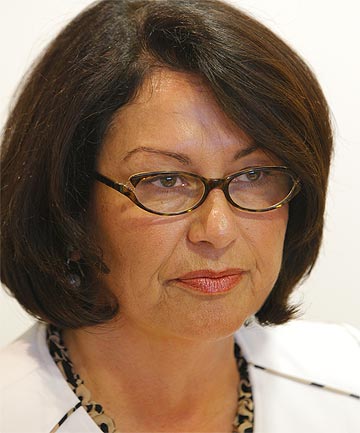

    New Zealand has a very good education system. That’s beyond debate. Can we make it better? Yes, we can and we must.

    We need to either work on your use of tense, or your spelling. You’ve used “has”, where as you need to have used “had”. Your sentence should read “New Zealand had a very good education system”. In addition to this, I’d probably shy away from Bob the Builder quotes, and rely more on tried and true cliché such as “If it ain’t broke, don’t fix it”.

    As a passionate New Zealander and as a mum, I want to see an education system that delivers quality learning for every child and young person every day. Their achievement matters, to their families, their communities – and to me.

    There is a chance that this paragraph may come across as bragging or somewhat arrogant. I am a New Zealander (and one might question my passion for the title under the current government) but I am not a mum. But I still want to see a quality education system in this country. Is my opinion not as important or passionate as yours because I have not been with child? Yet becoming a teacher without this does make my level of passion for education and learning far greater than most given most don’t want anything to do with schools unless they have children.

    As a teacher, I can safely say that if we have a “very good education system” that you stated in part 1, then we have very good quality “learning” each and every day for each child or young person. However, to presume that their achievement matters to their family is a bit much, unless you have personally interviewed them all. Likewise, communities usually don’t focus around the achievement rates of their young people. From my experience, families are focussed on raising young children to be the best they can be in all areas of life. Sometimes sports become more important than achievement rates, as much as overseas holidays or trips do. They tend to want to provide experiences that will assist with creating well rounded individuals. Communities also tend to focus not on achievement rates, but solutions to keeping the young people off the street, running groups, clubs, or catching up with the latest gossip or what not. They tend to focus on them as people, instead of as data, numbers, and test takers.

    I visit schools right across New Zealand on a regular basis, seeing for myself what’s happening in our classrooms. I speak to teachers, principals and parents about what I, as the Education Minister, can do to support them to ensure our kids are achieving. 

    It’s refreshing to hear that you get to travel around the country visiting schools. It would be such a wonderful experience to go around and see what a hard job teachers actually have, and what a great job they are already doing.

    I would suggest the use of a wider vocabulary instead of “speak to”, you could use the term “ask”. However, as I know, you have very little interest in hearing what teachers, principals, and parents have to say about what you can do to support them. I suspect you would just tell them what you will do, and leave it up to them to change what they do so that what you’ve decided to do will be of benefit to them.

    The proposed changes that we’re making in education are all about putting our kids at the centre of the education system, lifting the educational success of every young New Zealander. 

    Once again, this is an incredibly presumptuous statement, that a) kids weren’t at the centre of previous education systems, (which would be somewhat bizarre if that weren’t the case) – and b) that the changes that you’re making with or without the support of the education sector will lift the educational success of every child, more so than what the current system is and has already been doing before you stepped into power.

    This means ensuring we get the right funding for the right children at the right time. That there are a wide range of education options that reflect our modern era, and that schools are supported in the best possible way to ensure that every child is learning the skills and knowledge they need to succeed in life.

    I applaud your efforts in providing the right funding for the right children. However, your actions speak louder than words, and so far, you’ve shown a tendency to waste money on failing charter schools rather than investing in children. I suspect also, that the “right funding” that you talk about will, in turn, mean more funding, which your fellow minister in finances may wish to have a few words to you about.

    Schools also need to be supported to know this learning is taking place to make sure they’re doing the best job they can for our kids.

    Another presumptive statement Hekia. You are obviously not very aware of your audience when you write, a skill taught and learned in Level 3 of the curriculum by 9 and 10 year olds. Schools are already very aware of the learning taking place and the knowledge and skills required of students in this modern age. However, the basics of reading, writing, and maths are unlikely to change, and while you continue to maintain the expectation that schools assess against the National Standards, schools will unfortunately be forced to spend their time teaching and “learning” in these three curriculum areas.

    Our education system is well funded. At $11.04 billion this year it is the biggest ever investment in early childhood education and schools. That’s more than we spend on police, defence, transport, conservation and foreign affairs combined.

    Please refer to my earlier comment regarding charter schools. Maybe that might free up some of these funds for police, defense, and transport all of which are asking for more government funding.

    As I’ve often said, “that’s a shipload of money”.

    A very good attempt at the use of a familiar phrase or “kīanga”. However, it is not a ship full of money that is coming into harbour, because ships can carry a full load worth a lot more than $11.04b in notes alone.

    And that “shipload” is growing. Funding hasn’t been frozen. Schools’ operational funding has increased by $12.3m for next year taking it to a total of $1.35 billion.

    Once again, please refer to previous comment about ship load. It’s “shitload”; meaning a heck of a lot of excreetment.

    Also, I’m not sure coming out with fictional information in such an open letter is appropriate. Please read this article re: funding freeze.

    Spending has also increased by more than inflation, and I’m not expecting that to change any time soon.

    Yet the teachers who teach the children who you have now put at the centre of your education plan and the support staff who help them are given minor increases that do not keep up with the increases of living? I strongly suggest rewording or even removing this statement from your piece.

    The Funding Review currently taking place is focussed as much on whether we are getting the best for all these taxpayer bucks, as well as what more we might need.

    I’m not sure if using the colloquial term for “money” is the best use of your Thesaurus, Hekia. By using “bucks” it makes it seem unimportant, unvalued, taken for granted, or even rudimentary to your audience. Once again, you should consider your audience when writing this, considering the majority of them will be taxpayers themselves and probably would like you to respect their hard earned money a little more than calling it “bucks”.

    There are seven proposals being looked at as part of the Review and leaders from right across education have been included in the early development of these potential changes.

    The legislation currently making its way through Parliament is about providing more flexibility, not only to schools and early learning providers, but to parents as well.

    That is one thing it is providing – more flexibility. However, you need to add more details about the other things that it will bring. Details such as larger class sizes, more work for teachers, a national database of students that will track them through every year of their schooling. It’s details like these that your readers are interested in, even if you are not too keen on them yourself.

    New Communities of Learning, or Kahui Ako, are also helping schools and services to work together for the benefit of their students.

    Once again Minister, you need to add more details to how this is happening, and how it is benefiting the needs of individual students in their individual schools. Maybe alluding to the fact that this will lead to one principal and one board running multiple schools. No doubt this will free up some more of that “shipload” of bucks the education uses.

    I’ve consistently listened to the teacher unions since I came into the education portfolio, regularly meeting with them and working with them on a number of important initiatives.

    For the first time you have considered your audience, though it is important that when you do, you come across as sincere and truthful, rather than making things up. Also; I don’t believe you come “into” a portfolio. I suspect you were given it. Maybe you could reword your sentence to be a little less fictional by saying “I’ve consistently listened to the teacher unions bleating on since I received the education portfolio, regularly seeing them banging on my door, and ignoring them on a number of important initiatives until they give in and I do what I want anyway.”. I also find it ironic that hours after writing this letter, you leave on a trip meaning, for the third time in five years, you have declined the invite to said teacher union (NZEI Te Riu Roa) conference. That’s another example where actions speak louder than words.

    I will work with any groups or individuals that are seriously committed to improving children’s learning and raising achievement. 
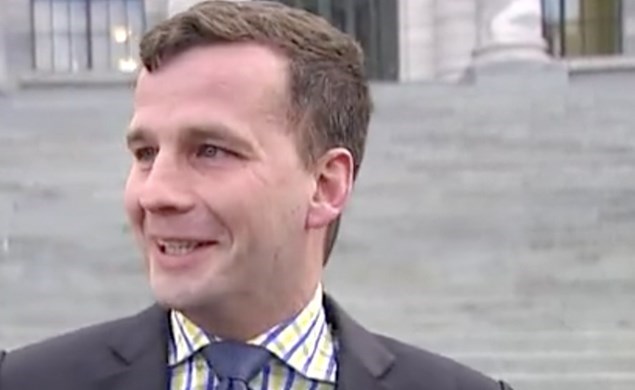
    This sentence is somewhat contradictory. I would say that it would be almost impossible not to work with yourself or your team on this. Will you have to demonstrate to yourself that you are, in fact, serious and committed to improving children’s learning before you will work with yourself? I know for one that the under-secretary of Education has no commitment to improving children’s learning, and if he does, it’s certainly not serious.

    Everything I’m working towards is about putting children and their achievement at the centre of the education system.
    It’s about lifting the learning potential of every child, so we can continue to grow as a nation, and prosper. It’s about preparing young New Zealanders for a contrary, challenging, exciting world.

    I’m not sure you have to continue to make things up and over-exaggerate about child achievement. I also think you should further consult your thesaurus regarding the words to describe the world. Contrary for example is a word that I would have thought you would be all too familiar with, especially with the number of backing down you’ve had to do in your time as Minister of Education. Maybe a “better, challenging, exciting world” might read better, especially as it provokes some sort of inspiration or hope for the young people who are lucky enough to be able to read this far into your letter without drifting off to sleep.

    Kids learning to flyI want our education system to ensure that every Kiwi kid can fly!

    That is a bold attempt with the use of metaphor  in your writing, Hekia, and definitely a great concluding sentence that really brings a climax to your points. However, I suspect that this will lead to some confusion as to the literal meaning of your sentence.For instance, if you’re wanting children to fly, they will need to evolve into a creature with wings, or maybe you are intending to use some of the shipload of bucks to subsidise the cost of airline tickets for children? Your intentions are not clear.

    * Hekia Parata is the Education Minister

    I suspect with Writing this poor with so many clinical errors, at this time in your political career, that in due course, you should be prepared to amend this line, using the past tense “was” instead of the present tense “is”.

    Teacher’s Note: I apologise for the over analysis of this Writing sample, though as you and your advisors have said in the past; data is the key to success. The more data I have on this Writing sample, the better success you will have. Though at this stage, you are still falling well below the expected level and unfortunately, this will result in you being required to find another school who are prepared to put up with your poor achievement rates. Maybe the charter school down the road will take you in.

  • Gold medals for all

    Global (Bulk) Funding

    In the weekend just been, I caught up with Ms Parata’s latest palava regarding schooling and in particular, the funding of it. Needless to say, there was lots of conjecture, and I found it hard (yet again) to agree with much of what she has to say.

    Olympics

    At the same time, we saw the wind down of the 31st Olympiad in Rio De Janerio. I was able to make some links between the two. I’ve tried to get my head around the idea of what success is, and what it looks like; both in education, as well as in life, and using the Olympics as a starting point On what success looks like for New Zealanders.

    Assessment

    Ms. Parata signalled the intention to have a never-ending assessment system throughout every year of a child’s schooling, so that we can track and monitor student achievement, and thus be able to allocate funding more accurately to children who need it as soon as we begin seeing them to fall behind.

    But how robust are these assessment systems? The National Standards are full of holes and have long been criticised for their lack of National moderation and lack of Standard measurement. Yet, as we know, the Government continues to set the expectation that 85% of students will be At or Above their corresponding level across the country according to those National Standards.

    To University and Beyond

    In her statements, Hekia also mentioned that the aspiration for her assessment and data driven school system is to monitor students at each and every level so that they can go on to finish school, go to university and get employed.

    I have a series of problems with this.

    Don’t get me wrong; University definitely expanded my worldview, my knowledge and skills as an artist, as a photographer, and as a teacher. I met my wife at University.
    However, my personal view on this point is that if everyone has a degree, then that degree becomes less valuable, or even meaningless. The more people that get it, the less rare it is, and the more people are expected to get it or achieve it, and therefore starts on a never ending downward spiral in worth or value. Even take, for example, the status a Ph D. It still holds a lot of value because it’s a whole heap of hard work and not everyone can achieve that level of study or knowledge. If they started handing out Ph D’s to any Joe Bloggs who shows up, then the value of it decreases.

    The Value of Gold

    Much like at the Olympics, if we were to hand out gold medals to all who attended, then the value, the meaning, and the hard work that is represented in the gold medal would become completely meaningless. Gold medals become worthless, and suddenly don’t mean anything to anyone. They may as well be medals for participation.

    The New Zealand Olympic committee seemed to have a more realistic view on success rates. At no point did they expect everyone to get a Gold medal. In fact, some weren’t expected to medal at all. Some achieved that Gold medal who were expected to achieve it (Bond & Murray, Drysdale, Burling & Tuke, Carrington). Some missed out who we expected to get it (Adams, All Black Sevens), but we certainly don’t see them as failures. We also had some athletes get medals with non-gold shades on them who we expected to do so (Ko, Willis). And then we had others who we never expected to medal, but who shone on the world stage to get a medal around their necks (Walsh, McCartney, Rooney).

    There’s more to Education

    Like I say; don’t get me wrong; University is great and is a huge expectation and motivator for many of our students. The high expectations of teachers these days assist students to surge on to extend their learning at university; and somehow we manage to correlate this with success.
    However, that’s not a good picture to paint, especially if you look at the employment depletion in the area of trades. You see; some students might not be wired to go on to university. Some students would and will make great road workers, builders, plumbers and electricians without having to attend University. Some students show great natural talent in sports and university simply gets in the way of them making the most of their younger fit years. Are they any less successful, just because they don’t go on to university?
    No.
    So why are we making university the be-all-and-end-all of our education system? Surely it should be aimed towards making each student the best they can be to make the most of what is before them and give them the skills they need to be successful in life, regardless of what that life may be?

    Failure or Success?

    What’s more, just because you go to university it does not mean you will succeed. I know of many people who have got a degree and haven’t been able to use it to gain employment at multi national companies making lots of money or otherwise being deemed as successful. They’ve ended up pushing trollies at the local New World, or working retail on the city mall.

    In addition to this, I know of cases where folk who have never set foot in university are having an incredibly successful life. My brother is one of them. Never been to University. Got a job pumping petrol for a year while he studied automotive electrical at polytechnic, and at 26 was owner operator of his own workshop in that industry. In more, seemingly substantial terms, the likes of Steve Jobs, Richard Branson, Mark Zuckerberg, and Bill Gates all dropped out of University. One could not say that these people were not successful.

    Success Never Looked So Good

    Nikki Hamblin made international headlines these Olympics, not because she won a race or achieved a Gold Medal in her time at Rio, but because she stopped and assisted an injured runner who had toppled over Nikki only moments earlier. Both runners finished stone cold last. No medal. No glory. But both women went on to achieve sporting greatness and success in a different way – in Olympic spirit (as opposed to worldwide trending – just type Nikki into Google and see what shows up! ).


    Likewise, take the story of nineteen year old Eliza McCartney, who against all odds, found herself in medal contention with a few jumps remaining. In the following moments, the look of success, the sense of achievement could not be hidden from McCartney’s face as she took out the Bronze medal.

    A massive achievement for the 19 year-old, and a successful Olympic campaign, even though it wasn’t a gold medal.

    Success at the Olympics is not just about getting a gold medal. It’s about so much more than that. Likewise, being successful in education isn’t just about heading off to university after you’ve finished high-school.

    In Conclusion

    We need to broaden our definition of what we consider success. I’ve said it all before. This continuing narrow view that all students should go to University as a measure of success is stifling the entire education system of this country as we measure and measure again the weight of the pig at every opportunity. To use an Olympic analogy; a runner, rower, pole-vaulter won’t get any better by continually going for personal bests and trying to set records. Strength training, fitness, endurance, mental coaching, and more is needed for any athlete to perform at their best when it matters – on the world stage, at the Olympics.

    Students need to see that they can be successful in life without that pressure of having to go to University. Going to polytechnic, learning a trade, or even going to work in retail can all be successful pursuits in life. Let us not forget, that just because the All Blacks were not at the Olympics, doesn’t mean they are not the world champions who can embarrass Australia given the other sporting event on this weekend just been. We can hardly call them failures just because they do not have a Gold medal around their necks.

  • Untrained Teachers Coming to a School Near You.

    There’s been quite a lot on the go this week in educational politics.

    But this one is one that should have every parent, school, and child very concerned.

    Education Minister Hekia Parata defends trainee teachers in new legislation

    At the release of the plans for partnership schools, there was very little surprise that they could hire who ever they liked as teachers, so that specially skilled and experts in different fields could work in these schools. It was advertised for the likes of Willie Apirana or Tana Umaga could be in front of a classroom and motivate and inspire children across a range of contexts and learning. Quite why they would want to be in a classroom instead of what they already do quite well, I don’t know.

    However, at the same time, the Minister tightened the reigns over the Education Council, and the regulations around appraisal and registration were put under the spotlight.

    This week however, the Minister has made a quick amendment to the Education Legislation Bill, that will essentially allow unqualified people to teach in state schools.

    “The proposed amendment to the Education Legislation Bill allows schools to establish a “trainee teaching” position for a school.

    According to NZEI, the primary teachers’ union, a “last-minute” change lets schools cheaply hire an “unqualified person in an unsupervised teaching role” while they did an initial teacher training programme.

    There has already been a lot made of the Teach First programme, where after a ridiculously short training period, teachers are pushed out into the real world with qualification to teach in the classroom, and many criticisms have been made of it.

    But why does the Minister suddenly need more teachers? We’re told that only 15% of graduates land a full time job.

    It’s simple.

    Experienced teachers cost money through salary to keep on staff. By reducing the number of experienced staff with jobs (through whatever method) they can be replaced by beginning staff who are paid less, due to the step that they will be starting on.

    At a recent meeting, when discussing the negotiations between NZEI and the Ministry for the latest collective agreement where the Education Council will be paying for the registration of teachers, Hekia Parata mentioned that she finds it strange that teachers don’t want to pay money into the Education Council; and that instead of paying into the union (NZEI) we should be paying into the Education Council.

    (Side Note: I might actually consider this if I had some kind of say on the Education Council; but if all the members on the council are simply appointed by the minister herself, then it is undemocratic and does not warrant my ‘subscription’.)

    In addition to this, David Seymour has weighed in on a different factor, but also brought into question the place of unions in the Secondary sector. “But what I would say is that all good, hard working teachers up and down the country might want to ask themselves if they want to be a member of an organisation that puts ideology ahead of kids like this.” – David Seymour

    What does this mean? Well, quite clearly, Hekia and her understudy don’t want the unions to exist. If teachers began paying into the Education Council instead of NZEI, then the union would cease to exist. If teachers leave unions on ‘moral’ grounds, then they will cease to exist. With all the control held within the Education Council, the Ministry can begin to tighten the screws even more on registration, and essentially drive out existing teachers. This has already begun to happen by using the whole vulnerable children act and finding “predators” that exist in the system. Each new case of child abuse from teachers or workers in schools as fuel to the fire of tightening the registration process, until even those of us who are great teachers, trained fully, and have a wealth of experience will be forced out as well.

    But it’s okay. Because even before they have completed training (which is already so minimal it’s under question) those enrolled in the Teach First programme can begin teaching in permanent positions around the country to replace the teachers who leave.

    No doubt, Hekia will come out with her standard response “It’s simply not true”, and the fact that there is no evidence to suggest this will happen is not a reason to ignore this as a threat in the future. The logical steps and the progression of this thing called GERM is taking place, and we’re seeing it happen right in front of it. They are put in for good reason, such as the registration process to weed out ‘those’ teachers, but their bigger mission opens it up to much more deviant possibilities.

    Watch this space people. Watch this space!

  • The Gap is Closing

    In response to:

    Hekia Parata: Improved Maori education shows gap is closing

    Key Points

    • Data used by Hekia Parata is from 2008 to 2014. Why didn’t she use 2015 Data which would have been more current?
    • Up to 2014, before schools got found out, there were schools who were screening students and would only have those that would succeed be represented in their data; or even sit NCEA Level 2.
    • Hekia makes mention of the increased “…information about the performance of their children and their schools and they are using that information to engage in informed discussion with teachers and schools”, which is a clear promotion of the changes the Government made to reporting schedules with the introduction of National Standards. Students who passed through NCEA Level 2 in 2014 would have had very limited, if any, input from anything related to the National Standards, as they will have been Year 8 or Year 9 when the standards were introduced.
    • “However, while there has been dramatic progress in recent years we are not satisfied” – and never will be until 100% of students are passing every form of qualification. This will of course immediately count for nothing, as it essentially makes those qualifications worthless if everyone has them.
  • Do as I say, not do as I do – Consulting the Community

    A rising trend is occurring right before our eyes, and it’s  more than concerning. It’s definitely poor role-modelling, and is more than just a little unfair.

    For years the Education Review Office has been wandering around the country critiquing schools on their community engagement and consultation in an effort to get schools to get parents interested in their child’s education; supposedly to address the supposed “long tail” of underachievement that has hindered our nation for the last countless decades. Schools have then gone above and beyond to engage whanau, caregivers, kindergartens, churches, and more, in an effort to get the ERO off their backs… Oh, and try and address any under-achievement.

    The reality is, that schools have worked incredibly hard on this and have invested their time heavily, and the same problem remains; the difficult parents are still hard to get a hold of, and the ones who already support their child and value education are only too happy to support the school.

    So while the ERO and the Ministry would have teachers invest heavily in consulting the community, the same does not happen from the Minister at all.

    Consultation

    This has been highlighted on numerous occasions at the lack of consultation within the education sector during the reign of Ms. Parata (and her predecessor, Ms. Tolley). One shouldn’t have to remind people of the introduction of National Standards. In recent times; there has been the Novopay botch up, the reneg on class sizes, the closure of some Christchurch schools (1,2,3), and the announcement of IES, all of which had little or no consultation with schools.

    Even when the Minister does decide to consult the sector, it is done in less than ideal ways. Take the latest consultation around the Education Act. The changes were announced six weeks before the deadline; and while this is seemingly enough time, one cannot ignore the irony that the consultation has been conducted at the busiest time of year for teachers, principals, and schools alike, and this is even before we find out if submissions that do make it through are heard and listened to. Add to this, that the closing of Parliament in upcoming weeks for the Christmas break, for this Education Act to be passed through in the new year. Why would you not allow submissions to be made over Christmas and January, when teachers would be able to voice their concerns or ideas? Well – simply because they don’t want to hear from their community.

    Community

    As of this year, the Minister now hand picks who is on the Education Council; the overseeing body of teacher conduct and registration. There is no longer any member on the council that is elected by teachers. This is hardly democratic, and is indicative of things to come, such as Ministry appointed school boards. In a sense, there is no one who represents the community on the community board.


    In the announced changes to the Education Act, it is quite clear that the Minister wants to centralise a lot of different parts of the school community. Boards of Trustees will eventually be phased out in favour of a Board that runs several schools. This will be in conjunction with the introduction of “Communities of Learning” and the selection (somehow) of lead principals. I’m not sure how a selection of principals when put in a room would decide who will be the lead principal and get a nice sum as a bonus. No doubt, eventually, the Ministry will have to select or appoint a principal to be the lead principal.
    As each school becomes part of a bigger community, the community will grow. But that’s not always a good thing. As a community gets bigger, it becomes more difficult to organise that community, or even get a sense of community. Imagine, if you will, a board in charge of your school with parents you never see, and don’t recognise because they don’t have children at your school and don’t even live in the same area. The same thing will happen with lead principals, as they get tied up with more leadership in other schools, there is the high possibility they’ll never be seen in their own schools. Students already have a hard enough job seeing their principal as it is, let alone if they’re going to be running other schools as well.

    In conclusion

    So while the ERO and the Ministry would have schools consult their community to address issues within schools, the Minster is busy removing the sense of community within the education sector, and also to make it impossible to have a community to engage with once they’re finished. If a community is too large, it no longer keeps its sense of community, and becomes untenable to organise and maintain. Eventually, the “top-down” model imposes its ideas on everyone else and they are told to put up or shut up. As for consultation, it would be safe to assume that the Minister has only recently found the definition of it in her dictionary. Up until now, it hasn’t even been a consideration. We are still waiting to see what is done with whatever number of submissions the Minister receives, but if past experience is anything to go by, there is a rather large rug being lifted up to sweep them under.

  • Updating the Education Act 1989

    Earlier this month, the Minister released a public document surrounding the public having their say on the updates this government are wanting to make to the Education Act. In it, they outline what they need to do to change the landscape of the education sector in this country. It is worded in an incredibly positive way, and they have been more than inclusive by ensuring the use of the word “may” throughout the document (which is at least an improvement on how they made changes with National Standards, Class Sizes, Christchurch School Closures, and Novopay!) However, there are some issues within it. Quite concerning things, that if passed, will allow for a lot of changes that we may or may not be interested in, but our chance to have a say will have gone. I’ve gone through and highlighted some of these things to hopefully shed some light on what is really being said.

    Achievement and Accountability

    The Education Act changes all centre around supposed “child’s pathway” through school, and focuses on “raising their achievement”. While a growth mindset is healthy for every classroom, at some point, there is a ceiling on what can be achieved. By having a law written that says that raising achievement levels is paramount, it means that there could be issues if a child HAS achieved, or schools already raise the achievement levels beyond any reasonable expectation. As will be an issue that comes up all through this, there is the ongoing issue around how this is measured. No doubt the Government will rely on data gathered through National Standards reporting, yet we already know that this is clunky at the best of times. In the seventh paragraph, the changes suggest that it will outline in law ‘who is responsible for what’. This seeks to allow the government to lay blame on individuals should things not go to plan. This may be a board, a principal, or a teacher. Of course, they are also quite clear that any submissions that suggest changes that would increase government spending on education will not be considered. Quite clearly the government thinks that it is already doing enough in this regard.

    IMPROVING THE WAY BOARDS PLAN AND REPORT

    Improvements can be made to the way school and kura boards plan and report on how they make sure the right things are being taught, how they are informing parents, whānau and communities about what they are doing, and how well children and young people are achieving.

    Red tape around planning and reporting could be reduced so that boards are able to focus on what is important in promoting student achievement and wellbeing. There are some things that are a ‘must do’ for boards, such as developing a strategic plan, providing annual performance information, and meeting statutory reporting requirements. But there are other requirements that could be removed, and some complexity could be reduced. For example, high performing schools could move to a four-year planning cycle.

    It may also be useful to let groups of schools and kura work together when they are planning and reporting. This would help a community plan more cohesively, share expertise and reduce administration. It could particularly benefit Communities of Learning and small or isolated schools and kura.

    In Other Words…

    In this section, it mentions ‘red tape’ which is very vague in what it means. Essentially, I think, they want to get rid of some of the bureaucracy that gets in the way from making decision and making changes. But as always, they label this as a way for Boards to focus on other things, such as improving student achievement. In the example, they state that ‘high-performing schools could move to a four-year planning cycle’. By “high-performing”, we can assume that they mean “high-achieving”. In the following paragraph, it says that it ‘may also be useful to let groups of schools and kura work together…’ making reference to their Communities of Schools model. We can safely assume that the word ‘let’ could also be taken to mean “make”, especially when schools are ‘not achieving’.

    RESPONDING MORE EFFECTIVELY TO PERFORMANCE

    With better and more timely information, parents, whānau and communities can have an active role in helping to improve achievement for their children and young people. The Act could allow for a set of indicators to be established so schools and kura know what areas they need to report on.
    For example how well students are doing, and how the school or kura is managing its money.

    The Update could enable schools, kura and Communities of Learning that are doing well to get more freedom and extra decision-making rights. This would be balanced by monitoring schools, kura and Communities of Learning carefully and clearly saying what will happen if things go off track.

    Responding More Effectively to Performance

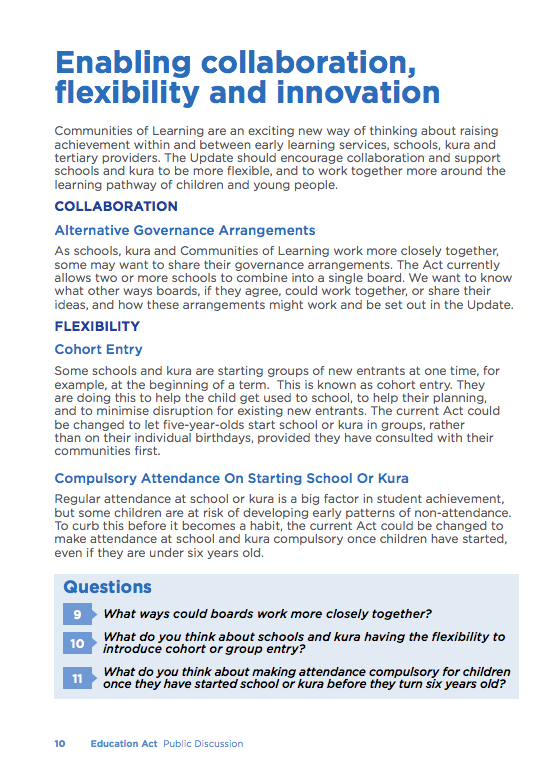
    Firstly, what does performance mean? No doubt, when the Ministry talks about performance, they mean achievement. Regardless of “better or more timely information”, parents, whanau, and the wider community can all have an active role in a child’s education. It does not have to be made into law through the Education act. It’s called parenting. It’s called raising children. It’s called childhood. A set of indicators that the change proposes are either National Standards, or a new set of KPI for schools. The suggested example of “how well students are doing” jumps up and screams “League Tables”, seeing as this is talking about reporting to parents and the community. This is public information that will be out there for everyone to see and compare, even though there is no doubt that these KPI will not show the value and worth of a school. This section goes on to include the Communities of Schools who do well will get more freedom – rewarding the “high achieving” schools once again, with more decision making rights. It then makes it clear that, in balance, poor performing schools would have such rights taken away and decisions would be made for you “if things go off track”. Which is exactly what we want as a school who’s students’ struggle, we definitely need an outsider coming in with a top down approach of “you will do better”; tongue firmly in cheek. Page 10

    Enabling Collaboration, Flexibility and Innovation

    This pare of the document just looks at the idea of Communities of Schools that the government has brought about through the IES. Under Alternative Governance Arrangements, they state that some schools who are working in a Community of Schools, “…may want to share their governance arrangements”. This is already happening with the property side of funding in some areas. Also, as is with earlier parts of this document, where it says “may want to”, it is also saying that some schools “may be forced to” share their governance. In terms of flexibility, it is interesting that the only reason why schools would be wanting to have different intakes at different parts of the year is largely to make National Standards reporting easier in Years 1 to 3. Their anniversary reports would all be at once, rather than spotted throughout the year, and it would tie in with the senior reports a lot more often. The question really is, is if your child misses out by a few weeks for the intake, they might essentially miss out on 3-6 months of schooling. What’s more, if a school down the road isn’t having intakes at set times, that family may decide to take their child elsewhere. Isn’t it already compulsory for children to attend school? What’s more, how is the Ministry going to enforce this, especially when funding for truancy officers has been cut, and the Government doesn’t want to spend any more on education? No doubt it will be one more thing that schools will have to chase up on in their own time.

    What is a “great” school?

    What makes a school great?
    How is this measured?
    There is no question, given the rest of this document, what the Minister sees as a “great school”. High achievement.

    But the word “Great” or “Greatness” surely encompasses so much more than this?
    Take for instance a local school in my area. A well recognised and renowned school, with parents and whanau driving from up to ten minutes away to send their child there. It is a decile 8 school and has about 330 students on its roll. 75% NZ/European and 17% Maori. Their ERO cycle is on a four to five year review. From the latest review it states that “Most students are achieving at or above the National Standards in reading, writing and mathematics.”
    One would say this is a great school.

    At the school I currently work at, the same can’t be said. We are about half the size, and fit in a decile 2 bracket. We have about 60% Maori students, 10% Pasifika and 20% NZ/European. We recently managed to scrape through and get a three year ERO review, which we celebrated like we just won the Rugby World Cup. Half of our students are below or well below the National Standard across all three areas.

    However, this year, both these two schools had their 50th Jubilee. Both of them started in 1965, the same time that Porirua officially became a city.
    At our school, we had close to 180 ex-students come and celebrate over the course of Labour Weekend, 2015. Old students came from all around the country, from Auckland to Timaru. We even had some fly in from overseas to come and visit their old primary school. We had a school gala which had cars parked along the street as far as the eye could see. The atmosphere was buzzing and our school was the centre of it all.

    In stark comparison, the other school had to cancel it’s celebrations due to lack of interest.

    I leave you with that question to ponder. Which is the greater school?

    Making every school and kura a great one

    Every school and every kura has to be a great one, and while most are doing well, a small number need more help to get there. Some more options could be put in the Act to help schools and kura get back on track. These could include an improvement notice, or an audit of one part of a school or kura. At the more serious end, a board could be asked to have different people on it.

    Naughty, Naughty!

    In this section, the Act turns its attention to the so-called ‘off track’ schools. The Ministry will help them get ‘back on track’, through the use of an “improvement notice” (similar to an infringement notice, I guess) or an audit (ERO visit). The serious end, the Ministry can remove a board if a school is REALLY ‘off track’, and no doubt choose (or appoint) the representatives on it.

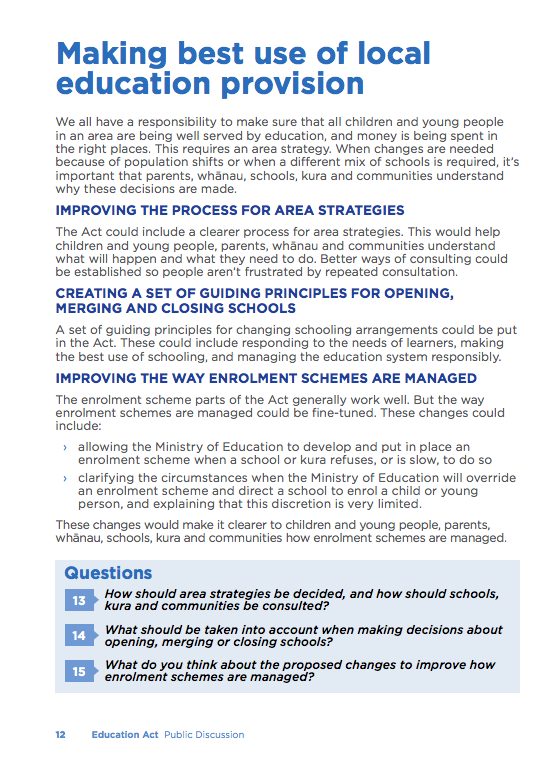
    Creating a Set of Guiding Principles for Opening, Merging and Closing Schools.

    What an interesting thing to amend within the Education Act. I wonder why this could have occurred? Maybe the Minister had too much trouble closing schools in Christchurch. Maybe she also had some difficulty merging some schools. And maybe they want to be able to open up new charter schools whenever they like. It has also made the provision for students to be forced to go to certain schools, and force certain schools to take certain students. Page 12

    In Conclusion…

    It is interesting the timing around this change. Reports are due, schools are winding down, half of the secondary schools are gone with exams, principals are drowned in end of year rollover for Novapay, and end of year activities. So it is unlikely that those who are working in the sector will have time or energy to fight the changes being proposed.

    No doubt we need to though, if we are unhappy with the proposed changes.

    Below are the details for how YOU can make a submission in answering the questions within the document.
    You need to do this. Answer, respond, challenge, debate. Talk over your ideas. The more responses they get, the more they might listen.

    Related Readings

    An easy way to make your submission is online at consultation.education.govt.nz. Here you will find an introductory video from Education Minister Hon Hekia Parata. There are questions to get you started, or you can upload a submission from your computer. You can also email your submission to education.update@education.govt.nz or write to: Education Act Update Ministry of Education PO Box 1666 Wellington 6140 New Zealand Submissions close on Monday 14 December 2015.

    PERSONAL INFORMATION AND CONFIDENTIALITY

    Submissions and documents associated with the consultation process meet the definition of official information and are therefore subject to the Official Information Act 1982. Please clearly indicate in your submission if you do not want your name to be included in any summary of submissions that we may publish.

    FURTHER INFORMATION

    If you have any questions about making a submission, or would like more information about the update of the Education Act 1989, please email education.update@education.govt.nz

  • Hekia wins the Rugby World Cup

    I saw this photo on Facebook today.

    I saw Shag’s tight grip and white knuckles not letting go of that cup and could only imagine what is going through that World Cup winning mind.

    Hekia Parata must have thought she had won the World Cup herself judging from her smile. But there is no way Steve is letting that baby go!