Tag: ministry

  • Please Restrain Me

    Seriously. The latest in Ministry bull-hockey is in full swing.

    Many teachers were somewhat perplexed at the latest heightening of the issue of restraint in schools, when the Ministry introduced a layer of bureaucracy to the issue of restraining children who were out of control in the school.  In the bulletin dated 21 August 2017, the Ministry states that

    “New rules have come into force which require schools to notify, monitor and report on the use of physical restraint.

    Schools should be, and usually are, a safe and happy place. But there are times when things risk getting out of control and someone needs to step in.

    On rare occasions a student may need to be physically restrained and new rules have now been issued to give greater clarity about when it is okay to do so.”

    Trust is a two way street, and the Ministry here demonstrates exactly the level of trust that it has in it’s teachers. Due to this, teachers are naturally cautious to this, with many thinking of where this leads. While the Ministry say that this is purely for monitoring purposes and to see if the school needs help in managing the behaviour at the school, many teachers are much more cynical, and can see this leading to sanctions on individual teachers who restrain too often, or repercussions to schools who are required to restrain on a regular basis. What’s more, the chances of legal procedures also looms in minds around the country.

    Which is why now, teachers more than ever are hesitant, and on occasion flat out refuse to restrain children, even when student safety is in question. The hassle of filling out the form is one reason for ignoring it, but the process behind the form, and the repercussions it could lead to are much bigger deterrents.

    Of course, the first question on many of our lips was – “What constitutes restraint?”

    The bulletin listed some examples for us, to give us an idea:

    “The legislation says that a teacher or authorised staff member can use physical restraint if he or she reasonably believes that there is a serious and imminent risk to the safety of the student or others, and the physical restraint must be reasonable and proportionate in the circumstances. Situations where it may be appropriate include:

    • Breaking up a fight

    • Stopping a student from moving in with a weapon

    • Stopping a student who is throwing furniture close to others who could be injured

    • Preventing a student from running onto a road.”

    Suddenly, separating two students who are throwing haymakers (an activity that happens at least once a month, if not once a week in some schools) now requires a teacher to fill out a form and report to the Ministry. A copy also goes to their Board of Trustees. An interview (usually by phone) also occurs after the form is submitted.

    So what about if I have to remove a child from class because they refuse to follow my instructions and are disrupting the class? Another form. Another interview. But is it restraint?

    So naturally, schools began asking the Ministry these questions, hoping to seek some clarification around the new laws that were put in place. Somewhat expectedly, the MoE had no answers. They fumbled around and provided comments that amounted to not much more than “We don’t know”.

    Surely they had a plan in place? Surely they could foresee that there would need to be some clarification for those on the front line as they ducked and dodged the furniture being thrown at them?

    Hastily, they put together an all encompassing workshop: “Understanding Behaviour, Responding Safely” or UBRS for short.

    I had the privilege of going to one of these courses today.

    What an absolute joke. Bordering on pathetic.

    The whole basis for the workshop was “Minimising the use of Restraint”. This says one thing; that we (MoE), think all teachers use restraint as step one in our behaviour plan. The majority of the course discussed and elaborated and explained all the ins and outs of managing behaviour, providing safe learning spaces, and building relationships with the children – once again assuming that teachers do not already do all of this.

    Seriously.

    In a room full of teachers, all of whom are wondering what is considered restraint, what isn’t considered restraint, when do I have to fill out the form and when do I not, and some safe and un-harmful ways to restrain children in a suitable way.

    Instead, this question (which was raised in the first five minutes of the workshop) got shut down and dismissed, as “we are looking at ways you can deal with the behaviour before it escalates”.

    Pathetic.

    To assume that teacher’s don’t already do all of that in their class; that they don’t get to know their students, work out what triggers students, work along students to de-escalate conflict, and do everything in their power to NOT get to a point where a student flies out of control, was nothing more than belittling and patronising.

    Yet this is what is being rolled out.

    We were even told that this wasn’t really even designed to be used at this level, and wasn’t about dealing with restraint. Yet on the Ministry website, it is made quite clear on their “Support for schools to manage challenging student behaviour” page which mentions restraint, that the training provided is “The Understanding Behaviour, Responding Safely (UBRS), workshop…” and “…is delivered in modules for whole school staff groups focusing on prevention and de-escalation strategies.”

    It does not mention anything about restraint, which the new laws are about, and are what teachers are actually concerned about, as opposed to managing behaviour focussed on prevention and de-escalation.

    What a joke.

    Look; Teacher’s aren’t walking about looking for kids to restrain. We aren’t going around antagonising and riling up students until they’re out of control and we need to drag them over to the school office.

    But if you’re going to make a “No restraint” rule, but make the exception for certain circumstances, then you’re going to have to do some work with those that are affected, namely teachers, on what those circumstances are, and safe ways (for the student AND the teacher) to carry out any kind of restraint IN CASE it is necessary.

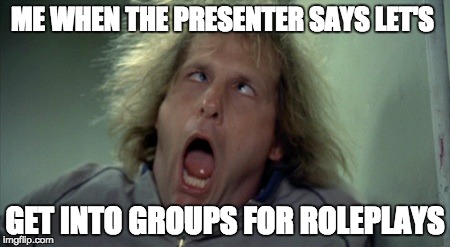
    P.S. Please, please, please; if you’re running an ADULT’s workshop, do not expect us to a) work effectively in groups with strangers and b) do roleplays.


  • Primary schools to measure student progress

    In response to https://beehive.govt.nz/release/primary-schools-measure-student-progress – August 26, 2017.

    Measure. Measure. Measure. Weigh. Weigh. Weigh. Data. Data. Data.

    “The Government has made a decision to shift towards a system that measures student progress, alongside National Standards / Ngā Whanaketanga Rumaki Māori, to help ensure every student gets the support they need to achieve…
    Monitoring student progress gives teachers more data on which to tailor learning plans for their students – and we want to roll this out to all primary schools and kura.”

    says Education Minister Nikki Kaye.

    More data. More weighing. More testing. More assessment.

    Guess what. Teacher’s already monitor progress. I can show you the progress each of my students are making (or not making) in each of the three big subjects that now dominate the New Zealand Curriculum. Obviously not enough though.

    “Measuring progression means teachers will be able to see how far children have come in the specific learning areas that make up National Standards.”

    In some regards, it is good that the Minister has acknowledged what teachers have been saying for a while. Some students make incredible progress within a year, but are still below or well below the expected standard set by the Standards.

    “The change also reflects the education sector’s observation that we don’t adequately show a student’s progress over time, particularly for students who may be below the standard, and this will help address that.”

    This is all well and good, but as schools have come to know through the berading from ERO and senior advisers, progress don’t mean jack when it comes to achievement, which is all ‘the Ministry’ and ERO actually care about. 85% At or Above. 85%. 85%. 85%.

    Ultimately however, this will actually just lead to the mandatory use of PaCT.

    To support teachers the Ministry of Education has developed progress tools, such as Learning Progression Frameworks, the Progress and Consistency Tool and Whakatupuranga, that help show how children are doing and how they can progress. These have been developed in a number of areas including reading, writing, maths and digital technologies.

    The Government wants to roll out tools like these to all primary schools and kura as evidence shows they deliver real benefits for teachers and kaiako, by streamlining paperwork and reducing their reporting workload.

    There has been copious amounts written about PaCT and it’s potential. Just have a look at the following

    Education continues down this reform, with National determined on making National Standards legitimate.


  • Inherit Racism in NZ Education

    Time and time again, we are told about the ‘long tail of underachievement’ and the hideously stereotyped over representation of Māori students within it.

    And because there is a ‘problem’, it seems that everyone is solely focussed on the achievement rates of Māori students. Ministry advisors visit principals and ask how their Māori target students are doing.
    Upon visiting ERO’s website, we see that they have a new approach for accelerating Māori achievement. Their major focus on any school they visit now is ‘How effectively does this school respond to Māori students whose learning and achievement needs acceleration?’
    In addition to this, we’ve heard from the Auditor-General that the supposed answer is more data on Māori students. All of this in an attempt to address the ‘problem’.

    It amuses me that ERO state that their reason  for targeting Māori student achievement is in an attempt to achieve ‘…equity and excellence of education outcomes for all New Zealand’s children and young people.’
    In other words; by targeting and singling out the failing Māori students, we are making schools more equitable for all students.

    This itself is incredibly insulting, and does nothing but reinforce the already very presumptive notion that Māori students are failing, as well as implies that Māori students are not intelligent, and aren’t achieving.

    What began me thinking about this was this video. It is a reaction towards the racial unrest happening in the US today.

    https://www.youtube.com/watch?v=sj19qIgkJUs

    It was very eye opening for me, especially when she says that there is only one race, and that is the human race. Races are just a construct that people have made to  over others.

    For years, ever since entering the classroom, I have rarely ‘seen’ the colour of my students. Obviously, some are white, like me, and others are brown; being Maori, Samoan, or other ethnicity where the pigment levels are higher than my own. But internally, in the way that I treat students, in the way I talk to them about their learning, their behaviour, their life; the colour of their skin has not even come into my consciousness. Interestingly, as I reflect on this fact – the students themselves don’t distinguish between being Māori, European, or Pasifika. They’re friends with whoever they want to be friends with; they work with whoever they want to.

    However, I’ve been made to feel bad about this. Evidently, by not noticing the colour of their skin, I am not addressing THEIR needs as a Māori student; even though I am treating them on an equal and level playing field as the many other students in my class. 

    Jane Elliot (of the prior video) illustrates why we should not say “we don’t see colour”. She has two people from a group come to the front, one white female, one black male, and asks what is the first difference the group notice. Someone says “male”, and Elliot asks if being a male is important to the man at the front. He responds appropriately. She asks if he would want others to see him as male. “Of course” he says. The next difference is his skin colour. “Is being black important to you” Elliot asks. 

    “Very important” he states.

    “And do you want others to see you as black?” 

    “Absolutely”. 

    It’s a part of who that man is. It makes up his identity; it’s part of his story of who he is, and he would want it to be valued by others just as he values it.

    We should absolutely see colour and value it as a factor in what makes up an individual’s identity; but that should have no bearing on the way that we treat them.

    Each child has their own culture, background, family situation, background, living environment, demographic, and world view (even if that has been constructed mostly by their parents and whanau at their age). Each child has their strengths, each child has their weaknesses. Being good at Mathematics, or succeeding in Reading, or creating amazing work in Writing has little to do with the colour of their skin or their whakapapa (genealogy), just as it has nothing to do with being right or left handed, which gender you are, or if you have blue or brown eyes. Intelligence, or educational achievement is not determined by the level of pigmentation that students are born with.

    No doubt; being of Māori descent has a lot more to do with a person than the colour of their skin; just as having Irish, Japanese, or African origins would as well. We’ve been told to “help Māori achieve as Māori“, and there has been endless discussion as to what this means, and what it looks like in the classroom. In a nutshell, teachers need to ensure that each child is valued for their culture. In particular, this statement refers to our Māori students. However, it is my belief that teachers already are doing this – certainly all the ones I have been in contact with over the years. Valuing a student’s culture, and treating them as important is completely independent of their intelligence or educational achievement. No matter the ethnicity, there is no evidence to suggest that a person’s culture or ethnicity has anything to do with their level of intelligence. There’s no evidence, because it simply does not exist.

    Of the many classes I’ve taught, there have been many, many students who have succeeded. Many, many of my best students (in academic regards, as well as all-round individuals) have been Māori, and despite the ongoing stereotype that they ‘should’ be struggling, have left other students, some Māori, some non-Māori, in their wake. In addition to this, many, many of my students have fallen short of the farcical ‘National’ ‘Standards’ level for their year group. Many of these students have not been Māori, and many have been girls – even though the presumption is that those that struggle most are Māori boys. Many of the best students in my class have had blue eyes, and some have had brown. Others have been left handed. And all of them have had some other random categorical anomaly that we could use to put them in a box.

    It wasn’t that long ago when children attending school were discouraged heavily from using their left hand to work. Starting back in the middle ages, left handers were believed to be of the devil, and “…discriminatory practices and attitudes against left-handers persisted well into the 20th Century. At mid-century, eminent American psychoanalyst Abram Blau was still suggesting that left-handedness was merely due to perversity and the result of emotional negativism, on a par with a child’s obstinate refusal to eat everything on its plate.”

    Yet now, it would seem completely ludicrous to begin collecting data on left handed students and pouring over their academic results in an attempt to prove or disprove their academic ability. Likewise, if blue eyed students were disproportionately making up the ‘long tail of underachievement’, then you would say that it would be a complete waste of time to begin targeting these students, over-testing them, collecting and analysing data to see what kind of teaching is going to best suit students with blue eyes. These two examples both seem ludicrous because a) they are, and b) we KNOW (or assume) that neither left-handedness or iris melanin levels have anything to do with a person’s academic potential or ability.

    maxresdefault

    So what is the solution? Well, if you can answer that, then you could probably make yourself quite a bit of money.

    All I know is that there are a myriad of things that allow students to achieve well academically.

    • Sometimes it may be their ability to focus and remain on a task.
    • Sometimes it may be their ability to retain information, whether from visual (pictorial, or words), aural, or kinesthetic.
    • Sometimes it may be the support they get at home to assist with their learning, or the development and engagement they get from adults in the household.
    • Sometimes it may be their ability to overcome distractions, health issues, or learning difficulties.
    • Sometimes it may be the amount of food they have to eat each day.
    • Sometimes it may be their ability to deal with stress, depression, or other mental struggles.
    • Sometimes it may be their ability to lead others, or work with others in collaborative ways.
    • Sometimes it may be their ability to use their own experiences to inform and make their  learning personal to them.
    • Sometimes it may be the importance or priority that education has in their family.

    Very few of these have anything to do with ethnicity. Regardless if you are left handed, blue eyed, Māori, Samoan, Irish, Japanese, African, or European, your ability to have academic success is largely based on things other than your culture or ethnicity.

    But most importantly, let’s abandon this construct of race. Regardless of who you are in New Zealand, we cannot change the past. Yes, there have been some atrocities carried out by the European’s upon arrival and colonisation – but none of them are alive today. Likewise, those that these acts were carried out against are no longer with us. Instead, it’s about time we begin moving on as one nation – together.  We are New Zealanders. We live in Aotearoa. We’re in this boat together.
    We cannot keep separating ourselves, and we cannot keep ‘targeting’ Māori students because they’re susceptible to failing. That merely provides and enables the box to keep them in – the very box we are trying to get them out of! It puts Māori in an inferior place – even if only subconsciously – and keeps them there by continuing to revisit, deliberate, collect data, analyse and otherwise pull apart every aspect of any test students sit. Instead, we need to see each student as individuals. If they need help academically, we provide them with the skills they need to hopefully succeed, regardless of their race. We value students of any nationality, ethnicity, culture, or eye colour. We consider this as an important part of each child’s character, and we use it to their advantage wherever possible. We ‘target’ the students who need help, and we celebrate the success of students, regardless of their gender, ethnicity, and eye colour.

    This essentially gets rid of the box.

    This essentially creates “…equity and excellence of education outcomes for all New Zealand’s children and young people.”

    Ki te kotahi te kakaho ka whati, Ki te kapuia e kore e whati

    Alone we can be broken. Standing together, we are invincible.


    Please note; as I write this, I want to maintain a very independent view. However, being of NZ/European descent, I have a certain point of view which may be different to others. I do not wish to speak for Māori when I say ‘get rid of the box’ – though I would very much assume that Māori wouldn’t want that box anyway!

    In all seriousness though, I cannot and will not speak for all people, and the views I share are my own. I am not an advocate for racism and sincerely hope that none of my statements have caused offense in regards to race. I am also not an advocate for ‘anti-racism’ or ‘reverse racism’, such as being annoyed or disgruntled at the priority placed on Māori students and not students of other ethnicities. Such a view is not helpful and shows a distinct lack of understanding of key issues relating to race and ethnicity prejudice.
    The statement of ‘Māori achieving as Māori’ has very much been difficult for me to get my head around over the years. This is mostly because I don’t see the relevance of defining a person’s culture with anything related to achievement.

    Please comment below, or get in touch with me if you would like to discuss any of the points raised, or to put me right in any of my statements.


  • How Teachers See Children

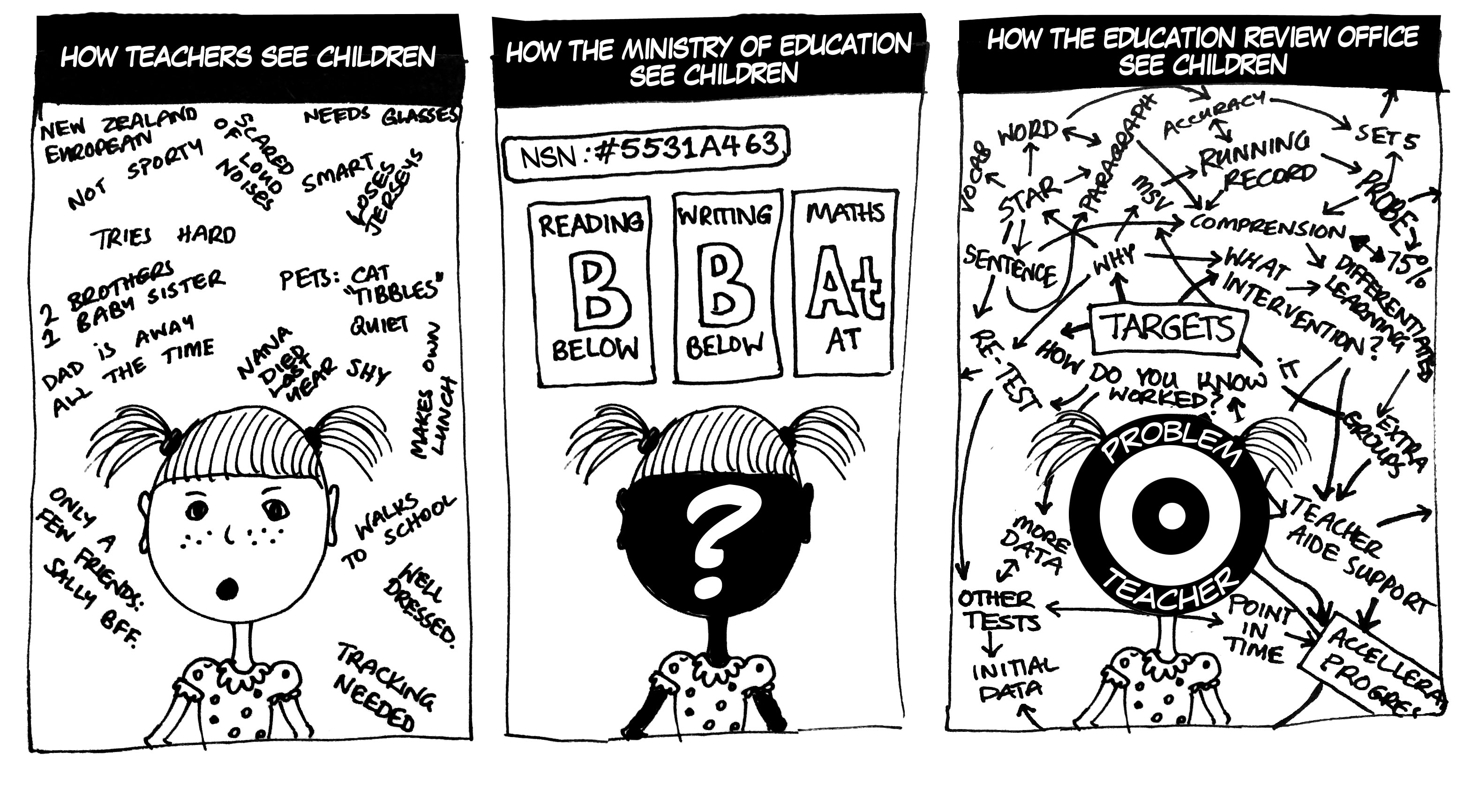
    I was thinking today about the different professional views on how we should be seeing children, and how completely different that is from any kind of reality that actually faces us in the classroom.

    The only way to try and illustrate that, is in picture form.