Tag: poverty

  • Tomorrow Schools and the Equity Gap

    It’s interesting to see that word “review” and “reform” getting bandied about.

    At one point, reform was an issue as we fought off “GERM”…

    Now, a review is taking place of our school system, and some suggestions being made, and suddenly those that may have been encouraging GERM are now questioning this review.

    The main objection to the review is stemming from the education elite; those sizeable schools who have clawed in students and money and status through whatever means possible. The bigger the school, the more influence you’re seen to have, as the more students you have, the more parents you have, and usually, the more chances of having very rich or important parents. The sphere of influence grows and it becomes all about who you know, not what you know.

    Take the article They’ve Seen the Future for instance; Martin Thrupp has some very good points that he makes in the article. He says…

    “It is a kind of view that runs through New Zealand society; this great concern about inequality, poverty and so on, but at the same time people who are on the advantaged side of it don’t necessarily want to share their resources.

    “Because of that, we do see principals of high socio-economic schools not particularly supportive of redistribution efforts and greater equity funding for low socio-economic schools.”

    He goes on to say that parents are the same, clustering together to improve their status, keeping up with the joneses, purchasing houses in specific zones (Look at the marketing done in the season of the Block where one house was in zone for a particular Auckland school). They work together to all jostle for position, and not only demand, but provide resources to ensure, that their child gets the best possible education. This carries on at home.
    Thrupp says that this doesn’t always happen in low-socio economic communities.

    We see what money means to those schools as well.

    Wellington College Principal says that with the donations his school receives, he is able… “to make decisions around overstaffing, to pay for a teacher’s salary beyond the [roll-related] staffing. It’s enabled us to sometimes have smaller classes, start new subjects, retain high-quality staff.”

    Now, that’s all well and good, and a great luxury to have. But there is always another side of the coin.

    This kind of luxury is simply not available to schools in low socio-economic  areas – places where smaller classes and decisions on overstaffing would be very much beneficial. These schools have high-quality staff, but they often get burnt out managing classes of 30+ pupils, or leave for greener pastures at schools that might be able to offer smaller classes, better resourcing, or other incentives for them. Needless to say, this also means that any high quality staff these schools have, won’t have the same effectiveness due to their larger class sizes. I don’t really care for what Hattie’s research (however bogus or biased it is) says about class size; if you take a great teacher and put them in front of 30 students, and then put them in front of 20 students, they are going to have better success (not to mention overall better well-being) in the class of 20 students.

    Okay. Time for some maths.

    In the article, it states that Wellington College received $5.7 million in donations in 2017, the most for any school. It’s roll is around 1750 students.

    So taking that $5.7million, and calculating how much that amounts per student, we end up with a figure of $3,257 per student. PER STUDENT.

    I can guarantee, that is more for one student than most schools receive in donations for their whole school. Add to that the notion that the Government suggested during their election run that they would subsidise schools $150 per student if they dropped their school donations for parents. This has yet to happen, but I know of several schools that have waived asking for school donations from their communities, because of this, but also because they know the burden it puts on some of their families.

    Three and a quarter thousand dollars per student is a long way from a mythical $150.

    No wonder these schools don’t want the review suggestions to be implemented.

    I wonder what would happen if, just for a week, those principals in the lofty heights of the wealth and famous, got to see the otherside of the coin, and got to see that we are all here for one reason – to educate our young people, and begin seeing this as a New Zealand wide system rather than just from their ivory insulated tower. Maybe, just maybe, they’d see things in a different light, and hopefully be able to see the disparity that exists and that this taskforce are trying to address.

    How can education in New Zealand provide the same opportunities for every child when there is such a massive gap between the rich and privileged and the rest who are doing the best they can with what they’ve got?


    Original Article: https://www.stuff.co.nz/national/education/110421061/theyve-seen-future–its-not-tomorrows-schools


  • Kiwi kids are missing school rather than turn up with no lunch | Stuff.co.nz

    Children around the country are missing school rather than turn up with no lunch, because their families feel ashamed.

    People who work with food banks and schools say the problem has widened from beneficiaries to low-income families in which both parents work, sometimes more than one job, and still struggle to pay the bills.

    Representatives of the Salvation Army, Child Poverty Action Group, Public Health Association, KidsCan and NZ Educational Institute were all aware of children being kept at home by caregivers rather than go to school with no lunch.

    Jeni Cartwright of the Child Poverty Action Group says there is no reporting on the numbers of children who miss school days because they don’t have lunch, but the CPAG research paper Hunger for Learning described it as “common”.

    A Salvation Army spokesman says that when families are struggling to pay bills, the food shop is one of the first things to be trimmed.

    Every day families ask the Salvation Army’s Hamilton food bank for lunch box basics, such as muesli bars and bread, that children can take to school.

    KidsCan provides food for close to 30,000 children at decile 1 to 4 primary, intermediate and high schools each week. Chief executive Julie Chapman says the charity serves 675 schools and there are 40 more on the waiting list.

    Around 22 percent of the children at those schools would go hungry at some point during the week, up from 11 percent in 2011, she says.

    Read full article here.

  • Killing Cortisol: What if Education and Poverty aren’t to blame?

    Over the last year and a half, I have been thinking on this, ever since being introduced to the stress hormone cortisol. 
    As always, I looked for a different way of presenting what I found out, and what I think could be a game changer in education - if anyone will listen. 
    It is always quite scary and nerve racking being at the forefront of anything new. Essentially what I need are a few more knowledgeable people in the area of brain chemistry, learning, child development, and stress disorders, to confirm that what I have is legitimate, and will make a difference.
    At this stage, it is merely speculation. It is paper proof - but now it needs to be put into action, which requires a big step of faith.
    Either which way, here is my inquiry into the stress hormone cortisol and the effect it has on our children, especially the impact it has on those attending low decile schools, and why those of lower socio-economic areas generally have lower achievement rates.
    
    Enjoy! 
    <iframe width="800" height="11208" frameborder="0" scrolling="no" style="overflow-y:hidden;" src="https://magic.piktochart.com/embed/21674759-kicking-cortisol"></iframe>
  • Prison Beds or Educated Society

    Two point five billion dollars.

    $2.5 billion dollars.

    $2,500,000,000.00

    That’s a lot of dollar coins.

    Let me tell you what they will spend it on.

    No. Not fixing the poverty problem sweeping the country. No. Not assisting children living in impoverished situations. No. Not sorting out the public health situation with junior doctors striking today. No. Not addressing the lack of funding in mental health with suicide prevention and support.

    So, after earlier this week scrutinising that crime is caused by poverty, rather than address the poverty situation that is staring everyone in the face (and not likely to go away just because you keep staring back), Judith Collins and her cronies announce that $1 billion of that cash injection will be used to create living arrangements for an additional 1800 inmates.

    To put those numbers into perspective; that’s $555,555.55 per bed. Five hundred and fifty five and a half THOUSAND dollars per room with a bed and a pan. To contain another criminal.

    Backwards

    For me, it’s non-sensical. It’s backwards. It’s purely responsive, rather than proactive.

    EVERY piece of research out there suggests that there is strong links between poverty and crime, as well as, education and crime. Surely (or is it just me) crime PREVENTION is a better use of money than catering for an increase of criminals into the system?

    You can’t prevent crime; but with strong links between poverty, education and the outcome of crime, then surely dealing with poverty and education is where the focus needs to be?

    If you are educated, then you know to read and write, you’re more likely to be able to get a job, you are more likely to be able to hold down a job, and the less likely you are to find yourself needing to get into trouble.

    And I’m not even an expert in the field. I haven’t had to research this. It is pure, bloody common sense. and logical thinking.

    There are currently 9,798 inmates in the current corrections system (Sept 2016).

    Let’s divide that spending out per inmate (I’ll even include the additional 1,800 inmates that these extra beds will allow for!)

    $2,500,000,000 / 11,598 = $215,554.40NZD per inmate

    Now, that is spread out over ‘about 5 years’.

    $215,554.40 / 5 = $43,110.88NZD per inmate, per year.

    That’s an ADDITIONAL forty three thousand dollars per inmate each year for the next five years, including the extra 1,800 inmates that they are supposedly catering for.

    Currently, in education, spending on each student is $7,046.00.

    Let’s see those numbers next to each other.

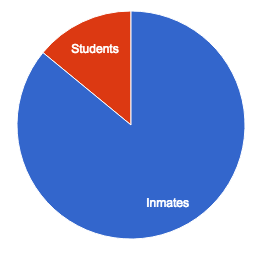
    Inmates Students
    $43,110 $7,046

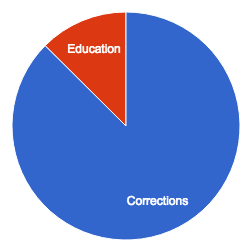
    What an absolute joke. Remember, the blue area in the graphs is what the corrections system is getting ON TOP OF the additional funding provided in the current budget already.

    Earlier in 2015, the Government announced a generous $359 million boost into the Education sector, but in a very restrictive way of schools being cajoled into CoL’s (Communities of Learning). To compare this with the $2.5 billion it’s just embarrassing. Here’s the graph for that as a comparison between what the Government is prepared to spend as ‘extra’. As a picture, it’s ridiculously similar to the current funding for students compared with the additional funding Corrections is getting.
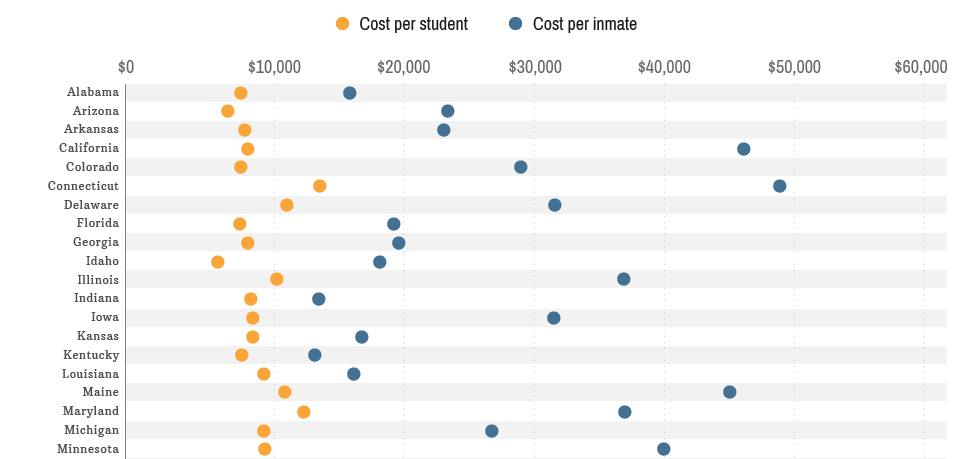


    United States has this problem: Not one State spends more on student education than it does for incarceration.

    Source: http://money.cnn.com/infographic/economy/education-vs-prison-costs/


    Now; don’t get me wrong. I am not here for a second suggesting that corrections does not need support; nor am I saying anything about how or where they spend their money. They have a job to do, and certain criminals do need “restricting in their day-to-day activities”, but lets start to look at solutions for the problem, rather than just catering for it.

    Let’s buy sunscreen rather than melanoma treatments.

    Let’s fix the hole in the bucket rather than filling it up time and time again.

    Let’s put a fence at the top of the cliff rather than an ambulance at the bottom.

    Let’s start investing in children, the next generation, the education of people, poverty, and homelessness rather than catering for the criminals that they will likely become because we continue to ignore the impact education and poverty are having on society today.

  • No to League Tables

    “Have we introduced league tables? No.” Hekia Parata said this in a meeting at a school as she rattled off a number of things ‘scaremongers’ had said would happen in regards to GERM. This included things like Performance Pay. This statement on league tables is also in addition to this article from 2012.

    League tables: Hekia won’t take on teachers

    Obviously however, John Key wants them; and so he gets the media to do the dirty work, even encouraging them to do so in the aforementioned article.

    And respond they did. Whilst Fairfax’s “School Report” has been out for a while now, it is now being advertised, with words like ‘rate’, and ‘compare’ being bandied about like red paint on a fire engine.

    Why are teachers and schools so against league tables?

    David Shearer (Labour Leader at the time) touched on a few of the concerns in the earlier article. It goes further than just what he addressed though.

    Take a small school. Decile 1 or 2. Even 3. Lots of poverty in its community. Health issues due to poor living conditions, damp houses and cold, harsh nights in the middle of winter. Families split, both parents working full time to break even. The kids love the school.

    The teachers work hard. They’re trained. They undertake PLD. They genuinely care and want the best for the kids; not just the ones in their class, but all tamariki that come through their gates. There are major success stories, but are generally few and far between.

    The teachers are good teachers. Children who have started life on the back foot and who are facing continual struggle in life are making amazing progress each year, but are still “below” the untrialled and untested National Standards that this government hangs its hat on. The children wouldn’t make the same progress if the teachers weren’t any good.

    But along comes Fairfax media and their “School Report”. It shows that this school is ‘failing’ compared with School B down the road (who may or may not be inflating their National Standards results). Their teachers may be good, but also might have a community where students aren’t walking down struggle street, and achieving at school is the number one priority. The amount of progress that they have to make is minimal in comparison, and their teaching staff may be able to relax and not work as hard in order to maintain certain results.

    Parents of the first school compare and begin to buy into the league table problem. They leave school A with its hard working teachers, whose progress and dedication to their students is unrivalled, yet don’t show up in the broad umbrella of “below”, and go to greener pastures.

    School A loses students. The roll decreases. They lose a classroom and a teaching position. Eventually another leaves, and another. The school gets smaller, and the results don’t change, to the point where it is forced to merge or become one of the government’s heralded Charter Schools.

    This is why league tables are dangerous. They compare apples with shackles, oranges with hairties. They force assumption that schools with poor results have bad teachers, when quite often the opposite is true. A lot of teachers would simple cave under pressure, give up, or be eaten alive in School A with the requirements of it’s akonga. They would equally struggle to not only raise the achievement level, but just maintain it.

    So when I see an advertisement to compare schools while I’m reading the latest news, I get annoyed. Frustrated. Because I am a good teacher. I work hard for my students and my students work hard for me. They are a challenge, but the hard work brings reward. They make phenomenal progress each year while they are in the shadows of elephants in the room that no one wants to acknowledge; but these improvements, no matter how amazing, fail to show up in a simple pie graph showing banded results. Some of these students will go from a reading age of 5 and a half, to a reading age of 7; yet because they are 8, are still below.

    The public compares schools. School A must be rubbish, with dead-beat teachers. I don’t want my child going there.

    Thanks Fairfax. I’m sure John Key appreciates the dirty work you’ve gone and done for him.


  • The True Cost of Charter Schools

    Its time to face some facts here. There is something terribly wrong with the current government’s focus for its funding, especially when it comes to education.

    I decided to do some comparisons on money spent (or not spent) and see if any of it makes sense. I wanted to compare the budget they approve for some initiatives, and deny for others. In particular, the comparison between keeping charter schools open, verses the Feed the Kids bill that was denied in March earlier this year.

    Embattled Charter School

    At the end of July, the Minister announced that she would keep a failing charter school open, even though she stated it would face closure, and even though clear evidence showed inappropriate use of funds and suspicious achievement results.

    “The Ministry of Education has directed a Northland charter school to replace its current principal with someone more “appropriate and experienced” or face closure. The beleaguered Te Pūmanawa o Te Wairua School in Whangaruru opened last year at a cost of $3million and has suffered a falling roll, truancy and low achievement levels in the year since.” – Feb 2015 – Māori TV

    Previously the Government could only confirm it would negotiate with the trust should it close. The Northern Advocate can reveal $4.4million has been spent on the kura, which opened last year, including a recent one-off payment of $129,000 to help remedy the ongoing issues. – July 2015 – Northern Advocate

    By keeping the school open, the ongoing cost of this school will have reached astronomical figures. By the end of this year, the cost of the school on the government will have surpassed $5.2million. It is important to note that this is the cost from its opening in 2014.
    The cost of this school to the government for it to remain open each year is only a mere $1.65million.

    There are 39 students at Te Pumanawa o te Wairua.

    That’s a cost of $42,271 per student each year (assuming the roll remains at 39).

    Feed the Kids Bill

    Let’s compare this cost with a recent bill that has been defeated by a mere 2 votes. This bill was nicknamed  the “Feed the Kids Bill”. It sought to provide breakfast and lunch for every student in Decile 1 and 2 schools across the country.

    Mrs Turei said the National-led Government is failing New Zealand children, as more are going without food than ever before.

    “They are funding some programmes, but not enough, so they accept that there’s a problem, why won’t they fix it?

    “It’s not that expensive either, it costs something between $10 million and $14 million to feed every hungry kid, every day in their school. What’s so hard about that?” – 19 March – Radio NZ

    Education Counts lists the July 2014 roll returns, which shows that the number of students in Decile 1 and 2 schools across the country; some 111,069 pupils.

    Doing some quick maths, I’ve worked out that using Mrs Turei higher estimate of $14 million, when spit among the number of students in Decile 1 and 2 schools, comes out at a staggering $120.

    One hundred and twenty dollars and five cents.

    That doesn’t sound right.

    According to FeedtheKids.org.nz, the full cost of the programme would be $100 million a year – including food, staffing, administration, monitoring and evaluation. That sounds a lot more than $14 million, but the reality is, that not every child at decile one and two schools will need breakfast or lunch. At the school I work out, I’d say close to 85% of the students come with suitable lunch each day. The 15% that don’t, would benefit from this service. This also works out with Mrs Turei says around the $14 million mark, being that it is 15% of the stated $100 million on the Feed the Kids website.

    Regardless, I did a little bit more maths calculations, and using the $100 million as the figures, the cost per student is a whopping $900.34

    Nine hundred and thirty four cents.

    Let’s just compare that to the one charter school that is being kept open for 39 students.

    Charter School: $42,271 per student
    Feeding Kids   :      $900 per student

    That simply cannot be right. Can it?

    Oh wait. Of course! The $900 per student is on top of their education cost, where as the $42,271 is the cost of their entire education for the year. We will have to account for the decile one and two student’s education.

    Taking an average decile two school, such as the one I currently work at, our figures per student work out at approximately $6,884.61 per student. Add on $900 to that, takes it to $7,784.61.

    Comparing this to the forty two thousand, two hundred and seventy one dollars spent per student at the embattled charter school, it puts some clear messages out there as to what is fair, what is equal, and what is right out there. It also shows us exactly where the focus is for this government – and it’s not for those that are struggling.

    What’s more concerning is that this is just one charter school. There are more in the pipeline. More that will take money away from the kids who, through no fault of their own, are going hungry this year.