Tag: school

  • Learning Starts with Showing Up

    Learning Starts with Showing Up

    Learning starts with showing up.

    That is until you understand how completely disheartening and wrong it is as a teacher and/or school admin to notify parents that their child has been away from school for ‘x’ number of days… and ask them if there’s anything you can do to support them back into the classroom, even though you are fully aware that the child is away from school because they are sick, or are bereaving the loss of a loved one in another part of the country.

    The current policy requires schools to notify parents at certain points of non-attendance. If the student has been away for 5 days of the term, they get their first notification from the teacher to inform them that they will no longer meet the 90% attendance rate.

    And why is notification such a big issue? It’s not.
    But it’s how it looks. It’s how it feels. And it’s also what it leads to.
    Because how it looks when a teacher emails a notification to a family while they are up north at tangi saying their child has now been away from school for 5 or more days is heartless. And what it leads to, eventually with enough days off, is prosecution.

    The issue is that this notification happens regardless of why that student might be away, and whether that reason is justified or not. The policy simply looks at one metric – are they at school or not?

    A child who is sick? Away from school. Counts towards notification
    A family away for bereavement in the family? Away from school. Counts towards notification.
    A child wags school? Away from school. Counts towards notification.

    Now don’t get me wrong. One of these situations absolutely needs to be addressed, followed up on, and should lead to prosecution if it is chronic. I don’t think you’ll find a single teacher who would argue against that. The others should absolutely not be put in that same category.


  • Understanding the Teacher Crisis

    The Side Eye: Everything to Everyone – understanding the teacher crisis:

    A unique take on the Teacher Crisis put into a visual narrative succinctly and accurately by Toby Morris.

    Be sure to check it out over at The Spinoff – The Side Eye.

    For the rest of the story, please head over to the original article here.

    https://thespinoff.co.nz/society/the-side-eye/03-12-2018/the-side-eye-everything-to-everyone-understanding-the-teacher-crisis/?fbclid=IwAR04F0_Wj102NUYIFSY1Th7SJhbX99I83ZLJJwidKkSEwdKfAnvlkLkycqY

  • Principal views on parenting and schooling

    This has been an issue that I believe is one of the biggest shifts in society in the last 20 years. As parents get so wrapped up in their own lives, their career, their jobs, the things they love to do, children get left by the wayside. They become an afterthought, a burden, even an inconvenience to some parents continuing their self absorbed lives.

    Don’t get me wrong. This is certainly not all parents, and not all children. But increasingly so, there are so many things that schools are picking up the slack on that traditionally have been parents and families roles. This puts additional pressures on schools, teachers, staff, resourcing and funding that are far in a way more than should be expected under the umbrella of ‘education’.

    Parents are the first teachers.

    Unfortunately, there are an increasing number who leave the basics up to the school to do. We’ve heard reports of children turning up to school in nappies and are not toilet trained, let alone know the alphabet or numbers. We’ve heard in the news lately how parents are expecting teachers to teach about social etiquette, social skills, and other things that have traditionally been the role of society.

    Original article: Principal bemoans threats to schools

    A Dunedin school principal is  increasingly  concerned  by the  social expectations imposed on schools,  and says some parents need to take more responsibility for their children’s actions.

    During the recent King’s High School senior prizegiving, rector Dan Reddiex praised his present cohort of pupils for their outstanding achievements  during the year, but went on to express deep concern about the future of education in New Zealand.

    He said the school’s ability to educate boys “in mind and in heart” was under threat.

    “Alarmingly, in my view, we are increasingly becoming as much a social institution as we are an educational one.

    “The expectations imposed upon us now as a school, to attend to and reverse the ills of our society, are completely unrealistic and they are beyond our resource capability.

    “It seems now, the first questions about the inappropriate text message sent by a school-age person in the weekend, or the under-age young person attending a party that goes wrong, are not ‘what were the parents thinking and what will the parents do about it’?

    “The first questions now are ‘what school does the young person go to and what is the school going to do about it’? And we’ve seen that in the national media this year…

    “I believe it’s not our parent body who thrust these expectations upon us. It’s the media and it’s increasingly a broader societal expectation.”

    Mr Reddiex said the lines of demarcation between parental and school responsibility and accountability had been “completely obliterated”.

    Following the prizegiving, he told the Otago Daily Times there was an expectation that schools would, in part, fulfil the function that historically had been the role of a parent.

    “The vast majority of parents are doing a fantastic job, but there are some who need to take more responsibility for their child’s behaviour.”

    Otago Secondary Principals’ Association secretary Gordon Wilson said it was a widespread issue.

    “Schools are under increasing pressure to help the community solve some of its issues, and often schools are seen as the last place where some of these issues can be addressed.

    “That’s not where schools should be. A lot of these issues that schools are being asked to deal with are not internal issues. They are issues that have arisen from outside the school.”

    Read more.

    Source: https://www.odt.co.nz/news/dunedin/principal-bemoans-threats-schools

  • School funding not always linked to results

    Investing in education is one of the most promising ways for countries to secure their future.

    And yet, there is a surprisingly tenuous relationship between the amount of money spent per student and the results of international Pisa tests, at least when comparing relatively wealthy nations.

    South Korea is one of the highest-performing OECD countries, but spends well below the average per-student expenditure.

    Students in Poland, which spends around $68,000 (£52,000) per student between the age of six and 15, perform at the same level at age 15 as the United States which spends over $115,000 (£89,000) per student.

    That means despite spending much more money the US does not gain any advantage in results.

    More broadly, the world is no longer divided between rich and well-educated countries and poor and badly educated ones and success is no longer just about how much money is spent, but about how that money is spent.

    The teacher-pupil ratio in China and the United States is almost identical. But the Chinese chose much larger class sizes than are seen in the United States, up to twice the size. That enables the Chinese to give teachers much more preparation time, lesson-development time, time to collaborate with other teachers, time to work with parents and time to tutor students who are behind in class.

    It is the same cost, but very different approaches. Chinese policymakers traded larger class size for more professional collaboration and more favourable working conditions for teachers, while American policy-makers opted for smaller classes, lower salaries and less time to plan and collaborate.


    Read more here.

    Source: http://www.bbc.com/news/business-40511185

  • Kids arriving at school in nappies

    Primary and early childhood teachers have asked the Government to let them divert money away from expert teachers to provide extra support for needy kids.

    Teachers’ union, the NZ Educational Institute, has asked the Ministry of Education to let schools and early childhood centres use some of the extra $359 million tagged for “communities of learning” to create “roles supporting children with learning challenges”.

    The communities, usually groups of six to a dozen schools, have money to pay up to 900 “expert teachers” to help other teachers in the group to meet “achievement challenges”, which have been mainly focused on literacy and numeracy, and pass rates in the National Certificate of Educational Achievement (NCEA).

    The institute opposed the initiative when the Government proposed it in 2014 because it was seen as a step towards performance pay – paying expert teachers more than others.

    But it eventually agreed to participate when the extra pay was limited to $8000 a year for expert teachers working within their own schools and $16,000 for those working across all the schools in their group, but with an agreement to review the scheme with the ministry this year.

    Institute executive member Virginia Oakly has told the conference in Rotorua that the ministry has agreed to give the communities some extra flexibility.

    But a review report, which the institute and the ministry had hoped to sign off last week before the conference, has not yet been agreed on because the ministry has not been willing to “stretch” the model as far as the institute wants.

    A main theme at the conference has been that teachers want more support for growing numbers of children who are violent and disruptive because of unsettled home lives, and many schools are reporting children starting school not yet toilet-trained and still in nappies.

    Former institute president Louise Green said the institute wanted ​to use the extra funding for communities of learning “more directly to support children’s needs rather than on allowances for a few rigidly prescribed roles”.

    But the institute “made no progress with the ministry on this issue”.

    President Lynda Stuart said teachers needed hands-on help from specialists who could work with needy children and their families, freeing the teachers to teach other children in their classes.

    “We want to see specialist frontline support that can go in and support teachers and schools – frontline ministry people, psychologists, speech/language therapists, occupational therapists, behaviour specialists,” she said.

    Read more here.

    Source: http://www.nzherald.co.nz/nz/news/article.cfm?c_id=1&objectid=11929058

  • 10 Things I Wish I Knew My First Year Of Teaching

    Original article by Terry Heick on TeachThought

    My first year of teaching was a blur.

    At the time, it didn’t feel like a blur. It felt a joyous, adrenaline-fueled rush of lessons, meetings, and new relationships. But in hindsight, it was definitely a blur. And now, years later, I can see a few simple tweaks would’ve gone a long way.

    1. Prioritize—and then prioritize again.

    You can’t do it all. You can’t save everyone. You can’t change the world, your school, department, or even (the entirety of) your classroom in one year.

    If I’d have known that, I’d have started with what I absolutely had to get done, and worked backwards from there.

    2. It’s not your classroom.

    It felt like my classroom. Name on the doorway, students coming to my room, my name on the rotation for bus duty, district walkthroughs holding me accountable.

    Philosophically, it was really more the classroom for the students, but even that isn’t entirely correct. It’s really the state or district’s classroom. At the end of the day, in lieu of all of your training, development, and instincts, your job—or my job, rather—was to implement the school and district’s policies to the best of my ability while leading the students to mastery of the national standards.

    Not endearing, but true.

    That doesn’t mean you can’t–or aren’t expected to–do all that you can to provide a compelling and progressive learning experience for your students, but if pursuit of that started to collide with school and district “non-negotiables”–as it often did–that perspective would’ve helped.

    It wouldn’t have dismissed me from personal or professional accountability, but it’d have helped me internalize that friction much more fluidly.

    3. Students won’t always remember the content, but many will never forget how you made them feel.

    One day, you’ll just be the blurry face in an adult’s memory. They’ll likely not remember how a poet used symbolism to establish a harsh tone in a poem, and they may not remember you, but they’ll never forget how you made them feel about themselves.

    4. Get cozy with the school custodians, secretary, librarian.

    You’ll need them.

    5. Longer hours isn’t sustainable.

    Change your habits and workflow instead. But you couldn’t have convinced me. All the teachers I saw lugged papers and gradebooks with them everywhere, so I thought I had to as well. Silly me.

    6. Student behavior is a product.

    Classroom management is more about the design of learning experiences than it is behavior. I was given several trainings in the school “classroom management system,” but didn’t understand that “behavior” was almost always a product of the way I designed learning experiences mixed with my relationship with the students.

    That’d have been nice to know.

    7. Don’t get sucked into doing too much outside of your class.

    But if you feel the need to be involved, do so with both feet. I did the best I could with Academic Team my first year of teaching, but in reality, the students deserved ten times the support I gave them.

    8. Help other teachers.

    Because you’re going to need them. So much is beyond your control, and it is your relationship with your colleagues that will sustain you when you’re behind or confused. I focused so much on curriculum, instruction, and the students themselves that I neglected this part.

    If you want to go fast, go alone; if you want to go far, go together.

    9. Reaching students emotionally matters. A lot.

    Relationships start with being authentic to students and helping them to feel understood–not respect, clear rules, and seating arrangements. Yay for having things completely backwards!

    10. Literacy is everything for academic performance.

    If students struggle reading and writing, everything else is a challenge.

    Read original article here.

    Source: https://www.teachthought.com/pedagogy/10-things-i-wish-i-knew-my-first-year-of-teaching/

  • John Hattie: It is time to be rid of deciles – Education – NZ Herald News

    The decile system was introduced to guide equity funding to schools and in general it has worked very well. But there are two distinct aspects of deciles that need to be looked at separately.Firstly…

    Source: John Hattie: It is time to be rid of deciles – Education – NZ Herald News


    Deciles have long been under attack. Schools complain going up and down, parents are misguided as to what they mean, and the whole system is destined for an overhaul.

    However, I tend to agree (surprisingly) with Hattie’s comments regarding it. Let’s not completely throw the baby out with the bathwater.

    “It is time to be rid of deciles, but please find a way to have equity funding without the stigma that students in poorer areas receive a poor education. It needs to be based on a “basket of measures” and not be a single measure.”

    The reality is, that the key focus is around deciles being mis-interpreted as the quality of education at that particular school.

    Surely a little bit of public education would go a long way as to expelling this myth? Maybe then the government might come to realise just how difficult teaching actually is!

  • Assessment Assessment Assessment

    In the current education climate, teachers are finding themselves with the responsibility of making OTJ’s (Overall Teacher Judgements) to report to parents about their child’s academic achievements, but the requirement to have evidence for these judgements. These are rarely school imposed, but instead come from the likes of the Ministry of Education or ERO, who continually ask “How do you know that?” type questions in relation to National Standards data, with schools only being able to say “because of the test results” as a viable and measurable response. Therefore schools are asking teachers to assess their students using a range of different school-set assessments.

    When I think of assessment, I usually can’t get pass the first three letters. It’s tedious, a bore, and whilst I enjoy analysing data from them, they are generally a waste of time when I consider what I could be doing – working alongside students, engaging with them, insipring them, and unleashing them.

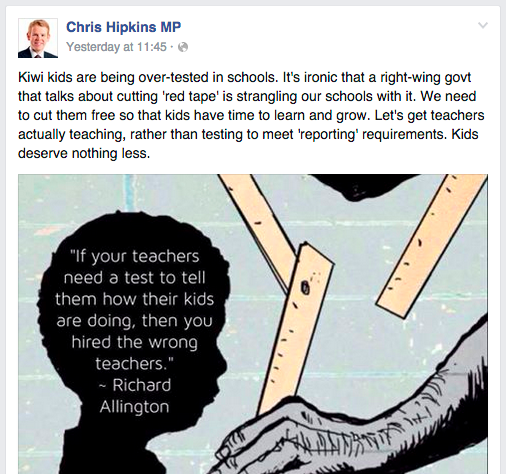
    Chris Hipkins wrote an interesting post about Kiwi kids being over tested. He says:

    Kiwi kids are being over-tested in schools… Let’s get teachers actually teaching, rather than testing to meet ‘reporting’ requirements. Kids deserve nothing less.

    It has been an issue I’ve noticed increasingly in my career. Whether it’s because I’m male, or because it’s genuinely difficult to do, I find that to test the entire class, I have to shut down the learning programme and go into ‘Assessment Mode’. I find I don’t do any actual “Teaching” during this time, more just provide suitable ‘practise’ type activities for students to work on independently while I repeat 1-on-1 testing. I can’t do both ‘assessment’ and ‘teaching’ at the same time. As a school, we are now moving away from whole-class testing because it gives a very limited view of the student’s abilities. But this means that more 1-on-1 testing is required. This can take 3 to 4 days to complete with a class of 28.

    I wrote a reply to Chris’s post that expressed my ideas:

    Thanks Chris for this! I’m a primary teacher and I’m constantly going into “assessment mode” to get through the entire class, that sometimes I wonder if I’m actually teaching them anything! By the time I’ve finished one lot of assessment, the next lot is on my desk!
    I feel that if I were able to work constantly alongside my students; encourage, inform, correct, show, teach, and build genuine learning relationships with them that I’d have a much better understanding of them as individuals and thus understand what they need in their learning. Any assessment should only be to confirm what teachers already know about their students.

    And that’s just it. If teachers were given the trust that a) they deserve, and b) that is required to make OTJ’s in the first place, then I’m sure that there would be better outcomes for all students. We are told constantly that teaching and learning is all about relationships, but I fail to see how sitting tests and being assessed builds any kind of meaningful learning relationship between student and teacher. Secondly – spending time working with these students and teaching them will only enhance my ability to make a judgement.
    We are showed the assessment pyramid regularly in P.L.D (Professional Learning & Development), and it still staggers me that things remain the same. The assessment pyramid works a lot like the food pyramid, with the top tier representing assessment that, whilst is usable, should not make up the bulk of assessment used in the classroom. The bottom tier represents assessments like teacher observations, anecdotal notes, conversations, discussions, behaviours, troubles, problem solving, which should be use more frequently. Yet the rate of importance placed on assessments is opposite. Those that fit down the bottom of the pyramid which should happen daily and make up the majority of our assessment as teachers, is given the least importance, while those at the top which happen once or twice a year, are relied heavily on when schools are asked to “prove it” by Ministry or ERO officials.

    Chris finished up his post by replying with a disclaimer that he in no way intends for there to be NO form of assessment, just that “…there is too much testing for ‘compliance’ rather than to genuinely inform the next steps in a child’s learning.”. And I wholeheartedly agree. If all we are doing is relying on test results, weighing the pig time and time again, it’s not going to help the students. Further to this is the issues happening in education overseas.

    Teachers in the U.S. have the common core to teach and to contend with where the success of the students in their class directly relates to their school image. What has ended up happening? Teachers preparing students for the test; not actually teaching them.

    My old Principal was so enamored by an awarded Title I school for bringing up test scores. Their formula? Test prep. We copied and plummeted.” – @TeacherReality

    It is highly tempting to give students practise at sitting tests, or answering similar questions over and over again, in order to boost their test score by being able to answer similar questions. But this in no way is why we became teachers. We didn’t become teachers to give test-like questions, show helpful formulas to solve test-like problems, or show them practise tests to help them pass a ‘real’ one. No. We became teachers because we wanted to impart knowledge, to inspire and to encourage, to challenge and watch students struggle in the hope that one day, one day, they would be able to apply themselves in life and succeed.

    As I write this, I find myself thinking; “I know all this, and say all this, but hypocritically find myself in class administering tests. Why!?”. Well, mostly this is because of the school having certain requirements (from external or internal pressures) of the teachers, as most schools around the country will have. So what can be done? What can I do as a teacher?

    These are genuine questions. I don’t have the answers. I have the ideal – which is to make observations and notes the most important and reliable source of information about student learning available. It means teaching and working alongside students. And so I must do that. I must make that a priority. I won’t be able to avoid the summative tests at all, but I can certainly try to maximise the time I do have to assess informally, and use these with more prominence than a one off test.

    How do you manage the balance of testing vs. teaching? What restrictions are placed on you by school or external sources in terms of assessment? How do you deal with that? What suggestions do you have for others? Please leave your comments below.

  • Student Success

    Can you read? Can you write? Can you count?

    If you say yes to these then you are a success. You have succeeded at school. You’ve made suitable progress through your years at school. Heck… You’re verging on being a genius. You’re probably headed to university, or some high end CEO job, and once you’ve done that, and are trying to work out what to do with your money after all the property you now own, you might just run for prime minister.

    If the importance that is placed on National Standards in this country is anything to go by, then this will be reality. Yet we keep on getting pressured into widening the curriculum day after day, by all the different curriculum areas; science, the arts, p.e. and health. Fitting all of this in within the school year is challenge enough, yet alone finding time in the school day. Many teachers have had to learn and adapt, and thus begin integrating reading, writing, and maths in amongst the other subjects.

    children-99507_640But isn’t success more than this?
    I’ve had a myriad of students through my classroom doors, some who are very successful academically. But I will always remember one student, Polly. Polly of course is a made up name designed to remind me who it is, but disguise her identity for privacy reasons. Polly was a neat student. She was on time most days, was well presented, had lunch, came from a home with supportive parents who turned up to school events when they could.  Polly had great friends, and was always very kind, considerate, and respectful towards others. She didn’t have a bad word to say about anyone. Polly got on and did her work. She was enthusiastic about school and about learning. She wasn’t the best at maths, reading, or writing, but always gave 100% effort and put her heart and soul into her work. But 2010 rolled around, and with it the implementations of National Standards, I found myself having to try and explain to Polly and her concerned parents why she was Well Below in all three areas. It simply wasn’t fair. Polly became a target student, and her progress was routinely monitored. By the time she left school, she was still Below the National Standards in all three subjects, but was a long way from being an ‘unsuccessful’ student. In fact, she was a very long way from being a ‘below’ student as well.
    You see, Polly had a lot going for her. She had perseverance. She had respect. She had kindness and reliability. Polly had great running ability, and determination, confidence, and commitment to boot. She had a dramatic flair, although only used this when she was required, on stage, in assemblies, and class plays. She got along with everyone, even those who crossed her. You see, when I said goodbye to Polly from my class, I knew it wouldn’t be the last I saw her. I knew that out in society, in the real world, whatever Polly chose to do with her life, she would be a success. She had the qualities that will make success inevitable. While she was not the brightest student academically, she will do well for herself regardless. Whether she becomes a stay at home mum, or a fast-food chef, air hostess, veterinary assistant, early childhood educator, bus driver, receptionist, or the second wealthiest CEO in the country, it won’t matter, because what ever she chooses, she will be successful at it – I am sure of it.

    grads

    In my experience, I’ve been through a few different ‘Graduate Profile’ activities, where we as teachers get around and discuss what skills and qualities we would like our students to leave our school with. Each and every time we end up with a list that includes many, if not all of the following skills and qualities:

    Creativity, Resilience,Able to work with a variety of different people, Motivated, Persistence, Expresses themselves, Curiosity, Humour, Endurance, Reliability, Empathy, Leadership, Compassion, Courage, Resourcefulness, Humility, Communication Skills, Thinks of others, Shows respect,  Shows not tells, Trusts others, Social skills,  Role model, Mentor, Volunteers, Gives to others, Active participator, Takes suitable risks, Uses initiative, Confident, Trustworthy, Problem Solver,Self Awareness, Self Discipline, Self Motivated, Ambitious, Flexible, Positive attitude.

    When you look through this comprehensive list, there is no question that they are suitable desires for schools to have for their students to have leave with, and more often than not, when teachers are asked to come up with such lists, no where is academic ability mentioned. No where on our Graduate Profile as a school does it say that a ‘model A’ student that leaves our school will be At or Above the National Standard.

    It’s definitely worth thinking about.

    What does success mean to you in regards to education and learning? Feel free to comment your ideas below.

  • Are Modern Learning Environments a Fad?

    We’ve all heard it in news, and seen it in the high glossy magazines or furniture websites, claiming ergonomic desks provide a quieter classroom, or driving through the new housing development with a 21st Century school nearby while the state housing that serves the poorer side of society watches on from across the road. Some have even experienced it going to a conference or workshop which are always held in the latest completed building project, often surrounded by glass walls and neatly air-conditioned atmosphere with the fresh aroma of recently laid high tensile carpet.

    Thats right. Modern Learning Environments, or ‘MLE’ for those of us keeping a list of teacher jargon and acronyms.
    Back when my grandparents went to school, every classroom was the same. A blackboard with chalk-filled scratches and impurities, each wooden desk facing the front, lined up in an individual grid for maximum efficiency. The teacher provided information for the masses, delivering speeches from the front like a preacher at a pulpit, and it was your responsibility to remember and follow directions or you would miss out.

    As time went by, we began to question the effectiveness of this. Desks began to get grouped into small clusters, and the term ‘desk groups’ was formed. In junior classes especially, desks were done away with completely, with furniture makers beginning to focus on large tables for schools. A classroom computer (ex-office computer) sits in the corner and is the place for students to go during wet lunchtimes where the class Solitaire challenge begins. The blackboard is removed for the front of a fridge, and is so called as a ‘whiteboard’. The teacher sets group work and walks around the class to ensure students are on task and discussing ideas together.

    Eventually we reach the current predicament where schools feel like they have to provide a range of different ‘areas’ for students. There are small pods of desks which link together in different ways, ottomans which cluster into circles or snakes, carpet pads or cushions instead of chairs, bean-bags are brought out from the corners, barstools with benches instead of individual desks. There is no ‘front’ of the classroom, and the standard whiteboard is now an interactive projector with multi-touch capability. We’ve opened up the school network to enable students to bring their own device (‘BYOD’) to school on which they can complete their school work. The teacher is a facilitator of learning for every student, and provides a model for inquiry, where students learn on their own with support from others around them, finding out what they want to find out, how they want to find it out. The classroom accesses all corners of the internet, and learning outside the classroom happens each week where the class Skypes another class across the other side of the world. The students are connected through a learning management system (‘LMS’), and parents regularly check in with their child’s progress at school through the school Moodle.

    What actually is a Modern Learning Environment?

    The Ministry of Education defines a MLE as follows:

    “A learning environment may be understood to be the complete physical, social and pedagogical context in which learning is intended to occur. …a modern learning environment is one that is capable of evolving and adapting as educational practices evolve and change – thus remaining modern and future focused.”
    MLE.education.govt.nz

    In short, a MLE is a space that changes depending on the learning at the time, and is future focussed as education progresses. It provides students and teachers with a choice on how to use the space, depending on the learning activity at the time. Students may find it more comfortable to lie on the floor with a laptop, rather than sit upright at a desk with pencil and paper.

    The Ministry website continues to explain that there are eight parts to consider when discussing a Modern Learning Environment.

    1. Accessible
    2. Air Quality
    3. Heating
    4. Healthy and Safe
    5. Lighting
    6. Insulation
    7. Sustainable
    8. Acoustics.

    It is important to remember that this is purely the physical environment. It does not consider online communities, or digital environments within this; but does take into account the idea of ‘ICT everywhere’.

    Why the Craze?

    So why is everyone clambering to get up the property ladder and develop their school into a MLE? Is it the consumer culture we’ve become so entrenched in now filtering into our expectations for school buildings. Is it the same reason that we have to have the latest iPhone as we do have to have the latest classroom fad?

    Firstly, we are attracted to the new. Many classrooms look tired. Those schools that were built during the baby boom in the 1960’s, now have classrooms that are pushing 50 years old. Heck, I bet any of us would look tired if we’d had 1000’s of kids running around us over the course of 50 years! Schools have lots of other priorities as they come to grips with the technical age, and ‘modernising’ classrooms is well down the list of things-to-do.

    It thus becomes very attractive walking into a classroom with clean walls, sharp, clean lines, superb lighting quality, and durable, usable spaces. I’m not sure cleaners will agree that full length glass walls are a good idea, but there is a sense of flow having them, un-defining the boundaries of a space and creating an openness to the area. There is a natural desire for this new environment, given that the alternative is so… old.

    The Need for Guidelines

    In some ways, with everyone wanting the new buildings and new furniture, there has to be suitable reasons and guidelines behind having them installed, so that the government can quantify and add some structure to the wants and desiers of every teacher in the country. The eight parts of the MLE were developed to ensure that there are reasons behind the decisions that are made regarding school property. Even when upgrading old school buildings, the eight boxes can get ticked off as the issues within them are addressed, and though they might not have the latest and greatest technology, or motion sensor lights, or wall to ceiling windows, or enough range in furniture to put a furniture sale to shame, they can still be considered as a MLE.

    So is it a Fad?

    Essentially, no. It’s not a fad. It’s not just the latest thing people are talking about. While environment is important, it is not the be all and end all of learning and education. Can it help? Yes. But a good teacher will teach well in any environment. A good student will learn well in any environment.

    But we are in the 21st Century. There are lots of amazing options out there to explore, especially in regards to our learning environments, and pursuing these is just another step in developing life long learners out of our classes.