Tag: students

  • Scrapping National Standards Bad News for Parents

    It was only a matter of time before this response came forward from the opposition.

    It is scary to think how blind some people become by their own ignorance. Nikki Kaye shows just how out of touch she is with schools and what National Standards actually provided.

    The government’s plan to scrap National Standards in schools is bad news for parents and will remove a key source of information, says former Education Minister Nikki Kaye.

    Chris Hipkins, education minister in Jacinda Ardern’s new Labour-led government, has said primary schools will have to report to parents on progress across curriculum subjects.

    But National Standards, which set out levels of numeracy and literacy for Years 1 to 8, will be abolished.

    Mr Hipkins told the New Zealand Herald there were a range of tools schools could use for that, and it was a matter between teachers and parents.

    Ms Kaye says it shows a disregard for parents and students.

    See. No. If anything, it shows regard for parents and students. No teacher wants to label children, and even less so when we’re being asked each year to label kids with labels that have extremely negative connotations. No student needs to work hard all year, only to be told they’re “Well Below”. A generation of students who think “What’s the point” and who have learned to give up because all the hard work they have done hasn’t met a certain standard? Yeah… disregard for parents and students. Totally.

    “Parents need to know where their kids are up to and children need to know how they are getting on,” she said on Monday.

    National Standards didn’t help with either of these two things. Firstly, no school to school moderation was ever held, and so these were not National, and nor were they standard as schools were left to interpret them themselves. Students will still get to know how they’re getting on, and probably more so now that teachers can talk about progress, and hard work, as well as countless other topics and interests held within the many facets of the curriculum, rather than just the narrow and prescribed view held by National Standard supporters.

    “Families also deserve to know what Labour will replace National Standards with – not be told they are going to overhaul the way our students learn but will get back to you with the details later.”

    Once again, Ms Kaye is wrong here. Why does National Standards have to be replaced with anything? Do doctors get rid of tumours and replace them with a benign lump of fat? No. Get rid of it. Destroy it. And let it heal. That’s what needs to happen here. In addition, National Standards has not been a system for how students learn, and never has. It has had a profound impact on how we teach, because of the complete restriction over the subjects that require the most attention, but it has not, and was never designed to, be a way that children learn.

    Ms Kaye says National Standards also provide the Ministry of Education with key information that allows targeted interventions when students are not achieving well.

    “Key information” that the man himself, Sir John Key, called ‘ropey’. Yeah. Such a loss to the MoE having to try and justify the standards. As for targeted interventions – I’d like to hear about where the Ministry had provided any kind of support to schools who had students that were not achieving well.

    This has been communicated numerous times to the Minister, the Government and the Ministry of Education. Maybe instead of sticking by the National Standards, own up and try and see that you might have gotten it wrong. No one will think less of you. But don’t come out and start sprouting out ideals and hyperbole about how integral National Standards were when quite clearly they aren’t. Trying to use parents and students views to justify them is poor, because for every parent that ‘raves’ about them, there are those that oppose them.

    Original Article: Scrapping National Standards ‘bad news’


  • Dyslexia in New Zealand Schools

    The current support for dyslexic students in New Zealand schools is a joke. An absolute joke.

    When there is a reportedly 7% of students in New Zealand Schools have Dyslexia, it doesn’t sound like much. However, in a class of 28 students (the funded class size), that’s 2 students who will be struggling with dyslexia. Statistics say that as many as 20% of students will have learning disabilities, and it’s been noted that overall, dyslexia makes up about half of those disabilities. This means it could be even 3 students in your class that will be struggling with dyslexia.

    I also suspect, that the aforementioned 7%-10% is just those that have been diagnosed, and as a teacher, there are many more that are never picked up for a number of reasons.

    That’s not good enough.

    What’s more, is the Ministry of Education, Ministry of Health, and the Government all turn a blind eye about dyslexia support in schools – mainly because if they admit that it is a problem in New Zealand schools that dyslexia affects student’s learning, then they’ll be called upon to do something about it and support schools to address the problem. That comes at a cost to the Government. Essentially, what this has led to is a bunch of private organisations filling this void. However, this of course, comes at a cost.

    From the figures I have heard, to just get assessed for dyslexia, it will cost schools or families anywhere from $250-$400. This goes some way to explaining why so many more students are not picked up and struggle their way through the system with little or no support for them, their teacher, or their parents.

    Go figure.

    As a teacher, I am passionate about this. Not to find a reason for under-achievement or raise excuses, but to get support for these students who are struggling. It frustrates me to see these kids come in, and feel like I have nowhere to turn to get support for them, and if there is, how it always seems to come to a dead-end.

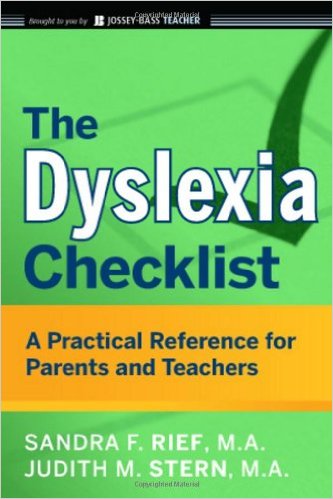
    In trying to understand dyslexia a bit more, and hopefully be able to support dyslexic students within my classroom myself (seeing as I’m getting no support), I have purchased a couple of books. One is ‘The Gift of Dyslexia’ by Ronald D. Davis (which I have leant to a friend when her child was diagnosed), and the other is ‘The Dyslexia Checklist’ by Sandra F. Rief and Judith M. Stern.  Hopefully they both offer some insight into how I can better support learners with dyslexia in my classroom.


  • Mannequin Challenge – Daily 5

    As a bit of End of Year fun, I got my students to make a quick video of our favourite part of each day – the Daily 5. In the video you’ll get a glimpse of what the Daily 5 are, what happens during Daily 5, and why the kids love it so much.

    Enjoy!

  • Gold medals for all

    Global (Bulk) Funding

    In the weekend just been, I caught up with Ms Parata’s latest palava regarding schooling and in particular, the funding of it. Needless to say, there was lots of conjecture, and I found it hard (yet again) to agree with much of what she has to say.

    Olympics

    At the same time, we saw the wind down of the 31st Olympiad in Rio De Janerio. I was able to make some links between the two. I’ve tried to get my head around the idea of what success is, and what it looks like; both in education, as well as in life, and using the Olympics as a starting point On what success looks like for New Zealanders.

    Assessment

    Ms. Parata signalled the intention to have a never-ending assessment system throughout every year of a child’s schooling, so that we can track and monitor student achievement, and thus be able to allocate funding more accurately to children who need it as soon as we begin seeing them to fall behind.

    But how robust are these assessment systems? The National Standards are full of holes and have long been criticised for their lack of National moderation and lack of Standard measurement. Yet, as we know, the Government continues to set the expectation that 85% of students will be At or Above their corresponding level across the country according to those National Standards.

    To University and Beyond

    In her statements, Hekia also mentioned that the aspiration for her assessment and data driven school system is to monitor students at each and every level so that they can go on to finish school, go to university and get employed.

    I have a series of problems with this.

    Don’t get me wrong; University definitely expanded my worldview, my knowledge and skills as an artist, as a photographer, and as a teacher. I met my wife at University.
    However, my personal view on this point is that if everyone has a degree, then that degree becomes less valuable, or even meaningless. The more people that get it, the less rare it is, and the more people are expected to get it or achieve it, and therefore starts on a never ending downward spiral in worth or value. Even take, for example, the status a Ph D. It still holds a lot of value because it’s a whole heap of hard work and not everyone can achieve that level of study or knowledge. If they started handing out Ph D’s to any Joe Bloggs who shows up, then the value of it decreases.

    The Value of Gold

    Much like at the Olympics, if we were to hand out gold medals to all who attended, then the value, the meaning, and the hard work that is represented in the gold medal would become completely meaningless. Gold medals become worthless, and suddenly don’t mean anything to anyone. They may as well be medals for participation.

    The New Zealand Olympic committee seemed to have a more realistic view on success rates. At no point did they expect everyone to get a Gold medal. In fact, some weren’t expected to medal at all. Some achieved that Gold medal who were expected to achieve it (Bond & Murray, Drysdale, Burling & Tuke, Carrington). Some missed out who we expected to get it (Adams, All Black Sevens), but we certainly don’t see them as failures. We also had some athletes get medals with non-gold shades on them who we expected to do so (Ko, Willis). And then we had others who we never expected to medal, but who shone on the world stage to get a medal around their necks (Walsh, McCartney, Rooney).

    There’s more to Education

    Like I say; don’t get me wrong; University is great and is a huge expectation and motivator for many of our students. The high expectations of teachers these days assist students to surge on to extend their learning at university; and somehow we manage to correlate this with success.
    However, that’s not a good picture to paint, especially if you look at the employment depletion in the area of trades. You see; some students might not be wired to go on to university. Some students would and will make great road workers, builders, plumbers and electricians without having to attend University. Some students show great natural talent in sports and university simply gets in the way of them making the most of their younger fit years. Are they any less successful, just because they don’t go on to university?
    No.
    So why are we making university the be-all-and-end-all of our education system? Surely it should be aimed towards making each student the best they can be to make the most of what is before them and give them the skills they need to be successful in life, regardless of what that life may be?

    Failure or Success?

    What’s more, just because you go to university it does not mean you will succeed. I know of many people who have got a degree and haven’t been able to use it to gain employment at multi national companies making lots of money or otherwise being deemed as successful. They’ve ended up pushing trollies at the local New World, or working retail on the city mall.

    In addition to this, I know of cases where folk who have never set foot in university are having an incredibly successful life. My brother is one of them. Never been to University. Got a job pumping petrol for a year while he studied automotive electrical at polytechnic, and at 26 was owner operator of his own workshop in that industry. In more, seemingly substantial terms, the likes of Steve Jobs, Richard Branson, Mark Zuckerberg, and Bill Gates all dropped out of University. One could not say that these people were not successful.

    Success Never Looked So Good

    Nikki Hamblin made international headlines these Olympics, not because she won a race or achieved a Gold Medal in her time at Rio, but because she stopped and assisted an injured runner who had toppled over Nikki only moments earlier. Both runners finished stone cold last. No medal. No glory. But both women went on to achieve sporting greatness and success in a different way – in Olympic spirit (as opposed to worldwide trending – just type Nikki into Google and see what shows up! ).


    Likewise, take the story of nineteen year old Eliza McCartney, who against all odds, found herself in medal contention with a few jumps remaining. In the following moments, the look of success, the sense of achievement could not be hidden from McCartney’s face as she took out the Bronze medal.

    A massive achievement for the 19 year-old, and a successful Olympic campaign, even though it wasn’t a gold medal.

    Success at the Olympics is not just about getting a gold medal. It’s about so much more than that. Likewise, being successful in education isn’t just about heading off to university after you’ve finished high-school.

    In Conclusion

    We need to broaden our definition of what we consider success. I’ve said it all before. This continuing narrow view that all students should go to University as a measure of success is stifling the entire education system of this country as we measure and measure again the weight of the pig at every opportunity. To use an Olympic analogy; a runner, rower, pole-vaulter won’t get any better by continually going for personal bests and trying to set records. Strength training, fitness, endurance, mental coaching, and more is needed for any athlete to perform at their best when it matters – on the world stage, at the Olympics.

    Students need to see that they can be successful in life without that pressure of having to go to University. Going to polytechnic, learning a trade, or even going to work in retail can all be successful pursuits in life. Let us not forget, that just because the All Blacks were not at the Olympics, doesn’t mean they are not the world champions who can embarrass Australia given the other sporting event on this weekend just been. We can hardly call them failures just because they do not have a Gold medal around their necks.

  • The Answer to everything is not an App.

    It’d seem that there is a reliance on tech and apps to meet the needs of students with learning difficulties.

    While there are apps and assistive technologies to help students with their learning, the reliance or focus on one particular app is not what the likes of RTLB or Special Needs teachers should be using to “solve” the learning needs of ‘problem’ children. It may be appealing because of a one off price that seems to satisfy the powers that be as a successful outcome for the student and signs off the intervention.

    But there is no way that any app, no matter how developed, how much money has been poured into it, that it should ever be “the answer” for students’ learning difficulties.

    Why?

    Because there is never ever one reason for students struggling in their learning. There are usually a myriad of issues, and strategies that address these are not going to be encompassed in an app.

    Don’t get me wrong, tech can be incredibly supportive in assisting students with with their learning; but in my experience it is much less about the apps you use, but the process that the technology makes and allows for in the classroom.

    Furthermore, teaching ‘an app’ is restricted to using that app and the limitations of it. Teaching a process opens up the student to other possibilities for using the technology (or not) in the future. Take for example Writing. You could teach a student how to use Microsoft Word and it could help them to write. But teaching them how to write is actually better (or more to the point – what is needed), and there are any number of apps that could assist with this, including Word, Google Docs, or Collabrify Writer.

    Somewhat ironically, I know of a case where a student diagnosed with dyslexia received the support of using the Chromebooks in the classroom to do her writing. This was the recommendation from the specialist that was providing the support for the teacher, and supposedly the student.

    However; talking with the student; she preferred to do her writing by hand because she didn’t have to ‘find’ the letters on the keyboard when she could just write them with a pencil when she wanted.

    Sometimes technology doesn’t have the answer that we’re looking for.

  • Coding in the Curriculum

    In 2018, the New Zealand Curriculum is destined to have a new addition to its subjects.

    From the age of five, children will now be taught about coding, logic, problem solving, if-else statements, app making, social media analytics, and probably hacking as well.

    But there is a lot, a LOT, of apprehension about this, even as a techie myself (for instance – I design websites, and have coded for much of my adult life). Put it this way; I’m not jumping up and down about this announcement.

    Who?

    I don’t know about you, but the first thing I asked was who is going to do this? I have met many a good soul who dedicate their lives to teaching students, but who’s computer literacy is extremely limited.

    And while the content knowledge required to for Level 1 of the curriculum will be very basic, it still requires a great deal more teaching knowledge to be able to teach it effectively. What are students getting stuck on? What are the next steps? How do I solve the next problem?

    Take for example Level 1 of the Reading curriculum. It’s fairly straight forward. Most, if not all (fairly presumptive, I know) adults could achieve this. Now think of the teaching knowledge you would need in order to teach it effectively. The sounds, the blends, the phonics, digraphs, vowel sounds and rules around their usage, the common pitfalls and sticking points as well as the various strategies required to assist and help students to progress to level two. And that’s just scraping the surface of teaching students to read.

    Imagine the level of teaching knowledge that is going to be required to effectively teach digital literacy.

    And now take that to level two, and level three of the curriculum.

    My current estimate, based on my current place of employment and the various other schools I have worked in, would be that about 10% of teachers would have the skill set required to teach digital literacy if it was introduced tomorrow. And that 10% is probably generous. Most of what makes a good programmer, coder, or even just a ‘tech guru’ is the ability to solve problems. When something goes wrong, you need to know what to do to fix it, systematically, step by step, eliminating variables as you go. From experience, many teachers struggle to problem solve why their projector isn’t connecting, or why the sound isn’t working on their laptop. How do we then get to a place where teachers are teaching students even more complex problem solving when you introduce if-else statements that don’t work!

    Many non-tech-savvy people turn to one demographic for help. Young people. Why? Because they’re already up with the play on technology. Their desire to explore, to learn, to develop skills with technology seems to happen automagically, and I can only see teachers and schools getting in the way of that. As well as this, I read an interesting post about ‘future-proof’ learning, predicting what the future holds for our students, and how we can’t and shouldn’t be including things in the curriculum that are a phase, or a fad.

    (Note: I realise that schooling exists past primary school; but we already have specialist subject teachers at Intermediate and High School level, and so schools would merely employ a specialist ‘digital literacy’ teacher.)

    How?

    Another aspect that may or may not have been considered is how schools are going to teach it. You know, the practical side of it. You see; I’ve only once had to write down a piece of code on paper (during a Comp101 exam I took in Uni). It was nigh on impossible not being able to check and edit the code to improve it or to see if it worked. A lot of coding is trial and error.

    Essentially, if digital literacy is to be taught, then students will need devices. Doing it with pencil and paper will only last so long.

    Now I’m not sure about your school; but our decile 2 school has only just got to the point of having 1 device between 2 in the senior school, and 1 to 4 in the junior school. Yes; we can combine sets of these devices to allow every student to have access to one, but my point is, there are lots of schools out there who wouldn’t have this level of technology in their school yet.

    With more devices comes more problems. More students who run into connection issues, which in turn requires the teacher to know how to solve that problem (many of which once again, don’t know how to go about doing this on their own laptops as it is).

    When?

    Ultimately though, when are teachers going to fit this in? Or is it going to be integrated throughout the day? I guess that comes down to the individual teacher. But I know for one, I would love to spend more time teaching students how to use the Chromebooks, how to code a website, and more; but the reality is that I have a hard enough job covering the rest of the curriculum sufficiently, as well as the ever increasing demand on Maths, Reading, and Writing, without adding more to that workload.

    Gripe

    Don’t get me wrong. I’m not having a go at my colleagues or other teachers. They all have strengths and are all marvellous teachers. I merely see a massive gap between adding a subject to the curriculum and the current knowledge of those that have to deliver content about that subject. Massive gap.

    I can see my job as a tech-savvy teacher becoming more than it already is, as I can see me having to assist with other classes tech problems more than I already do, provide support for when tech devices go wrong, and provide ongoing P.D. as teachers encounter problems or inspiration that they want to explore.

    Once again – not sure when I’m going to actually get to teach my own class.

  • Using Google Classroom

    In 2014 Google released it’s LMS to the world. Aptly called “Google Classroom”, it was little more than a Google Plus type newsfeed for classes. Teachers could sign up student accounts, and set assignments and post announcements.

    Read more: About Google Classroom

    Since it’s release, it continues to be developed. There are now polls, feedback, assignment documents. It even integrates with Google Calendar to keep students on top of the upcoming and due assignments that teachers set.

    Obviously, the target audience for Classroom is for use in High Schools. However, I have also used it rather successfully in upper primary school as well.

    Using Google Classroom in the Classroom

    First, go to http://classroom.google.com. It will then ask you to either sign in using your Google Account (Education), or if you’re already signed in, then you can Create or Join a class. You’ll want to Create one. Click on the plus, and click on Create.

    Of course, you can create as many classes as you need. One for each year level, subject or whatever. As a primary school teacher, I create one class for each year I teach.

    The great thing is, Google Classroom integrates straight with Google Drive, and creates a “class folder” for students work, posts, documents and everything else.

    For my class, each student has a school Google Account. I then put up the unique class code on the whiteboard and ask each student next time they log onto the Chromebooks to join the class.
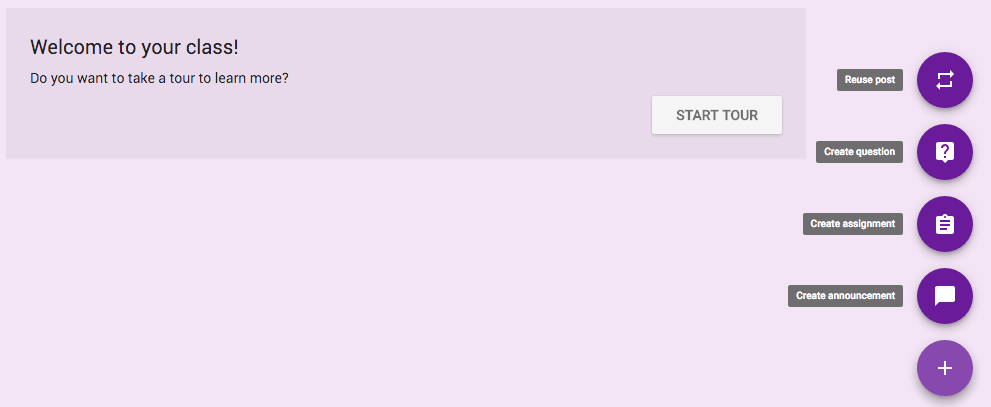
    Once this is done, it is relatively simple to add assignments, projects, and ideas to the ‘news feed’ for the Classroom.
    For instance, if there is a particular video that I want the students to watch for a lesson, I can create a new post, and share the link. Students will then look at the Google Classroom and see the video link, and in time, watch it. Much like a newsfeed, they can comment and share their thoughts (though mostly comments turn to “wassup au” and the like) as they find themselves in a new social environment and explore communicating with each other in different ways!
    Once you have setup your class, it’s easy to manage assignments. Let’s say an afternoon’s work requires students to research and answer a few questions; you could set up a Google Document that has the questions on it. Each student gets a copy of this, and fills it in as they work through the afternoon, and at the end, they click on “Turn in”. This submits the work to the teacher, who can then provide feedback as necessary. The great thing about it is that it keeps students motivated; much more than just printing off a worksheet of questions and getting them to hand it in on your desk at the end of the day!

    There are a number of settings which are pretty straight forward which will help you set up your Google Classroom to your own preference. Things like whether students can comment or post, who can see what, and the look and feel of the site.

    There’s a heap more going on, and more is being developed each day, but as I always try and encourage – get in there and play around yourself. You learn more by doing anyway!

    Related Links

  • Troubled Behaviour

    Over the years I have seen many different behaviours, and many different children struggling to cope with the myriad of expectations, rules, and consequences that they are faced with from place to place. Dad has different rules to Mum, and then School is completely different again; especially since it’s the 5th school in 5 years.

    In 2013 I had some insight from RTLB into ‘Restorative Practise’. I went to see Margaret Thorsborne run her workshops, as well as a behavioural workshop for traumatised children. Whilst our school remains sceptical of a complete restorative approach, I maintain most of the practises within my classroom where possible.

    My focus on behaviours comes about because of the students in my class, and I want to be able to better reach them and do something productive with their views on school, rules, and consequences; before it becomes too late. I have had a fair few students who have left before I’ve had the chance to help, and this does plague my mind a bit.

    I also am not a ‘growly’ teacher. I’ve had students say I need to be ‘madder’ at them to sort out their behaviour. But my personal opinion is that being mad doesn’t make anyone better. Certainly not me. I refuse (for the most part) to raise my voice, and instead will go for a quiet word off to the side, than a stand-up-the-front performance. At the end of the day, what I require from the kids is respect. Once there is respect, then there is listening, and there is learning. I would much rather have the students do what I ask because they respect me than because they fear me.

    As part of this, I began looking into what happens when these ‘trauma students’ find themselves in that downward spiral where they get to the point of not caring about the consequences; why it happens, what causes it, and how restorative practise might help in the situation.

    As always, I kinda went overboard and presented this in an infographic of sorts.

    View the full version here


  • The Choice Classroom

    Choice. Urban slang; originally spoken in New Zealand, is used as a pun at the way New Zealanders speak. Used as description of something you think is good. Synonyms: radical, wicked, awesome, brilliant, best-thing-ever.

    It describes a classroom that I want to be a part of. But more than the above description, choice also means the enabling of being able to choose between two or more options. This is my classroom.

    What choice means in the classroom

    Choice is valuing students as individuals.

    Choice is students working independently at their own level, at their own pace.

    Choice is students working on what they want to work on.

    Choice is motivating. Choice is engaging. Choice is inspiring.

    Students who can choose their activity, the way they present their work, the time or place that they do their work, and even their consequence or behaviour management, become much more learning oriented purely because they have control over it. Powerlessness is the leading cause of burn-out, and not having control is key to this feeling of powerlessness. In regards to being able to choose their learning, what they do when, and how they present it, means that students have an investment to the learning ahead of them and are automatically motivated because the choice has been theirs. Even with choosing consequences or behaviour management, students become more self-disciplined as they have been able to have an active part of the process.

    A very interesting article looks into the issues surrounding choice in the classroom. ‘Choices for Children: Why and how to let students decide‘ says “At least one recent study has found that children given more “opportunity to participate in decisions about schoolwork” score higher on standardized tests; other research shows that they are more likely than those deprived of autonomy to continue working even on relatively uninteresting tasks. There is no question about it: even if our only criterion is academic performance, choice works.”

    How choice works in the classroom

    Firstly, this is an almost inexhaustible list of ways you can use choice in your classroom. This certainly isn’t anything major, but there are some examples that follow that I use in my classroom. They work, and I can vouch for them with my given experience.

    The first hurdle is doing it. You have to make a conscious decision, or choice, to include it in your classroom.

    Then begin introducing choice in the following ways:

    Presentation

    Presentation is one of the easiest ways to allow students to have choice in the classroom. Instead of saying “Make a poster” for the latest bit of topical research, say “Make a poster, or a power point presentation”. Students will make the choice based on their strengths, though many will choose the slideshow option because of the allure of technology. Additional choices could include a class speech, a short video, a diorama, a 3D model, a hanging mobile, a book, a pamphlet, or a webpage.

    Tic-Tac-Toe

    No, not naughts and crosses. Tic-Tac-Toe are nine related activities that require the use of different skills or intelligences. Students choose three activities in a row in order to complete the task. I used these to good effect as a reading follow up task, where students would choose activities as a follow up to the text that they read with me. A good Tic-Tac-Toe will have three different activities in each three-in-a-row possibility. One might include an aspect of drawing, one an aspect of writing, and a third might include a worksheet.


    Daily 5

    The game changer for me when it came to choice was initiating Daily 5 in my classroom. Daily 5 allows students to choose the activity they work on, selecting from the five options of read to self, read to someone, listen to reading, work on writing, and word work. These each have rules and guidelines decided on by the class, and so rather than students being put in a group, read a set book, do a follow-up worksheet as a daily rotation, students have these five literacy activities that they get to choose from. Essentially, rather than have a group rotation of activities, students choose from the activities based on what they want to do at the time. Rather than students doing a worksheet they don’t want to do, they might choose to do some word work where they practise their spelling words. Or rather than being forced to read with the teacher, they might choose to read to someone instead. What this means is individualised learning, where the teacher can conference with students during the time, and students are motivated because they are choosing their learning.

    Inquiry Learning

    One of the big pushes in education over the last 3 years has been the idea of ‘Inquiry’, where students learn what they want to learn about. Inquiry essentially replaces what used to be called ‘Topic’. Topic was teacher decided, with learning activities and experiences made up and put into the unit plan to scaffold students to a set destination. Using Inquiry changes all that to the students. While curriculum areas still need to be covered, a ‘big idea’ is come up with by the teacher, syndicate, or school, sometimes with student input, and then the rest is left up to the students, especially in regards to what they want to find out about the big idea, and how they want to go about finding it out, and what they’re going to do with their new found knowledge. Completely student focussed. Completely student motivated.


    So that’s how you start. The options are limitless. The choices endless.

    What a choice classroom!


  • Assessment Assessment Assessment

    In the current education climate, teachers are finding themselves with the responsibility of making OTJ’s (Overall Teacher Judgements) to report to parents about their child’s academic achievements, but the requirement to have evidence for these judgements. These are rarely school imposed, but instead come from the likes of the Ministry of Education or ERO, who continually ask “How do you know that?” type questions in relation to National Standards data, with schools only being able to say “because of the test results” as a viable and measurable response. Therefore schools are asking teachers to assess their students using a range of different school-set assessments.

    When I think of assessment, I usually can’t get pass the first three letters. It’s tedious, a bore, and whilst I enjoy analysing data from them, they are generally a waste of time when I consider what I could be doing – working alongside students, engaging with them, insipring them, and unleashing them.

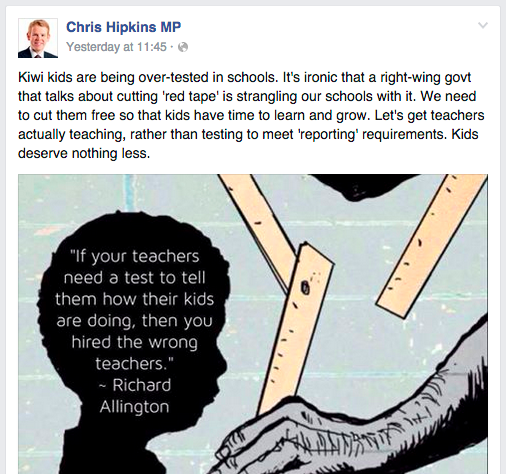
    Chris Hipkins wrote an interesting post about Kiwi kids being over tested. He says:

    Kiwi kids are being over-tested in schools… Let’s get teachers actually teaching, rather than testing to meet ‘reporting’ requirements. Kids deserve nothing less.

    It has been an issue I’ve noticed increasingly in my career. Whether it’s because I’m male, or because it’s genuinely difficult to do, I find that to test the entire class, I have to shut down the learning programme and go into ‘Assessment Mode’. I find I don’t do any actual “Teaching” during this time, more just provide suitable ‘practise’ type activities for students to work on independently while I repeat 1-on-1 testing. I can’t do both ‘assessment’ and ‘teaching’ at the same time. As a school, we are now moving away from whole-class testing because it gives a very limited view of the student’s abilities. But this means that more 1-on-1 testing is required. This can take 3 to 4 days to complete with a class of 28.

    I wrote a reply to Chris’s post that expressed my ideas:

    Thanks Chris for this! I’m a primary teacher and I’m constantly going into “assessment mode” to get through the entire class, that sometimes I wonder if I’m actually teaching them anything! By the time I’ve finished one lot of assessment, the next lot is on my desk!
    I feel that if I were able to work constantly alongside my students; encourage, inform, correct, show, teach, and build genuine learning relationships with them that I’d have a much better understanding of them as individuals and thus understand what they need in their learning. Any assessment should only be to confirm what teachers already know about their students.

    And that’s just it. If teachers were given the trust that a) they deserve, and b) that is required to make OTJ’s in the first place, then I’m sure that there would be better outcomes for all students. We are told constantly that teaching and learning is all about relationships, but I fail to see how sitting tests and being assessed builds any kind of meaningful learning relationship between student and teacher. Secondly – spending time working with these students and teaching them will only enhance my ability to make a judgement.
    We are showed the assessment pyramid regularly in P.L.D (Professional Learning & Development), and it still staggers me that things remain the same. The assessment pyramid works a lot like the food pyramid, with the top tier representing assessment that, whilst is usable, should not make up the bulk of assessment used in the classroom. The bottom tier represents assessments like teacher observations, anecdotal notes, conversations, discussions, behaviours, troubles, problem solving, which should be use more frequently. Yet the rate of importance placed on assessments is opposite. Those that fit down the bottom of the pyramid which should happen daily and make up the majority of our assessment as teachers, is given the least importance, while those at the top which happen once or twice a year, are relied heavily on when schools are asked to “prove it” by Ministry or ERO officials.

    Chris finished up his post by replying with a disclaimer that he in no way intends for there to be NO form of assessment, just that “…there is too much testing for ‘compliance’ rather than to genuinely inform the next steps in a child’s learning.”. And I wholeheartedly agree. If all we are doing is relying on test results, weighing the pig time and time again, it’s not going to help the students. Further to this is the issues happening in education overseas.

    Teachers in the U.S. have the common core to teach and to contend with where the success of the students in their class directly relates to their school image. What has ended up happening? Teachers preparing students for the test; not actually teaching them.

    My old Principal was so enamored by an awarded Title I school for bringing up test scores. Their formula? Test prep. We copied and plummeted.” – @TeacherReality

    It is highly tempting to give students practise at sitting tests, or answering similar questions over and over again, in order to boost their test score by being able to answer similar questions. But this in no way is why we became teachers. We didn’t become teachers to give test-like questions, show helpful formulas to solve test-like problems, or show them practise tests to help them pass a ‘real’ one. No. We became teachers because we wanted to impart knowledge, to inspire and to encourage, to challenge and watch students struggle in the hope that one day, one day, they would be able to apply themselves in life and succeed.

    As I write this, I find myself thinking; “I know all this, and say all this, but hypocritically find myself in class administering tests. Why!?”. Well, mostly this is because of the school having certain requirements (from external or internal pressures) of the teachers, as most schools around the country will have. So what can be done? What can I do as a teacher?

    These are genuine questions. I don’t have the answers. I have the ideal – which is to make observations and notes the most important and reliable source of information about student learning available. It means teaching and working alongside students. And so I must do that. I must make that a priority. I won’t be able to avoid the summative tests at all, but I can certainly try to maximise the time I do have to assess informally, and use these with more prominence than a one off test.

    How do you manage the balance of testing vs. teaching? What restrictions are placed on you by school or external sources in terms of assessment? How do you deal with that? What suggestions do you have for others? Please leave your comments below.