Tag: stuff

  • Two Auckland charter schools still have no idea if they will be open next year | Stuff.co.nz

    It amazes me the arrogance and ignorance of some people.

    Just read the comments to see the myriad of people all wondering what Labour’s problem with charter schools are.

    If they’re making a difference, and they’re meeting the needs of some kids, then surely that’s a good thing, regardless of how they get there? Right?

    Sure.

    Except, how do they get there.

    Entire schools, using tax payer money to be set up and run, with ‘special character’, which in this case includes class sizes of no more than 15.

    Okay. Let’s break it down.

    Let’s say that the Ministry of Education has $10,000 dollars to give to all schools to run for the year. Realistically it’s much more than this, but my ‘0’ key is starting to wear out…

    From this pool of money, $7,000 is given to the state sector to teach and to raise achievement and pay the teachers and try to make educational outcomes in the positive. $3,000 is given to charter schools to do what they want with it.

    However. There are 14 state schools using the $7,000, and only 2 charter schools using the $3,000. Let’s break this down. Each state school gets $500, and each charter school gets 3 times that.

    Now… Because the state schools are given a class size of 28 students, this works out to be $17 per student.

    Because the charter schools can state that their class sizes be no bigger than 15, this works out to be $100 per student.

    Now… This isn’t the issue that those of us in the state sector have an issue with. The issue is that there is an unfair playing field being created between the public sector and charter schools which are a mish-mash of private/public. The trouble being that not every student can go to a charter school and access that amazing resource.

    And in the meantime, that $3000 could have been going into the state system to provide similar benefits of smaller class sizes to every school, to every student, not just the few that manage to live near or get accepted into charter schools.

    I guess it comes down to one thing…

    Don’t read the comments!

    Source: Two Auckland charter schools still have no idea if they will be open next year | Stuff.co.nz

  • Hekia Parata: Let’s be better learning

    I do love it when the Minister writes an open letter. It means she says what she thinks people want to hear, rather than what she actually does when people aren’t looking, taking the leadership stance of “Do as I say, not as I do”. In it, the minister harps on about providing better learning – a term that is so contrary to it’s original use. To learn is to aquire, receive, be given knowledge. To teach is to give, present, or to pass down knowledge. But there seems to be this trend to use “learning” instead of “teaching” which I disagree with; probably in an effort to degrade the skill required to be a teacher.

    The legendary Boonman took to his usual satire in response to this article, and as can be expected, didn’t hold back with the comedy; which although is somewhat hilarious, is also true – which is why we laugh (because if we didn’t; we would cry).

    However much I would like to be as satirical, I figured I would merely provide some teacher feedback, some next learning steps on the writing sample provided to us from Ms Parata’s pen. I hope that she will take the feedback on board, and work with her teacher to address some of the errors in her writing.
    Read the original letter here: Hekia Parata: All ears to anyone ‘seriously committed’ to improving kids’ learning.

    Let’s begin learning.


    New Zealand has a very good education system. That’s beyond debate. Can we make it better? Yes, we can and we must.

    We need to either work on your use of tense, or your spelling. You’ve used “has”, where as you need to have used “had”. Your sentence should read “New Zealand had a very good education system”. In addition to this, I’d probably shy away from Bob the Builder quotes, and rely more on tried and true cliché such as “If it ain’t broke, don’t fix it”.

    As a passionate New Zealander and as a mum, I want to see an education system that delivers quality learning for every child and young person every day. Their achievement matters, to their families, their communities – and to me.

    There is a chance that this paragraph may come across as bragging or somewhat arrogant. I am a New Zealander (and one might question my passion for the title under the current government) but I am not a mum. But I still want to see a quality education system in this country. Is my opinion not as important or passionate as yours because I have not been with child? Yet becoming a teacher without this does make my level of passion for education and learning far greater than most given most don’t want anything to do with schools unless they have children.

    As a teacher, I can safely say that if we have a “very good education system” that you stated in part 1, then we have very good quality “learning” each and every day for each child or young person. However, to presume that their achievement matters to their family is a bit much, unless you have personally interviewed them all. Likewise, communities usually don’t focus around the achievement rates of their young people. From my experience, families are focussed on raising young children to be the best they can be in all areas of life. Sometimes sports become more important than achievement rates, as much as overseas holidays or trips do. They tend to want to provide experiences that will assist with creating well rounded individuals. Communities also tend to focus not on achievement rates, but solutions to keeping the young people off the street, running groups, clubs, or catching up with the latest gossip or what not. They tend to focus on them as people, instead of as data, numbers, and test takers.

    I visit schools right across New Zealand on a regular basis, seeing for myself what’s happening in our classrooms. I speak to teachers, principals and parents about what I, as the Education Minister, can do to support them to ensure our kids are achieving. 

    It’s refreshing to hear that you get to travel around the country visiting schools. It would be such a wonderful experience to go around and see what a hard job teachers actually have, and what a great job they are already doing.

    I would suggest the use of a wider vocabulary instead of “speak to”, you could use the term “ask”. However, as I know, you have very little interest in hearing what teachers, principals, and parents have to say about what you can do to support them. I suspect you would just tell them what you will do, and leave it up to them to change what they do so that what you’ve decided to do will be of benefit to them.

    The proposed changes that we’re making in education are all about putting our kids at the centre of the education system, lifting the educational success of every young New Zealander. 

    Once again, this is an incredibly presumptuous statement, that a) kids weren’t at the centre of previous education systems, (which would be somewhat bizarre if that weren’t the case) – and b) that the changes that you’re making with or without the support of the education sector will lift the educational success of every child, more so than what the current system is and has already been doing before you stepped into power.

    This means ensuring we get the right funding for the right children at the right time. That there are a wide range of education options that reflect our modern era, and that schools are supported in the best possible way to ensure that every child is learning the skills and knowledge they need to succeed in life.

    I applaud your efforts in providing the right funding for the right children. However, your actions speak louder than words, and so far, you’ve shown a tendency to waste money on failing charter schools rather than investing in children. I suspect also, that the “right funding” that you talk about will, in turn, mean more funding, which your fellow minister in finances may wish to have a few words to you about.

    Schools also need to be supported to know this learning is taking place to make sure they’re doing the best job they can for our kids.

    Another presumptive statement Hekia. You are obviously not very aware of your audience when you write, a skill taught and learned in Level 3 of the curriculum by 9 and 10 year olds. Schools are already very aware of the learning taking place and the knowledge and skills required of students in this modern age. However, the basics of reading, writing, and maths are unlikely to change, and while you continue to maintain the expectation that schools assess against the National Standards, schools will unfortunately be forced to spend their time teaching and “learning” in these three curriculum areas.

    Our education system is well funded. At $11.04 billion this year it is the biggest ever investment in early childhood education and schools. That’s more than we spend on police, defence, transport, conservation and foreign affairs combined.

    Please refer to my earlier comment regarding charter schools. Maybe that might free up some of these funds for police, defense, and transport all of which are asking for more government funding.

    As I’ve often said, “that’s a shipload of money”.

    A very good attempt at the use of a familiar phrase or “kīanga”. However, it is not a ship full of money that is coming into harbour, because ships can carry a full load worth a lot more than $11.04b in notes alone.

    And that “shipload” is growing. Funding hasn’t been frozen. Schools’ operational funding has increased by $12.3m for next year taking it to a total of $1.35 billion.

    Once again, please refer to previous comment about ship load. It’s “shitload”; meaning a heck of a lot of excreetment.

    Also, I’m not sure coming out with fictional information in such an open letter is appropriate. Please read this article re: funding freeze.

    Spending has also increased by more than inflation, and I’m not expecting that to change any time soon.

    Yet the teachers who teach the children who you have now put at the centre of your education plan and the support staff who help them are given minor increases that do not keep up with the increases of living? I strongly suggest rewording or even removing this statement from your piece.

    The Funding Review currently taking place is focussed as much on whether we are getting the best for all these taxpayer bucks, as well as what more we might need.

    I’m not sure if using the colloquial term for “money” is the best use of your Thesaurus, Hekia. By using “bucks” it makes it seem unimportant, unvalued, taken for granted, or even rudimentary to your audience. Once again, you should consider your audience when writing this, considering the majority of them will be taxpayers themselves and probably would like you to respect their hard earned money a little more than calling it “bucks”.

    There are seven proposals being looked at as part of the Review and leaders from right across education have been included in the early development of these potential changes.

    The legislation currently making its way through Parliament is about providing more flexibility, not only to schools and early learning providers, but to parents as well.

    That is one thing it is providing – more flexibility. However, you need to add more details about the other things that it will bring. Details such as larger class sizes, more work for teachers, a national database of students that will track them through every year of their schooling. It’s details like these that your readers are interested in, even if you are not too keen on them yourself.

    New Communities of Learning, or Kahui Ako, are also helping schools and services to work together for the benefit of their students.

    Once again Minister, you need to add more details to how this is happening, and how it is benefiting the needs of individual students in their individual schools. Maybe alluding to the fact that this will lead to one principal and one board running multiple schools. No doubt this will free up some more of that “shipload” of bucks the education uses.

    I’ve consistently listened to the teacher unions since I came into the education portfolio, regularly meeting with them and working with them on a number of important initiatives.

    For the first time you have considered your audience, though it is important that when you do, you come across as sincere and truthful, rather than making things up. Also; I don’t believe you come “into” a portfolio. I suspect you were given it. Maybe you could reword your sentence to be a little less fictional by saying “I’ve consistently listened to the teacher unions bleating on since I received the education portfolio, regularly seeing them banging on my door, and ignoring them on a number of important initiatives until they give in and I do what I want anyway.”. I also find it ironic that hours after writing this letter, you leave on a trip meaning, for the third time in five years, you have declined the invite to said teacher union (NZEI Te Riu Roa) conference. That’s another example where actions speak louder than words.

    I will work with any groups or individuals that are seriously committed to improving children’s learning and raising achievement. 
    This sentence is somewhat contradictory. I would say that it would be almost impossible not to work with yourself or your team on this. Will you have to demonstrate to yourself that you are, in fact, serious and committed to improving children’s learning before you will work with yourself? I know for one that the under-secretary of Education has no commitment to improving children’s learning, and if he does, it’s certainly not serious.

    Everything I’m working towards is about putting children and their achievement at the centre of the education system.
    It’s about lifting the learning potential of every child, so we can continue to grow as a nation, and prosper. It’s about preparing young New Zealanders for a contrary, challenging, exciting world.

    I’m not sure you have to continue to make things up and over-exaggerate about child achievement. I also think you should further consult your thesaurus regarding the words to describe the world. Contrary for example is a word that I would have thought you would be all too familiar with, especially with the number of backing down you’ve had to do in your time as Minister of Education. Maybe a “better, challenging, exciting world” might read better, especially as it provokes some sort of inspiration or hope for the young people who are lucky enough to be able to read this far into your letter without drifting off to sleep.

    Kids learning to flyI want our education system to ensure that every Kiwi kid can fly!

    That is a bold attempt with the use of metaphor  in your writing, Hekia, and definitely a great concluding sentence that really brings a climax to your points. However, I suspect that this will lead to some confusion as to the literal meaning of your sentence.For instance, if you’re wanting children to fly, they will need to evolve into a creature with wings, or maybe you are intending to use some of the shipload of bucks to subsidise the cost of airline tickets for children? Your intentions are not clear.

    * Hekia Parata is the Education Minister

    I suspect with Writing this poor with so many clinical errors, at this time in your political career, that in due course, you should be prepared to amend this line, using the past tense “was” instead of the present tense “is”.

    Teacher’s Note: I apologise for the over analysis of this Writing sample, though as you and your advisors have said in the past; data is the key to success. The more data I have on this Writing sample, the better success you will have. Though at this stage, you are still falling well below the expected level and unfortunately, this will result in you being required to find another school who are prepared to put up with your poor achievement rates. Maybe the charter school down the road will take you in.

  • The Gap is Closing

    In response to:

    Hekia Parata: Improved Maori education shows gap is closing

    Key Points

    • Data used by Hekia Parata is from 2008 to 2014. Why didn’t she use 2015 Data which would have been more current?
    • Up to 2014, before schools got found out, there were schools who were screening students and would only have those that would succeed be represented in their data; or even sit NCEA Level 2.
    • Hekia makes mention of the increased “…information about the performance of their children and their schools and they are using that information to engage in informed discussion with teachers and schools”, which is a clear promotion of the changes the Government made to reporting schedules with the introduction of National Standards. Students who passed through NCEA Level 2 in 2014 would have had very limited, if any, input from anything related to the National Standards, as they will have been Year 8 or Year 9 when the standards were introduced.
    • “However, while there has been dramatic progress in recent years we are not satisfied” – and never will be until 100% of students are passing every form of qualification. This will of course immediately count for nothing, as it essentially makes those qualifications worthless if everyone has them.
  • The Cost of Free Education

    Families struggle to afford the rising cost of back-to-school requirements

    Free Education

    Firstly, I want to point out that this is purely my thoughts on this, and only using my view as a teacher and educator in my opinions of this. I believe education should always be free. I do not have children, and have come from a family fortunate enough to be able to afford education. I have never been in a position where I haven’t been able to make ends meet, and so this of course affects my views.

    I am, however, very aware and understand that the pressure and cost of school for some families is beyond their means at the present time, and I want to acknowledge that the beginning of the year can be an incredible hardship for them. I certainly do not intend to belittle that in any way.

    There are a number of issues that this article raises in its conscious or unconscious attack on schools. There are several inaccuracies from the outset, which are relatively clear from a schools point of view. Obviously, this article takes the side of the parents; as is much of the comments I’ve seen on social media about this. But hopefully your eyes might be opened to the reality of things for schools.

    The article begins by saying that the $35,000 spread out over each child’s years of schooling at a state school ($2.7K per year, $13.48 per school day) includes “…fees, extracurricular activities, other necessities, transport and computers, by the time they finish year 13.

    Fees

    State schools are not allowed to charge fees, yet many do. They are not compulsory to pay, and there have been several cases out there that have brought this to light. A certain school giving tags or badges out to show who has paid and who hasn’t comes to mind.

    A popular “fee” schools have introduced has been the ‘activity fee’. This often is to help cover or subsidise the cost of additional activities or programmes that the school is involved with during the year. This usually includes things like swimming, EOTC trips/activities, outside provider programmes, arts exhibitions or performances, etc. All of these activities are in aid of enriching the curriculum or learning experiences for the students. Schools cannot charge for accessing the curriculum, else it is not a free education. However, costs such as transport, instructors, tickets, or entry fees, are all too sizeable for schools to foot the bill themselves, even with an education rate or subsidy, and so schools often will ask families to help with this cost through an “activity fee”.

    Extracurricular Activities

    By its very definition, extracurricular activities are in addition to the curriculum. They are ‘above and beyond’ school time and school learning. Because of this they are, in their very nature, voluntary. Whilst I would strongly encourage such activities that are an addition to schooling; sports teams, musical instrument tuition, Kapahaka groups – they are in no way compulsory and should not be held ‘against’ a school by including them as a cost for free education.

    Other Necessities

    Other necessities is an incredibly vague term, but I assume that this relates to things like stationery and uniforms. These are not so much as part of the curriculum, but being part of a school. Unfortunately, there’s not much schools can do. Stationery is required to record, write, draw, detect, explore, share, and learn each and every school day. Unfortunately there’s no escaping this cost, and it seems unreasonable to hold this cost against a school from running a ‘free’ education. It’s almost like that free 14 day trial of the latest TV infomercial product, but you have to pay $9.95 in postage and packaging. The trial of the product itself is free, but there is still a cost to getting it to you for you to make the most of it.

    Transport

    Transport is a factor that has two sides to it. One, as mentioned, is getting students to and from activities, and buses are as cheap to charter as one would hope. The other aspect of ‘transport’ is getting to and from school. Sometimes this is by choice to send your child to another school further away than a local one, and sometimes the closest school is more than a walk away. Either way, this should not be considered a ‘cost’ on free education, in the same way that a plane ticket to a free concert in another city makes the concert any less ‘free’. You still have to get to it for it to be free!

    Computers

    Computers are an area that I am highly passionate about, especially in relation to education. Tech in classrooms has always been 10 years behind the times. And there is one reason for this.

    Cost.

    By the time a product or idea is ten years old, it’s become cheap enough for schools to get into the classrooms.

    Remember; for schools, yes there are some discounts, but in reality, the main factor is in the numbers. If each class at our school got an extra iPad for its use, the school doesn’t just have one iPad to purchase/lease. It has nine. And that’s just for one iPad between 28-30. For more usable numbers, you’d probably need at least 8 or 9 per class, making that upwards of 72 iPads. Not sure if you’ve purchased iPads before; but I can tell you that while education discounts help A LOT; 72 iPads is still a sizeable amount for a school to foot the bill for.

    Thus came the idea of schools introducing BYOD. Bring Your Own Distraction (device). By expecting each student to bring their own device, the school no longer has to pay massive amounts of money to have technology in the classroom that students can use for learning. However, this does come across as a ‘cost’ for education, but does come with the choice for students to bring any device; even ones they might already have, or that their family has.

    Once again however, schools can’t enforce this as compulsory. It is much the same as stationery in that it’s required, but comes at a cost for schools.

    Schools are pretty good at understanding situations, and will often have a selection of school devices available for students who don’t have devices to use throughout the day, should they be required for learning.

    I feel sorry for the mother who forked out for an iPad. The whole idea behind BYOD is that students should be able to bring their “own device”, regardless of brand. Enforcing that parents supply a particular brand, especially Apple products which are have a reputation of being among the most costly, is relatively insensitive of the school. It is also insensitive and bordering on illegal to put them on a stationery list as a requirement and not as an optional extra. I know some schools have put “computer usage subsidy” on stationery lists to help schools cover the cost of technology; but I’m told that this is also frowned upon by the powers that be.

    Getting Assistance

    Financial assistance is always an option in the many schools I have worked in. Schools are very aware of the cost they ask for, and are generally very understanding, especially with families with multiple children at the school, that it can be a struggle to make means meet. Many times, subsidies, reduced costs, sponsorships, scholarships, payment plans, and even waive the cost, are all possibilities that schools use to assist families. However; schools can only really help those families that they know of; and those that ask for help. Unfortunately here in lies the problem, in that there is certain social stigma, or whaka Ma around admitting to others that you dont have any money. But if schools don’t know, or aren’t told, there isn’t much they can do to help out.

    In addition to schools, there are also many other outside agencies and organisations that offer assistance, especially in the ‘back-to-school’ season. From stationery, to backpacks, to school shoes, there are a lot of options available; but once again, the stigma, shame, or pride get in the way. If they don’t know you’re struggling, then they can’t help out! I know the Social Workers in Schools has been able to assist in finding in and accessing these for people.

    Politics

    Weigh in the politicians. Chris Hipkins is right; there is an equity problem. There has become an expectation for schools to be at the forefront of technology like never before, and the idea of personal devices has increased the cost of getting technology into schools exponentially. Ms. Delahunty chimes in with overseas trips being offered as part of certain subjects, but again, these are always extra to the curriculum and while it’s “unfair” that not all families can afford to send their child on such trips, that is in-fact life. Some people are more privileged than others. Some are more blessed than others. That impedes not on the “free” education that state schools offer.

    In true Hekia form, she plays down everything and runs with a stock standard head in the sand response. She states that there is “no charge for education at state schools. “No child in New Zealand should miss out on an education because of cost.”.

    No child should. But some do. A lot do.

    She does make a factual statement I agree with in that most schools know the issues their community faces, and “…work hard to avoid imposing costs on them…”.

    “In addition, a range of support is available from the Ministry of Social Development for beneficiaries who are finding the start of the school year a particular challenge. My advice to any parent who is worried about the cost of uniforms, stationery or other school equipment such as electronic devices is to talk to their schools, who often have arrangements in place to assist families who are struggling financially.”

    I must say, this is the first and only time I have agreed with nigh on everything the Minister has to say. If cost is an issue – go and talk to the school. Meet with the teacher, principal, a board member, or even the office admin and ask. Don’t just blindly go and pay for the unaffordable if you are financially burdened, especially at this time of year.

    Every year an article like this comes out. The wonderful vibe schools get from its community heading into Christmas with the thanks and recognition of all that the teachers and staff have done throughout the year for their child is quickly forgotten and the media jumps on a bandwagon to hate on schools. For once the Minister is publicly defending schools in this case, which is a welcome change.

    The reality is this.

    Children cost money.

    An extra mouth to feed, an extra set of clothes, a extra health risk, an extra movie ticket, an extra holiday programme, and the list goes on.

    Yes, education and health care should be free. And yes, education, up until year 13 is free at all state schools.

    But yes, there are extra costs involved with schooling, like there are with having children in the first place. That’s life unfortunately; and it’s not school’s fault (not that it’s actually anyone’s fault – its just the way it is!)

    So let’s stop this back-to-school school bashing that goes on each year, and look for ways to help the situation for those who are struggling.

    To Help

    – Talk to your school. Be open and honest about your situation. Ignore the whaka ma because it is only in your head. Behind closed doors of the principals office, financial situations can be discussed and there is less judgement and more understanding than you’d expect. We always look for the worst in ourselves.
    – Education grants are often available for schools for certain projects. Some are easier to access than others; but the reality is, many schools and staff are busy and rarely have time (or energy) to go through lengthy grant application and approval processes. Maybe you could fill out the application for the grant on behalf of the school. Grants can go a long way into alleviating things like transport costs or increasing the budget for technology and devices within a school.

    – Offer to help with transport. I certainly wouldn’t recommend that every family do this to get out of paying for buses, but if you are out of pocket but have a car and license, I’m more than sure that arrangements could be made for you to transport your own child. In addition to this, it may be that the school may be able to reduce the cost of the trip if you come along with your child to supervise and support. Just an idea.

    – Education rates. Maybe you own a company, large or small. While the discounts offered to schools are sometimes sizeable and do go some way to alleviating the cost of things such as technology devices, if companies see the value in education rather than in money only, then put your money where your mouth is and offer them at import cost, so that your company isn’t taking profit from them, or even better, discount THAT rate aswell. I’m not saying make them free for schools (though I’m not going to stop you if that’s what you think you should do!), but discount them further than the 10 or 15% that schools usually get.

    – Make busses free for schools. This becomes a massive hurdle for schools to access other areas of education, such as swimming. With school pools being closed, and the local out door pool a) booked out during summer and b) closed during winter, we have about a 15-20km trip to the next closest pool. The biggest associated cost is not pool entry, nor is it the swimming instructors (both of which either the school pays for or we use grant monies for) but is the cost of the busses. Obviously bus companies have running costs to cover and driver salaries, but once again, there seems to be more than this put onto the cost for schools to offer the free education that our tamariki deserve.

    Free education is their right.

    Let us deliver on that for them.

  • Teachers with Mental illness investigated


    Firstly; I’m a teacher.
    Secondly; I suffer from depression.
    Thirdly; I’m a teacher with depression.

    Yes; every part of my life is affected by my mental illness. That does not stop me from being a good teacher, nor does it make me an incompetent teacher – just as a broken arm wouldn’t stop me from being a good teacher, or an incompetent writer/journalist.

    I don’t even know where to begin with yesterday’s article “Nearly 100 mentally-ill teachers investigated by the Education Council in the past six years“. Aside from having the longest headline in history there was stunned silence from my normal full of thoughts head. Shocked. Appalled. There are just so many false correlations and connections being made that simply fly in the face of all that is good and healthy for de-stigmatizing mental illness.

    Teacher Incompetence

    There is a complete and utter misconception here that mental illness correlates to teacher incompetence. It doesn’t.

    Obviously there are choices people make; especially around drugs and alcohol, that have no place in the classroom. But this is teacher incompetence, and would be (hopefully) dealt with regardless of whether that teacher had mental health issues or not.

    Taking your issues out on children in the classroom is teacher incompetence, not a mental illness.

    Not all teachers with mental illnesses display any signs of incompetence. Not all incompetent teachers have mental illnesses.
    The two are individually occurring instances.

    Yes; there have been times where I have doubted my ability to teach with my depression. I have raised it with my Principal on more than one occasion. But that’s my depression speaking through my lack of self esteem. My Principal and colleagues assure me otherwise.

    Stigma around Mental Illness Alive and Well

    In a time where stigma around mental illness needs to be addressed, this type of article does nothing to help or even show some sense of understanding at all. It’s disappointing to have to stand up and speak out on two of my passions under attack; mental health awareness and teaching

    The only piece of common sense in this article comes from a Masterton principal when he says:

    School boards employed people “fit for the job in every sense”, and people with mental health problems could still be good teachers with the right support.

    Mental

    Furthermore, I can’t believe that someone would be so naive as to include aspergers and ADHD as ‘mental illnesses’. They are not. They are syndromes; disorders. They are not ’caused’ by anything but instead are pervasive developmental disorders. With illnesses, such as depression, there is always the sense that you can get better. From my understanding there’s no getting better from aspergers, autism, or ADHD. Sure; you learn to cope, with experience, medication, and other means, but it is always there.

    Raising awareness and understanding

    I’m not sure what experience Caleb Harris (the writer of the article) with mental health, and I don’t like to presume anything, but the way in which this article is written is incredibly insensitive to those who currently suffer from mental illness, as well as those who are great teachers.

    A message I received from a friend summed it up for me.

    “To anyone suffering with Mental Illness; You are one badass mother f***** because nothing is more terrifying than battling with your own mind every single day.”

    We keep on keeping on. Every day we already deal with our own thoughts, the last thing we need is more stigma attached by articles like this one, which make broad sweeping statements about the mental health of the profession

    Sweeping Statements

    Those that have been investigated, have been investigated because their mental health has affected their ability to act rationally and suitably for a teacher. Their mental illness has taken its toll, and for some, it has been deemed necessary to terminate their ability to teach in a school.

    Let us not also forget that the statistics expressed in the article are of the express minority. 100 teachers over six years, works out as 16 per year. 16 out of the 100,000 registered teachers is a very small percentage. 0.016% in fact.

    To imply then that teachers with mental illness are a liability and should be investigated is antagonising to say the least, especially considering that, according to the Mental Health Foundation, as many as one in five New Zealanders have, or will experience, mental health issues each year.

    Teacher’s are people too, and so if we apply this ratio to our 100,000 teachers, that is approximately 25,000 teachers. Of those 25,000 teachers, only 16 per year have been investigated.

    When you look at that statistic, it amplifies the problem with this article. Instead of seeing the positive, Mr. Harris has gone about to vilify teachers suffering from mental health issues. Many have mentioned that it is a lot easier to de-professionalise teaching if the current workforce is seen as ‘unfit’ for the job. Even members of the public took to the comments section to try and tell teachers that there is stress in every job and to get over it (which is completely unrelated – besides; stress is not a mental illness, it is a factor that leads to mental illness).

    Higher praise

    Instead, the article should have focused on the 24,984 teachers who, though suffering with the demons inside their heads and battling them within themselves daily, still manage to hold down their job, working day in and day out, turning in long hours (especially during report writing season), being role models and mentors for the children in their class and their school, and have survived another year. Least of all it should congratulate the whole teaching profession for doing what very few can do; teach the next generation, be patient for the ones who struggle, be understanding to those that think differently. Day in and day out you have all worked hard for your student’s, to see them be the best that they can be, even when they’re at their worst, and you’ve seen them do better. You’ve laughed when they’ve laughed, and hit your head against a brick wall when you’ve had to tell them to put their hand up for the thousandth time, and yet for every single child you can see the potential, and tell them that they can be whatever they want to be, and encourage each of them to pursue their dreams no matter the cost.

    Even if that dream is to be a Masterton based journalist.


    See – it doesn’t feel very good, does it Mr. Harris?


    If you know of anyone, or see symptoms that they may be struggling with mental illness, please encourage them to seek help. If you can; be a friend – sit and listen.

    National helplines

    Lifeline – 0800 543 354 or (09) 5222 999 within Auckland

    Suicide Crisis Helpline – 0508 828 865 (0508 TAUTOKO)

    Healthline – 0800 611 116

    Samaritans – 0800 726 666


  • Ministry website ‘gold-plated’?

    The Ministry of Education has spent a whopping $1.2million on a new website.

    Source: Ministry website ‘gold-plated’?

    I am dumbfounded. Absolutely speechless.

    For once, two of my main passions collide for the first time since designing and building our school website. I worked on this in the school holidays, in my own time, and built it with content from the school’s previous website’s content.

    $1.2 million. It’s $1,200,000. That is a lot of dollars being spent for a website, which in technology terms will be requiring a re-design in 4 years time, is a ridiculous amount.

    That’s $300,000 for each year of it’s life.

    Being a web developer of a variety of small websites, I know the approximate costs of doing this. To get some idea around website costings for large websites, I went and looked up approximate costs for large website designs, for which Education.govt.nz would fit into.

    Executionists suggests that large websites with all the costs can range in the area of $14,700 – $29,900. Being from a US based website, we can assume that this translates to $23,000 – $46,000 per year.

    While this is based on approximate costs, it certainly isn’t anywhere in the region of $1.2 million, or even $300,000.

    Silverstripe is the CMS (Content Management System) that is being used as the backend of the website. This is a Wellington based company, who I have had some minor dealings with (friends of friends helped develop it). Its incredibly flexible, but a lot of the management is done for the user. Silverstripe do partner with developers to help build web solutions. However, it is also Open Source, meaning the Government doesn’t NEED to pay a cent for it.  In 2013, the Government teamed up with Silverstripe as a ‘common web platform’, because it would save money by encouraging the use of Silverstripe for all Government websites, which suggested that 10-15 government  websites were built or redesigned each year.

    The Government has even set up a demo of Silverstripe so that Government agencies can have a play around. Actually, anyone can have a play around. I quite easily signed in and could begin building a demo site. It was easy to see how the Ministry of Education website was developed on from here.

    So, if this is the case, if the back end is already sorted out into default templates; then how did this website end up costing $1.2million?

    Refresh

    There is no doubt the old Ministry of Education website was due for a rebuild. The old site was developed in 2008, and I’m surprised it has taken this long for it to be re-built. Though, if it has a $1.2 million price tag, maybe it is understandable.

    It frustrates me that all that is said in defense of this spending is that the previous website was old and tired and required a rebuild, with new functionality and innovations that is required for our learners, whanau, and teachers in today’s online environment.

    But, at the end of the day, the money spent is exorbitant amount in any terms. It makes me wonder if the Government even “shopped” around for its development. Surely there are a variety of design companies out there that would do as good a job, including all the “functionality”, for a much more reasonable price tag. No one is saying it didn’t require a rebuild. What is being said is that it doesn’t need a whopping $1.2 million spent on a rebuild.

    Historic Trend

    Wait a minute. Haven’t we already seen this? Extreme expenditure on seemingly mundane things?

    Of course we have. This Government has built a reputation for burning holes in it’s pockets.

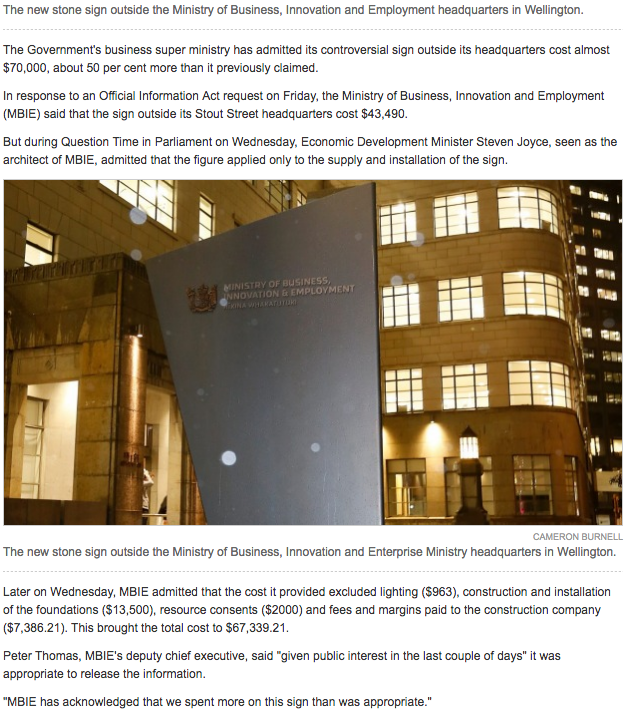
    Take the case of the Ministry of Business, Innovation, and Employment. In June, it emerged that $70,000 (not previously stated $24,000) was spent on a stone sign out the front of the building. In either case, $24,000 is a ridiculous amount.

    Fast forward to June 17, and it emerges that MBIE spends a whopping $140,000 on a curvy screen that is now in their reception area in the head office in Wellington. This is to go along with a $75,000 reception desk.

    It doesn’t just stop there though. Let’s take a look at the $26,000,000 spent on the new flag that ‘no one’ wants. I say no-one, but I may be exaggerating – much like the expenditure of this Government.

    Meanwhile, children starve, nurses go without a pay-rise, and miners face an improper burial. No amount of money should hold these things back from happening, yet picking and choosing seems to be all that happens.

    As Chris Hipkins and others have put it; this money could be better spent on other things. That’s not to say that the website shouldn’t have been rebuilt; but that this could have been carried out without spending such an unreasonable amount of money.


  • Picture Books and Literacy Learning

    I was perplexed, astonished, gobsmacked, and bewildered when I read this article this morning.

    Picture books hurt reading, says linguist Pamela Protheroe

    Read Article – Stuff.co.nz

    There are very few words I can say right now about it.
    Luckily, most of us in Education circles have gotten used to ignoring such ‘research’ and will continue to listen to trained, practising teachers who know what works, rather than these so-called ‘researchers’ who blow in and blow out of a classroom to report their findings.

    But seriously. Let’s stop for just one moment. Someone has based their research thesis on this. Countless dollars on resources, time, and all sorts to carry out this research, and for the most part, it goes against every bit of logical instincts we have.

    My first reaction was – what are the implications for schools should this research be taken on board? Book rooms around the country turned upside down, with pictures being deleted from Ready to Read books, and replaced with text-only books. Picture books being thrown onto a fire in the school courtyard outside the school library. Its just not an image you even want to imagine books and schools becoming.

    Let’s face it. We’ve all been through school where picture books were more than a staple diet. They have helped us to make sense of the world, and have scaffolded our learning of English, which is confusing at the best of times! They have provided enjoyment and fun for reading. Even today, I prefer a good picture book, and the art covered pages that bring the story to life.

    And guess what. I’m not dyslexic. In fact, many of us aren’t. And even those that I know who are dyslexic, have not only learned to adapt with this world, but have done so from a very young age; suggesting that dyslexia isn’t really something that comes to haunt us in later life like baldness or arthritis might. I’m more than sure that if this research was the least bit true, that with the copious amounts of picture books that have been read over the years, we would have countless adults complaining of suddenly developing dyslexia and getting their words and letters muddled.

    Try, just for a minute, to picture it. Where the Wild Things Are, without the beautiful scratching and muted illustrations. The Very Hungry Caterpillar without the large stenciled fruit and holes in the pages. Green Eggs and Ham without the train going through the tunnel on tracks supported by the bamboo-like truffalo trees. There is no way that these stories, without their illustrations, would remain in our minds, but more importantly, remain in our hearts.

    9985972026_54e0b07122Imagination at heart

    As for ruining imagination; I somewhat agree. I believe the imagination of young people has been harmed by the overstimulation of digital media, film, and video games. But not by picture books. Not by still images. The stationary pictures that grace a page provide just a small portion of the imagination required to gather in the entire story. There are a lot more aspects to a story than even what the picture on a page can show us. Theres movement, there’s action, there’s descriptive settings, and facial expressions. There’s reactions and emotions, all of which change and adapt with the story, something that a still image in a picture book. They rather provide a starting point and a kick start for students imaginations to build on.

    Pictures, Pictures, Pictures

    My personal favourite is a book that has no words in it whatsoever. Most likely this is because of my prejudice towards art and drawings. It’s called ‘The Arrival‘ by Shaun Tan, and it is magical. In my teaching through Daily 5, a world wide literacy programme based on in class practice, developed by teachers for teachers, one of the things that is taught is ‘three ways to read a book’. One of those is to read by using the pictures. Even I ran into problems with this when teaching older children, who are now reading chapter books which contain very few pictures!

    In Conclusion

    I guess it is quite good that this researched doesn’t have a memorable name. I can’t even remember it from the title.

    There are a few things that we need to remember. They completely dispute her findings, and lay them to rest almost instantly. Firstly, like music, pictures are a universal language for all. They tell a story on their own. They are invaluable for communicating ideas for ELL students.

    And lastly, and most importantly, I leave you with one common phrase that is used all over the world, and speaks complete truth every time it is used. And I cannot think of a more suitable time to use it than this.

    “A picture is worth a thousand words.”