Tag: testing

  • Teacher Workload: After the Standards

    There was a small sigh of relief when the Rt Hon. Chris Hipkins announced that National Standards were no longer a government requirement for primary schools to use. Okay; it was more of a large cheer than a small sigh, but suddenly we are nigh on six months from that announcement, and as a teacher, I’m not seeing much of a decrease in workload.

    Yet we’re assured that the government is working to reduce paperwork in the teaching profession.

    When announcing the scrapping of National Standards, Hipkins got rid of the four point ruler for measuring children, but ensured that teacher workload remained high. You see, he said that “Parents will still receive reports at least twice a year on their child’s progress and achievement in maths, reading and writing as well as across the curriculum areas. But this reporting will focus on children’s progress, rather than measuring them against arbitrary National Standards.” – Chris Hipkins

    So now, not only do we have to continue to report to parents twice a year (suggested at every 6 months), we are now also commenting across all of the curriculum areas.

    You see; National Standards themselves did not add any extra work to the teacher workload. We already know from day in and day out interactions with the students, whether a student is below, at, or above – and so making that call took a matter of minutes and a slightly different grey shade on the report. The issue teachers had with National Standards was largely around the barbaric way it labelled children as failures, and was too broad in its measure to show any progress students might have made.

    No; it wasn’t National Standards themselves that caused an insurmountable amount of additional workload. It was the need to report to parents formally in written form twice a year.

    Prior to that, parents would usually have a parent/teacher meeting in the middle of the year to chat about how their child was doing, and a written report at the end of the year as a summary of how well their child was doing. Evidently this wasn’t enough. Too many children were slipping through the gaps and failing. We needed to keep parents informed on their child’s progress (or lack of) so that we could catch them before they fell through.

    Except, now; with the requirement of two written reports, teacher’s workload doubled. But not just in writing screeds and screeds of reports. Teacher’s also need to gather data on each student, test them (and re-test them), anaylise their data, and compare it to an arbitrary set of benchmarks in order to see their progress. Instead of doing this at the start of the year to inform teaching and then repeating in Term 4 to write a summative report, we are now carrying out these tests throughout the year, to spread the workload out, and to be able to write two reports.

    So while the National Standards have been scrapped, their remnants still remain, and continue to add to the workload and stress being experienced by teachers across the country.

    Time for some Maths.

    In our school’s current reporting format (which is largely based off a Ministry approved/suggested template) I have written on average 105 words for each of the Reading, Writing, and Maths curriculum areas. This includes the current progress a child is making and their next learning steps. That’s 315 words per report. My current class has 31 students in it. That’s 9,765 words. Double that because we report twice a year, and add some on for a General comment on the final report, and we’re bordering on 20,000 words each year in reports. To give an idea of how much this is, a Massey University Research Report worth 60 credits should not exceed 20,000 words, and a 90 credit Thesis paper should not exceed 30,000 words.

    Every year.

    What’s the solution? There’s no easy way to say this; but getting rid of the mid year report and replacing it with parent meetings seems the only way to bring the workload back to something more manageable. In my experience, there are parents of below expectation students who are aware they are below. Parents who don’t know their child is below the expectation are usually ones who a) aren’t actively helping in any way and won’t help in any way just because it’s written on a piece of paper, or b) aren’t all that concerned. This is a generalisation, sure; but I suspect that parents who care about their child’s education are going to be aware of where their child is in relation to where they’re expected to be without the need for it to be written down in a report. I also suspect that making parents who don’t care about their child’s education aware of where their child is in relation to where they’re expected to be isn’t going to change the amount of care or effort that they are going to be willing to invest in order to make any sizeable difference.

    Therefore, the need to report twice a year is somewhat redundant. It’s created twice the workload, and stretched assessment throughout the year (instead of letting the teacher teach throughout the year) and adds to the stress without actually adding anything to education.

    Related Reading


  • Individual Testing is Killing Teaching

    When I was at school, I can’t remember ever doing a one on one test with my teacher.

    I’m not saying it didn’t happen. I’m saying I don’t remember it. I do remember being tested, in whole class tests, PAT mostly. Colouring in blank circles was fun.

    At some point, teachers or schools or ERO or MOE wanted to know more. They wanted to get more specific information on the learners, to track, to identify gaps, or simply to report against National Standards for.

    And it lead to each individual child in every class being tested individually. Each child’s strengths can be identified, and the gaps they have can then be specifically targeted. Teachers knew what each child needed, and could pass comment on this first hand to their parents or caregivers, through the wonderful National Standard reports that were sent home twice a year.

    Great.

    Except that it is unmanageable.

    28 kids in your class. That’s 28 tests, all carried out individually with the teacher. That’s 27 students who are left to quiet independent work while the teacher questions 1 child. Rinse and repeat. Let’s say that each test takes 5 minutes with the teacher, allowing for arrival, sit down, thinking time, and several correct questions that lead to more difficult ones (and therefore more thinking time) and then leaving time. At 5 minutes a test and 28 students, that’s 140 minutes of testing. 2 hours and 20 minutes to conduct one test for the whole class. 

    This of course does not account for the additional time of hushing students, interruptions, and maintaining a semblance of order over the class while trying to test one child at a time. The testing can take days, usually weeks to get through the whole class one at a time.

    This is the problem though. During those weeks, there is no teaching happening. It’s simply independent work while I test. It becomes too hard to switch between teacher and tester, and so constant switching between these two roles sends one spiralling into minor bouts of schizophrenia.

    Add in that this is one test, for one subject, say Maths. Add in Writing. Add in Reading.

    The stain of National Standards lingers on. While many schools have ditched them, the mindset of the assessments that have been left behind are still causing teachers to be testing, testing, testing – not because of the National Standards, but because of the style of assessment that schools are now using.

    There is no doubt that these tests produce a very accurate and specific picture of what each child knows and doesn’t know, and it becomes very hard to argue against. However, there needs to be some compromise, otherwise we will continue to fall into one of the two modes – teaching or testing – throughout the year.

    But why?

    Why do we test at all – in all honesty?

    In this article, there are numerous points made. Most poignantly is where it says “some countries have achieved better outcomes from their state systems by deliberately shunning standardised testing. In this informative Atlantic article, the Finnish journalist Aru Partanen cites the attributes of a Finnish school system that regularly outscores the US ( and New Zealand) in international rankings of student achievement. Among other things, Finland has no standardised testing, and no private schools at all.”

    In the opening paragraph, it raises exactly where we are at in New Zealand education right now. It says “Testing kids in the classroom sounds like a good idea. Surely that keeps tabs on how they’re doing, and identifies which kids might be falling through the cracks…and that’s all good, right? Well…except that most teachers have always done testing, have always sought to detect kids at risk, and have always managed to strike a healthy balance between teaching and testing. The issue is whether the demands to follow standardised testing procedures (and the practices and attitudes that go with them ) may now be poisoning the whole environment for learning.”

    This was written in 2013. Five years ago. I had been teaching for three years. Now five years later, and approaching a decade in the classroom, I am still teaching and then testing. Now, with the removal of national standards, we have the opportunity to make a change. Something has to change.

    I didn’t become a teacher to make kids sit tests, or even interview kids about what they know and if they can tell me different ways of solving the same problem. I didn’t become a teacher to spend hours on end analysing data and working out what kids don’t know and feel guilty for how much more I should be working.

    I became a teacher to teach. I became a teacher to help kids learn.


    Related Reading
  • Assessment Assessment Assessment

    In the current education climate, teachers are finding themselves with the responsibility of making OTJ’s (Overall Teacher Judgements) to report to parents about their child’s academic achievements, but the requirement to have evidence for these judgements. These are rarely school imposed, but instead come from the likes of the Ministry of Education or ERO, who continually ask “How do you know that?” type questions in relation to National Standards data, with schools only being able to say “because of the test results” as a viable and measurable response. Therefore schools are asking teachers to assess their students using a range of different school-set assessments.

    When I think of assessment, I usually can’t get pass the first three letters. It’s tedious, a bore, and whilst I enjoy analysing data from them, they are generally a waste of time when I consider what I could be doing – working alongside students, engaging with them, insipring them, and unleashing them.

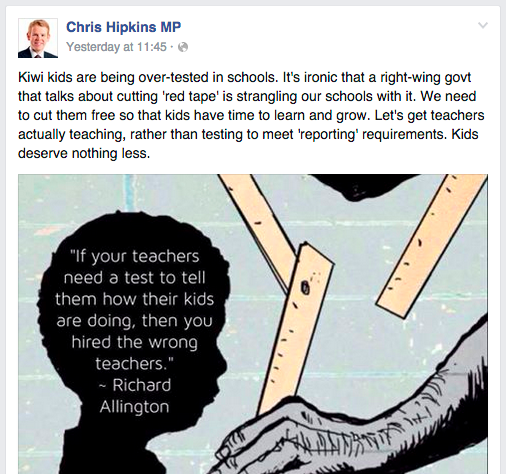
    Chris Hipkins wrote an interesting post about Kiwi kids being over tested. He says:

    Kiwi kids are being over-tested in schools… Let’s get teachers actually teaching, rather than testing to meet ‘reporting’ requirements. Kids deserve nothing less.

    It has been an issue I’ve noticed increasingly in my career. Whether it’s because I’m male, or because it’s genuinely difficult to do, I find that to test the entire class, I have to shut down the learning programme and go into ‘Assessment Mode’. I find I don’t do any actual “Teaching” during this time, more just provide suitable ‘practise’ type activities for students to work on independently while I repeat 1-on-1 testing. I can’t do both ‘assessment’ and ‘teaching’ at the same time. As a school, we are now moving away from whole-class testing because it gives a very limited view of the student’s abilities. But this means that more 1-on-1 testing is required. This can take 3 to 4 days to complete with a class of 28.

    I wrote a reply to Chris’s post that expressed my ideas:

    Thanks Chris for this! I’m a primary teacher and I’m constantly going into “assessment mode” to get through the entire class, that sometimes I wonder if I’m actually teaching them anything! By the time I’ve finished one lot of assessment, the next lot is on my desk!
    I feel that if I were able to work constantly alongside my students; encourage, inform, correct, show, teach, and build genuine learning relationships with them that I’d have a much better understanding of them as individuals and thus understand what they need in their learning. Any assessment should only be to confirm what teachers already know about their students.

    And that’s just it. If teachers were given the trust that a) they deserve, and b) that is required to make OTJ’s in the first place, then I’m sure that there would be better outcomes for all students. We are told constantly that teaching and learning is all about relationships, but I fail to see how sitting tests and being assessed builds any kind of meaningful learning relationship between student and teacher. Secondly – spending time working with these students and teaching them will only enhance my ability to make a judgement.
    We are showed the assessment pyramid regularly in P.L.D (Professional Learning & Development), and it still staggers me that things remain the same. The assessment pyramid works a lot like the food pyramid, with the top tier representing assessment that, whilst is usable, should not make up the bulk of assessment used in the classroom. The bottom tier represents assessments like teacher observations, anecdotal notes, conversations, discussions, behaviours, troubles, problem solving, which should be use more frequently. Yet the rate of importance placed on assessments is opposite. Those that fit down the bottom of the pyramid which should happen daily and make up the majority of our assessment as teachers, is given the least importance, while those at the top which happen once or twice a year, are relied heavily on when schools are asked to “prove it” by Ministry or ERO officials.

    Chris finished up his post by replying with a disclaimer that he in no way intends for there to be NO form of assessment, just that “…there is too much testing for ‘compliance’ rather than to genuinely inform the next steps in a child’s learning.”. And I wholeheartedly agree. If all we are doing is relying on test results, weighing the pig time and time again, it’s not going to help the students. Further to this is the issues happening in education overseas.

    Teachers in the U.S. have the common core to teach and to contend with where the success of the students in their class directly relates to their school image. What has ended up happening? Teachers preparing students for the test; not actually teaching them.

    My old Principal was so enamored by an awarded Title I school for bringing up test scores. Their formula? Test prep. We copied and plummeted.” – @TeacherReality

    It is highly tempting to give students practise at sitting tests, or answering similar questions over and over again, in order to boost their test score by being able to answer similar questions. But this in no way is why we became teachers. We didn’t become teachers to give test-like questions, show helpful formulas to solve test-like problems, or show them practise tests to help them pass a ‘real’ one. No. We became teachers because we wanted to impart knowledge, to inspire and to encourage, to challenge and watch students struggle in the hope that one day, one day, they would be able to apply themselves in life and succeed.

    As I write this, I find myself thinking; “I know all this, and say all this, but hypocritically find myself in class administering tests. Why!?”. Well, mostly this is because of the school having certain requirements (from external or internal pressures) of the teachers, as most schools around the country will have. So what can be done? What can I do as a teacher?

    These are genuine questions. I don’t have the answers. I have the ideal – which is to make observations and notes the most important and reliable source of information about student learning available. It means teaching and working alongside students. And so I must do that. I must make that a priority. I won’t be able to avoid the summative tests at all, but I can certainly try to maximise the time I do have to assess informally, and use these with more prominence than a one off test.

    How do you manage the balance of testing vs. teaching? What restrictions are placed on you by school or external sources in terms of assessment? How do you deal with that? What suggestions do you have for others? Please leave your comments below.