Tag: twitter

  • A Twitter Conversation: May 2019

    A Twitter Conversation: May 2019

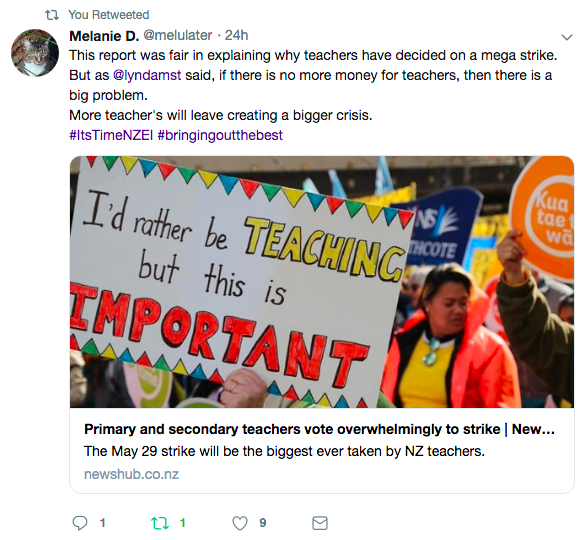
    ​School teachers and principals across the country have agreed to stage New Zealand’s largest-ever strike as negotiations with the Ministry of Education continue to stall.

    The Post Primary Teachers’ Association (PPTA) and New Zealand Educational Institute (NZEI) Te Rui Roa announced the move on Sunday, and said rolling strike action was also possible.

    Ths strike, on May 29, will involve almost 50,000 primary and secondary teachers and primary principals, and will affect hundreds of thousands of students in more than 2000 schools.

    https://www.stuff.co.nz/national/education/112655087/teachers-have-voted-to-strike-on-may-29


    The Conversation

    Obviously there has been a lot of reaction to the recent vote to hold a mega strike, and a lot of this reaction has been documented on Twitter. I wanted to collect this reaction and keep a record of it in our blog. I have come to realise that I value the posts on this site, but often a lot of conversation happens on Twitter and then falls off into the Twittersphere.


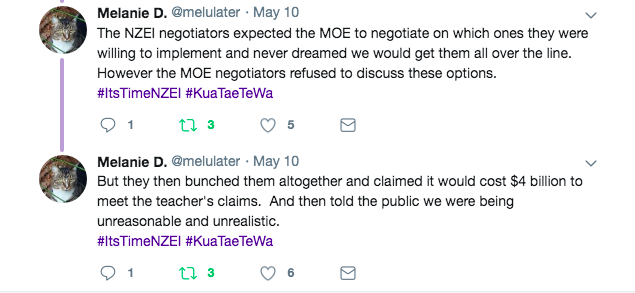
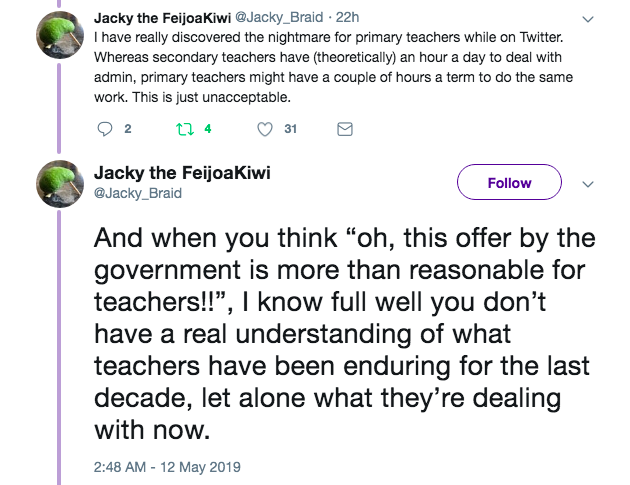
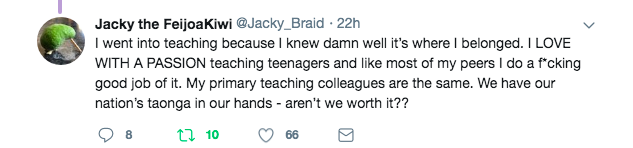
    • The crisis is real, and it’s spreading. And the more who leave, the more work has to be picked up by other all-ready-stressed teachers. And thus the crisis is exponentially growing. And all the government is prepared to do is start training replacements!?
    • In all of these pay negotiations, not once have teachers been asking for anything that is unreasonable… It’s not like we’re asking for a slushy machine in every school!
    • Come on … Make history. Be the one MP to stand up for teachers and get them what they deserve. Show the public the importance of education in this country. Go on. I dare you!
    • So it’s not that the government CAN’T meet what we’re asking for…. it’s that they WON’T.
    • Kinda think that the Teacher Unions need to start playing hardball. Indefinite strike would soon get some results. Look at the bus drivers….

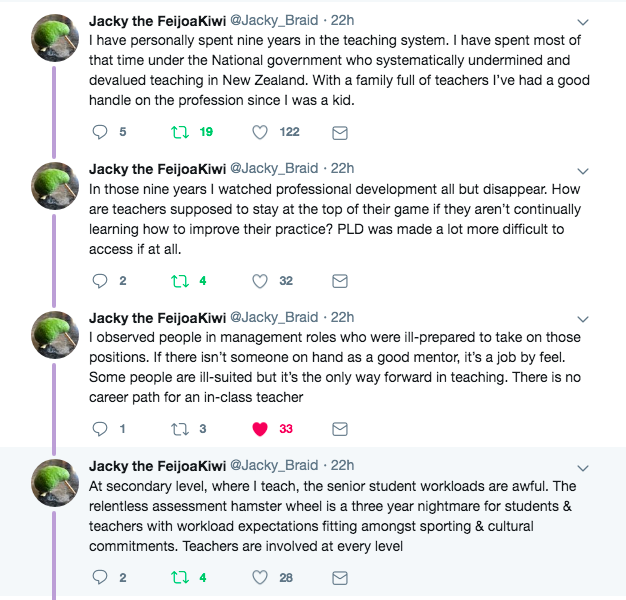
    • Started putting my thoughts down about teacher workload into a tweet…. ran out of characters and lost all energy and enthusiasm for continuing. A story all too common for lots of teachers at the moment!
    • Essentially here’s what would solve a lot of problems: • Pay Teachers more, because we’re worth it and we deserve it. • Shrink class sizes, because with less students comes less work but more teaching. • More SENCO resourcing, because there are more needs than ever before.
    • Shrinking class sizes is key. Less reports to write, less assessments to do, less paperwork to compile. More time for each student. More genuine relationships. More teaching. More jobs available for the additional teachers that come back into the workforce!
    • For me; class size plays a huge role on the teacher. For the last few years I’ve consistently had over 31 students in my class. Believe me; when there are 6 away and the class is only 25; it makes a HUGE difference in the way the classroom feels, acts, and learns.
    • For me, having more time in itself doesn’t sort anything out; it means time out of class if anything. What I need is less students in front of me which will in turn give me more time for each one. It also lessens the time I need for assessments, reports, planning etc…. win win!

    • I left the union at the end of last year. Not regretting it. They should be doing a LOT more given the circumstances, and a clear plan seems to be lacking. Seem to be floundering in too many ideas rather than laying out a “game” plan for teachers and the government to follow!
    • So why did the Ministry turn up to the last round of negotiations with NZEI with no new offer? Took active teachers and leaders out of their classrooms, made them organise relievers, sort out transport… for what!? No new offer!? How disrespectful.

    • Let’s face it. I am a teacher. No government is ever going to be able to pay me what I’m worth. I knew this going into the profession. But come on… at least you could try and show me I’m valued
    • Quick question … Why has class size not been a major negotiating point as a way of reducing workload? Teachers are definitely asking for this!!!

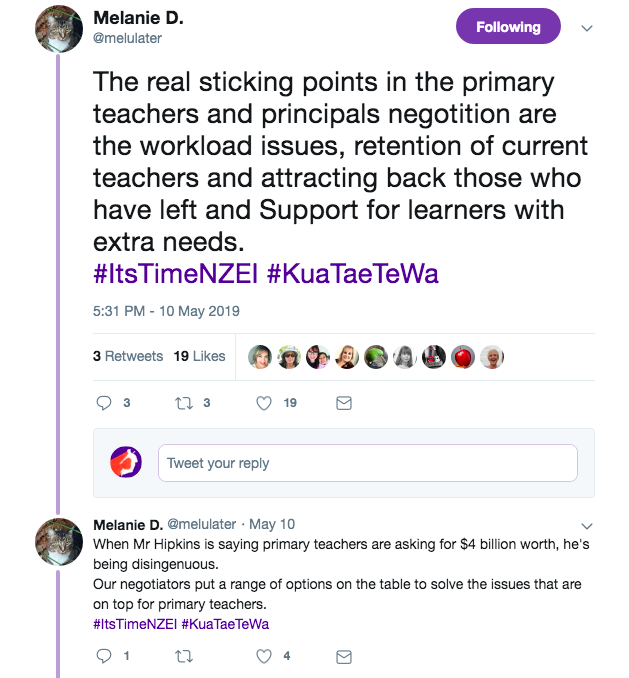
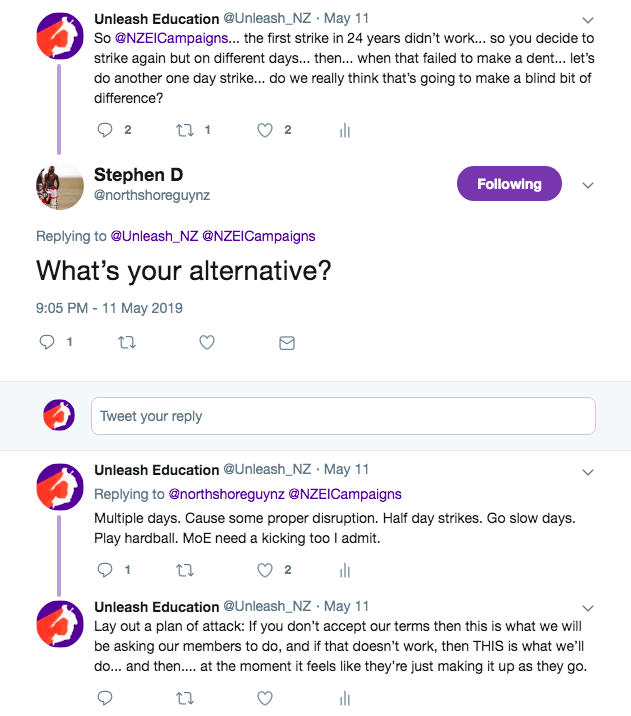
    • So … the first strike in 24 years didn’t work… so you decide to strike again but on different days… then… when that failed to make a dent… let’s do another one day strike… do we really think that’s going to make a blind bit of difference?
    • Multiple days. Cause some proper disruption. Half day strikes. Go slow days. Play hardball. MoE need a kicking too I admit.
    • Lay out a plan of attack: If you don’t accept our terms then this is what we will be asking our members to do, and if that doesn’t work, then THIS is what we’ll do… and then…. at the moment it feels like they’re just making it up as they go.
     

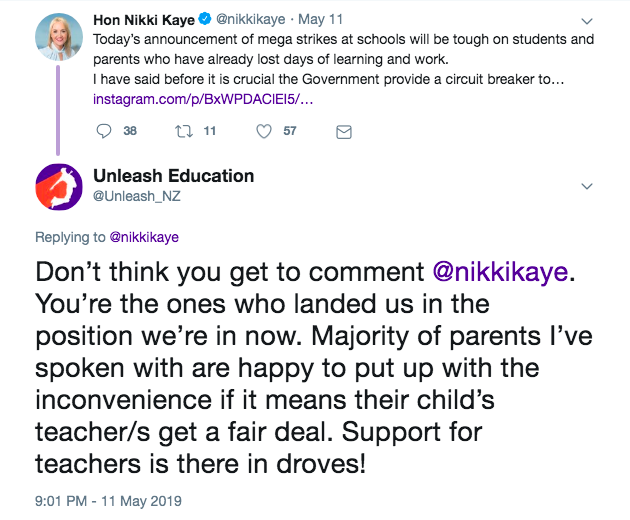
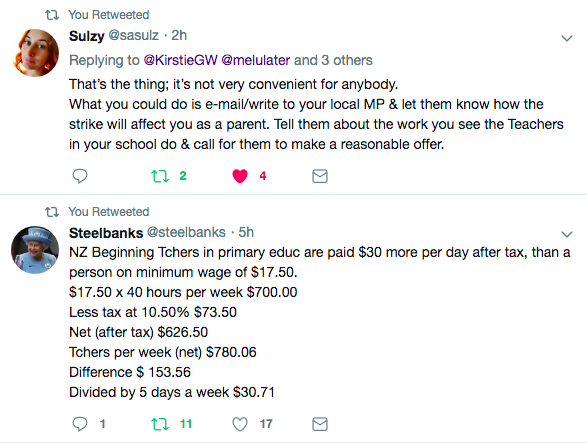
    • Don’t think you get to comment . You’re the ones who landed us in the position we’re in now. Majority of parents I’ve spoken with are happy to put up with the inconvenience if it means their child’s teacher/s get a fair deal. Support for teachers is there in droves!
    • But seeing as you do get to comment; what would National’s offer be if you were still in Govt?
    • I also find your teacher ratio comments hard to believe, given Hekia wanted to raise them through the roof. If I were you I’d be offering apologies and then begin making things right rather than trying to blame the ones who came after you for the monster you created.
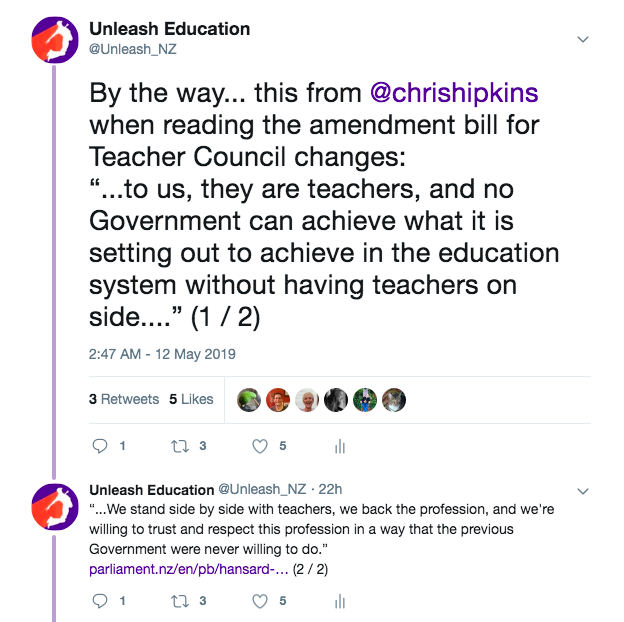
    • By the way… this from when reading the amendment bill for Teacher Council changes: “…to us, they are teachers, and no Government can achieve what it is setting out to achieve in the education system without having teachers on side….” (1 / 2)
    • “…We stand side by side with teachers, we back the profession, and we’re willing to trust and respect this profession in a way that the previous Government were never willing to do.” (2 / 2)


  • The Success (and failure) of Social Media in Education

    Let’s face it. With the advent of Facebook, the world got smaller. We made connections with anyone and everyone. This was then increased with Twitter, where 95% of the people I now follow I have never met in person. As humans, we crave interaction, but for many of us, prefer to do this in the comfort of our own homes.

    With the ‘Social Media’ organising and integrating itself with our social lives, it is no wonder that people have begun to form personal and professional relationships with others.

    Earlier this year I began to separate my personal and professional face online. There were a number of reasons for this, least of all in an attempt to not let my work and home life become too unbalanced. As teachers, we are well aware of the fact that it is almost impossible to ‘switch off’ thinking about our class, our students, or our profession, and anything to help me to do this is a good thing. Having the education world infiltrating my personal twitter account, or clogging up my Facebook feed was hindering such progress.

    In all of this, I am a firm believer in using the right tool for the job. Don’t get me wrong – I am also a New Zealander, and so built into my DNA is the innate desire to be creative with the use of certain tools and materials that lends more to a creative mindset. But at the end of the day, while you could play golf with a hammer (you should try it!), the hammer is still going to be best used to knock in nails.

    I was reminded of this when viewing a post asking what people thought of Pond, and why people flocked to a Facebook group to share resources and ideas, rather than use this new initiative by Network 4 Learning.

    The reasons were neither here nor there, with some being the annoyance of having to log in to yet another website (oh the hardship), but more concerningly, was the fact that they saw it as sterile and empty, with little interaction or use.

    Unfortunately, these people have missed the point of Pond. They’ve assumed that it is another social media, and thought ‘Why would I need another social media when Twitter and Facebook suit my needs?’. Well, put simply; Pond is not a social media. It is a database of resources in a central location. Think of it a bit like Pinterest.

    The social aspect of Pinterest is no way near as prevalent as Facebook or Twitter. But Pinterest definitely serves a purpose, and many, many teachers use it daily to gather ideas, inspiration, and resources.

    So why do I need Pond? Why not just use Pinterest? Well, it comes back to using a tool for its purpose. It also comes back to the sense of ‘New Zealandness’. Pond has been developed by New Zealanders. The resources are supplied by New Zealand teachers, for New Zealand teachers. While the log-in provided a turn off for some users, the reason behind using the Education Sector Login was so that this resource remains only for teachers (you have to admit, there is some comfort in knowing that). In addition, Pinterest includes EVERYTHING, and anything, whereas Pond will be providing teacher and education specific resources that have been tried and tested in the New Zealand classroom. Don’t get me wrong; Pinterest has its place. People can become creative and adapt and change it and use it for different aspects, build Boards for just Education or Teaching resources and more. But I believe that Pond has more to offer the New Zealand teacher in the long run, purely because that’s its core function and focus. That’s what it has been designed for.twitter-292994_1280
    I kind of think of it as shopping. At the Warehouse, they have a lot of stock, and a wide variety of every product you probably want. It certainly has its place and is a one stop shop for most people. But if we’re honest, we probably wouldn’t purchase a wedding ring from there. You’d go to a specialist jeweller. Likewise, while Pinterest has everything under the sun and works on the same principles, if its Teacher resources from New Zealand teachers, I believe you’ll get better results (even if you have to pay a bit more for it!)

    Making them Separate

    So, although the lines are constantly blurred between work and home, especially with teaching, there are a series of steps that you can follow to help keep aspects of it separate.

    • Create a different Twitter account for your work. This helps with a range of situations – including having parents or students following you. It limits your feed to other Teaching Professionals, and focuses your tweets on education related things. Managing multiple accounts is the hardest part of it, but with Hootsuite, and Tweetdeck, one can overcome this with relative ease.
      Mention your new account to your current education based followers, and then eventually get around to following them all back on your new account. Then gradually remove them so you can keep your personal and work related accounts separate.
    • Make a separate category or WordPress Multisite for your teaching posts. I used to include all my posts and thoughts and ideas in my own personal website. But my profession is somewhat unrelated to who I am as a person, and it begins to separate them out. As with twitter, it also helps focus the energy of my posts to a specific topic.
    • Facebook has always been for people I actually know, or have met. The only teachers I have on there are those I work with each day, those I trained with, or those that are friends who also happen to be teachers. One way I could see that you could keep things slightly separate would be to either create a separate account, or create a Page for yourself as a Teacher.

    Whilst it can seem like a bit of a mission to separate them out, especially if you’ve already started building your online following base, I have found it really refreshing to begin to build a void between these accounts in attempt to leave work and work before I come home. Likewise I don’t have Education and Teaching infiltrating my personal feeds when I’m browsing in my down time.


    Twitter vs Facebook

    social-iconsI for one am not going to get involved in a Twitter vs Facebook vs Pinterest vs Instagram vs anything. All have their value, and you can decide for yourself which you like and which you don’t. But for mine, I have a number of reasons I prefer to use (and refer to) Twitter for teaching and education.

    Firstly, Facebook was designed to connect people with people. Comments, posts, replies, and likes, all come from people, and go to people. While ideas and resources can get published here, and you can get inspiration from them, it seems to me to be a bit forced. Especially annoying are the notifications which constantly come up from groups that you belong to.Like using a hammer to chisel a notch out of a piece of wood. You can do it, but it’s easier to get a chisel.
    Twitter however shares the net with people. You can easily enter links straight away and put it out to EVERYONE, not just your friends or people who are part of a group. Those that wish to follow you (for the most part) can. And you can follow them back. This allows you to connect with people with a common interest. You can seamlessly pass on content, and by mentioning their handle, quickly reply or message them in an open conversation. Its a lot less formal and a lot more open and free to use it for all your purposes.

    Following a #hashtag also helps, and there are several “chats” that happen weekly which are open to everyone. All you have to do is search for the hash, and join in!

    So that’s my guide to Social Media and Teaching. No doubt, others will have their views, and will use what you use. This is merely my own observations as to what works for me.