Tag: workload

  • Teaching Portfolios: Making them Work

    Even though they are not required by the Teaching Council, many schools use Teaching portfolios to show evidence that a teacher is meeting the criteria and standards for registration, and therefore can be signed off when their registration comes up for renewal.

    The format of appraisal and the keeping of portfolios has been a bug-bear of teachers for a while now, with the increase of workload in collecting evidence and putting it in a portfolio for something that is not actually required.

    However, I argue that portfolios are a good way of keeping records of your teaching career and can help make you a more reflective teacher in the process. I think that they would be worth maintaining even if they are not required.  While I acknowledge there is a bit of work required to keep it, there are several ways in which you can streamline the process so that keeping a portfolio is no longer a burden or a time-sapping exercise.

    The following are several keys to success that I’ve found along the way so that keeping and maintaining your teacher portfolio.

    Rule 1: Make it work for you; instead of you working for it…

    The number one thing you need to do when making your portfolio is to make it work for you.

    What does this mean?

    Put simply, choose a system, a method of keeping evidence, resources, materials, artefacts that is natural to you. If you’re a hands on person who prefers hard copies of things, then use a clearfile or lever-arch folder, or even a cascading folder.
    If you keep a lot of your teaching work in Google Docs, or use Google Drive a lot, then create a folder for evidence and put all the files in there.
    If you put a lot of your teaching work online, then you could set up a blog or website.

    Choose a system that works for you

    • Clearfile
    • Lever-arch File
    • Cascading Folder
    • Cardboard Box
    • Google Drive Folder
    • One Note Notebook
    • Google Site
    • Website
    • Blog

    You can find out more about each of the main ways to organise your portfolio at the following articles:

    Date Based Portfolio

    Standard Based Portfolio

    Organise it how your brain works

    Following on from the previous point on making it work for you: Setting up your portfolio in the way that your brain operates means that organising and maintaining your portfolio will be second nature to you rather than battling with yourself internally each time you come to update it.

    There are two main ways in which you can organise your teaching standards portfolio:

    • Date Based
      This consists of folders or sections labeled by date (ie. 2018, 2019, 2020). In each folder you put evidence of your teaching practise as it happens.
    • By Standard
      This consists of creating a set of six folders or sections, one for each of the six teaching standards. As you create each piece of evidence, simply put it in the folder that it best suits.

    Obviously there are other ways as well. I’ve found the best to be a combination of these two ways. It doesn’t matter really how you choose to organise it, as long as whichever way you choose is how your brain best processes a portfolio of this kind.

    Robust yet Flexible

    It wouldn’t be a blog about teaching without a bit of an oxymoron in it. When you set up your portfolio, make sure whatever system you choose to organise it in is robust. Stick to it, and keep it consistent. At the same time however, be flexible enough to adapt it to fit your needs as you go. Don’t be afraid to try new things, reorganise it or adjust it as you need to. Remember, the first rule is key: this HAS to work for you. As soon as it doesn’t, you’re working for it and it become cumbersome.

    Tags Are Your Friend

    One thing I have found the more and more portfolios I have made over my years as a teacher is that you need a way to tag or categorise each piece of evidence. Regardless of whether you go with a date based or standards based approach, having a system of tags will save you a lot of time. Using tags avoids the problem mentioned next.

    Avoid doubling up

    There is nothing more demoralising to a teacher (or anyone for that fact) than having to do something twice.

    Therefore, ensure that you only have to enter evidence into your portfolio once. The use of computer based portfolios certainly helps with this, especially with evidence that fits under multiple standards.

    Avoid doubling up

    There is nothing more demoralising to a teacher (or anyone for that fact) than having to do something twice.

    A very good portfolio will find a way in which you can keep your work organised when you create it AND enter it into your portfolio at the same time. This is somewhat of a pipedream, though definitely possible. Essentially this is where flexibility of your system is key, as this wouldn’t be possible for every piece of evidence, but definitely a possibility for some.

    Keep an eye out for more…

    We will be adding more Teacher Portfolio ideas, tips, tricks, and how-to guides in the near future. Check back here for more!

  • A Twitter Conversation: May 2019

    A Twitter Conversation: May 2019

    ​School teachers and principals across the country have agreed to stage New Zealand’s largest-ever strike as negotiations with the Ministry of Education continue to stall.

    The Post Primary Teachers’ Association (PPTA) and New Zealand Educational Institute (NZEI) Te Rui Roa announced the move on Sunday, and said rolling strike action was also possible.

    Ths strike, on May 29, will involve almost 50,000 primary and secondary teachers and primary principals, and will affect hundreds of thousands of students in more than 2000 schools.

    https://www.stuff.co.nz/national/education/112655087/teachers-have-voted-to-strike-on-may-29


    The Conversation

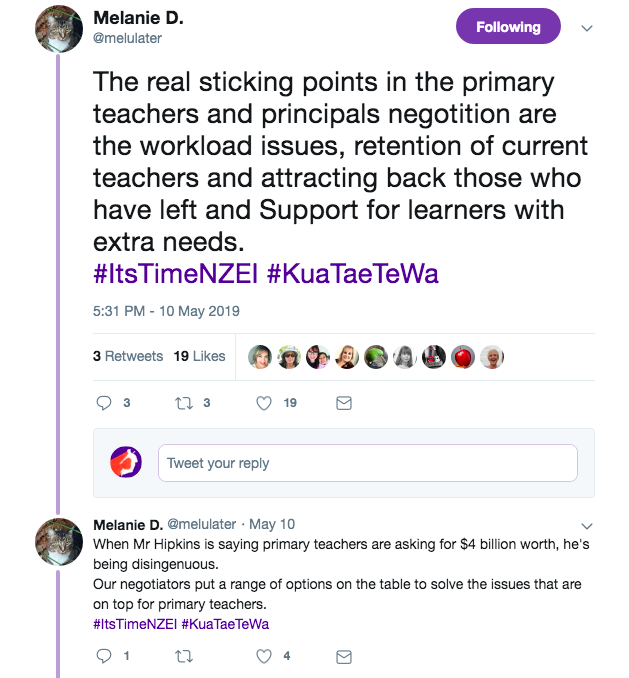
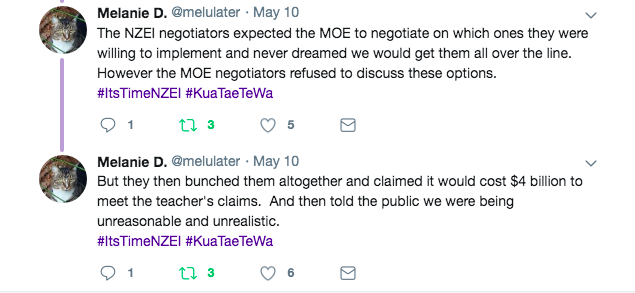
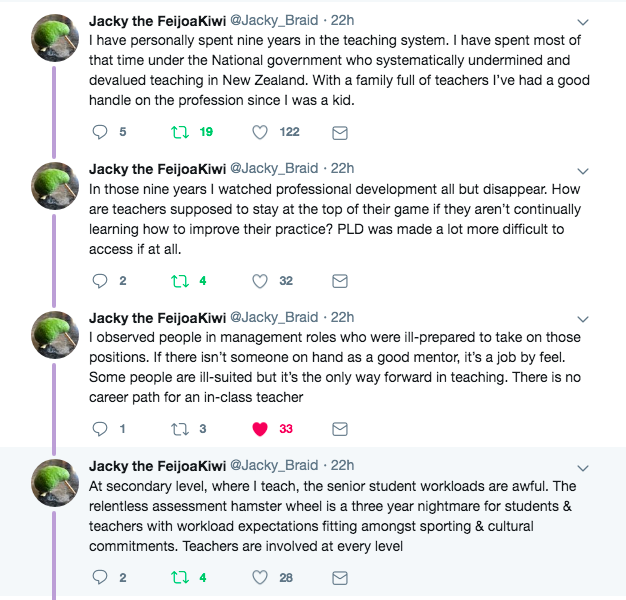
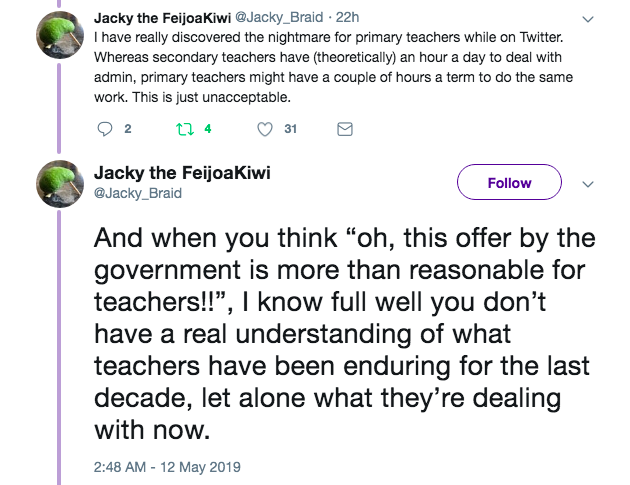
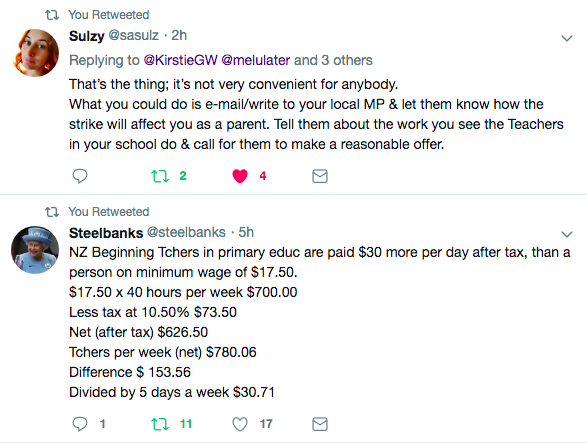
    Obviously there has been a lot of reaction to the recent vote to hold a mega strike, and a lot of this reaction has been documented on Twitter. I wanted to collect this reaction and keep a record of it in our blog. I have come to realise that I value the posts on this site, but often a lot of conversation happens on Twitter and then falls off into the Twittersphere.


    • The crisis is real, and it’s spreading. And the more who leave, the more work has to be picked up by other all-ready-stressed teachers. And thus the crisis is exponentially growing. And all the government is prepared to do is start training replacements!?
    • In all of these pay negotiations, not once have teachers been asking for anything that is unreasonable… It’s not like we’re asking for a slushy machine in every school!
    • Come on … Make history. Be the one MP to stand up for teachers and get them what they deserve. Show the public the importance of education in this country. Go on. I dare you!
    • So it’s not that the government CAN’T meet what we’re asking for…. it’s that they WON’T.
    • Kinda think that the Teacher Unions need to start playing hardball. Indefinite strike would soon get some results. Look at the bus drivers….

    • Started putting my thoughts down about teacher workload into a tweet…. ran out of characters and lost all energy and enthusiasm for continuing. A story all too common for lots of teachers at the moment!
    • Essentially here’s what would solve a lot of problems: • Pay Teachers more, because we’re worth it and we deserve it. • Shrink class sizes, because with less students comes less work but more teaching. • More SENCO resourcing, because there are more needs than ever before.
    • Shrinking class sizes is key. Less reports to write, less assessments to do, less paperwork to compile. More time for each student. More genuine relationships. More teaching. More jobs available for the additional teachers that come back into the workforce!
    • For me; class size plays a huge role on the teacher. For the last few years I’ve consistently had over 31 students in my class. Believe me; when there are 6 away and the class is only 25; it makes a HUGE difference in the way the classroom feels, acts, and learns.
    • For me, having more time in itself doesn’t sort anything out; it means time out of class if anything. What I need is less students in front of me which will in turn give me more time for each one. It also lessens the time I need for assessments, reports, planning etc…. win win!

    • I left the union at the end of last year. Not regretting it. They should be doing a LOT more given the circumstances, and a clear plan seems to be lacking. Seem to be floundering in too many ideas rather than laying out a “game” plan for teachers and the government to follow!
    • So why did the Ministry turn up to the last round of negotiations with NZEI with no new offer? Took active teachers and leaders out of their classrooms, made them organise relievers, sort out transport… for what!? No new offer!? How disrespectful.

    • Let’s face it. I am a teacher. No government is ever going to be able to pay me what I’m worth. I knew this going into the profession. But come on… at least you could try and show me I’m valued
    • Quick question … Why has class size not been a major negotiating point as a way of reducing workload? Teachers are definitely asking for this!!!

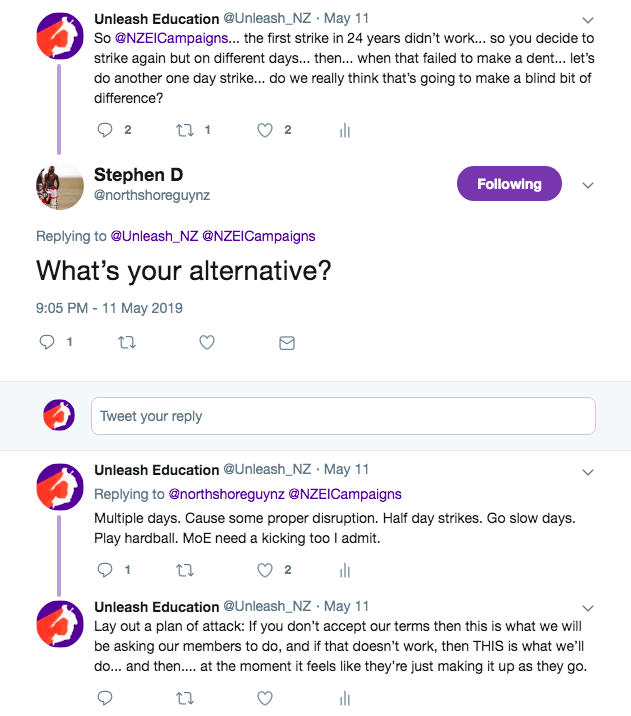
    • So … the first strike in 24 years didn’t work… so you decide to strike again but on different days… then… when that failed to make a dent… let’s do another one day strike… do we really think that’s going to make a blind bit of difference?
    • Multiple days. Cause some proper disruption. Half day strikes. Go slow days. Play hardball. MoE need a kicking too I admit.
    • Lay out a plan of attack: If you don’t accept our terms then this is what we will be asking our members to do, and if that doesn’t work, then THIS is what we’ll do… and then…. at the moment it feels like they’re just making it up as they go.


    • Don’t think you get to comment . You’re the ones who landed us in the position we’re in now. Majority of parents I’ve spoken with are happy to put up with the inconvenience if it means their child’s teacher/s get a fair deal. Support for teachers is there in droves!
    • But seeing as you do get to comment; what would National’s offer be if you were still in Govt?
    • I also find your teacher ratio comments hard to believe, given Hekia wanted to raise them through the roof. If I were you I’d be offering apologies and then begin making things right rather than trying to blame the ones who came after you for the monster you created.

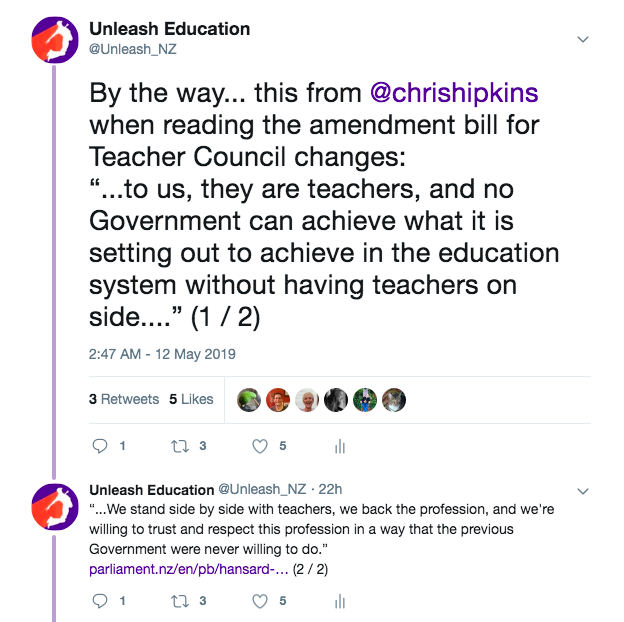
    • By the way… this from when reading the amendment bill for Teacher Council changes: “…to us, they are teachers, and no Government can achieve what it is setting out to achieve in the education system without having teachers on side….” (1 / 2)
    • “…We stand side by side with teachers, we back the profession, and we’re willing to trust and respect this profession in a way that the previous Government were never willing to do.” (2 / 2)


  • Automatic Google Drive student notifications

    As a teacher, I’m constantly looking for ways to make my life easier. The computer is but a tool to use, and it can be used to do many menial tasks that we often end up doing manually or doing ourselves. Because of this, I’m a huge proponent of the saying “Work smarter, not harder”. We can free up additional time and systems by simply handing these over to the computer to do.

    One of the great things that Google Suite has is the ability for students to share their work with the teacher. At first I was hesitant to hand out my teacher’s email address, but since doing so, I have students sharing their latest work with me almost automatically, and providing feedback in this way is really valuable. Further to this is their ability to collaborate together, and this year I am wanting to utilise the function of shared folders more.


    To do this, I wish for students to put any file or creation into a shared folder. This then becomes easier to keep track of all of their work. The main problem with doing this of course is that you never know when a student has added a file to the folder or not, meaning you have to keep visiting the folder and checking it yourself.

    Welcome to Zapier.

    With Zapier, I can set it up so that when a file is added to a particular folder (i.e. classroom Shared folder) it will email a notification to me.

    With Zapier you can set up automate processes between different services.

    One of those is between Google Drive and Gmail.

    Simply connect up your accounts, then select which folder you want to “watch” and which email you’d like to be notified.

    Then, whenever that folder gets a file added to it, you will receive an email. Share this folder with your class and wait for students to start dropping their files into it.

    Done!

  • How my school takes the stress off teachers

    My school has found ways to reduce the workload burden on teachers – while also helping us become more effective in the classroom.

    We all know that stress is a problem in teaching, with workloads and other pressures affecting the health of many across the UK. But I’ve experienced a variety of different approaches to teaching during my career, and I’ve seen that working long hours doesn’t necessarily equal better performance in the classroom.

    At my current school, Torquay Academy, I’ve noticed that staff are far more positive about the impact they’re having on their students than those in previous schools. While it’s difficult to measure staff wellbeing in a statistical sense, staff absence levels are at a record low, which suggests that stress levels are manageable. Our recent Ofsted inspection [pdf] noted that staff take pride in being part of the school and “overwhelmingly” support the principal’s leadership. Meanwhile, our results have improved for the third year running.

    A common approach to lessons gives teachers control

    Our teachers are allowed to talk, and our students are expected to listen. Influenced by Doug Lemov’s Teach Like a Champion strategies, there is a strong focus on teachers embedding structured routines into their lessons so students are clear about what is expected of them. Teachers are almost universally given their subject specialism to teach. Within the structure of the lesson, teachers are encouraged to allow their passion for the subject to drive the narrative of the lesson, instead of spending hours planning bite-sized activities.

    There is a strong correlation between the introduction of these methods in 2014 and the improved results. As teachers have gained increased confidence in their use, results have increased year-on-year, with significantly more students leaving school with five A*-C in 2017 (75%) than in 2014 (28%). Of course, there have been other factors, but placing what happens within the classroom at the centre of all we do has certainly been the most significant.

    We have an efficient whole-school behaviour policy

    We believe the most effective behaviour management tool in any teacher’s repertoire is praise. Success by students at our school is celebrated at every possible opportunity, and those who get it right are noticed and acknowledged.

    When a student’s behaviour impacts on others, the issue is dealt with swiftly. Crucially, it’s not down to individual teachers to set or follow up detentions; this is managed centrally by an assistant principal dedicated to behaviour. Teachers simply need to speak to the child after school, and make a phone call home to inform parents.

    Find out more here.

    Source: https://www.theguardian.com/teacher-network/teacher-blog/2017/sep/22/how-my-school-takes-the-stress-off-teachers

  • Teachers commit to action, if needed, to free teachers to teach

    Primary teachers and principals have committed to taking action next year in order to give every child more teacher time, and attract more people to teaching.

    At their annual conference in Rotorua today, members of NZEI Te Riu Roa committed to fighting for pay and workload changes that will help retain and recruit teachers, and free teachers to teach.

    Collective agreements for primary principals and teachers are up for negotiation in the middle of next year.

    “Children go to school to learn the critical skills and abilities they’ll need when they grow up, and for that they need teachers to have time to teach,” said NZEI president Lynda Stuart.

    “Right now, children are missing out on some opportunities to learn because their teachers are bogged down in administration and testing, or are struggling to get support for children with additional needs.

    “To make matters worse, children are increasingly in doubled up classes because their school can’t find enough teachers.

    “Teachers and principals are fed up with seeing children miss out on the education they deserve and we’re tired of trying to hold the system together when it’s broken.

    “It’s time to get serious about giving our children the best education in the world and to focus on what’s really going to make a difference.

    Source: Teachers commit to action, if needed, to free teachers to teach

  • ERO strikes again. Seriously!?

    In their latest document of propaganda, ERO have made the following recommendations for schools to work towards improving the way they deliver education for their students. It is, however, only in draft format in it’s present state, but makes pretty clear the direction that they’re heading. It’s called “Effective School Evaluation”. Within it they have a table which includes examples of shifts in practice that schools have made to improve outcomes for learners. Their words, not mine.

    In it, they have different headings and different recommendations within each one. I’ve had a quick perusal through them, and there are a few that stand out that I wish to bring to your attention.


    Educationally powerful connections and relationships

    FROM: 15% attendance by parents and whānau at interviews – TO: 85% after introducing a whānau tutor system and giving parents and whānau a 20 minute interview with one teacher.

    Shifting from 15% of parents and whānau turning up to 85% turning up is not as easy as writing it down in a statement and assigning a “whānau tutor” . I’m not sure where ERO get their 15% of parents turning up for interviews, but I can only assume that it was from a school who was REALLY struggling.

    15% of a class of 28 (the current funding ratio for class sizes) is 4.2 families. At a meeting of 10 minutes each, this impacts on a teacher of…, wait for it,  42 minutes of additional non-contact time expected of teachers.

    ERO would like to increase attendance to parent-teacher interviews to 85% through the use of ‘whānau tutors’. Who will these tutors be? You guessed it – teachers. Who else is there?
    What will we be expected to do? And how will that ensure that parents come to teacher meetings if they are busy, or can’t make it, or are sick or looking after the tamariki? Seriously. It’s almost like ERO have no touch on reality.

    ERO also mentioned that the expected length on such meetings would be 20 minutes so that discussions can be in depth and meaningful.

    85% of a class of 28 (the current funding ratio for class sizes) is 23.8 families. At a meeting of 20 minutes each, this impacts on a teacher of…, wait for it, 476 minutes. That’s a total of 7 hours and 55 minutes additional time expected of teachers.

    Now; let us assume that in an alternate universe where teachers would be paid by the hour, and the pay rate would be on par with other trades at $80 an hour. We can safely assume that this would happen after school hours, so we’d have to pay time and a half. However, let’s be generous and just charge out the usual rate (That is the usual treatment of teachers time these days anyway!).
    So at $80.00 an hour, for 8 hours, that is $640 per teacher. That’s just for the interviews. That does not take into account the “whānau tutoring” that will also be expected of teacher’s time. I’m not sure when I last had 8 hours of additional time in my already jam packed schedule. Or are we expected to come back on the weekend to meet with parents?

    This goes along the same lines as a PacT Tool Workshop that I attended, in which they said that it’d probably take 25 minutes for each child when you first start doing it. I worked that out at the meeting and it was the turning point in my support for it. It worked out to be an additional 11 hours just to create an OTJ for every student in the class; something that should take no more than 30 minutes in my opinion.


    Responsive Curriculum, effective teaching and opportunity to learn

    FROM: Teaching Writing – TO: Teaching Writers

    Move from Teaching Writing to Teaching Writers.

    They think that this is a clever statement to cause thoughts and shifts in thinking. There are a few flaws however.

    To be a writer, you need to know how to write. Many new entrants do not know how to write, and yet we probably should teach them something about writing?

    Secondly, let’s look at the language being used.

    Writing – noun. The act of writing. A subject of study.

    Writers – noun. A person who writes.

    The shift ERO want us to make is from teaching a subject, to teaching the people. However, as a teacher, what am I doing when I teach Writing? I’m teaching students how to write better. What am I doing when I teach writers? I’m teaching students how to write better.

    Well, it would seem I can tick that one off the list of things to do.


    Responsive Curriculum, effective teaching and opportunity to learn

    FROM: Deficit thinking and blaming students for poor outcomes – TO: Teachers recognising the need to improve their teaching.

    Finally (for this post anyway), the last recommendation I’ll touch on is this. ERO wish us to move from deficit thinking on why students are failing, and instead, focus on how teachers can teach better.

    Go on. Bash away. We know you don’t respect us enough to give us credit, or even acknowledge that some of us (if not all of us) are actually doing the best we can with what we’ve got. They also forget that most of the students we teach are doing the best with what they’ve got. But the truth of the matter is there are other impacts on a child’s learning beyond that of their academic ability and the teacher’s adequacy in being able to teach. Poverty, hunger, broken families, abuse, violence. Need I go on?
    No. It couldn’t possibly be any of these mitigating factors. No. It’s because we are not teaching them well enough that there are poor outcomes.  Pffft. To suddenly start blaming ourselves for why students are not progressing is just as counter-productive as saying it’s the student’s fault that they aren’t succeeding.

    It’s enough to make my blood boil.

    At least I’ll stay warm while the educational winter is setting in.