This year I was asked to write a guest article for EdBookNZ 2015, which is an initiative started up for the Connected Educator month of October each year.
Check it out here

This year I was asked to write a guest article for EdBookNZ 2015, which is an initiative started up for the Connected Educator month of October each year.
Check it out here
The silent classroom is a thing of the past. Long days at your desk, all facing north, with the teacher’s desk aligned in the opposite direction at the front have been relegated to the storage cupboard along with the typewriter and cassette tape.
Instead, the class is a buzz. Students, while individual and unique, are working together to achieve a common goal. The key competencies of ‘Relating to Others’ and ‘Participating and Contributing’ both get ticks in their boxes. Motivated by their own choice, students are inquiring into the affects of bees or lack thereof on the environment.
The Collaborative Classroom has come about to closely align with ‘Modern Learning Environments (MLE), and seeks to align the physical aspects of the classroom environment with the collaborative philosophy of today’s education standards. It is one thing to get students to work together, to have collaborative practises, to have a teamwork based curriculum, but if all the classroom isn’t set up for students to work together, then they won’t. Certain aspects of the ‘Collaborative Classroom’ leads students naturally to work together.
But with the environment there needs to be shifts in the teaching that allows students to work together, to search, struggle, challenge, and extend each other, and hopefully, grow a deeper understanding in the topic, their peers, and themselves. In essence, the teaching environment leads to modern ways of reinventing the way we acquire knowledge.
I do not think there are many modern day teachers who don’t incorporate some collaborative tasks into their daily programme. We are constantly reminded of the value of strategies like ‘Think, Pair, Share’ and ‘Reading Jigsaw’. Certainly, having recently gone through training college, the idea of ‘group work’ and collaboration are well ingrained in the pedagogy of how we were taught to teach.
Now there is a move to ensure that such activity is not only expected, it flourishes and happens naturally purely because of the classroom layout. As this Government rolls out a selection of funds for schools to ‘modernise’ their learning environments, the collaborative classroom is immediately considered as the way forward. Larger open spaces which are customisable are favoured for this, as different tasks require different needs.
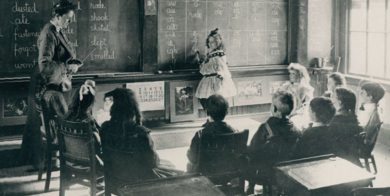
Working in groups is not a new thing. As we can see in this old classroom photo, whilst individual desks are set apart, all facing the front, we can see the children of the class in a circle, participating in a lesson. Everyone doing the same thing so that they all left school fitting in a particular box was the aim.
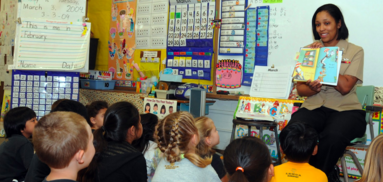
In the 1990’s, desks were somewhat modernised, along with individual trays that have multiple uses. Large, often bulky ‘personal computers’ were all the range, and it wasn’t uncommon for each class to have at least one that sat in a corner, just waiting to be played with during a wet lunch time, or if you were lucky, publish a piece of writing.
The introduction of a mat area also became popular, inviting students in closer to see details, but also participate in a lesson that was separate from the daily grind of staying in one place all the time. For the first time we see a dedicated wide open space in the classroom.
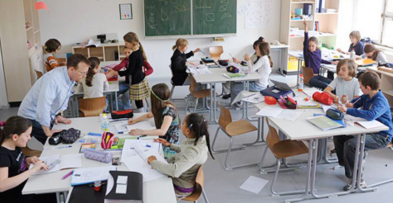
Enter the year 2000, turn of the century, and educators are looking for ways to encourage student talk, real life learning, and discourse in the classroom. But without a budget, schools had to use what they had. Individual desks were kept, but placed into groups. Each child would still have their belongings, but they would also be part of a group to work with, discuss ideas, and work together as a team.
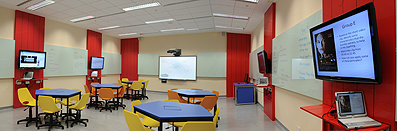
It is around this time that the idea of a collaborative classroom came into play. Hubs of tables fill wide open space. The clutter is generally gone, but there is space for learning to happen. The walls are adorned with linked up screens that can be viewed from anywhere in the room.
The role of both the student and the teacher has changed along with the physical space. In the 1900’s, the role of the teacher was that of a preacher. The fount of knowledge to fill the empty minds of the students. Repetition, repetition, and repetition was the key to learning, and if you didn’t get it first time, you’d keep doing it until you got it right.
Take this through to today, we have a teacher who is a facilitator for learning. They pose questions that challenge and encourage wonderment. They inspire and engage. Students are the driving force for learning. They pick up an idea and take it further in the direction they want to take it. They work together to co-construct their success criteria, and figure out the how themselves. They rely not on the teacher for information, but on their own ability to go and find out. They are both collaborative, but independent, and the balance of these happens seamlessly. In an article written well before it’s time (1990), Tinzmann, MB et al. state that
“Effective communication and collaboration are essential to becoming a successful learner. It is primarily through dialogue and examining different perspectives that students become knowledgeable, strategic, self-determined, and empathetic. Moreover, involving students in real-world tasks and linking new information to prior knowledge requires effective communication and collaboration among teachers, students, and others.”
The environment is only one part of the Collaborative Classroom. What is more important is the learning going on inside it. Rebecca Alber states:
“Learning, and higher-level learning such as synthesising information from several documents or analysing scientific data, can hit much deeper when done collaboratively. Let’s not forget Lev Vygotsky and his educational theory that proposes learning as a social process. And if he were alive today, he would most likely agree with the saying, Two minds are better than one. He might even add, “Better yet, how about three or four?”
It doesn’t matter if you are stuck in a 1960’s classroom with cupboards and storage, old flip-top lidded desks, and steel framed chairs; the way you go about teaching (or facilitating learning) is key.
Is it any wonder then why the subtitle of this article spells out Teamwork with each first letter?
In the current education climate, teachers are finding themselves with the responsibility of making OTJ’s (Overall Teacher Judgements) to report to parents about their child’s academic achievements, but the requirement to have evidence for these judgements. These are rarely school imposed, but instead come from the likes of the Ministry of Education or ERO, who continually ask “How do you know that?” type questions in relation to National Standards data, with schools only being able to say “because of the test results” as a viable and measurable response. Therefore schools are asking teachers to assess their students using a range of different school-set assessments.
When I think of assessment, I usually can’t get pass the first three letters. It’s tedious, a bore, and whilst I enjoy analysing data from them, they are generally a waste of time when I consider what I could be doing – working alongside students, engaging with them, insipring them, and unleashing them.
Chris Hipkins wrote an interesting post about Kiwi kids being over tested. He says:
“Kiwi kids are being over-tested in schools… Let’s get teachers actually teaching, rather than testing to meet ‘reporting’ requirements. Kids deserve nothing less.“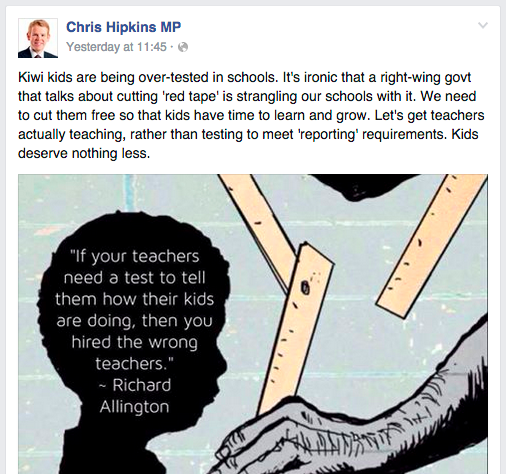
It has been an issue I’ve noticed increasingly in my career. Whether it’s because I’m male, or because it’s genuinely difficult to do, I find that to test the entire class, I have to shut down the learning programme and go into ‘Assessment Mode’. I find I don’t do any actual “Teaching” during this time, more just provide suitable ‘practise’ type activities for students to work on independently while I repeat 1-on-1 testing. I can’t do both ‘assessment’ and ‘teaching’ at the same time. As a school, we are now moving away from whole-class testing because it gives a very limited view of the student’s abilities. But this means that more 1-on-1 testing is required. This can take 3 to 4 days to complete with a class of 28.
I wrote a reply to Chris’s post that expressed my ideas:
“Thanks Chris for this! I’m a primary teacher and I’m constantly going into “assessment mode” to get through the entire class, that sometimes I wonder if I’m actually teaching them anything! By the time I’ve finished one lot of assessment, the next lot is on my desk!
I feel that if I were able to work constantly alongside my students; encourage, inform, correct, show, teach, and build genuine learning relationships with them that I’d have a much better understanding of them as individuals and thus understand what they need in their learning. Any assessment should only be to confirm what teachers already know about their students.“
And that’s just it. If teachers were given the trust that a) they deserve, and b) that is required to make OTJ’s in the first place, then I’m sure that there would be better outcomes for all students. We are told constantly that teaching and learning is all about relationships, but I fail to see how sitting tests and being assessed builds any kind of meaningful learning relationship between student and teacher. Secondly – spending time working with these students and teaching them will only enhance my ability to make a judgement.
 We are showed the assessment pyramid regularly in P.L.D (Professional Learning & Development), and it still staggers me that things remain the same. The assessment pyramid works a lot like the food pyramid, with the top tier representing assessment that, whilst is usable, should not make up the bulk of assessment used in the classroom. The bottom tier represents assessments like teacher observations, anecdotal notes, conversations, discussions, behaviours, troubles, problem solving, which should be use more frequently. Yet the rate of importance placed on assessments is opposite. Those that fit down the bottom of the pyramid which should happen daily and make up the majority of our assessment as teachers, is given the least importance, while those at the top which happen once or twice a year, are relied heavily on when schools are asked to “prove it” by Ministry or ERO officials.
Chris finished up his post by replying with a disclaimer that he in no way intends for there to be NO form of assessment, just that “…there is too much testing for ‘compliance’ rather than to genuinely inform the next steps in a child’s learning.”. And I wholeheartedly agree. If all we are doing is relying on test results, weighing the pig time and time again, it’s not going to help the students. Further to this is the issues happening in education overseas.
Teachers in the U.S. have the common core to teach and to contend with where the success of the students in their class directly relates to their school image. What has ended up happening? Teachers preparing students for the test; not actually teaching them.
“My old Principal was so enamored by an awarded Title I school for bringing up test scores. Their formula? Test prep. We copied and plummeted.” – @TeacherReality
It is highly tempting to give students practise at sitting tests, or answering similar questions over and over again, in order to boost their test score by being able to answer similar questions. But this in no way is why we became teachers. We didn’t become teachers to give test-like questions, show helpful formulas to solve test-like problems, or show them practise tests to help them pass a ‘real’ one. No. We became teachers because we wanted to impart knowledge, to inspire and to encourage, to challenge and watch students struggle in the hope that one day, one day, they would be able to apply themselves in life and succeed.
As I write this, I find myself thinking; “I know all this, and say all this, but hypocritically find myself in class administering tests. Why!?”. Well, mostly this is because of the school having certain requirements (from external or internal pressures) of the teachers, as most schools around the country will have. So what can be done? What can I do as a teacher?
These are genuine questions. I don’t have the answers. I have the ideal – which is to make observations and notes the most important and reliable source of information about student learning available. It means teaching and working alongside students. And so I must do that. I must make that a priority. I won’t be able to avoid the summative tests at all, but I can certainly try to maximise the time I do have to assess informally, and use these with more prominence than a one off test.
How do you manage the balance of testing vs. teaching? What restrictions are placed on you by school or external sources in terms of assessment? How do you deal with that? What suggestions do you have for others? Please leave your comments below.
We’ve all heard it in news, and seen it in the high glossy magazines or furniture websites, claiming ergonomic desks provide a quieter classroom, or driving through the new housing development with a 21st Century school nearby while the state housing that serves the poorer side of society watches on from across the road. Some have even experienced it going to a conference or workshop which are always held in the latest completed building project, often surrounded by glass walls and neatly air-conditioned atmosphere with the fresh aroma of recently laid high tensile carpet.
Thats right. Modern Learning Environments, or ‘MLE’ for those of us keeping a list of teacher jargon and acronyms.
 Back when my grandparents went to school, every classroom was the same. A blackboard with chalk-filled scratches and impurities, each wooden desk facing the front, lined up in an individual grid for maximum efficiency. The teacher provided information for the masses, delivering speeches from the front like a preacher at a pulpit, and it was your responsibility to remember and follow directions or you would miss out.
As time went by, we began to question the effectiveness of this. Desks began to get grouped into small clusters, and the term ‘desk groups’ was formed. In junior classes especially, desks were done away with completely, with furniture makers beginning to focus on large tables for schools. A classroom computer (ex-office computer) sits in the corner and is the place for students to go during wet lunchtimes where the class Solitaire challenge begins. The blackboard is removed for the front of a fridge, and is so called as a ‘whiteboard’. The teacher sets group work and walks around the class to ensure students are on task and discussing ideas together.
Eventually we reach the current predicament where schools feel like they have to provide a range of different ‘areas’ for students. There are small pods of desks which link together in different ways, ottomans which cluster into circles or snakes, carpet pads or cushions instead of chairs, bean-bags are brought out from the corners, barstools with benches instead of individual desks. There is no ‘front’ of the classroom, and the standard whiteboard is now an interactive projector with multi-touch capability. We’ve opened up the school network to enable students to bring their own device (‘BYOD’) to school on which they can complete their school work. The teacher is a facilitator of learning for every student, and provides a model for inquiry, where students learn on their own with support from others around them, finding out what they want to find out, how they want to find it out. The classroom accesses all corners of the internet, and learning outside the classroom happens each week where the class Skypes another class across the other side of the world. The students are connected through a learning management system (‘LMS’), and parents regularly check in with their child’s progress at school through the school Moodle.
The Ministry of Education defines a MLE as follows:
“A learning environment may be understood to be the complete physical, social and pedagogical context in which learning is intended to occur. …a modern learning environment is one that is capable of evolving and adapting as educational practices evolve and change – thus remaining modern and future focused.”
MLE.education.govt.nz
In short, a MLE is a space that changes depending on the learning at the time, and is future focussed as education progresses. It provides students and teachers with a choice on how to use the space, depending on the learning activity at the time. Students may find it more comfortable to lie on the floor with a laptop, rather than sit upright at a desk with pencil and paper.
The Ministry website continues to explain that there are eight parts to consider when discussing a Modern Learning Environment.
It is important to remember that this is purely the physical environment. It does not consider online communities, or digital environments within this; but does take into account the idea of ‘ICT everywhere’.
So why is everyone clambering to get up the property ladder and develop their school into a MLE? Is it the consumer culture we’ve become so entrenched in now filtering into our expectations for school buildings. Is it the same reason that we have to have the latest iPhone as we do have to have the latest classroom fad?
Firstly, we are attracted to the new. Many classrooms look tired. Those schools that were built during the baby boom in the 1960’s, now have classrooms that are pushing 50 years old. Heck, I bet any of us would look tired if we’d had 1000’s of kids running around us over the course of 50 years! Schools have lots of other priorities as they come to grips with the technical age, and ‘modernising’ classrooms is well down the list of things-to-do.
It thus becomes very attractive walking into a classroom with clean walls, sharp, clean lines, superb lighting quality, and durable, usable spaces. I’m not sure cleaners will agree that full length glass walls are a good idea, but there is a sense of flow having them, un-defining the boundaries of a space and creating an openness to the area. There is a natural desire for this new environment, given that the alternative is so… old.
 The Need for Guidelines
In some ways, with everyone wanting the new buildings and new furniture, there has to be suitable reasons and guidelines behind having them installed, so that the government can quantify and add some structure to the wants and desiers of every teacher in the country. The eight parts of the MLE were developed to ensure that there are reasons behind the decisions that are made regarding school property. Even when upgrading old school buildings, the eight boxes can get ticked off as the issues within them are addressed, and though they might not have the latest and greatest technology, or motion sensor lights, or wall to ceiling windows, or enough range in furniture to put a furniture sale to shame, they can still be considered as a MLE.
Essentially, no. It’s not a fad. It’s not just the latest thing people are talking about. While environment is important, it is not the be all and end all of learning and education. Can it help? Yes. But a good teacher will teach well in any environment. A good student will learn well in any environment.
But we are in the 21st Century. There are lots of amazing options out there to explore, especially in regards to our learning environments, and pursuing these is just another step in developing life long learners out of our classes.
Please read my full article here: The Use of Chromebooks and Google Apps in Education
There are multiple reasons why we decided to head down the Chromebook and Google App path. While I do not wish to delve into all of these, some of them include:
From the outset, I encouraged students to share their work with me through my work email address. This enabled me to check on their progress of their publishing at the end of the day. It also established an expectation and some excitement as the students rose to this new responsibility of being able to email their teacher.
During my experimentation with Google Docs, I eventually realised that you can see others editing in real time. I already knew that I could comment on a document, but this new realisation enabled me to work with James on his Maths problems. I created a very short screencast of this process as it happened. Once again, this is timely feedback, with additional support and encouragement for a learner who otherwise struggled to remain on task, let alone be motivated to work at home.
Throughout the video I have made notes as to when I used any of these acts of teaching, and by the end of the three minute clip, I realised that each and every of the seven Deliberate Acts of Teaching had been used. It made me aware that not only had I just been helping a student out with some homework, but that the process had enabled me to offer some additional teaching with sound pedagogical base. Not only that, but by the end of this online session, James had completed the worksheet, and had shown how he accurately uses different strategies to solve subtraction problems. These are what we have currently been learning in class, but now they were being practised and solidified at home.
For a long time I saw the motivation of technology to be more of a surface feature that was more bells and whistles than anything worthwhile. By seeing the value of real-time feedback, the ability to provide next steps along with examples, all completed seamlessly while checking emails at home, it is impossible to ignore this as a viable learning possibility. The potential within Google Apps is difficult to comprehend, as more and more ideas are developed and utilized within the classroom. Teachers will need to find themselves not only having to be technologically savvy, but also technologically creative in the way they are able to use technology in their classroom; not just as a gimmick or a reward for early finishers, but as the foundation for further learning in any and every curriculum area. As we continue to move into a world where technology is becoming ever more integrated into everyday life, it is only fitting that schools become a place where this is not only enhanced, but innovated, and become places where tomorrow’s citizens begin their technological journey.
Those that know me know I am not much of a reader. Obviously I have to keep that quite quiet in the classroom, because I want to encourage my class to read as much as possible. To do so, I usually use a lot of picture books as inspiration for reading. I like picture books because; well lets face it… they have pictures! And some of those picture are works of arts all on their own. Whilst at University, a group of friends and I had an assignment to write a children’s “EBook” for use in a classroom. We had so much fun with it, we actually wrote a few books.
Now; this was back in the time before iPads, E-Readers and the like. We had to use Powerpoint to create them for use as an EBook.
Having just purchased iPads for each classroom at our school, I went and found some picture books on iBooks. It gave me an idea.
A good idea.
So I dug around my old files from university, and eventually found our original powerpoint EBook. I took it, converted it into a suitable format using iBooks Author, and now it is currently awaiting approval from Apple NZ to be made available in our country. Seeing how easy it was, I decided that actually, I could probably use my love of art and painting, and couple it with my vocation, and make some picture books suitable for 10 year olds and up.

I even found out how to get ISBN numbers – and it’s not that hard!!!
Keep an eye out on iBooks Store for an author out there with my name on it!
In Education in New Zealand over the last couple of months, we have heard the threats of performance pay, and bumping up class sizes, and developing better teachers. This has been well documented in the press, with recent articles on Stuff outlining the intentions of the current Government.
www.stuff.co.nz/national/education/6930082/Bigger-class-sizes-announced – 16 May, 2012
www.stuff.co.nz/6936035/Bad-report-card-for-bigger-classes – 17 May, 2012
Please take your time to read both posts, and then my thoughts regarding the future of New Zealand’s education. There are also further links to similar articles at the bottom of this post.
If you think that this doesn’t affect you, you may be right. But this will be affecting your child, your son, daughter, or your niece, nephew, or your friends children. You will know someone, some child that this will affect, and it would pay to be thinking of them when you consider these points.
From these articles, there are three major changes that the Government is pushing. They are wanting Better Teachers, so there are going to be changes to educating teachers to be better. They are introducing larger class sizes, so that there are less teachers to pay. And finally they are wanting to introduce performance pay for teachers, as a “reward” for good teachers.
Part of the intentions of the National led government, (who don’t even make up the majority of this country’s support!) to try and sell these policies, is to say that they want to make better teachers. No one is going to be able argue that having better teachers is not a good thing. Aside from that, it is incredibly insulting to the profession so suggest that teachers at the moment aren’t “better”.
And how do we define “better teachers”?
How do we assess whether one teacher is better than another?
Well, the government would say “By results against the National Standards”, which we know is a load of crock, because National Standards are a set of unfounded and unjustified guidelines for failure not achievement. Add to that the fact that National Standards are based on an “Overall Teacher Judgement” , which surely enters into a conflict of interests, where results are used to determine if you are a better teacher than someone else.
Enter National testing. This will be the next line of changes to the system, as Teachers will not be trusted to make the decision as to where the students are at, so we will have a National Standardised test that every kid in New Zealand will sit.
The other thing the government would say regarding how you assess whether a teacher is better than another is this coin word called “Engagement”.
My first, and only question will be – “How do you plan to measure engagement?”. The answer to that will be so flimsy and washy that even tree huggers would be ashamed.
So how else will we get “better” teachers? By educating more teachers (of which there is already an excess of; or is it to replace all the good teachers who leave because of this)? They are also talking of making additional study requirements of existing teachers, on top of teaching a class, and raising the achievement of that class so that they can get paid? Is anyone else getting this!? It sucks. Yet its happening.
This is a planned red herring for these changes. They’ve set this one out as a mouse, so that everyone dances and screams, whilst across the room they sneak through the lion which is performance pay. The major change isn’t the raising of the class size, but that schools will be funded based on the class size. See, changing the class size requirements in Year 2 to 10 classes from 23-29 pupils to 27.5 pupils isn’t going to make much of a difference. I started this year with 28, and am now down to 27 (essentially 27.5!). In years gone by I’ve had 29, and even a term of having 31. It’s not like they’re making class sizes 35, 40, 45…. Yet.
Yet what a difference it makes when I have a class of 22 -24. The room is quieter, which means there are less distractions, and more learning productivity. The students are more relaxed and more focussed, and so tend to be more “engaged” – if that can be observed. The teacher is more relaxed and has a better headspace, and is less likely to be having to deal with the niggles that occur in larger class sizes. We get through groups quicker (or can cover more learning in extended group times) allowing me to touch base with students one on one and see how they are going. The students get a long better, its easier to keep an eye on them. Everything is better. There is not a single downside to having less students in the class – if you are focussed on the benefits for the students.
However, if you are not focussed on the benefits for the students, and are instead focussed on the red number at the end of the leger, then of course, larger class sizes to take in every child in New Zealand, means less teachers over all, which means less salaries to pay, and salaries take up 80% of the budget.
But larger class sizes mean less one on one time with the teacher than they already get, there’s more noise, which increases distractions, and lowers learning. There are more niggles in the class, which raises the teacher’s stress levels as they try and contend with keeping on top of things. Students realise this, and also notice that they can get away with little things while the teacher is busy dealing with other problems. Less quality time is spent on teaching, and more on crowd control.
Two principals commented in the latest article on Stuff today. One said that he started teaching “…he had a class of 40 and that was not conducive to modern teaching methods. ‘It was `Sit down and do this’. There was very little discussion and very little of what makes teaching effective.’”
The other makes an incredibly good point, one that I hope everyone else can come to realise, in that larger class sizes means that “The very group that the Government say they want to work with most – Maori, Pacific Islanders, special needs students – we know that when there are large classes, it is harder for them to achieve.” – Bad-report-card-for-bigger-classes – Stuff, 17 May 2012.
But politicians will argue that a “good” teacher will be able to teach any number sized class. Some university proffessors who also haven’t had any teaching experience in the last 20 years, will also try and tell you that “research suggests” that quality teaching is more important than class size.
So let us get the “best” teacher in the country, and put them in front of 35-40 students. Not for a day. For the year. According to these politicians (who have never taught a class, or if they did, they left and became politicians – says more about them than they think!), this teacher should have no problems raising achievement against National Standards, while continuing to teach other subject areas, complete reports, analyse data and provide differentiated learning for the class, whilst maintaining control of the behaviour in the classroom.
Today (17 May, 2012) it was announced that performance pay would be decided on, not just by an appraisal system, but also based on achievement results of National Standards.
I find it relatively humouring, but I am very much annoyed that this has been somewhat hidden by the whole uproar over class sizes, as it is quite clearly a much bigger issue.
Before I begin into my rant, I want to make it clear that I understand the need for a performance pay type model. There are some “bad” teachers out there, and there does need to be a system for working them out, and removing them from the system. The good teachers do deserve to be rewarded for their efforts, and often are in the areas of being given units for the additional work that they do.
So I do agree that poor teachers need to be whittled out, and the good teachers do need rewards.
However, performance pay based on results is not the way. Especially when those “results” are going to be based on National Standards, which still have not been fully developed or implemented properly or fairly, and have so far been able to tell us nothing about achievement, but instead, have given us a very good picture of failure.
Basing performance pay on results is ridiculous. And here’s why:
Some students are behind the eightball when it comes to learning. A list of factors would be longer than my arm, but a few would include such things as;
Many of these things are out of the school’s control, and are out of the child’s control, and sometimes even out of the parents control. No one can be blamed for any of this happening – not even the government. It’s called life.
But what will end up happening?
I have had students in the past who were well below the National Standard. There is no hiding it. The parents were made aware of this, and there were no real surprises at all. Every teacher that had been before me, and myself, had worked hard to raise the level of achievement, and had done so, but at a very low pace. And nothing would have changed that. The student, at the end of the year, had made a year’s progress, but was still well behind the eightball when it came to National Standards.
I have a privileged view of this whole issue. I have worked in classrooms for the last 3 years. I know what it is like. What is scary is that the people who are making these decisions, not only don’t have any experience of what it is like, and are merely concerned with making the red figure at the end of the leger smaller, but they don’t want to listen to those who actually have some idea about it.
But I get that. Why would you listen to teachers? Of course teachers are going to complain about being paid based on performance. Of course teachers are going to complain about having larger class sizes.
But what about listening to what has happened in the past? Look at the education system in the UK. A mess. Why? Because of the National Standards that they introduced into their country, which has completely destroyed the hope in teachers and students over there.
Look at the education system in the US. A mess. Why? Basically because of Charter schools and performance pay (from what I’ve read – I could be wrong…)
But why are we taking our world leading education system, with it’s curriculum that was world beating, and developed for a decade to be flexible and adjustable to suit EVERY classroom in Aotearoa, New Zealand, and completely changing it to be based on National Standards in Reading, Writing and Maths (3R’s… which I thought had been dispelled with the inkwell and cane in classrooms of old). Not only that, but then we go and base our whole education system on models that have been complete failures in other countries.
How stupid do we have to be to follow a bunch of sheep off a cliff?
What really scares me even more, is the notion that there might be a chance for parents and students to have input into the performance pay of a teacher. “[Ms Parata] revealed that parents and even students would soon get the chance to review teacher performance…”
Evidently my 9 and 10 year olds are the best kind of people to decide if I’m a good teacher or not, and whether I get paid. Who knew? Next there’ll be a National Standard in “Reviewing your teacher”.
I wonder how politicians would react to the tables being turned.
Maybe, we set a baseline salary for MP candidates.
And let’s introduce performance pay to that.
So a salary of $144,000 a year (which is the pay check one receives (2012) if he or she is just a member of parliament, with no other responsibilities…) will be available, but the percentage of that salary is decided upon how many votes you received. So if you get 100% of the vote in your electorate, then you should be entitled to 100% of the pay. But, if you got 59% of your constituents vote, then your salary would be $84,960 a year (which is nothing to shrug your shoulders at). The left over $59,040 could then be put into a fund that will supply services such as Health, Education, Police, with the funding that they deserve, or at least help contribute towards it.
I bet they probably wouldn’t like that.
I bet they’d probably complain about it.
I bet they’d probably complain a little like what the teachers are complaining like now.
I bet they’d decide against it.
So thank you to all of you out there who voted this government in. Thank you to all the teachers who blindly voted National because they fit in the pay bracket for tax cuts. The only thing we can do now is sit back and watch the future of this country plummet into the depressing depths of “Well Below” and “Below”, as the rich get richer, and the poor get poorer (in every aspect, wealth and education).
Is it that dire? Or can we actually get out there, and support the teachers?
Your child has a teacher, who works hard, works weekends, takes work home, and sacrifices their time, their money. If you don’t have a child, you will know someone who does, and that child also has a hard working teacher trying to make a living. And for those living under a rock and think that teachers work from 9 until 3, and get heaps of holidays and shouldn’t be complaining, you need to get a reality check. I am assuming you have a 9-5 office job. Teachers work 8-5pm most days of the week, just like you. We often have to take work home on the weekends (although I try to avoid this as much as possible, because like you, I am trying to have a life as well!), and as for holidays, they are not. We work in the first week finishing off things from the last term. And in the second week we plan and prepare for the next term. The school holidays are just work without kids, which is exactly what you and the majority of the rest of the workforce does day in day out.
I want to encourage you to be active, if not for your child, then for me, a teacher. Write to your local MP, expressing your concern over these changes. Write to John Key (the current Prime minister) and express your concern and lack of support for these changes. The worst thing you can do is sit there and do nothing. Actually I lie. The worst thing you can do is sit there and blame teachers, and complain about how we are complaining about our future.
And what can teachers do? Well, we can bring the country to a stop by all walking out on our classes, together, as one. Parents all over the country will be forced to take the day off work. Production will go down. And no doubt, there will be complete and utter blame put on Teachers instead of the real cause of the strike, which is the Government’s decisions. But the reality is that I don’t want my teaching ability to be judged by the results of 9 and 10 year olds against an unproven and unjustified National Standards which have nothing to do with achievement, and everything to do with failure.
Related Reading
Teacher Performance Pay under fire – 17 May 2012
Concern over teacher performance pay – 17 May 2012
Principals criticise move to bigger classes – 17 May 2012
Education Changes: video – 16 May 2012
Teacher performance pay gets tick – 3 May 2012
Please Note: I am a registered teacher in New Zealand. I have been teaching for 3 years in New Zealand classrooms. The views I have expressed here are my own, and not necessarily the views of the school I currently work for, nor the Board of Trustees of that school.
 It can be a tricky task selecting what to include in your classroom blog, and what to leave out. The following are some guidelines that will hopefully keep you safe, whilst allowing your content to remain interesting and keep students and parents informed.
1. Keep it about the learning
Focus the content and theme of your classroom blog on the learning that is happening. Discuss the tasks and learning intentions you focussed on as the teacher. Report about the different group lessons and the learning that took place.
2. What happens in the classroom, stays in the classroom
This is the “fine line” that is uncrossable if you want to keep yourself safe. It may seem slightly ironic, because to have a classroom blog, you’re automatically NOT keeping it “in the classroom”. But what is meant by this is that the personal experiences that are shared, the individual behavior problems that occurred, assessment results and the like are to stay in the classroom, under all circumstances. If you focuss on the learning that is happening, as per point 1, then this shouldn’t be an issue. You certainly don’t want to be sharing the argument two students had and the consequences they faced, or writing about the latest test results, all written out online.
3. No names
When sharing students work (maybe a piece of writing – see point 5), only use initials to identify students. Then your class will still know whose writing it is and it can be shared with friends and family, without students names being all over the Internet. This is also linked to the No Faces (point 4) rule, where you should never link a photo with a students name. Individual privacy is paramount.
4. No faces
Any photo that includes faces, especially those of children, needs permission from that person (or their parent/guardian in the case of children) before it is placed on the Internet. This can be a bit of a hassle, but well worth it if you can manage to get everyone’s permission. You could, rather than get permission from every parent (and have to keep record of those who have and haven’t given permission), just blur everyone in the photo’s face, or where possible, exclude faces from the photos when you take it. My tip is to take photos from behind a student, so that you can only see the back of their head, is a great way of protecting identity while showing your class has people in it!
To blur faces, you can use picnik.com or other free photo editors using a blur brush tool. Once again, individual privacy is paramount.
5. Celebrate Success
Whether on the sports field, or a particularly successful learning experience, celebrate the success. If someone has written an awesome story, get them to write it up and add it to the blog.
6. Update Regularly
The last thing anyone wants to see is the latest content being 2 years old, about some lesson that happened with a class group that is no longer even at the school. Your updates should be at least once every two weeks, if not more. Make it a target to write a post each week. This will enable you to make it a habit, and hopefully, will become part of the classroom routine.
7. Keep it Fresh
If you always do what you’ve always done, you’ll always get what you’ve always got. Think of new ways to use the blog in your classroom. Set a treasure hunt around the internet, include lots of media, include work expectations, tell a photo story told by the kids. Don’t just make it about the things that happen in the class, but make it a place where things happen.
8. Avoid Copyright Issues
Don’t use images from the internet. I know it’s easy to do, especially with Google Images, but try and keep any media on your website self-created. It also provides more of an insight into your classroom and school environment if all the media on the classroom blog is from – well… the classroom.
9. Keep Yourself Safe
Avoid posting things about yourself as the teacher. Keep your personal life to yourself. You have to remember to remain the consummate professional, both in the classroom, and online. If you wouldn’t share it with your kids, then you shouldn’t be sharing it online either. Setting up your own teacher blog may be a better forum to share things about yourself.
10. Spread the Word
If there’s no visitors, there’s no point. Get people to the blog. Set tasks for the students on it. Include a hidden code that students, if they find it, they get an award. Get students to show their parents their work that you’ve put on there. Get parents to share it with grandparents, and eventually, you’ll have a community culture in your class, purely and simple from your blog.
Remember, your blog is for students and families, but it is also available to the whole world over the Internet. Keep this in mind when you make any post! Individual privacy is paramount. Keep yourself safe, and most of all – get posting!
A while back I made a class resource that was as much fun making as it is using. Many people use the Traffic Light model for noise level indication, with Red being “Silent”, Orange being “Quietly Working” and Green being “Talking”.
I decided it needed something extra, and so, using inspiration from Charles Dickens and Dr. Seuss, I created a few poems.
Why I’ve made an entry to my blog about it? Well, because every time I change it, I read the poems, and every time, without fail, it works. Especially Quietly Working. This is because it helps the students to understand the expectations, in a quirky and fun way.

The Poems are as follows:
It was just before playtime,
When all through the class
Not a sound was there stirring,
Not even a gasp.
The children were working
In their books with care
In the hope that the Teacher
Would soon be able to hear
The whispers of silence
That had magically appeared.
After the hustle and bustle
Was gone
And the silence had spoken
And grimaced and shone
The children they worked and
They slaved
In hope that they might talk
Just once that day
The teacher said “Fine,
You’ve worked hard and tough”
And he let them whisper
And a whisper was enough.
For ages they worked and
Toiled away
Waiting for the chance of
Group work that day
For the students knew that in
Group work they could talk
As long as it was on task and
Not silly parrot squawk!
In their groups they said
It was so,
It’s okay for us to talk now
All systems are go!