Tag: learning

  • The Choice Classroom

    Choice. Urban slang; originally spoken in New Zealand, is used as a pun at the way New Zealanders speak. Used as description of something you think is good. Synonyms: radical, wicked, awesome, brilliant, best-thing-ever.

    It describes a classroom that I want to be a part of. But more than the above description, choice also means the enabling of being able to choose between two or more options. This is my classroom.

    What choice means in the classroom

    Choice is valuing students as individuals.

    Choice is students working independently at their own level, at their own pace.

    Choice is students working on what they want to work on.

    Choice is motivating. Choice is engaging. Choice is inspiring.

    Students who can choose their activity, the way they present their work, the time or place that they do their work, and even their consequence or behaviour management, become much more learning oriented purely because they have control over it. Powerlessness is the leading cause of burn-out, and not having control is key to this feeling of powerlessness. In regards to being able to choose their learning, what they do when, and how they present it, means that students have an investment to the learning ahead of them and are automatically motivated because the choice has been theirs. Even with choosing consequences or behaviour management, students become more self-disciplined as they have been able to have an active part of the process.

    A very interesting article looks into the issues surrounding choice in the classroom. ‘Choices for Children: Why and how to let students decide‘ says “At least one recent study has found that children given more “opportunity to participate in decisions about schoolwork” score higher on standardized tests; other research shows that they are more likely than those deprived of autonomy to continue working even on relatively uninteresting tasks. There is no question about it: even if our only criterion is academic performance, choice works.”

    How choice works in the classroom

    Firstly, this is an almost inexhaustible list of ways you can use choice in your classroom. This certainly isn’t anything major, but there are some examples that follow that I use in my classroom. They work, and I can vouch for them with my given experience.

    The first hurdle is doing it. You have to make a conscious decision, or choice, to include it in your classroom.

    Then begin introducing choice in the following ways:

    Presentation

    Presentation is one of the easiest ways to allow students to have choice in the classroom. Instead of saying “Make a poster” for the latest bit of topical research, say “Make a poster, or a power point presentation”. Students will make the choice based on their strengths, though many will choose the slideshow option because of the allure of technology. Additional choices could include a class speech, a short video, a diorama, a 3D model, a hanging mobile, a book, a pamphlet, or a webpage.

    Tic-Tac-Toe

    No, not naughts and crosses. Tic-Tac-Toe are nine related activities that require the use of different skills or intelligences. Students choose three activities in a row in order to complete the task. I used these to good effect as a reading follow up task, where students would choose activities as a follow up to the text that they read with me. A good Tic-Tac-Toe will have three different activities in each three-in-a-row possibility. One might include an aspect of drawing, one an aspect of writing, and a third might include a worksheet.


    Daily 5

    The game changer for me when it came to choice was initiating Daily 5 in my classroom. Daily 5 allows students to choose the activity they work on, selecting from the five options of read to self, read to someone, listen to reading, work on writing, and word work. These each have rules and guidelines decided on by the class, and so rather than students being put in a group, read a set book, do a follow-up worksheet as a daily rotation, students have these five literacy activities that they get to choose from. Essentially, rather than have a group rotation of activities, students choose from the activities based on what they want to do at the time. Rather than students doing a worksheet they don’t want to do, they might choose to do some word work where they practise their spelling words. Or rather than being forced to read with the teacher, they might choose to read to someone instead. What this means is individualised learning, where the teacher can conference with students during the time, and students are motivated because they are choosing their learning.

    Inquiry Learning

    One of the big pushes in education over the last 3 years has been the idea of ‘Inquiry’, where students learn what they want to learn about. Inquiry essentially replaces what used to be called ‘Topic’. Topic was teacher decided, with learning activities and experiences made up and put into the unit plan to scaffold students to a set destination. Using Inquiry changes all that to the students. While curriculum areas still need to be covered, a ‘big idea’ is come up with by the teacher, syndicate, or school, sometimes with student input, and then the rest is left up to the students, especially in regards to what they want to find out about the big idea, and how they want to go about finding it out, and what they’re going to do with their new found knowledge. Completely student focussed. Completely student motivated.


    So that’s how you start. The options are limitless. The choices endless.

    What a choice classroom!


  • Assessment Assessment Assessment

    In the current education climate, teachers are finding themselves with the responsibility of making OTJ’s (Overall Teacher Judgements) to report to parents about their child’s academic achievements, but the requirement to have evidence for these judgements. These are rarely school imposed, but instead come from the likes of the Ministry of Education or ERO, who continually ask “How do you know that?” type questions in relation to National Standards data, with schools only being able to say “because of the test results” as a viable and measurable response. Therefore schools are asking teachers to assess their students using a range of different school-set assessments.

    When I think of assessment, I usually can’t get pass the first three letters. It’s tedious, a bore, and whilst I enjoy analysing data from them, they are generally a waste of time when I consider what I could be doing – working alongside students, engaging with them, insipring them, and unleashing them.

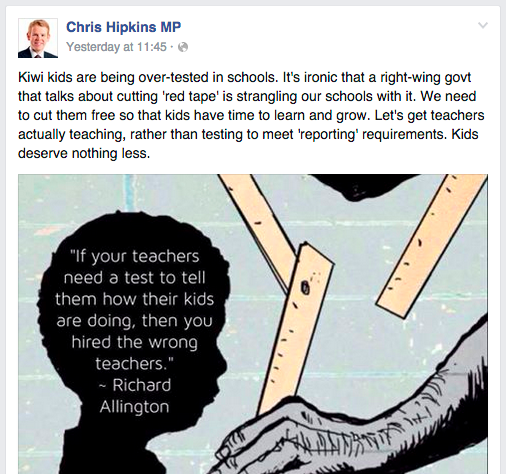
    Chris Hipkins wrote an interesting post about Kiwi kids being over tested. He says:

    Kiwi kids are being over-tested in schools… Let’s get teachers actually teaching, rather than testing to meet ‘reporting’ requirements. Kids deserve nothing less.

    It has been an issue I’ve noticed increasingly in my career. Whether it’s because I’m male, or because it’s genuinely difficult to do, I find that to test the entire class, I have to shut down the learning programme and go into ‘Assessment Mode’. I find I don’t do any actual “Teaching” during this time, more just provide suitable ‘practise’ type activities for students to work on independently while I repeat 1-on-1 testing. I can’t do both ‘assessment’ and ‘teaching’ at the same time. As a school, we are now moving away from whole-class testing because it gives a very limited view of the student’s abilities. But this means that more 1-on-1 testing is required. This can take 3 to 4 days to complete with a class of 28.

    I wrote a reply to Chris’s post that expressed my ideas:

    Thanks Chris for this! I’m a primary teacher and I’m constantly going into “assessment mode” to get through the entire class, that sometimes I wonder if I’m actually teaching them anything! By the time I’ve finished one lot of assessment, the next lot is on my desk!
    I feel that if I were able to work constantly alongside my students; encourage, inform, correct, show, teach, and build genuine learning relationships with them that I’d have a much better understanding of them as individuals and thus understand what they need in their learning. Any assessment should only be to confirm what teachers already know about their students.

    And that’s just it. If teachers were given the trust that a) they deserve, and b) that is required to make OTJ’s in the first place, then I’m sure that there would be better outcomes for all students. We are told constantly that teaching and learning is all about relationships, but I fail to see how sitting tests and being assessed builds any kind of meaningful learning relationship between student and teacher. Secondly – spending time working with these students and teaching them will only enhance my ability to make a judgement.
    We are showed the assessment pyramid regularly in P.L.D (Professional Learning & Development), and it still staggers me that things remain the same. The assessment pyramid works a lot like the food pyramid, with the top tier representing assessment that, whilst is usable, should not make up the bulk of assessment used in the classroom. The bottom tier represents assessments like teacher observations, anecdotal notes, conversations, discussions, behaviours, troubles, problem solving, which should be use more frequently. Yet the rate of importance placed on assessments is opposite. Those that fit down the bottom of the pyramid which should happen daily and make up the majority of our assessment as teachers, is given the least importance, while those at the top which happen once or twice a year, are relied heavily on when schools are asked to “prove it” by Ministry or ERO officials.

    Chris finished up his post by replying with a disclaimer that he in no way intends for there to be NO form of assessment, just that “…there is too much testing for ‘compliance’ rather than to genuinely inform the next steps in a child’s learning.”. And I wholeheartedly agree. If all we are doing is relying on test results, weighing the pig time and time again, it’s not going to help the students. Further to this is the issues happening in education overseas.

    Teachers in the U.S. have the common core to teach and to contend with where the success of the students in their class directly relates to their school image. What has ended up happening? Teachers preparing students for the test; not actually teaching them.

    My old Principal was so enamored by an awarded Title I school for bringing up test scores. Their formula? Test prep. We copied and plummeted.” – @TeacherReality

    It is highly tempting to give students practise at sitting tests, or answering similar questions over and over again, in order to boost their test score by being able to answer similar questions. But this in no way is why we became teachers. We didn’t become teachers to give test-like questions, show helpful formulas to solve test-like problems, or show them practise tests to help them pass a ‘real’ one. No. We became teachers because we wanted to impart knowledge, to inspire and to encourage, to challenge and watch students struggle in the hope that one day, one day, they would be able to apply themselves in life and succeed.

    As I write this, I find myself thinking; “I know all this, and say all this, but hypocritically find myself in class administering tests. Why!?”. Well, mostly this is because of the school having certain requirements (from external or internal pressures) of the teachers, as most schools around the country will have. So what can be done? What can I do as a teacher?

    These are genuine questions. I don’t have the answers. I have the ideal – which is to make observations and notes the most important and reliable source of information about student learning available. It means teaching and working alongside students. And so I must do that. I must make that a priority. I won’t be able to avoid the summative tests at all, but I can certainly try to maximise the time I do have to assess informally, and use these with more prominence than a one off test.

    How do you manage the balance of testing vs. teaching? What restrictions are placed on you by school or external sources in terms of assessment? How do you deal with that? What suggestions do you have for others? Please leave your comments below.

  • Te Reo Māori for Teachers

    Over the years I have been wanting to learn Te Reo Māori. It is a beautiful sounding language and is an important asset to any New Zealander in understanding Māori culture. It is of particular importance to every New Zealand teacher, as their use and encouragement of Te Reo will help the language to grow and flourish, and show the next generation of New Zealanders its importance. By giving the language a place in the classroom, we in turn show that using the language, for our Māori students, is of great value.

    My problem is that I’m not the best when it comes to learning languages. I never have been. I suspect that to learn enough for me to fluently rattle of sentences will require both time and dedication, and then some more time. This, however, is very difficult to find in the teaching profession. There has been murmurings that Te Reo support for teachers should be a priority for the government if it is serious about upskilling educators to pass on the language to the next generation.

    However, I shall not give up, and I have begun to compile a selection of common phrases teachers often use in the classroom, in the hope that some of these will stick for me, and become a little more natural as I work towards learning Te Reo Māori.

    Directions and Instructions

    E tu Stand Up
    E noho Sit Down
    Haere mai Come here
    Haere atu Off you go
    Kia tere! Be quick / Quickly!
    Rārangi mai/atu Line up over here/there.
    Rārangi ki waho/roto Line up outside/inside
    Whakamaua/Tangohia tō potae Put on / Take off your hat
    Katia/Huakina te kūaha  Open / Shut the door
    Kuhu mai ki roto  Come inside
    Hoki atu ki tō tūru Go back to your seat

    Commands

    Titiro (mai) Look (this way)
    Huri mai Turn this way
    Huri atu Turn away
    Kia tau Settle down
    Taihoa Wait
     Kāti  That’s enough

    Praise and Encouragement

    Ka Pai  Very good
    Ka mau te wehi!  Awesome!
    Mīharo! Wonderful!
    Ka taea e koe! You can do it!

    Questions

    Kei hea tō pukapuka/pene rākau? Where is your book/pencil?
     Kei hea ia?  Where is he/she?
     Nā wai tēnei pukapuka?  Whose book is this?
     Kua reri?  Are you ready?

    Have you got any more phrases or vocabulary that you use in your classroom?
    Please comment your ideas below!


    Notes:
    Thanks to Tom Robinson for his guide to macron use in HTML.
    Another great idea is to learn a word a day. Here are 365 of them! NZ History
    This is another great resource I suggest getting your hands on! He Reo Ora

  • Educated Statistics

    Those that know me, know I hate Maths, but love Statistics. Maybe it’s the graphs and the figures; but mostly it’s the story they tell without having to say anything. Interpreting the statistics isn’t rocket science, and generally they can speak a lot of sense into a confusing situation.

    It’s no wonder then that recently I have been looking into a range of different statistics surrounding Education in New Zealand at the moment. With the upcoming election, it’s important to have a grasp on what the current Government is trying to do, as well as what the implications are (if any) for them or the opposition hopefuls.

    Class Size vs & Quality Teaching

    Firstly, there is a perception out there that the two major parties are at odds about their policies. National are investing in IES / Quality Teaching and Labour are saying the money would be better spent being putting into lowering class sizes. This is not an either / or situation, but a fact that both are important, but each are differing as to the importance of them, and the priority they hold in the current educational climate.

    I must say that having worked in a classroom for the last five years, I would be able to better spend my time focussing on each individual child in my class if there were less of them. Not because of a time factor (although this would certainly come into it) but because of a behaviour management factor. I certainly notice a huge improvement in my students focus when there are 5 or 6 away. My class size for the lat 6 years has been:

    • 2009: 31 students
    • 2010: 28 students
    • 2011: 29 students
    • 2012: 27 students
    • 2013: 27 students
    • 2014: 27 students

    National claims to already have addressed the class size issue by employing more teachers. I’ve yet to see any impact of this at the school where I work, and certainly from the class sizes above we’re still talking a lot of students. I’m also not about to say that Labour’s proposed ratio of 1:26 is going to change much; except that if I’m operating on a ratio of 1:29 and I have 27 (2 less than the ratio size), then under Labour I should see a class of 24. Which already becomes more manageable from a teaching point of view.

    Class Sizes & Number of Teachers

    Yesterday I wrote about this in another blog post (see here):

    “I headed over to EducationCounts.govt.nz and downloaded their spreadsheet on student numbers since 1996.

    We can see that Screen Shot 2014-09-05 at 6.29.05 pmin 2008, the student numbers were 758,094 students.

    In 2013 there were 762,400 students. This is an increase of 4,306 students. That’s 0.56%. Half a percent.

    4,306 students would be spread across 149 classrooms, (based on the teacher/pupil ratio in NZ state schools of 1:29)

    That’s 149 teachers that are needed in the increase to maintain this ratio.

    In 2008, there were 52,958 teachers according to EducationCounts.govt.nz. In 2012 (which is as far as I can go from the same spreadsheet) there were 54,250 teachers.
    However, in this news release, it states that teacher numbers increased from 55,124 in 2008 to 58,707 this year. Discrepancies will exist, and some will include ECE Teachers and other teachers.
    For the first set of data from EducationCounts (which remember, is a government website), there is an increase of 1,292 teachers, or 2.4%.
    For the second set of data from the press release, there is an increase of 3,583 teachers, or 6.4%.

    Both somewhat removed from Hekia’s 15% (or ghost teachers as I call them).

    Even if we take the smaller percentage, and the increase of 1,288 teachers in 2012, it is still far, far away from the 149 new teachers that are required. That’s a surplus of 1,139 teachers.

    Obviously a lot of teachers are part time or reliever teachers. So lets take a look at FTTE teachers (Full Time Teaching Equivalent).

    With full time teachers, there has been an increase of 1,102 FTTE Teachers (2008-2012 data). Still not even close to the 149 teachers it would require to lower the class ratio to 1:29 based on the data.

    The difference between full time teachers, and the total number of teachers is just under 6,000 teachers in 2012. With 49,305 full time teachers spread across the 762,400 students (2013), this makes a teacher ratio of 1:15. This of course is an average, with a lower ratio in junior classes and senior classes, creating the 1:29 bulge in the middle.

    To change the ratio from 1:29 to 1:26 it requires a bit more mathemagic. The main reason for the difficulty is we have to work out the different ratios. For this, we go back to our first spreadsheet. I’ve put the resulting data into the table below.

    Current Teacher / Student Ratio No.of Students Required No. of Teachers Lowered Teacher / Student ratio Required No. of Teachers
    for New teacher/student ratio
    Year 1  1:15 64,208 4,280 1:12 5,350
    Year 2-3  1:23 118,549 5,154 1:20 5,927
    Year 4-8  1:29  295,858 10,202 1:26 11,379
    Year 9-10  1:23.5 117,265 4,990 1:20 5,863
    Year 11  1:23 60,805 2,643 1:20 3,040
    Year 12  1:18 55,277 3,071 1:15 3,685
    Year 13  1:17 48,905 2,876 1:14 3,493
    Total 33,216 Teachers  38,737 Teachers

    I don’t confess to being a mathmagician; and there may be a high possibility I’ve missed out some key information. At least I’m prepared to admit it if I get it wrong. If you find some issues with these numbers, can you please comment about where I’ve gone wrong so I can put it right.
    But to my knowledge, I’ve done the math correctly; and it raises some very interesting questions. Most importantly, if we lowered class size ratio by 3 students for each year bracket, we only increase the FTTE by 5,500, and we are still well within the current 49,305 current FTTE teachers.”

    The Cost

    One thing I didn’t go into in my last post is the cost associated with lowering the class size. Obviously cost is a big factor when government’s make policies, though some (including me) may ask does it matter when it comes to Education – we’re building the future generation… We do still need to be accountable.

    One thing I won’t go into arguments over is the associated costs such as building new classrooms to accommodate the extra classes needed due to the decrease of teacher:student ratio (needing a higher number of classrooms in the school”. The reason being is two fold: firstly, that the government hasn’t taking into consideration the associated costs, such as, hiring relievers, in their IES policy, and secondly, there are many, many schools with now empty classrooms, as there are also those with no extra classrooms. When we are discussing averages (such as we are here given the access to data I can find) we learn that we give and take a little either way.

    So lets have a look at the stats:

    The average teacher salary in 2012 was $71,526. The average secondary school teacher earned $73,995, while the average primary school teacher earned $69,660. Whether this figure has gone up or down since 2012 is difficult to guess as we would have to ask Novopay!

    Using these averages and multiplying them out by the increases I found yesterday, we get a table that looks like this:

    New T:Ss Ratio Number of New Teachers Req. Cost
    Year 1 1:12 1,070 $74,536,200
    Year 2-3 1:20 773 $53,847,180
    Year 4-8 1:26 1,177 $81,989,820
    Year 9-10 1:20 873 $64,597,635
    Year 11 1:20 397 $29,376,015
    Year 12 1:15 614 $45,432,930
    Year 13 1:14 617 $45,654,915
    Total 5,521 $395.5 million

    Don’t worry though. Take off 15% that the Government gets back through taxes, and the actual cost to the Government to lower class sizes to my proposed (and generous) class size model is $336.2 m. Certainly looks a lot like $359m to me. In fact, with the additional $22.8 million left over, they could put it into my personal account for having such a brilliant idea.

    What about Private & Charter Schools?

    Private Schools

    One of the most boring and overused quotes in the class size debate is: “You don’t remember your class size, but you remember when you had a good teacher.”

    I went to private schooling. I think my largest class was in Intermediate where I think we peaked at about 24 students. I certainly remember my good teachers. I also remember the bad ones. I also remember that none of my classes were with 30 other students.

    The quote is over-rated. You can say just about the same for anything. ‘You don’t remember all the meal’s you’ve had, but you remember you if you had a good chef’ or ‘You don’t remember all the kilometres you walked, but you remember your favourite pair of shoes’ or ‘You don’t remember all of the politicians names, but you remember when one used this quote’! It’s just silly nonsense they try and play with your intellect.

    The fact is, yes; I felt I was an individual in the classes. I wasn’t lost under 30 other students. I had my chance to shine.

    Incredibly interesting that John Key chooses to send his children to private schools. Hekia Parata’s own daughter attended Wellington Girls High School, the only Decile 10 state school for girls, which also consistently gets 4-5 year ERO reviews (since 2005), and boasts a 25 pupil class size.

    Charter Schools

    Based on the interview given on Q&A this morning (part 1, part 2) (Sunday 7 September 2014, 13 days out from the election), Hekia listed some hard hitting ‘facts’ about Charter Schools and their registered teacher status (Video at 5:57) . I put facts in inverted commas, because we all know how the Minister can get these wrong from time to time and has to back down from her statements. However, she was quite adamant that these were in fact true, that out of the 36 teachers at the charter schools, 32 were registered with a practising certificate.

    Unfortunately for Hekia, she also spelled out a few more interesting pieces of data along side this. She stated that there were:

    340 students in the 5 charter schools. Doing the maths, this makes the average Charter School size with a roll of 68 students. Obviously, some will be higher, some will be lower. I’m purely talking about the averages.
    In addition to this, if we take our 340 students and divide them evenly among the teachers at these charter schools (all 36 of them), it doesn’t take much to realise that there is less than 10 students per teacher. In fact it’s 9.6 students per teacher.

    Put in cold, hard, but realistic terms, it’s an average class size ratio of 1:9.6 . Which is quite low when considering my class of 27. That’s one third of the size, something I couldn’t even have a decent dream over these days.

    As a side note, I’m quite intrigued that the term ‘Partnership School’ (remember that!?) has been dropped in all political debates around this issue so far.

    In Conclusion

    Do we need lower class sizes? No.
    Do we need the Investing in Educational Success policy? No.
    Do we need to make wholesale changes to the Education system? No.

    We have world class teachers who get paid boatloads to go and work overseas.
    We have a world class curriculum which other countries only dream of and drool over.

    The reality is that as most educationalists (including Parata and Key) know that the biggest influences on a child’s upbringing happen outside of the school gates. National Standards have done nothing but show where people live. I’ve calculated in my previous posts the amount of time our children are actually in school in any given year back in 2011. The stats are hard to believe: its less than 15% of the year when broken down into hours!
    The problem for the government (and teachers) is that they cannot control those factors. And so rather than being seen to be doing nothing about ‘the tail’ of underachievement, the government is targeting teachers and schools and saying that we aren’t doing a good enough job and we have to try something different. That quote pops out from Hekia’s mouth ‘If we always do what we’ve always done, we’ll always get what we’ve always got’. Yet what if it’s not education that is the problem? We have a tail which underachieves, not because they are dumb or incompetent, but because their home-life is stressed, violent, and broken. There’s no food on the table and no money under it. Keeping warm is a luxury, let alone keeping healthy. All of these issues are BIG factors which I have written about before. My challenge for those that don’t believe these are factors is to go without food for a day or two and try studying for an exam. Seriously, after about 10 minutes of reading text, you will only be thinking about how hungry you are. And when that’s all you’re thinking about, it becomes very difficult to stay focussed and learn anything. Now make yourself a 10 year old child. You might begin to understand the ACTUAL reality behind our under achieving tail.

    Unfortunately for everyone, those issues are out of anyone’s control. There is a limit as to how much the government can control those ‘out-of-school’ influences. And so they make changes to those things they can control – the teachers. Change. Change. Change. Assess. Assess. Assess. And cross our fingers that things get better.


    Note: You may detect a degree of bias away from the National Party, and that is purely because they have made the job of teaching to be a lot more work for not much reward with National Standards (which aren’t even National, nor Standard – yes I have proof should you wish to see it), as well as a lack of confidence in Hekia Parata; backing down on increasing class sizes (which was the honourable thing to do), closing schools in Christchurch, and the ridiculous implementation of Charter Schools based on the wishes of ONE candidate who had a cup of tea with the Prime Minister once. Need I mention the balls up with Novopay, the resignation of Secretary of Education Lesley Longstone, the deformation of Teacher’s Council to be replaced by a board with no Teacher representative, and of course the new Investing in Educational Success initiative. I am in no way a Labour supporter or spokesperson, and have disagreed with many of their policies around the Mid 2000’s.
    None of the stats, facts, or figures I have had to hack into anyone’s emails or websites to obtain. These are all freely available to the public through websites that I have visited. I have no affiliation with WhaleOil.
    I must also point out and make this very clear; I write this as an individual, not as a representative of my classroom, nor my school, or Board of Trustees which I currently serve on. My views are my own, and I encourage you to talk with me should they raise any concerns for you.

  • Charter Schools: The Future of Success

    Managed to catch the encore screening of 3rd Degree (TV3) this week which had an exposé on the 5 trial Charter Schools being run in Auckland at the moment.

    3rdDegree

    3rd Degree: Charter Schools

    All in all Charter Schools have been portrayed as the greatest thing happening in our education system. We obviously think that just because they’ve failed overseas in the UK and the US, that they won’t fail here.
    There are many benefits to the charter schools; ones that the staff, parents, and children are more than aware of, and make these school incredibly popular on paper.
    Lets have a look at some of the benefits:

    Smaller Classes

    With State Schools often bursting at the seams with 30-35 students in a class, a class size of 15 is brilliant for those who are struggling with aspects of their learning. They get to work more intently with their teacher and receive help more regularly.

    Before Charter Schools, the Government wanted to save money by increasing class sizes across the country. Obviously the government is trialling small class sizes with these Charter Schools so that they can see if it works for the State sector as well…right?

    Not Just Teachers

    How much more invigorating and real would learning be if you had a skilled professional accountant running the economics class. Or heavyweight boxer David Tua running a boxing class for fitness. What amazing engagement and opportunities would be presented to the students at the school, to have people at the top of their professions giving back into the learning. They don’t have to be a registered teacher at all in order to be able to inspire the next generation of society.

    Of course, one does take a little precaution, because as it turns out, even with tight registration guidelines from the Teacher’s Council, there were a few cases of inappropriate conduct.

    But I’m sure getting rid of registration for Charter School teachers will instil a new sense of trust for employees and employers, and in turn, parents and students.

    Freedom of Curriculum

    At Charter Schools, the staff are able to offer a flexible and selective curriculum for their students. They’re able to pick and choose what they teach. So many students have failed the state system because they don’t like the prescriptive nature of the learning and all of the subjects that gets crammed in every day. At Charter Schools, you can rely on real life experiences, like going to the beach, exploring, and learning through hands on activities.
    Charter schools are also exempt from having to report against National Standards, and so will be able to focus on other areas of learning, rather than get burdened into Reading, Writing, and Maths that the State schools have to focus on, even though the National Standards, of course, have been given honorary status as raising kids achievements.

    New Zealand has one of the best curriculums in the world, and was designed over countless hours, weeks, months, years, to be flexible and to encourage creativity, to allow students to engage with a rich learning that was unprecedented anywhere else in the world. Of course, it only has that freedom if Teachers are empowered to do so, and aren’t hog-tied by the constant monitoring and assessing required of them by the National Standards in Reading, Writing, and Maths.

    In Conclusion

    Charter schools are wonderful. They take kids who dropped out of state school and re-invigorate them with learning in various different ways. They allow parents to make choices for the future of their children’s education.

    But questions linger in my mind. Why do we need to set up a new breed of schooling, with private investors running schools for a profit, or picking and choosing their students? If all of these great things are happening in these 5 trial schools, why can we not make it a reality in our current state schooling?
    If smaller class sizes is such a big draw card in raising student engagement, why not have smaller class sizes in ALL schools across New Zealand, instead of charter schools?
    If access to the wider New Zealand Curriculum (which already exists by the way) is what gets kids enthused about learning and engaging them with the big wide world, then why do we narrow teacher’s minds by getting them to focus on National Standards so much? If it’s good enough to ditch the National Standards for Charter Schools, then why not ditch it for ALL New Zealand schools, seeing as it doesn’t seem to make a difference on student’s ability to learn.

    Note: In essence, we could return education to the way it was before National implemented all these changes, and we would have a wide and rich curriculum that teachers felt empowered to choose from, and the freedom to make that choice. We would have a set of registration requirements that drive so many good teachers out, and yet somehow keeps some bad ones in. We would have less focus on Reading Writing and Mathematics that narrows and stunts the grown of learning in the classroom. And after the comments of students, parents, and staff regarding class sizes at the Charter Schools in the 3rd Degree exposé, I truely hope that one John Hattie doesn’t give this government any more advice, and that they might use the $359 million they are spending on the new career roles (IES) to put towards more classes in schools with less students in each class.

  • L.I.Y. – Focusing Students

    “We want W.A.L.T that is less Disney”.
    A brilliant quote from Lester Flockton.

    In my classroom, I have developed a new way of presenting the “WALT”.
    W.A.L.T stands for “We Are Learning To” which is how the Learning Intention (or L.I.) should start for students.
    In my class I did away with W.A.L.T.
    It annoyed me and my students are more than capable of understanding “Learning Intention”. So I use L.I.

    Recently we have heard about the benefits of students knowing WHY they are learning what we are learning. I have thought about this and added to the L.I.

    L.I.Y – a little bit like D.I.Y, but not. It allows a teacher to combine the WHAT we are learning, and the WHY we are learning it. The “Y” stands for the word it sounds like… “why”.

    I have been using this system in my class in all subjects and it has been really interesting to see students picking up on the new way of thinking and there has been a noticeable improvement in engagement.

    History

    For a long time I have been sceptical and cynical about the use of Learning Intentions in the classroom. My main reason being that we never had them growing up, and I turned out okay. We never worried about what we were learning or why we needed to learn it. We just did it because we respected the teacher and trusted that what they were doing in class was part of them providing a good education, so we just did what we were told.

    However, it is a reality and an expectation that teachers should be directing their students by explaining what the students should be learning.

    Much has been made of Success Criteria, or S.C. It’s the HOW students will know they succeeded or WHAT it is students are going to be doing.
    To be honest I am even less enthusiastic about S.C. The How is just what happens during the lesson. I always give my students targets during a lesson, or expectations for what they need to complete. They know what they have learned without having to over think about it.

    Sometimes it does feel like there is a lot of actual teaching time used up explaining what I’m going to be teaching, rather than actually teaching it. But I have seen some benefits, and even as a teacher, it is quite cool to see my learners come full circle and realise what they learned.

    I feel that now with L.I.Y., I have made it myself. I came up with it using my own thought process, and because I “own” it, and made it my own, I’m more likely to use it on a regular basis in my class.

  • Where are the kids learning?

    I was told not so long ago, that kids only spend 13% of their time at school. It was in relation to say that kids actually don’t do a lot of their learning at school. Kids will learn through all sorts of means, from what they hear, what they see, what they experience.

    Even as a teacher, I thought, that can’t be right. That can’t be right at all. Only 13%!!?

    Here’s the Maths:

    40 weeks at school. 5 days a week. 6 hours a day.
    6 x 5 = 30 hours per week.
    30 x 40 = 1200 hours at school per year.

    365 days per year. 24 hour days. 8760 hours per year total.

    (1200 ÷ 8760) x 100 = 13.7% of total time spent at school each year.

    So my question to you is “Where are the kids learning?”. Is it at school? Because only 13 percent of their time, the things they see, the things they hear, and the things they experience, is at school. So what happens in the rest of it? Is it in front of the TV? Playstation? After School Care? Internet? Where is your child learning? 87% of your child’s time is outside of school time. What are you doing to help your child learn the right things during that time? Teachers are paid to teach. That is their job. And I can say whole heartedly, that teachers work hard to ensure that every hour that the children are in their care, that they are providing learning experiences and tasks for those children. And they certainly have to maintain a strict criteria to ensure that they are teaching things suitable for the children to learn (unlike some TV channels!). But no matter how hard they work to teach effectively, and teach the right things, they still only have 13% of the child’s time.

    There are some parents doing wonderful things to provide a well rounded education for this generation of young people. They are following up homework, they are reading to their children, they are providing experiences that kids can learn life skills from, they are getting them involved in weekend sports.

    But others choose to point the finger at schools, and fail to see the three fingers pointing back at them.