
Tag: politics
-
Education Act 1989 – My Submission
Below is my submission to the Education Act changes. I’ve taken the time to write down my thoughts and views as best I can. In no way am I suggesting I have all the answers, nor that my answers are the best. But at the very least I have made an effort to curve some of the changes that the Government is trying to make. As expressed in my previous article, if you take some of these changes to their logical conclusion, it leaves for a not so pretty picture of our education system.
You can make your own submission here:
https://consultation.education.govt.nz/education/update-of-the-education-act-1989/consult_view
1. What should the goals for education be?
The goals for education should be to allow children to be children, and to learn as the individuals that they are, and to have success in the areas that are important to them.
This takes into account all areas of a child’s learning, their culture, ethnicity, gender, socio-economic background, and individuality.
It values Māori students as Māori students, Pasifika as Pasifika, Boy as Boy, and Girl as Girl and is inclusive of every child as an individual. It embraces students to be themselves, and to succeed as themselves; not by what is put upon them by a teacher, a school, a community, or a government.
It does not allow for putting students within a box. It does not suggest that all students learn a particular way, at a particular rate, or in a constant and consistent way.
Everyone learns differently, and the only way to acknowledge that is to value every child as an individual; and because they are an individual, success for them may be very different to success for another student.2. What process should be used for setting a national priorities statement for early learning and schooling
Any process for setting any priorities across the country need to have a degree of democracy about them. There needs to be reasonable discussion and discourse about them, and those who are ‘on the front line’ need to be consulted. Any expectations of schools does need to be made clear, though each school or kura needs to be able to have the flexibility to make those expectations work for their learning community and wider community. Schools should be worked alongside by the Ministry to ensure that any priority on a national scale is able to be implemented and what it looks like for each individual school or kura.
3. What should the roles and responsibilities of a school or a kura be?
Making a board’s role and their responsibilities clear is a must. As the staff representative of our school’s board, there are many things that the board is doing that may or may not be their responsibility, and the guidelines around this is nearly always vague.
The role of each board should be:
- Ensuring that each learner achieves the best that they can. This includes working in partnership with their Māori whānau and community.
- Working with and consulting the wider community to ensure that each learner is supported at school and at home.
- Working with other boards and education services within their community to share ideas, resources, and initiatives that work, bearing in mind that every school and community is different, and what works for one community, may not work for another.
- Consulting with the community over how to shape their school; as a learning environment, as a community hub, the atmosphere, the direction, and the culture of the school or kura.
The responsibilities of each board should be:
- Setting policies to guide and direct school and kura management.
- Ensuring the school’s curriculum aligns with both the New Zealand Curriculum, the requirements of the Act, and the needs of each learner.
- To be good employers of staff. This includes being involved in the appointment process and performance of staff, but always in conjunction with other professionals in the school, such as the Principal, Deputy Principal, or others in the school management team.
- Providing a safe environment to learn in. This includes physical and emotional well-being within the school.
- Setting a strategic plan that reflects the goals and priorities of the community and its students.
4. What changes could be made to simplify planning and reporting:
Boards should focus on the strategic goals of the school. This is an important part of their job as members of the parent community of a school, and as previously stated, is important for each school to have its own direction based on the community wishes. This should be carried out with suitable consultation.
Removing requirements for “high performing” schools is ambiguous, because of the subjectivity of the term “high” and “performing”.
Having boards work together does not necessarily mean less administration, and I know that each school has it’s own learners at heart, and any idea to work with other boards will be somewhat superficial.
Boards should focus on their own school, and do what is best for their learners, without having to worry about other schools or communities.Should the Ministry see it fit, a report template for Boards to work through would simplify the process; though this template would have to be fairly generic to allow for the diverse nature of schools around the country.
5. How can we better provide for groups of schools and kura to work together more to plan and report?
As mentioned, this may or may not be a good idea. School boards should focus on their own school. Any planning should seek to improve their own school, and any reporting should be for their school, as this is the school that they know.
It is also very difficult to comment on this particular question without seeing the obvious link and prompting to mention Communities of Learning / Communities of Schools, which fits under the IES – which is identified as a matter not covered in this consultation.
6. How should schools and kura report on their performance and young people’s achievements to parents, family, whanau and communities?
Schools and kura should report on their performance and young people’s achievements to parents, family, whanau and communities in ways that are deemed suitable or wanted by their community. This should be found out within the consultation process.
A set of indicators should only be set if they are deemed necessary by the Board or community and should not be set by any government on a national level.
Any performance report that is made for public should be done in a way that maintains confidentiality of its students. It should be written with the intention of informing its community, and not the general public. This will eliminate any temptation for the Ministry or the media to enter into creating league tables, and should provide each school community with a picture of what the school is doing well with, and what the school is working towards.
There is huge concern around giving schools that are doing well more freedom, as this is entirely subjective. As mentioned, a set of indicators should not be enforced across every school in New Zealand, as they would need to reflect the schools individual goals, aims, and any direction set by its community as per its consultation with parents and whānau.
7. What should the indicators and measures be for school performance and student achievement and well-being?
These should be decided by each individual school and only by the school, based on the learning needs of its students, and upon the direction set by its community. This should be in an endeavour to value and invoke a school culture that is unique to each learning community, school, kura, or wider community.
8. What freedoms and extra decision-making rights could be given to schools, kura and Communities of Learning that are doing well?
Schools should be given the right on when, how, and what it reports to its communities. As mentioned earlier within this submission, it is a slippery slope when additional rights and freedoms are given based on performance, given that this is such a subjective and generic term.
9. What ways could boards work more closely together?
School boards could work together by having a shared resource that is used or shared between schools. This could include something like a shared community school pool, or sports ground. It could also include learning resources that are shared between schools, or even include digital resources that are shared online. Proffessional Development of each board could be shared and attended by multiple boards.
10. What do you think about schools and kura having the flexibility to introduce cohort or group entry?
It seems to me, having been involved in a school for 6 years now, that the only reason why this is on the table for discussion is because schools want to make it easier to report for cohorts of students, rather than individually when each individual completes a year of school. If National Standards was not a factor, I see no reason why schools would want this flexibility, given that if you had a family waiting to enroll their child for a term, that the family would probably go to another school.
Seeing as any submission is not able to call into question National Standards, it becomes difficult to comment any further.
It is also concerning if a child is already behind in their learning, and doesn’t start school for 3 months while they wait for the next cohort entry, how much further will they be behind?
11. What do you think about making attendance compulsory for children once they have started school or kura before they turn six years old?
This is a good idea. I was unaware that this wasn’t already in law.
12. What additional supports or responses could be used to address problems that arise in schools and kura?
Before one begins to start investigating into addressing problems that arise, one needs to identify what makes a “great” school. There are many great schools – one of which is the one I teach at (which is why I still teach there). We have an amazing community, a great ethos and atmosphere, and a fantastic, dedicated young staff. We struggle to live up to any measure in regards to the National Standards and the 85% expectation, but we do more than our best for the students that walk through our gates. We had students fly in from around the country and from overseas to attend the school’s 50th Jubilee, while another well reputed school in the wider area had to cancel their 50th Jubilee due to lack of interest. We have sports teams which has represented our school in local sports tournaments, and have won competitions both in sporting achievement, as well as in fair play.
Our school is a great school.
However, to those who look at our school purely from a data and assessment point of view, we wouldn’t be considered a great school. I am more than certain that we are just one such school with a similar story all around the country.
Support for schools that could be used to address problems need to work WITH the school, working alongside it so that both the school community, staff, and the students feel valued and feel part of the solution, rather than the suggested “top-down” model of serving improvement notices, or auditing the school, or replacing people on the board. Any review of this, including those from ERO, are almost false, as they come in for a day to meet with the senior leadership team, and then start looking at data and paperwork. These would be more beneficial to “problem schools” if they worked in the school, alongside the staff and students and got to know the school, how it works, what the challenges they face are, and work with the staff and board to put suggestions in place to solve the problems. The “top down” approach does not work. It imposes a set of ideals on top of a school without taking into account any of the challenges that the school is facing each and every day, and are not excuses, but actual reasons behind some of the problems. This targeted approach is how teachers should work with their students, yet for some reason, this is not replicated in other areas of the education system.
13. How should area strategies be decided, and how should schools, kura and communities be consulted?
Each school needs to be directly included in any discussions around any strategies that apply to them. This should be done in a timely fashion, and be conducted with enough time for each school to reach a suitable outcome.
14. What should be taken in to account when making decisions about opening, merging or closing schools?
There are so many factors that should be taken into account when opening, merging, or closing schools.
It should be based on:
What the school feels should happen
What the school board thinks should happen
What the school community thinks should happen
Roll growth or decline in the areaIt should not be based on:
Academic performance of the school15. What do you think about the proposed changes to improve how enrolment schemes are managed?
This should be left to a consultation between what the school thinks is best for their enrolment, what any Community of Learning agrees upon, in conjunction with the Ministry.
I think it is dangerous territory we head into with any piece of legislation which starts to use the words “this discretion is very limited” when giving the Ministry the right to override any decision made by the school. -
Updating the Education Act 1989
Earlier this month, the Minister released a public document surrounding the public having their say on the updates this government are wanting to make to the Education Act. In it, they outline what they need to do to change the landscape of the education sector in this country. It is worded in an incredibly positive way, and they have been more than inclusive by ensuring the use of the word “may” throughout the document (which is at least an improvement on how they made changes with National Standards, Class Sizes, Christchurch School Closures, and Novopay!) However, there are some issues within it. Quite concerning things, that if passed, will allow for a lot of changes that we may or may not be interested in, but our chance to have a say will have gone. I’ve gone through and highlighted some of these things to hopefully shed some light on what is really being said.

Achievement and Accountability
The Education Act changes all centre around supposed “child’s pathway” through school, and focuses on “raising their achievement”. While a growth mindset is healthy for every classroom, at some point, there is a ceiling on what can be achieved. By having a law written that says that raising achievement levels is paramount, it means that there could be issues if a child HAS achieved, or schools already raise the achievement levels beyond any reasonable expectation. As will be an issue that comes up all through this, there is the ongoing issue around how this is measured. No doubt the Government will rely on data gathered through National Standards reporting, yet we already know that this is clunky at the best of times. In the seventh paragraph, the changes suggest that it will outline in law ‘who is responsible for what’. This seeks to allow the government to lay blame on individuals should things not go to plan. This may be a board, a principal, or a teacher. Of course, they are also quite clear that any submissions that suggest changes that would increase government spending on education will not be considered. Quite clearly the government thinks that it is already doing enough in this regard.
IMPROVING THE WAY BOARDS PLAN AND REPORT
Improvements can be made to the way school and kura boards plan and report on how they make sure the right things are being taught, how they are informing parents, whānau and communities about what they are doing, and how well children and young people are achieving.
Red tape around planning and reporting could be reduced so that boards are able to focus on what is important in promoting student achievement and wellbeing. There are some things that are a ‘must do’ for boards, such as developing a strategic plan, providing annual performance information, and meeting statutory reporting requirements. But there are other requirements that could be removed, and some complexity could be reduced. For example, high performing schools could move to a four-year planning cycle.
It may also be useful to let groups of schools and kura work together when they are planning and reporting. This would help a community plan more cohesively, share expertise and reduce administration. It could particularly benefit Communities of Learning and small or isolated schools and kura.
In Other Words…
In this section, it mentions ‘red tape’ which is very vague in what it means. Essentially, I think, they want to get rid of some of the bureaucracy that gets in the way from making decision and making changes. But as always, they label this as a way for Boards to focus on other things, such as improving student achievement. In the example, they state that ‘high-performing schools could move to a four-year planning cycle’. By “high-performing”, we can assume that they mean “high-achieving”. In the following paragraph, it says that it ‘may also be useful to let groups of schools and kura work together…’ making reference to their Communities of Schools model. We can safely assume that the word ‘let’ could also be taken to mean “make”, especially when schools are ‘not achieving’.
RESPONDING MORE EFFECTIVELY TO PERFORMANCE
With better and more timely information, parents, whānau and communities can have an active role in helping to improve achievement for their children and young people. The Act could allow for a set of indicators to be established so schools and kura know what areas they need to report on.
For example how well students are doing, and how the school or kura is managing its money.The Update could enable schools, kura and Communities of Learning that are doing well to get more freedom and extra decision-making rights. This would be balanced by monitoring schools, kura and Communities of Learning carefully and clearly saying what will happen if things go off track.

Responding More Effectively to Performance
Firstly, what does performance mean? No doubt, when the Ministry talks about performance, they mean achievement. Regardless of “better or more timely information”, parents, whanau, and the wider community can all have an active role in a child’s education. It does not have to be made into law through the Education act. It’s called parenting. It’s called raising children. It’s called childhood. A set of indicators that the change proposes are either National Standards, or a new set of KPI for schools. The suggested example of “how well students are doing” jumps up and screams “League Tables”, seeing as this is talking about reporting to parents and the community. This is public information that will be out there for everyone to see and compare, even though there is no doubt that these KPI will not show the value and worth of a school. This section goes on to include the Communities of Schools who do well will get more freedom – rewarding the “high achieving” schools once again, with more decision making rights. It then makes it clear that, in balance, poor performing schools would have such rights taken away and decisions would be made for you “if things go off track”. Which is exactly what we want as a school who’s students’ struggle, we definitely need an outsider coming in with a top down approach of “you will do better”; tongue firmly in cheek.
Enabling Collaboration, Flexibility and Innovation
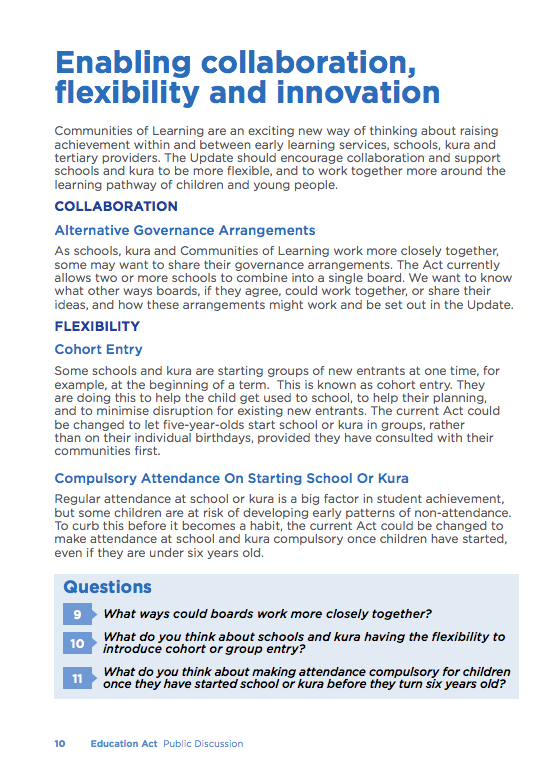
This pare of the document just looks at the idea of Communities of Schools that the government has brought about through the IES. Under Alternative Governance Arrangements, they state that some schools who are working in a Community of Schools, “…may want to share their governance arrangements”. This is already happening with the property side of funding in some areas. Also, as is with earlier parts of this document, where it says “may want to”, it is also saying that some schools “may be forced to” share their governance. In terms of flexibility, it is interesting that the only reason why schools would be wanting to have different intakes at different parts of the year is largely to make National Standards reporting easier in Years 1 to 3. Their anniversary reports would all be at once, rather than spotted throughout the year, and it would tie in with the senior reports a lot more often. The question really is, is if your child misses out by a few weeks for the intake, they might essentially miss out on 3-6 months of schooling. What’s more, if a school down the road isn’t having intakes at set times, that family may decide to take their child elsewhere. Isn’t it already compulsory for children to attend school? What’s more, how is the Ministry going to enforce this, especially when funding for truancy officers has been cut, and the Government doesn’t want to spend any more on education? No doubt it will be one more thing that schools will have to chase up on in their own time.
What is a “great” school?
What makes a school great?
How is this measured?
There is no question, given the rest of this document, what the Minister sees as a “great school”. High achievement.But the word “Great” or “Greatness” surely encompasses so much more than this?
Take for instance a local school in my area. A well recognised and renowned school, with parents and whanau driving from up to ten minutes away to send their child there. It is a decile 8 school and has about 330 students on its roll. 75% NZ/European and 17% Maori. Their ERO cycle is on a four to five year review. From the latest review it states that “Most students are achieving at or above the National Standards in reading, writing and mathematics.”
One would say this is a great school.At the school I currently work at, the same can’t be said. We are about half the size, and fit in a decile 2 bracket. We have about 60% Maori students, 10% Pasifika and 20% NZ/European. We recently managed to scrape through and get a three year ERO review, which we celebrated like we just won the Rugby World Cup. Half of our students are below or well below the National Standard across all three areas.
However, this year, both these two schools had their 50th Jubilee. Both of them started in 1965, the same time that Porirua officially became a city.
At our school, we had close to 180 ex-students come and celebrate over the course of Labour Weekend, 2015. Old students came from all around the country, from Auckland to Timaru. We even had some fly in from overseas to come and visit their old primary school. We had a school gala which had cars parked along the street as far as the eye could see. The atmosphere was buzzing and our school was the centre of it all.In stark comparison, the other school had to cancel it’s celebrations due to lack of interest.
I leave you with that question to ponder. Which is the greater school?
Making every school and kura a great one
Every school and every kura has to be a great one, and while most are doing well, a small number need more help to get there. Some more options could be put in the Act to help schools and kura get back on track. These could include an improvement notice, or an audit of one part of a school or kura. At the more serious end, a board could be asked to have different people on it.
Naughty, Naughty!
In this section, the Act turns its attention to the so-called ‘off track’ schools. The Ministry will help them get ‘back on track’, through the use of an “improvement notice” (similar to an infringement notice, I guess) or an audit (ERO visit). The serious end, the Ministry can remove a board if a school is REALLY ‘off track’, and no doubt choose (or appoint) the representatives on it.
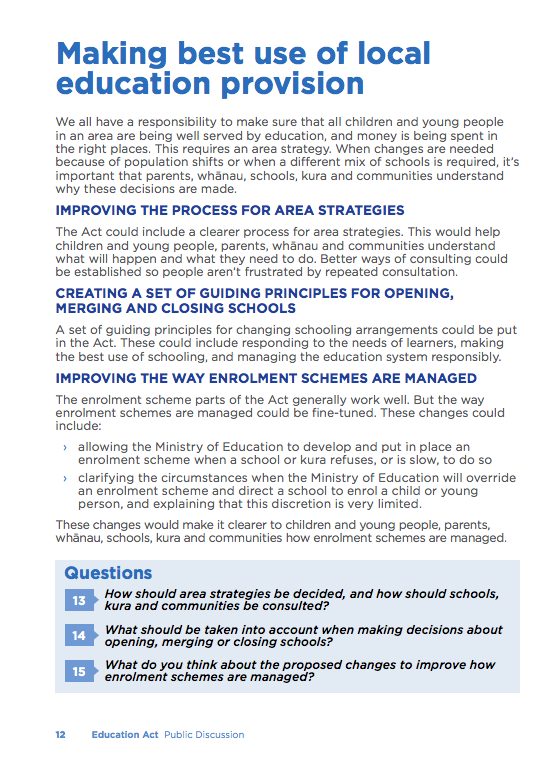
Creating a Set of Guiding Principles for Opening, Merging and Closing Schools.
What an interesting thing to amend within the Education Act. I wonder why this could have occurred? Maybe the Minister had too much trouble closing schools in Christchurch. Maybe she also had some difficulty merging some schools. And maybe they want to be able to open up new charter schools whenever they like. It has also made the provision for students to be forced to go to certain schools, and force certain schools to take certain students.
In Conclusion…
It is interesting the timing around this change. Reports are due, schools are winding down, half of the secondary schools are gone with exams, principals are drowned in end of year rollover for Novapay, and end of year activities. So it is unlikely that those who are working in the sector will have time or energy to fight the changes being proposed.
No doubt we need to though, if we are unhappy with the proposed changes.
Below are the details for how YOU can make a submission in answering the questions within the document.
You need to do this. Answer, respond, challenge, debate. Talk over your ideas. The more responses they get, the more they might listen.Related Readings
- Updating the Education Act 1989
- Education Act 1989
- Education Act changes shift focus to kids – 3News
- Principals unhappy with timing of Education Act Review Consultation – Stuff.co.nz
An easy way to make your submission is online at consultation.education.govt.nz. Here you will find an introductory video from Education Minister Hon Hekia Parata. There are questions to get you started, or you can upload a submission from your computer. You can also email your submission to education.update@education.govt.nz or write to: Education Act Update Ministry of Education PO Box 1666 Wellington 6140 New Zealand Submissions close on Monday 14 December 2015.
PERSONAL INFORMATION AND CONFIDENTIALITY
Submissions and documents associated with the consultation process meet the definition of official information and are therefore subject to the Official Information Act 1982. Please clearly indicate in your submission if you do not want your name to be included in any summary of submissions that we may publish.
FURTHER INFORMATION
If you have any questions about making a submission, or would like more information about the update of the Education Act 1989, please email education.update@education.govt.nz
-
Hekia wins the Rugby World Cup

I saw this photo on Facebook today.
I saw Shag’s tight grip and white knuckles not letting go of that cup and could only imagine what is going through that World Cup winning mind.
Hekia Parata must have thought she had won the World Cup herself judging from her smile. But there is no way Steve is letting that baby go!
-
Student achievement to be used to fund schools under new model
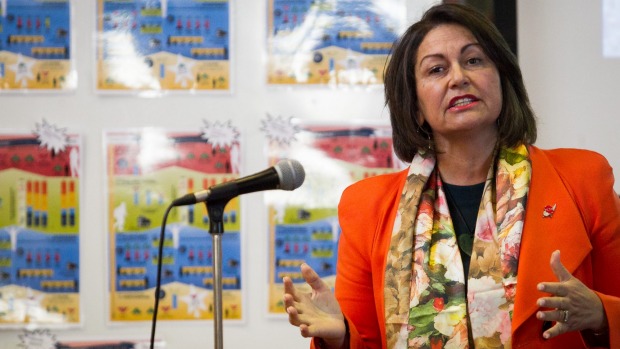 How well students perform in the classroom will soon play a part in how much funding a school gets.
Source: Student achievement to be used to fund schools under new model | Stuff.co.nz
Here we go. All the haters out there get ready. This isn’t going to be pretty.
Essentially this has been on the tables for a while.
Now, before all the scaremongerers get going; this is not Teacher Performance Pay, so we’re safe for now. As soon as Teacher pay is based on student achievement, we will see a both mass exodus of teachers, and a massive push of teachers towards ‘successful’ schools with ‘successful’ students. It will also lead to a complete demolition of the National Standards, as teachers will be forced to resist temptation to inflate their own results. What teacher in their right mind is going to mark students as well below, when that could affect your pay?
An interesting side note, as I check out the glorious photo of the Minister in mid speech, I can’t help but notice the Public Achievement Information (PAI) in the background. These have been recently released, and I have it on relatively good authority from someone in the profession who has gone through the data with a fine tooth comb, that the data in the PAI are inaccurate with that which schools have sent in. Go figure!
Credibility long gone…
As has come to be expected from the Minister’s office; a big contradiction 18 months after making this statement:
“This morning, Parata said there was no shift to performance-based funding, instead it would be a “recalibration” of the decile system.” – 17 March 2014
I’m guessing, by “no shift” she meant “no shift today”, and “recalibration” should have been “complete removal”. Can we believe anything the Minister says, if in 18 months time she’s going to renege on any decision she’s made?
Are you listening?
There is an incredibly beautiful editorial in the Listener that was written around the last time the idea of performance pay came about, back in March last year.
It puts forward the arguments much better than I could ever hope to. So I’ve picked and chosen some of the key points below:
With the changes still hypothetical, it’s important not to lose sight of the brick wall such a policy would have to hurdle: the dearth of appropriate data. As Treasury warned Bill English in 2011, if we want to go down the performance-pay route, we need to collect a different sort of data. At present, “the ministry cannot identify which schools add the most value to their students”.
Unless Parata has some secret assessment system waiting in the wings, she will be relying on NCEA and National Standards.
Both are unusual in that they are largely set and marked by teachers. The OECD’s highly influential education frontman, Andreas Schleicher, whom Parata bounced the last performance-pay policy off before it was publicly announced, has flat-out said they can’t be used for anything resembling performance pay. Doing so would “distort” the assessments, he warns.
…
There’s a good reason why police, lawyers and judges, for example, are not incentivised on the basis of securing convictions: it would make a mockery of the justice system. The same precautions need to apply in education.
Stumbling blocks abound. How to compare a school where all the students sit NCEA with one in which half the kids opt for Cambridge or the International Baccalaureate exams? How to compare a school where a large proportion of NCEA credits come from exams and traditional academic subjects with one that leans heavily on less-demanding vocational courses?
It is possible that this is what PaCT will essentially become for the Ministry – a way of quantifying National Standards and the “OTJ” to make it an “OCJ” – or Overall Computer Judgement. This might be the “secret assessment system waiting in the wings”.
Poorer Performance needs the help
One gets the impression from Ms. Parata’s statements today, that the “Performance Pay” she is hinting at is to give greater support to the schools that need it. This is actually one thing that I as a teacher can agree with; possibly the first thing she’s alluded to that I can say that since she has been in office. But the Minister did not come out and actually say it. But by reading between the lines, she alludes to how they can support students to do better.
“You can’t have a funding review of a New Zealand education system where how well kids are or aren’t doing wouldn’t be a part of it,” she said following the conference on Thursday.
“Obviously where we end up might be a very different place but my desire absolutely is to take count of how well our students are doing in the system and how we might support them to do better.”- 1 October 2015
It is definitely interesting times in education. We all need to be aware of the decisions being made, (or not being made) and be careful not to assume too much. As Parata says, it is still in it’s infant stage of being developed.
Who knows, in 18 months she might change her mind again.
-
Flag it!
Last month I wrote about the true cost of charter schools, after getting infuriated by the decision by the government to continue pumping money into embattled charter schools, which are failing miserably. The reality is, this government turned down the funding for food in schools, leaving kids hungry all around the country. Thanks to the likes of KidsCan, rumbly tummies are not an entire reality just yet.
Red Peak
Today it has been announced that the “Red Peak” design has been accepted as a fifth option going to referendum in November. This is on top of the four that has already been agreed upon by the selection panel. It turns out that any design with enough public sway will be allowed in.
Now I know that this is an education blog, so I better tie this to education some how; but the mere fact that this is going ahead is a complete joke.
Firstly, to put together the referendum, promotional material, holding TWO referendums, is costing the country $26million
$36million.In comparison, $14 million would allow the Feed the Kids bill to be funded for a year.
John Key. This is your life.
It is obvious to some, and others need to wake up and see the writing on the world. John Key is about to move on from politics. He has pretty much done everything. He’s become Prime Minister. Defeated Helen Clarke. Defended the role successfully twice. He has hosted a Rugby World Cup, met the rich and famous, hosted the Prince and Duchess of Cambridge, met with the President of the United States, got on the Letterman show, and countless other ‘achievements’.
But this is his swan song. The Prime Minister who changed a nation. Well… changed it’s flag at least.
No matter the cost. $26million
36 million.ThirtyTwenty six, with six 0’s following after it.
And because it’s his swan song, he wants to make sure that it’s his legacy he leaves. Red Peak has been allowed through, not because John Key likes it, but because it has public support. And it’s not even that it has public support for that flag, but that it has public support for a change. That’s all that John wants to be remembered for.
Personally
Personally, I don’t want to let John Key have that acknowledgement. He hasn’t done anything for this country other than provide a bit of people skills and a beaming smile.
He doesn’t care which flag, as long as it’s changed, and so if “Red Peak” has a selection of people who will vote for a change, he wants them on board – hence the inclusion of it as a fifth option.In addition to this, people are saying that they will vote for a change just to ensure that the whole process is not a waste of money. Regardless of if there is a change or not, lets get this straight; its a waste of money. Full stop.
But to help highlight the waste of money spent, it will of course be better to vote for no change. This will call into question why such an exorbitant amount of money was spent.
John Key should always be remembered in history for the muppet who in the spotlight of a world wide event coined the term “Troaty” and followed this up by trying to be a third hand in a handshake. And who can forget his ponytail pulling antics.
-
The True Cost of Charter Schools
 Its time to face some facts here. There is something terribly wrong with the current government’s focus for its funding, especially when it comes to education.
I decided to do some comparisons on money spent (or not spent) and see if any of it makes sense. I wanted to compare the budget they approve for some initiatives, and deny for others. In particular, the comparison between keeping charter schools open, verses the Feed the Kids bill that was denied in March earlier this year.
Embattled Charter School
At the end of July, the Minister announced that she would keep a failing charter school open, even though she stated it would face closure, and even though clear evidence showed inappropriate use of funds and suspicious achievement results.
“The Ministry of Education has directed a Northland charter school to replace its current principal with someone more “appropriate and experienced” or face closure. The beleaguered Te Pūmanawa o Te Wairua School in Whangaruru opened last year at a cost of $3million and has suffered a falling roll, truancy and low achievement levels in the year since.” – Feb 2015 – Māori TV
Previously the Government could only confirm it would negotiate with the trust should it close. The Northern Advocate can reveal $4.4million has been spent on the kura, which opened last year, including a recent one-off payment of $129,000 to help remedy the ongoing issues. – July 2015 – Northern Advocate
By keeping the school open, the ongoing cost of this school will have reached astronomical figures. By the end of this year, the cost of the school on the government will have surpassed $5.2million. It is important to note that this is the cost from its opening in 2014.
The cost of this school to the government for it to remain open each year is only a mere $1.65million.There are 39 students at Te Pumanawa o te Wairua.
That’s a cost of $42,271 per student each year (assuming the roll remains at 39).
Feed the Kids Bill
Let’s compare this cost with a recent bill that has been defeated by a mere 2 votes. This bill was nicknamed the “Feed the Kids Bill”. It sought to provide breakfast and lunch for every student in Decile 1 and 2 schools across the country.
Mrs Turei said the National-led Government is failing New Zealand children, as more are going without food than ever before.
“They are funding some programmes, but not enough, so they accept that there’s a problem, why won’t they fix it?
“It’s not that expensive either, it costs something between $10 million and $14 million to feed every hungry kid, every day in their school. What’s so hard about that?” – 19 March – Radio NZ
Education Counts lists the July 2014 roll returns, which shows that the number of students in Decile 1 and 2 schools across the country; some 111,069 pupils.
Doing some quick maths, I’ve worked out that using Mrs Turei higher estimate of $14 million, when spit among the number of students in Decile 1 and 2 schools, comes out at a staggering $120.
One hundred and twenty dollars and five cents.
That doesn’t sound right.
According to FeedtheKids.org.nz, the full cost of the programme would be $100 million a year – including food, staffing, administration, monitoring and evaluation. That sounds a lot more than $14 million, but the reality is, that not every child at decile one and two schools will need breakfast or lunch. At the school I work out, I’d say close to 85% of the students come with suitable lunch each day. The 15% that don’t, would benefit from this service. This also works out with Mrs Turei says around the $14 million mark, being that it is 15% of the stated $100 million on the Feed the Kids website.
Regardless, I did a little bit more maths calculations, and using the $100 million as the figures, the cost per student is a whopping $900.34
Nine hundred and thirty four cents.
Let’s just compare that to the one charter school that is being kept open for 39 students.
Charter School: $42,271 per student
Feeding Kids : $900 per studentThat simply cannot be right. Can it?
Oh wait. Of course! The $900 per student is on top of their education cost, where as the $42,271 is the cost of their entire education for the year. We will have to account for the decile one and two student’s education.
Taking an average decile two school, such as the one I currently work at, our figures per student work out at approximately $6,884.61 per student. Add on $900 to that, takes it to $7,784.61.
Comparing this to the forty two thousand, two hundred and seventy one dollars spent per student at the embattled charter school, it puts some clear messages out there as to what is fair, what is equal, and what is right out there. It also shows us exactly where the focus is for this government – and it’s not for those that are struggling.
What’s more concerning is that this is just one charter school. There are more in the pipeline. More that will take money away from the kids who, through no fault of their own, are going hungry this year.
-
IES and the Poisoned Apple

Over the next few weeks, primary teachers are meeting to discuss the proposed changes to the IES (Investing in Educational Success) announced last year.
The changes are, to some, significant and, before I get too cynical, NZEI have done a good enough job even getting the Ministry of Education to make any amendments to their proposed $359,000,000.
However, when this was first broached with the sector, a resounding 93% of NZEI members voted to have nothing to do with it. They saw the pitfalls of such a system, such as quality teachers no longer in their classrooms, teacher workload, and the fact when it comes to education one size does not fit all, and what works in one school won’t necessarily work in another, and voted appropriately. Still, NZEI remained in the negotiating tent; however smelly; to try and make the most of a sucky situation.
Joint Initiative
Now they have a working alternative, which has many changes which I won’t go into. You can read more here.
However, it doesn’t address the fact that quality teachers and principals will essentially become part time at multiple schools, rather than full time in the classes and schools that benefit from their time and effort. The whole initiative makes busy teachers busier, and the so-called benefits it will bring to student success is hardly mentioned in any of the agreement negotiations, and instead all possible roles are discussed at length. It all seems to just focus around teacher busy-ness, and misses the point completely. This could just be because the agreement is between teachers and the government, but regardless; it somewhat surprises me that student success isn’t more of a factor.
Let us not forget that this is hailed as raising student achievement, where there is little or no supportive evidence that this will work at all.Essentially all that has happened is turd polishing.
The Poisoned Apple
Let’s look at it like this.
The government has offered the teaching community a nice, juicy, red apple. It shimmers and shines in the light and looks delicious to a hungry princess. The soft light glints off it’s polished skin, the deep red matches the crimson lipstick of her luscious lips.
However, this current government’s education office is run by a witch with a mirror on the wall, and she has poisoned the apple with a curse, as she has done for the other apples she has tempted us with.
Teachers realised this very early on, and did not want a bar of it. They could see the money spent to buy the apple could be much better spent on other things; like an orange tree.
But the witch isn’t offering the orange tree. She’s offering the apple.
Now, NZEI advisor comes to the rescue, or so we think, and the advisor to the king talks with the witch. They discuss at length the properties of the apple, and how it could be made better, so that the princess might eat it. They decide that turning it into a toffee apple might be more appealing. They cover it with the caramel coloured glaze that drips down and turns the apple into a gooey, sticky, goodness.
While the toffee apple is much more appealing, and is somewhat irresistible in comparison with the delicious apple that was offered before. But deep down the princess knows that the apple is still poisoned and will be the end of her. Still, upon receiving advice from the advisor, she takes a bite. We all know what happens next.
The only problem is the solution requires a huntsman with a large axe. Which we don’t have.
Instantly Sceptical
Essentially, with this government’s attitude and treatment towards teachers, they haven’t done themselves any favours. Add to this the class size fiasco, and you have a workforce which simply does not trust or have faith in anything you try to accomplish. The way they steamrolled out the National Standards turns out to be indicative of how they have continued to operate; make it policy, and then consult with those involved. We saw this again in the Novopay disaster.
It is no wonder then that teachers were instantly sceptical of IES and picked it apart. It’s also no wonder that the Ministry seem to be rolling on regardless of the situation. I also suspect that it won’t matter what new policy the government bring out in education; teachers are simply going to oppose it purely because of this government’s track record.
Essentially the vote this week isn’t voting on whether we want the joint initiative agreement made by NZEI and the Ministry of Education or not; it’s voting on whether we want what the Ministry proposed in IES, or the joint initiative (which essentially is a no-brainer for any teacher). In the past it’s quite clearly been said, when given the choice of Ministry backed options, or NZEI backed options, go with NZEI because at least they are looking out for and supporting teachers. They have the teacher’s interests at heart.
But democratically, a vote like this is completely flawed. We’re choosing between a poisoned apple, and a poisoned toffee apple. At the end of the day, it looks the same, it smells delicious, it’s big, red, and juicy, but you wouldn’t want to take a bite.

