Download full article (PDF – 1.9 Mb)
I am man
Male teachers teaching males .
A study into the influence of male teachers on the education of boys at primary school.
A lot is made about the education of boys and the problems surrounding them.
We continue to see female students outperform their male counterparts year in and year out when it comes to academic ability. This happens mostly in secondary education, but is often assumed this starts earlier in life, when students are in primary school.
In conjunction with this is the ratio of male teachers to female teachers, which is about 1:5. Only 16.5% of primary teachers are male (according to 2013 data), which compares to only 41% in secondary school [1]. When we begin to look deeper into these numbers it becomes even more interesting.
For instance, we can discount principals from our data, as very few of these are full time teachers in a classroom. In 2012, the number of male principals was more than female principals by just 67 (compared with 437 more in 2004). Continuing this trend is somewhat inevitable, and we would expect by now that there are more female principals than male principals.
There are 1,961 primary schools in total (including full primary, intermediate and contributing schools). The number of male teachers (excluding principals) in these schools is 3,633 [2].
If all the male teachers were equally distributed across the country, there would be only 1.8 male teachers per school. Let’s be humane and round that up to 2 male teachers per school on average, just so we don’t have to remove 0.2 of one of our male teachers. Obviously, some will have 2, some may have 3, some even 4, while others will only have 1, or more concerning, none.
Add in to this the specialist teachers in Intermediate schools who teach woodwork, art, music, computers, design, and other technology options, many of whom are usually male; thus bringing the number of males as classroom teachers down. In fact, you wouldn’t be wrong in saying there are less than two male teachers in the average New Zealand primary school.
To me, it’s not good enough. 
Take an average New Zealand primary school of 300 pupils for example. Based on the government’s current ‘ideal’ class size of 28 students, there would be 11 classrooms at this school. Of those 11 classroom teachers, we can apply the 16.5% of teachers being male. That leaves us with 1.8 teachers. Now I’ll be generous and make that two. Two male teachers in the school. That means there are only 56 out of 300 students who have a male teacher for that year. That’s only 18% of the school on any given year.
If we extrapolate this further, we can work out some probabilities of students having a male teacher. For this, we will assume that there are no male teachers in the new entrants class at this school – as is the case for most schools around the country. This raises the percentage of male teachers to 19.8% given we are eliminating one year of teaching.
Warning: Complicated mathematics approaching!
Now, with this higher percentage, we can calculate the probability of having a male teacher at some point during your primary school years – Year 2 to 6. (This excludes Intermediate given the complications around tech teachers, as well as varying class sizes.)
The formula is:

Y = Possible years with male teacher (5) n = No. of Male T’s

F = Female Teacher % M = Male Teacher %
Yt = Total years at Primary School (6) n = No. of Male T’s
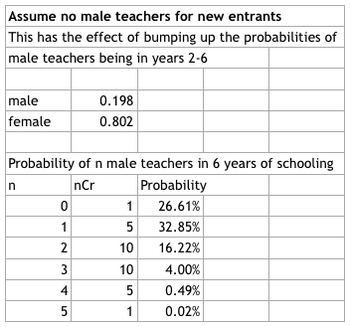
So with that, we have the table of the probability of having ‘n’ number of male teachers during primary school. The chance of not having a male teacher at all is about 26%, and there is only a 32% chance of having only one male teacher in your primary school years. Not surprisingly, the chance of having multiple male teachers during your six years of primary schooling is even lower, and the probability decreases rapidly the more male teachers we put into the equation.
We can take this even further when we start to place this into a real life situation, where most schools these days are splitting year groups up, and combining them into one classroom. We usually see this around mixed classes of year 3-4 and year 5-6.
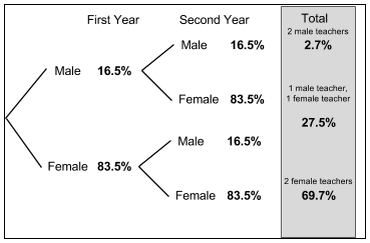
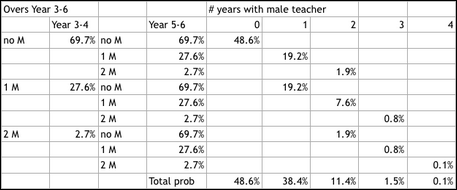
This shows us that having two female teachers for these two years (where year levels are split) is more than twice as likely to happen than having a male for one or both of them. It’s nigh on 70% chance that primary school students will have a female teacher for both years. This assumes of course that students have the same possibility as the first year (i.e. half the year group changes teacher). This becomes exponential when we throw the same probabilities for the following two years in 5 and 6. In the table below (Table 1) (filled with yet more complicated mathematics), we can see how the probability changes as students go through the education system today.
Some interesting points to note:
- There is nigh on 50% chance of not having a male teacher for Years 3-6.
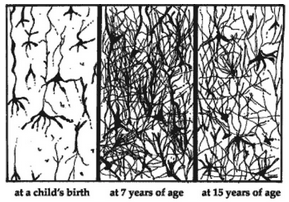 During years 3 – 6, students are making the most neuron connections in their brain than they ever do in the rest of their life. This is a critical stage in the development of their personality, knowledge, emotions, health, and well-being. This can be seen in Figure 2 below. The connections are at their most dense at the age of 7, which is when a student heads into year 3. From there, the important connections that have been made grow stronger, and those that have been made upon misconceptions disappear.
- We can see that there is less than 40% chance of having just one male teacher during these formative years.
- That drops significantly for students to have two male teachers. Given that we have established that there would be 2 male teachers (on average) at a 300 pupil strong school, there is only 11.4% chance of a student being taught by both of them over the course of 4 years.

I could spend hours going into the complexities of why men don’t want to be teachers. We can look at all the excuses. We can blame money or abuse claims. But to me it’s more than that. I want to put it back to the kids. That’s why I got involved in teaching. It’s not for me. Not for my benefit. I’ve had my education, filled with influential male teachers that to this day I still look up to and admire, and am infinitely in debt to for their impact on my life. No. The reason I am a teacher is for the kids.
In a NZ Herald article by Nicholas Jones, he interviewed Phil Harding, the Principals’ Federation president, who said that ‘many schools struggled to hire male teachers, and there were good reasons why a more even gender split was desirable.
“Look at the percentages of children that are living with no father in their daily lives. We see the fallout from that with boys that have lost their way, are desperately unhappy, and don’t feel like they can talk about it with mum.
“So that all gets bottled up and rebounds in the playground in anger – deeply seated stuff.” [3]
These kids need male role models in their lives – boys and girls alike – but especially boys. Some are lucky to have them. Fathers who love their wives or partners, and who adore their children give their kids someone to look up to. Some have grandparents who were born in a different and more disciplined era. Some have uncles who they admire. But all too many have no one. A father who is in prison. An uncle doing crack. A grandfather who passed away last week. They come to school and the only other male influence they have in their lives is a little brother who they had to make lunch each morning.
This is the reality for many of our students today.
I have a colleague who makes a good point when it comes to male teachers; and that is that a good teacher is a good teacher, regardless of gender. This view is upheld by Dr. Graham Stoop who says “Evidence tells us that the most important factor in lifting achievement is the quality of teaching, not the gender of the teacher”.
But as a male teacher, there is something more to it. I agree that a good teacher will teach well. But there appears to be a different bond between males to males that don’t exist between males and females, and this begins at a very young age. I am speaking from experience; both as a boy learning from male teachers at primary school, and as a male teacher teaching in a primary school.
I have seen that the boys gravitate more towards me, they watch and they learn from me in a way that they don’t with my female colleagues. I’ve seen them become engaged, and felt included as a guy, rather than just another student in the class. I’ve seen them try out their sense of humour because they know that it is safe to do so with a guy. I’ve seen them take risks and give things a go in physical education, because its the guy thing to do, and as a male teacher I have encouraged the bravado within the safety of the classroom or school grounds.
There is no suggestion that females can’t or don’t do these things and provide the opportunities to do it, but there is something unknown going on when there is a male teacher who is able to engage and inspire the boys in his class.
Think of it as a child version of when four men can go round to a mates place, slouch down into a range of seating options, say nothing at all to each other and yet have an entire conversation at the same time. No one can explain it, not even men themselves; but it exists.
In almost an uncanny concurrence, we are forever hearing about the falling rates of boys achieving academically, being left behind in educational dust by their female counterparts. For a long time, girls have always been more academically inclined than boys, and this has shown up in New Zealand assessment results for decades. It would seem that boys have given up on education long, long ago, and would rather be out playing sport, building things, making things with their hands, and having a bit of rough and tumble.
But there is more to education than academic results, right? We already know that the success of education rides on the ability of the teacher to engage and inspire, motivate and challenge, as well as, build relationships with their students. We know that there are many circumstances that hinder progress, but in the same way, there are many circumstances that foster it.
Could it be possible that there’s a small chance that the key to improve boys educational success lies in male teachers? What if the difference that needs to be made in order for boys to become both academically successful, but also become valuable and responsible members of society is directly (or otherwise) linked to the influence they have from male teachers? What if the way of building up and equipping tomorrow’s men with the knowledge, skill, resilience and determination to be better men; be better husbands or partners; be better fathers; to stand up and say “I Am Man!”; was to present itself in the way of today’s men being an everyday influence on today’s boys. One of the most powerful ways, but certainly not the only way, to do this lies in teaching. Every day for six hours you have tomorrow’s men attention and engagement to make a difference.
But how strong is this link between men in teaching and boys’ achievement in education.
I’m certainly not the first to wonder about this. It is “One of the more common themes… that a relationship exists between boys’ achievement levels and the numbers of male teachers (Sunday Star Times, 1 Aug 1999).” [4]
To do this, I want to look at the results of boys achievement at various stages through New Zealand education history. I then want to match these points in time with the decline of male teachers. Potentially, we may see a trend beginning to happen, where the achievement (or non-achievement) of boys is directly linked to the number (or lack of) male teachers.
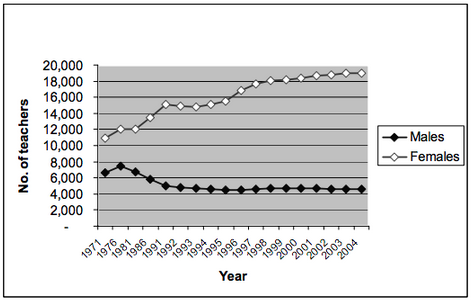 Because there is no national assessment data for primary schools like there is for secondary schools in the form of NCEA, or in years gone by School Certificate and Bursary, I have offset the years by five, accounting for the fact that those sitting NCEA Level 2 in 2009, for example, would have been leaving primary school in 2004, and therefore affected by 2004’s male primary teachers.
Statistics around male teachers across the decades was initially obtained from Harker (2006) [5] who got his data from the Ministry of Education website at the time.
We can see a downward trend from the 1970’s, to a plateau from 1991 onwards. Meanwhile, the number of female teachers has steadily increased over this time, and thus, the percentage of male teachers in classrooms continues to drop.
In the following few pages I have made a series of charts and tables of information surrounding school leavers highest attained academic results.
I have included students that have left with no qualifications at all, as well as, those that have achieved Higher School Certificate, NCEA Level 2 or higher. Comparing these with the numbers of male teachers should give some indication around the effect less male teachers has on the students.
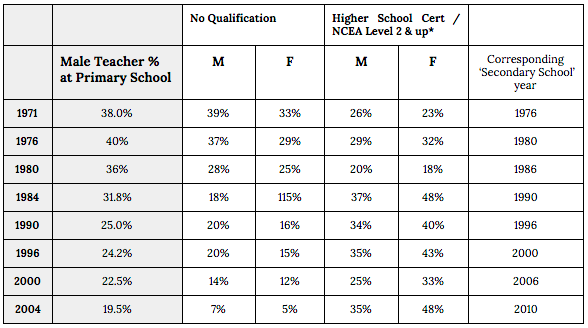 The table here shows the truth behind some common assumptions that are well known. Firstly, that there is a decline of male teachers in the primary sector. Secondly, it shows us, in two different ways, that females are outperforming boys when it comes to secondary school education achievement. In the ‘No Qualification’ columns, we see that more males are leaving school with no formal qualification than females.
At the other end of the spectrum, we can see that from the mid-80’s onwards, more females are achieving Higher School Certificate or NCEA Level 2 than males.
From this, it does not look good for the theory that the lack of male teachers is having an effect on boys academic results. In essence, if this were the case, we should be seeing the rate of males leaving with no qualifications increasing as the number of male teachers decrease. Along with this, we should see those male students passing with Higher School Certificate or NCEA Level 2 decrease at the same rate as the percentage of male teachers in schools.
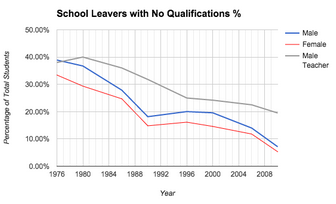 However, we see the opposite of this, and is only highlighted by the graph, where school leavers with no qualifications is slowly declining at about the same rate as the percentage of male teachers.
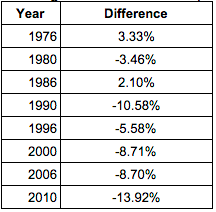
There is only one glimmer of light that goes along to mirror the impact of male teachers. Whilst I have been purely looking at the performance of boys at secondary school, it is important to look at the comparison against females, as that tends to be what they are compared with each and every year. This is what tells us that there is a problem.
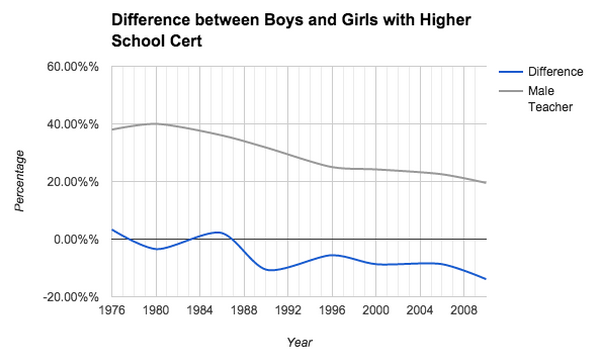
The way to compare the two is to take the lower away from the higher to give a marginal difference and measure the gap between the two genders.
From the graph above, we can see a range of differences across the decades which is to be expected. But if we imagine a trendline on the difference line, it might look a lot like the gray line that is representing the percentage of male teachers in primary schools. However, this is not nearly enough evidence to suggest that the lack of male teachers in primary schools is having a detrimental effect on the state of secondary school leavers attainment rates.
It is hardly surprising, thinking back to my high school years, that primary school teachers have any effect on the exam and assessment results of teenage boys.
DATA SOURCES
1976-1986: No online copies available. See ‘Education Statistics of New Zealand Booklet’ for these years.
1990: 1990 Education Statistics of NZ Booklet.pdf
1996: 1996 Education-Statistics of NZ Booklet.pdf
2000-2006: Education Statistics Downloads – Years 1999 to 2009
2010: Highest Attainment Numbers
Until there is measurable and reliable data on the progress and achievement of primary school students, there will be little way of actually proving that male teachers benefit male students more than female teachers. And even then, I am not sure that it would be that cut and dry.
Some would say – ‘Why don’t you use National Standards to see the effect?’. Well, firstly, National Standards have only been around five years. The standard deviation for any percentages would eliminate any rate of drop for male teachers during that time. Secondly, the National Standards are still ‘being developed’ in the sense that teachers have only just gotten an understanding around them. Even the government admits that the figures are ‘ropey’ and cannot be relied upon to help use determine if there is any link between male teachers and male student performance. Without the National Standards being more robust, gathering any information around student performance at primary school is far too difficult.
But what if, like many key areas of learning that go past unnoticed, the impact of male teachers on male students cannot be measured through student assessment? For instance, how does one actually measure influence? Or motivation? Or engagement? All of these aspects we agree would lead to students learning more and understanding more, but none are easy to calculate or measure so as to be compared with the declining percentage of male teachers in the classrooms.
What if the impact of male teachers on students doesn’t make itself known until much later on; years after they leave school, decades, even generations later? Otherwise, why is there such concern over the dwindling numbers of male teachers in our primary school classrooms?
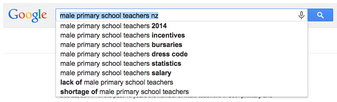
I did a Google search for “male primary school teachers nz”, half expecting (but not really) to see articles about role models, positive posts about great male teachers, the range of skills needed etc.
Instead, of the 10 results that were listed on page one, six of them were about the lack of male teachers.
 Even the article I featured in, which had all sorts of positivity around being male and being a teacher in a primary school had a negative headline leading the charge – “Wanted: Male primary school teachers” – as if we had suddenly reached dire straits and desperately needed more male teachers in Wainuiomata. While even more male teachers would be welcome, it isn’t as if there is a shortage.
For me, it comes back to the unmeasurable factors that males bring to teaching that provides students with a balance. Without male teachers providing that important balance, education becomes very ‘one sided’ and female dominated.

Role models. People we look up to for inspiration, encouragement, example. Someone we try and emulate and better ourselves to be like. Research in 2008 in the UK, carried out by folks who have more time for this kind of thing than I do as a practising teacher, have interviewed a sample of 800 males in the United Kingdom[6]. They found that over half consider male teachers they had in their schooling years to be a ‘fundamental role model in their life’. In addition to this, over a third of these men also thought they were challenged to work harder at school because of having a male teacher.
In the article, Dr. Tanya Byron says “Male primary school teachers can often be stable and reliable figures in the lives of the children that they teach.”
All of these factors mentioned in the article are not at all academic based, but definitely contribute to the overall education of students; in this case boys. While evidence explored earlier in this study shows that male teachers have little impact on the academic outcomes of boys at secondary school, we can definitely see how other factors could be definitely influenced by having a stable, reliable male role model as a teacher.
We are forever debating around the other influences that affect our students every day, and what impact they have. Teachers get told that we are just making excuses for the students not learning at a hypothetical expected level, when in reality, these are completely real for our students. Things like poverty, nutrition, hygiene, and hunger are all massive influences on our students every single day.
So it should come as no surprise that male teachers can have some (positive) influence on our students lives, even if there aren’t any ‘academic benefits’ because of this. We can certainly assume that any positive influence provided by any teacher will improve student well-being.
In turn, we can also say that any positive influence from male teachers will have a profound and meaningful impact on boys.
Providing this role model becomes vitally important when considering the number of families with fathers who are no longer a part of their child’s everyday life. In 2006, Auckland University looked at the change in family situations in New Zealand based on the Census taken over the years [7].
They found some interesting calculations regarding income, education, and other factors that make up whanau around the country. Using their data, I looked at those families that had dependable children (unable to earn, and therefore dependant on their parent/s) with two parents, and families that had dependable children with only one parent.
In 1981, only 14% of these children who depended on their adults came from one parent situations.
In 2006, that number has doubled to 28%. That’s nigh on one third of our kids who are living with only one parent, usually their mother.
Please note, I am completely aware that some of these ‘one parent families’ will be solo dads who are looking after their kids, and who are providing an awesome role model for their children. But in my experience, I would say that in nine out of 10 cases, it is the mother who ends up looking after the children after a breakup. And while most fathers still remain in contact with their children, it is very rarely a consistent or sizeable influence that a child is experiencing day in and day out, such as that which a male teacher would have for example.
It therefore becomes vitally important, especially for these 28% of students in our classes, that they are getting the input from male role models into their lives, in some shape or form, and male teachers can be the most influential of all the options. You can see a nine year old boy coming from a broken home where Dad has left the scene and Mum is working, doing the best she can, just how important a male teacher might become in his life. It may not make a blind bit of difference to him academically, but to his well-being, his confidence in himself as a young man, and his perception of men in his life, the influence that teacher could be on his life may be one of the most important things that happens for that child.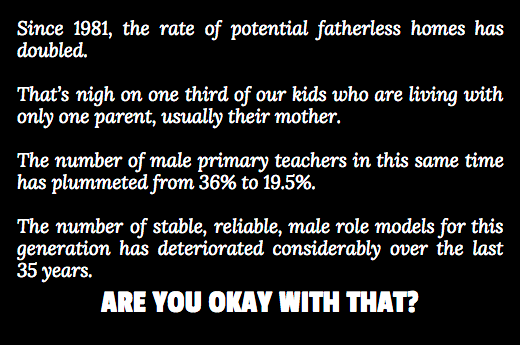
In this same time period where we see more one parent (usually mothers) families, we also see the decline in male primary school teachers.
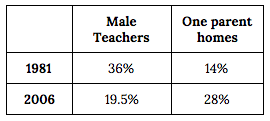
From this table we can see how the number of male teachers goes down, while the number of single parent families goes up. Because the single parent family usually (but not always) means the mother, we can assume that the number of male role models is also decreasing at home. The number of stable, reliable, male role models for this generation has deteriorated considerably over the last 35 years.
The impact that this has had on society as a whole is difficult to determine. It may not become evident until many years, even decades down the track. We often say that children these days are less resilient, less disciplined. But then, people have been saying that for generations, and there’s nothing to suggest that male role models instill any more discipline in individuals than females. This is why it becomes difficult to see the impact that the decline of male role models has had on children of today, and on society as a whole.
Conclusion
In summary, I have found out some interesting insights into the struggles that education faces now in the current climate in regards to the imbalance of gender in schools, especially primary schools. Fighting with some complicated statistical equations, we found that there is a 26% chance that your child could go through their primary education without having a male teacher at all. There are less than two male teachers in the average New Zealand primary school.
Are you okay with that?
There seems to be an unwritten anomaly that occurs between adult males, and this is something that happens instinctively. This made me think that, as a boy at school, there is something more about having a male teacher. There is an intrinsic link that is difficult if not impossible to put your finger on. This led me to believe that there is something beyond being a good teacher that makes male teachers an important part of a child’s education, especially for boys.
But none of this can be backed up by figures. So looking at academic results, one has to look at secondary results, as nothing quantifiable, or reliable, is readily available on a
national level for primary school students. Going back to the 1970’s, I compared the academic results with the decline of male primary teachers. I used a five year offset to see the impact that a 1971 primary teacher has on a 1976 secondary school student, to no avail. There is no evidence to suggest that the lack of male primary teachers is having any effect on secondary school results. In fact, if anything, the opposite is true (though I don’t believe for a moment that male teachers are hindering any academic progress on our generations).
As we head on into the future, the number of male role models in students lives are diminishing, and this should be a concern to all of us.
So it comes down to that intrinsic link between males. Be it macho, be it strength, mana, boldness, or the old adage of boys will be boys, the fact is the only ones who know what it’s like to be a boy at school are men. And the only ones who can go about helping these boys become tomorrow’s men with understanding and experience are male role models. There is no doubt that many, many females have had an amazing impact on each and every man going through school. There have been numerous females who have focussed their entire careers around the education of boys. One that comes to mind immediately in this country is the late Celia Lashlie.
Celia’s work stems from prison and the system and process around the journey boys get set on to end up there. It was with a bit of a shock that we heard of her passing in February this year. Such a strong advocate for boys and men around this country, her shining light snuffed out at such a crucial time.
But one of the quotes I read of hers when summing up her work, she said:
‘My job was only to collect the stories and hold up the mirror, it was not then, nor is it now, to translate for men what they are seeing in the mirror or to tell them what to do next.’ [8]
In a sense, this is exactly the outcome of my study in the preceding pages. In a sense, only men will know how important it is for boys to have male role models. Females know the importance of it, and are becoming teachers to be role models for them (and all students of course). But they can’t be male role models for them.
So here I am, telling you what to do next.
Male teachers who are reading this: keep strong. You chose this profession for a reason. Or if you didn’t, you have surely found one along the way. Hang onto that reason. Don’t quit just because the going gets tough. One of my favourite, and most influential quotes for me from the first season of “The School”, or “Educating Essex (2011)” [9] as it is formally known by in the UK, is from Mr. Drew, who says:
“I like young people. I find them interesting. I find them exciting, I find them invigorating. I just think it’s so grotesquely critical of adults in the modern age to
say that young people today are worse. They’re not worse, they are products of what we as a society create. And they have less opportunity to be children.
So, yes, it’s hard work, but why is hard work a bad thing? Hard work is surely what makes people better. So, yeah, it’s hard work, but okay good, thank you, I like hard work.” [10]
Ever since hearing that, I’ve kept it. Yes, it’s hard work. But I like hard work.
If you are male and thinking of becoming a primary teacher; do it. Don’t worry about the attached stigma, or what people think about you. If you feel that you’re going to be a good teacher and want to make a difference in tomorrow’s men, there is no better way. The pay isn’t as much as you could get in the private sector, but its a living, and the rewards are so much greater than anything money can buy anyway.
The reality is, the difference you can make today, is going to benefit generations to come.
I can’t and won’t sell teaching to you. It has its benefits and its pitfalls just like any other career path. But you will know if you have the teaching bug. Its a little bug that grows inside. It buzzes with enthusiasm when it sees learning happening. It flutters with excitement when you pass information on to others. It gets a kick out of seeing eyes light up. Its a passion deep inside, and without it, teaching won’t be for you. But with it, you will be the greatest thing that happens for some students that will go on to affect them for the rest of their lives.
References
[1] (2014). Efforts to get more male teachers failing | Stuff.co.nz. Retrieved May 7, 2015, from http://www.stuff.co.nz/national/education/64375435/Efforts-to-get-more-male-teachers-failing.
[2] (2012). Teaching Staff | Education Counts. Retrieved May 7, 2015, from https://www.educationcounts.govt.nz/statistics/schooling/teaching_staff.
[3] (2014). Lack of male teachers ‘affecting boys’ – National – NZ Herald … Retrieved May 7, 2015, from http://www.nzherald.co.nz/nz/news/article.cfm?c_id=1&objectid=11359588.
[4] Major, Dayle. “Male Teachers and Boys’ Achievements.” (2000).
[5] HARKER, R. (2006). Teacher Numbers in New Zealand: Attrition and Replacement. Retrieved from http://www.teacherswork.ac.nz/journal/volume3_issue1/harker.pdf.
[6] (2013). Male teachers vital role models for boys – The Guardian. Retrieved May 19, 2015, from http://www.theguardian.com/education/2008/sep/30/primaryschools.malerolemodels.
[7] (2010). Measuring Changes in Family and Whānau Wellbeing Using. Retrieved May 19, 2015, from http://www.stats.govt.nz/browse_for_stats/people_and_communities/Families/changes-in-family-using-census-1981-06.aspx.
[8] (2015). A life lesson from Celia Lashlie – Bevan James Eyles. Retrieved May 19, 2015, from http://www.bevanjameseyles.com/blog/2015/3/4/a-life-lesson-from-celia-lashlie.html.
[9] (2011). Educating Essex – Channel 4. Retrieved May 19, 2015, from http://www.channel4.com/programmes/educating-essex.
[10] (2014). Jul. 18, 2014 – adrienne santos. Retrieved May 19, 2015, from http://adriennesantos.com/post/92143214503/i-like-young-people-i-find-them-interesting-i
Acknowledgements
A huge thank you to my sister, Dr. Bridget Ingham who helped with the ‘mathemagics’ that was going on in part two. There is certainly no way that I would have been able to extrapolate that level of statistics to bring the probability of getting a male teacher at primary school without it.
Thank you also to my current place of employment. You took a risk and employed a fresh faced young male teacher and gave me a start into teaching. There’s not a day that goes by that I am not grateful for the opportunity I have to be an influence in the boys and girls at our school.
Thanks to my wife who has put up with a semi-unresponsive husband as I work late into the nights typing up my findings. Your ongoing support gives me the strength to face each day.
Lastly, thanks to the late Roger Mexted, who taught me as a boy, and taught me as a student teacher in his class. Your role model has left a permanent impression on my life, as a teacher, as a person, and as a man.
Edited by Al Ingham, Bonnie Macbeth and Ruth Hastings. Many thanks.
Download full article (PDF)

Once again the universities are the big winners in the Budget. Unfortunately, despite international research increasingly pointing to the value of workplace training and apprenticeships, the 2015 Budget…
 – was a college (NZ calls them ‘universities’) drop out – ie. he left before completing any tertiary qualification. Another rather successful college drop out is one Mark Zuckerberg, who is creator and CEO of a website called Facebook.com. You might have seen it? Zuckerberg has a reported personal wealth of some $38.6 billion (US) at the age of 31. He was a billionaire by the age of 23 – 5 years out of high school. He put himself on a $1 salary in 2013.
 BYOD – standing for Bring Your Own Device, has been around for a while now; ever since schools opened up their networks and went wireless, students and teachers alike have been able to access the wealth of information that is available on the internet today.

 We are showed the assessment pyramid regularly in P.L.D (Professional Learning & Development), and it still staggers me that things remain the same. The assessment pyramid works a lot like the food pyramid, with the top tier representing assessment that, whilst is usable, should not make up the bulk of assessment used in the classroom. The bottom tier represents assessments like teacher observations, anecdotal notes, conversations, discussions, behaviours, troubles, problem solving, which should be use more frequently. Yet the rate of importance placed on assessments is opposite. Those that fit down the bottom of the pyramid which should happen daily and make up the majority of our assessment as teachers, is given the least importance, while those at the top which happen once or twice a year, are relied heavily on when schools are asked to “prove it” by Ministry or ERO officials.