Tag: education

  • Kids arriving at school in nappies

    Primary and early childhood teachers have asked the Government to let them divert money away from expert teachers to provide extra support for needy kids.

    Teachers’ union, the NZ Educational Institute, has asked the Ministry of Education to let schools and early childhood centres use some of the extra $359 million tagged for “communities of learning” to create “roles supporting children with learning challenges”.

    The communities, usually groups of six to a dozen schools, have money to pay up to 900 “expert teachers” to help other teachers in the group to meet “achievement challenges”, which have been mainly focused on literacy and numeracy, and pass rates in the National Certificate of Educational Achievement (NCEA).

    The institute opposed the initiative when the Government proposed it in 2014 because it was seen as a step towards performance pay – paying expert teachers more than others.

    But it eventually agreed to participate when the extra pay was limited to $8000 a year for expert teachers working within their own schools and $16,000 for those working across all the schools in their group, but with an agreement to review the scheme with the ministry this year.

    Institute executive member Virginia Oakly has told the conference in Rotorua that the ministry has agreed to give the communities some extra flexibility.

    But a review report, which the institute and the ministry had hoped to sign off last week before the conference, has not yet been agreed on because the ministry has not been willing to “stretch” the model as far as the institute wants.

    A main theme at the conference has been that teachers want more support for growing numbers of children who are violent and disruptive because of unsettled home lives, and many schools are reporting children starting school not yet toilet-trained and still in nappies.

    Former institute president Louise Green said the institute wanted ​to use the extra funding for communities of learning “more directly to support children’s needs rather than on allowances for a few rigidly prescribed roles”.

    But the institute “made no progress with the ministry on this issue”.

    President Lynda Stuart said teachers needed hands-on help from specialists who could work with needy children and their families, freeing the teachers to teach other children in their classes.

    “We want to see specialist frontline support that can go in and support teachers and schools – frontline ministry people, psychologists, speech/language therapists, occupational therapists, behaviour specialists,” she said.

    Read more here.

    Source: http://www.nzherald.co.nz/nz/news/article.cfm?c_id=1&objectid=11929058

  • New Domain Name

    Welcome to UnleashEducation.co.nz

    It’s here! Finally, after many months of deliberation, we have bit the bullet and purchased the domain name “unleasheducation.co.nz”. We haven’t updated the website any to match however, as some have come to expect, as we’re quite happy with the design we have currently.

    So update your bookmarks, share out the links, tell your family and friends, and check it out to make sure it all works!

    Enjoy!

  • No More Sense from Seymour

    And so it begins.

    The non-sensical dribble spews forth from the under-secretary of Education, who gets into a lucrative position on the back of one electorate described on Wikipedia as an “exclusive, affluent suburb of Auckland”.

    That’s right. Mr. Seymour is at it again as he launches the ACT Party campaign.

    We will pay good teachers more. And great ones even more. No doubt David will be the judge as to which teachers make good teachers and which ones make great ones. I would put money on schools not being able to decide that themselves, and even more money on it being based on student results i.e. National Standards ala Performance Pay.

    Of course, one can see his point when he opens with the statement that the average teacher is paid a pittance, and deserve to be paid more.

    To fix that, the party is proposing an extra $1 billion in funding for education. “ACT’s proposed good teacher grants will give your average teacher a pay rise of $20,000 per year,” Mr Seymour claimed.

    But to receive the extra money, schools “need to opt out of the centralised payroll system and collective agreements”.

    This has rubbed a lot of people (in particular teachers) up the wrong way. No surprises there.

    But here’s why his solution makes no sense.

    Hypothetically Synonymous Seymoronous

    Let’s assume that schools go for this, and EVERY school in the country pays their teachers an average of $20,000 per year more than they are already. That is going to cost a lot.

    However, none of that has anything to do with collective agreements, the unions, or any centralised payroll system. They are not synonymous with each other.

    It’s illogical.

    In fact, under Seymour’s scheme, teachers could stay in the union with the collective agreement, and they could still get paid $20,000 more if he really means it; just get a new collective agreement ratified between the government and the union, or have both – give a bit more to schools to ‘top up’ teacher salaries that are paid through the collective agreement. It’s only because ACT are notoriously anti-union that he is dangling the carrot for principals and teachers to consider.

    Pay more Seymour

    The second factor is that given the current climate in education, there are teachers leaving in droves, and not always because they aren’t being paid enough. On many occasions, the workload is too much. Refer to this article in March. As a teacher, like many others, I would probably take less workload over getting paid more to ‘compensate’ for the increased workload that is currently expected of us.

    In Conclusion

    While paying teachers more is a genuinely nice touch, Mr. S, if you really cared and were really in touch with the education sector, and you actually wanted to value teachers, then maybe the first step is to work with the union rather than trying to sabotage it into non-existence.

    Illogical. Blackmail. Numpty.


  • Four in five Christchurch primary schoolers exhibit PTSD symptoms, study finds | Stuff.co.nz

    Up to 80 per cent of Christchurch 5-year-olds are showing post-traumatic stress disorder symptoms, research shows.

    Source: Four in five Christchurch primary schoolers exhibit PTSD symptoms, study finds

    As many as four in five Christchurch primary schoolers are exhibiting symptoms of post-traumatic stress disorder (PTSD), a local study has found.

    Children who started school in the years after the Canterbury earthquakes were “neurologically different” – and a city-wide focus on resilience has only deepened the crisis, researchers Kathleen Liberty and Maureen Allan found.

    The 300 children in the study were five times more likely to exhibit symptoms of PTSD than other Kiwi children. Eighty per cent had at least one symptom and a third exhibited at least six of 12 symptoms. About a third had eight or more behavioural problems.

    Strategies to address the problem suggested by Liberty and Allan have achieved a 27 per cent decrease in behavioural issues since February 2016, sparking “an explosion of interest” in their five-year project, the pair said. Since May, 11 schools and kindergartens had signed up for a duplicate study.

    University of Canterbury associate professor Liberty and Resource Teacher Learning and Behaviour (RTLB) manager Allan teamed up for the study after noticing differences in 2012’s new entrants.

    Read more…

  • Future of education in NZ for National freightrain

    In response to NZ Herald – Every child’s chance to learn second language: National’s education policy – 27 August 2017.

    Whilst some schools are struggling to get students to learn a first language, we’ll be teaching them coding and a second language as well should National get through to it’s fourth consecutive term.

    National Standards will be extended.

    And low and behold, surprise, surprise, they will be pumping money into improving the teaching of maths to primary schools.

    Seriously. When will they get the message?

    The second part of the package was a $126 million investment to raise maths achievement for primary school students. English said National Standards showed New Zealand needed to lift its game in maths. “So we’ll provide our students and teachers with the tools they need to do that… We’ll help 1200 teachers a year complete extra university papers targeted at teaching maths to primary students… We’ll also provide intensive classroom support for students, where schools have identified the need to improve their maths.”

    Obviously teachers are the reason students aren’t achieving in Mathematics. Rubbish teachers and ineffective teaching. Ignore the fact that there are other factors at play for many students, it MUST be the useless teachers we have that are failing our students.

    So to fix this problem, we’ll send teachers back to university to learn how to teach Mathematics more effectively by ex-teachers-turn-lecturers who couldn’t hack it in the classroom 15 years ago with some kind of trendy fad way of teaching. Probably after school, in teacher’s own time.

    Teachers work out of their skin. Anyone who has visited schools that are supposedly ‘struggling’ knows that there are other factors in any underachievement.

    It’s made even more a joke when you begin to look at the reason behind such a policy. A simple search on our favourite search engine shows that Education Counts has the data for National Standards Results, 2016 (PDF). On the very first graph of this document we see that Reading sits at 77.8%, Maths at 75.4% and 71.2% for Writing. So why are we targeting Maths?

    Quite simple actually.

    Maths is the easiest to address. It has a ‘right’ and a ‘wrong’. It’s measurable. It’s quantifiable. It’s the easiest to show progress. It’s assessments are stable and data rich. This is something that Reading and Writing don’t have, being largely subjective – especially Writing. The government want to ride on some success. By investing in Mathematics and measuring the future success of their education budget, they can prove that National Standards work, and legitimise all three subjects.

    However, what teachers really want, and really need, are some resources, assessments, and some structure around how Writing is assessed and taught, and to see how this can impact on all other subjects (including Mathematics). Pumping more money into Mathematics is an easy out for the Government, whilst appearing that they are putting in resources and funding into education before an election, whilst in reality, they are plugging a hole that isn’t leaking (or not leaking as much).

    Are any teacher’s actually excited about this? About having more money put into Mathematics, even after ALiM and other initiatives? About the prospect of having to go back to complete some additional university papers?

  • Prison Beds or Educated Society

    Two point five billion dollars.

    $2.5 billion dollars.

    $2,500,000,000.00

    That’s a lot of dollar coins.

    Let me tell you what they will spend it on.

    No. Not fixing the poverty problem sweeping the country. No. Not assisting children living in impoverished situations. No. Not sorting out the public health situation with junior doctors striking today. No. Not addressing the lack of funding in mental health with suicide prevention and support.

    So, after earlier this week scrutinising that crime is caused by poverty, rather than address the poverty situation that is staring everyone in the face (and not likely to go away just because you keep staring back), Judith Collins and her cronies announce that $1 billion of that cash injection will be used to create living arrangements for an additional 1800 inmates.

    To put those numbers into perspective; that’s $555,555.55 per bed. Five hundred and fifty five and a half THOUSAND dollars per room with a bed and a pan. To contain another criminal.

    Backwards

    For me, it’s non-sensical. It’s backwards. It’s purely responsive, rather than proactive.

    EVERY piece of research out there suggests that there is strong links between poverty and crime, as well as, education and crime. Surely (or is it just me) crime PREVENTION is a better use of money than catering for an increase of criminals into the system?

    You can’t prevent crime; but with strong links between poverty, education and the outcome of crime, then surely dealing with poverty and education is where the focus needs to be?

    If you are educated, then you know to read and write, you’re more likely to be able to get a job, you are more likely to be able to hold down a job, and the less likely you are to find yourself needing to get into trouble.

    And I’m not even an expert in the field. I haven’t had to research this. It is pure, bloody common sense. and logical thinking.

    There are currently 9,798 inmates in the current corrections system (Sept 2016).

    Let’s divide that spending out per inmate (I’ll even include the additional 1,800 inmates that these extra beds will allow for!)

    $2,500,000,000 / 11,598 = $215,554.40NZD per inmate

    Now, that is spread out over ‘about 5 years’.

    $215,554.40 / 5 = $43,110.88NZD per inmate, per year.

    That’s an ADDITIONAL forty three thousand dollars per inmate each year for the next five years, including the extra 1,800 inmates that they are supposedly catering for.

    Currently, in education, spending on each student is $7,046.00.

    Let’s see those numbers next to each other.

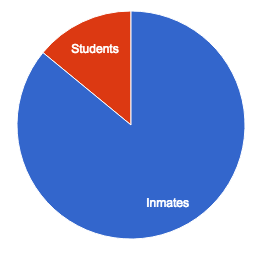
    Inmates Students
    $43,110 $7,046

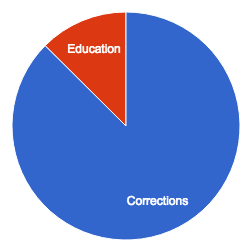
    What an absolute joke. Remember, the blue area in the graphs is what the corrections system is getting ON TOP OF the additional funding provided in the current budget already.

    Earlier in 2015, the Government announced a generous $359 million boost into the Education sector, but in a very restrictive way of schools being cajoled into CoL’s (Communities of Learning). To compare this with the $2.5 billion it’s just embarrassing. Here’s the graph for that as a comparison between what the Government is prepared to spend as ‘extra’. As a picture, it’s ridiculously similar to the current funding for students compared with the additional funding Corrections is getting.
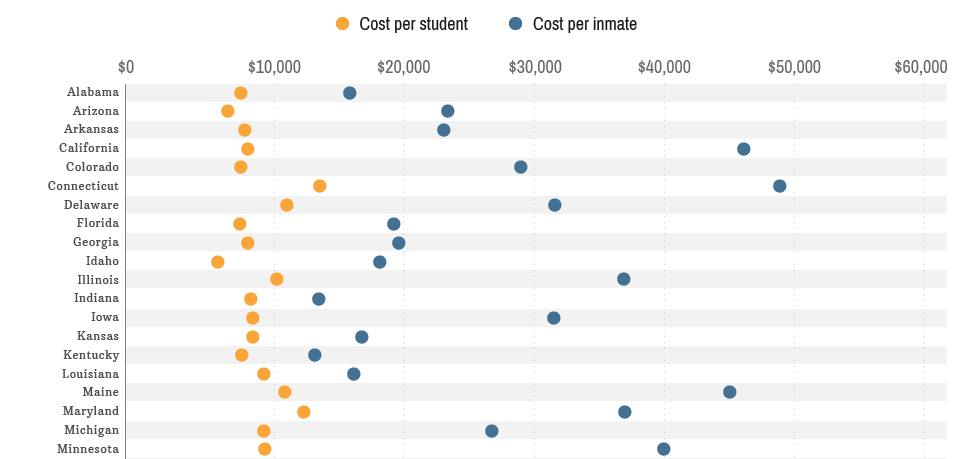


    United States has this problem: Not one State spends more on student education than it does for incarceration.

    Source: http://money.cnn.com/infographic/economy/education-vs-prison-costs/


    Now; don’t get me wrong. I am not here for a second suggesting that corrections does not need support; nor am I saying anything about how or where they spend their money. They have a job to do, and certain criminals do need “restricting in their day-to-day activities”, but lets start to look at solutions for the problem, rather than just catering for it.

    Let’s buy sunscreen rather than melanoma treatments.

    Let’s fix the hole in the bucket rather than filling it up time and time again.

    Let’s put a fence at the top of the cliff rather than an ambulance at the bottom.

    Let’s start investing in children, the next generation, the education of people, poverty, and homelessness rather than catering for the criminals that they will likely become because we continue to ignore the impact education and poverty are having on society today.

  • How to Dismantle the Public Education System in NZ

    As a follow up to my post from last year, I came across a step by step guide to how to get rid of any public education system a country has. As you look through, you can see where Hekia has ticked each step and how she managed to do it. You can also see the last remaining steps and how close she is to completely dismantling the public school system in New Zealand. How long before she’ll be able to tick those off as well?

    Enjoy!

    Below is a PDF version for you as well.

    [icon name=”file-pdf-o” class=”” unprefixed_class=””] How to Dismantle the Public Education System in NZ

    Feel free to share and spread the above infographic far and wide.

  • Gold medals for all

    Global (Bulk) Funding

    In the weekend just been, I caught up with Ms Parata’s latest palava regarding schooling and in particular, the funding of it. Needless to say, there was lots of conjecture, and I found it hard (yet again) to agree with much of what she has to say.

    Olympics

    At the same time, we saw the wind down of the 31st Olympiad in Rio De Janerio. I was able to make some links between the two. I’ve tried to get my head around the idea of what success is, and what it looks like; both in education, as well as in life, and using the Olympics as a starting point On what success looks like for New Zealanders.

    Assessment

    Ms. Parata signalled the intention to have a never-ending assessment system throughout every year of a child’s schooling, so that we can track and monitor student achievement, and thus be able to allocate funding more accurately to children who need it as soon as we begin seeing them to fall behind.

    But how robust are these assessment systems? The National Standards are full of holes and have long been criticised for their lack of National moderation and lack of Standard measurement. Yet, as we know, the Government continues to set the expectation that 85% of students will be At or Above their corresponding level across the country according to those National Standards.

    To University and Beyond

    In her statements, Hekia also mentioned that the aspiration for her assessment and data driven school system is to monitor students at each and every level so that they can go on to finish school, go to university and get employed.

    I have a series of problems with this.

    Don’t get me wrong; University definitely expanded my worldview, my knowledge and skills as an artist, as a photographer, and as a teacher. I met my wife at University.
    However, my personal view on this point is that if everyone has a degree, then that degree becomes less valuable, or even meaningless. The more people that get it, the less rare it is, and the more people are expected to get it or achieve it, and therefore starts on a never ending downward spiral in worth or value. Even take, for example, the status a Ph D. It still holds a lot of value because it’s a whole heap of hard work and not everyone can achieve that level of study or knowledge. If they started handing out Ph D’s to any Joe Bloggs who shows up, then the value of it decreases.

    The Value of Gold

    Much like at the Olympics, if we were to hand out gold medals to all who attended, then the value, the meaning, and the hard work that is represented in the gold medal would become completely meaningless. Gold medals become worthless, and suddenly don’t mean anything to anyone. They may as well be medals for participation.

    The New Zealand Olympic committee seemed to have a more realistic view on success rates. At no point did they expect everyone to get a Gold medal. In fact, some weren’t expected to medal at all. Some achieved that Gold medal who were expected to achieve it (Bond & Murray, Drysdale, Burling & Tuke, Carrington). Some missed out who we expected to get it (Adams, All Black Sevens), but we certainly don’t see them as failures. We also had some athletes get medals with non-gold shades on them who we expected to do so (Ko, Willis). And then we had others who we never expected to medal, but who shone on the world stage to get a medal around their necks (Walsh, McCartney, Rooney).

    There’s more to Education

    Like I say; don’t get me wrong; University is great and is a huge expectation and motivator for many of our students. The high expectations of teachers these days assist students to surge on to extend their learning at university; and somehow we manage to correlate this with success.
    However, that’s not a good picture to paint, especially if you look at the employment depletion in the area of trades. You see; some students might not be wired to go on to university. Some students would and will make great road workers, builders, plumbers and electricians without having to attend University. Some students show great natural talent in sports and university simply gets in the way of them making the most of their younger fit years. Are they any less successful, just because they don’t go on to university?
    No.
    So why are we making university the be-all-and-end-all of our education system? Surely it should be aimed towards making each student the best they can be to make the most of what is before them and give them the skills they need to be successful in life, regardless of what that life may be?

    Failure or Success?

    What’s more, just because you go to university it does not mean you will succeed. I know of many people who have got a degree and haven’t been able to use it to gain employment at multi national companies making lots of money or otherwise being deemed as successful. They’ve ended up pushing trollies at the local New World, or working retail on the city mall.

    In addition to this, I know of cases where folk who have never set foot in university are having an incredibly successful life. My brother is one of them. Never been to University. Got a job pumping petrol for a year while he studied automotive electrical at polytechnic, and at 26 was owner operator of his own workshop in that industry. In more, seemingly substantial terms, the likes of Steve Jobs, Richard Branson, Mark Zuckerberg, and Bill Gates all dropped out of University. One could not say that these people were not successful.

    Success Never Looked So Good

    Nikki Hamblin made international headlines these Olympics, not because she won a race or achieved a Gold Medal in her time at Rio, but because she stopped and assisted an injured runner who had toppled over Nikki only moments earlier. Both runners finished stone cold last. No medal. No glory. But both women went on to achieve sporting greatness and success in a different way – in Olympic spirit (as opposed to worldwide trending – just type Nikki into Google and see what shows up! ).


    Likewise, take the story of nineteen year old Eliza McCartney, who against all odds, found herself in medal contention with a few jumps remaining. In the following moments, the look of success, the sense of achievement could not be hidden from McCartney’s face as she took out the Bronze medal.

    A massive achievement for the 19 year-old, and a successful Olympic campaign, even though it wasn’t a gold medal.

    Success at the Olympics is not just about getting a gold medal. It’s about so much more than that. Likewise, being successful in education isn’t just about heading off to university after you’ve finished high-school.

    In Conclusion

    We need to broaden our definition of what we consider success. I’ve said it all before. This continuing narrow view that all students should go to University as a measure of success is stifling the entire education system of this country as we measure and measure again the weight of the pig at every opportunity. To use an Olympic analogy; a runner, rower, pole-vaulter won’t get any better by continually going for personal bests and trying to set records. Strength training, fitness, endurance, mental coaching, and more is needed for any athlete to perform at their best when it matters – on the world stage, at the Olympics.

    Students need to see that they can be successful in life without that pressure of having to go to University. Going to polytechnic, learning a trade, or even going to work in retail can all be successful pursuits in life. Let us not forget, that just because the All Blacks were not at the Olympics, doesn’t mean they are not the world champions who can embarrass Australia given the other sporting event on this weekend just been. We can hardly call them failures just because they do not have a Gold medal around their necks.

  • The Answer to everything is not an App.

    It’d seem that there is a reliance on tech and apps to meet the needs of students with learning difficulties.

    While there are apps and assistive technologies to help students with their learning, the reliance or focus on one particular app is not what the likes of RTLB or Special Needs teachers should be using to “solve” the learning needs of ‘problem’ children. It may be appealing because of a one off price that seems to satisfy the powers that be as a successful outcome for the student and signs off the intervention.

    But there is no way that any app, no matter how developed, how much money has been poured into it, that it should ever be “the answer” for students’ learning difficulties.

    Why?

    Because there is never ever one reason for students struggling in their learning. There are usually a myriad of issues, and strategies that address these are not going to be encompassed in an app.

    Don’t get me wrong, tech can be incredibly supportive in assisting students with with their learning; but in my experience it is much less about the apps you use, but the process that the technology makes and allows for in the classroom.

    Furthermore, teaching ‘an app’ is restricted to using that app and the limitations of it. Teaching a process opens up the student to other possibilities for using the technology (or not) in the future. Take for example Writing. You could teach a student how to use Microsoft Word and it could help them to write. But teaching them how to write is actually better (or more to the point – what is needed), and there are any number of apps that could assist with this, including Word, Google Docs, or Collabrify Writer.

    Somewhat ironically, I know of a case where a student diagnosed with dyslexia received the support of using the Chromebooks in the classroom to do her writing. This was the recommendation from the specialist that was providing the support for the teacher, and supposedly the student.

    However; talking with the student; she preferred to do her writing by hand because she didn’t have to ‘find’ the letters on the keyboard when she could just write them with a pencil when she wanted.

    Sometimes technology doesn’t have the answer that we’re looking for.