Tag: education

  • IES and the Poisoned Apple

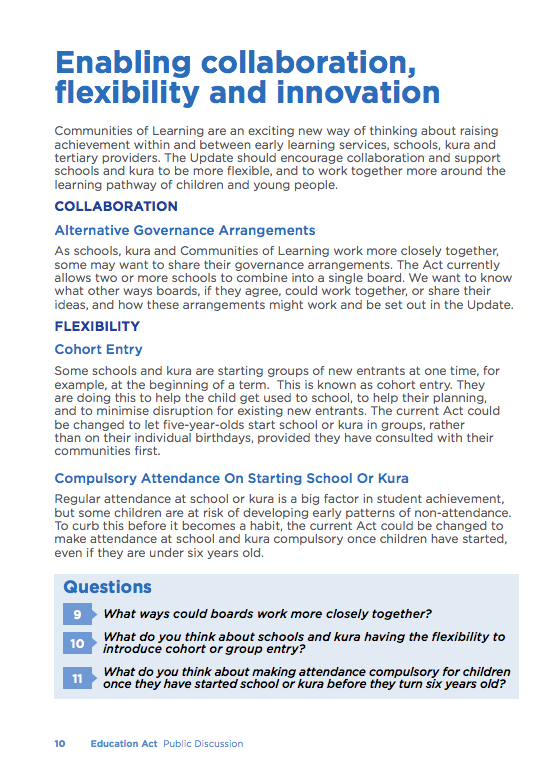
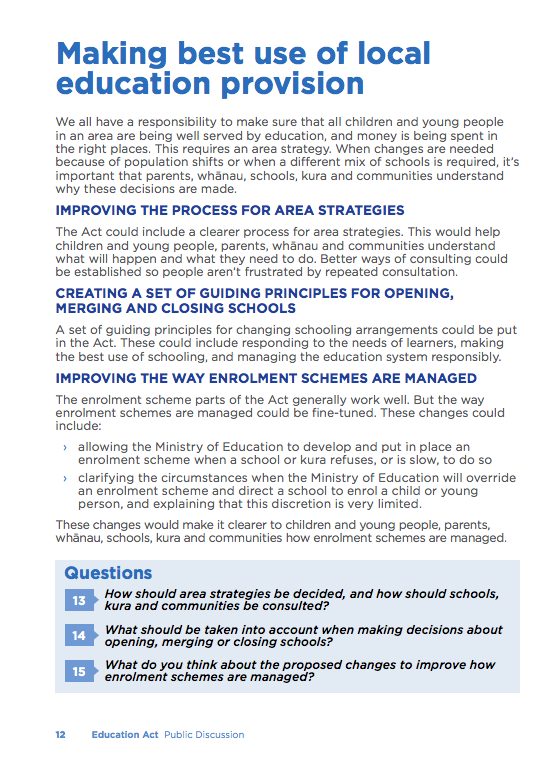
    Over the next few weeks, primary teachers are meeting to discuss the proposed changes to the IES (Investing in Educational Success) announced last year.

    The changes are, to some, significant and, before I get too cynical, NZEI have done a good enough job even getting the Ministry of Education to make any amendments to their proposed $359,000,000.

    However, when this was first broached with the sector, a resounding 93% of NZEI members voted to have nothing to do with it. They saw the pitfalls of such a system, such as quality teachers no longer in their classrooms, teacher workload, and the fact when it comes to education one size does not fit all, and what works in one school won’t necessarily work in another, and voted appropriately. Still, NZEI remained in the negotiating tent; however smelly; to try and make the most of a sucky situation.

    Joint Initiative

    Now they have a working alternative, which has many changes which I won’t go into. You can read more here.

    However, it doesn’t address the fact that quality teachers and principals will essentially become part time at multiple schools, rather than full time in the classes and schools that benefit from their time and effort. The whole initiative makes busy teachers busier, and the so-called benefits it will bring to student success is hardly mentioned in any of the agreement negotiations, and instead all possible roles are discussed at length. It all seems to just focus around teacher busy-ness, and misses the point completely. This could just be because the agreement is between teachers and the government, but regardless; it somewhat surprises me that student success isn’t more of a factor.
    Let us not forget that this is hailed as raising student achievement, where there is little or no supportive evidence that this will work at all.

    Essentially all that has happened is turd polishing.

    The Poisoned Apple

    Let’s look at it like this.

    The government has offered the teaching community a nice, juicy, red apple. It shimmers and shines in the light and looks delicious to a hungry princess. The soft light glints off it’s polished skin, the deep red matches the crimson lipstick of her luscious lips.

    However, this current government’s education office is run by a witch with a mirror on the wall, and she has poisoned the apple with a curse, as she has done for the other apples she has tempted us with.

    Teachers realised this very early on, and did not want a bar of it. They could see the money spent to buy the apple could be much better spent on other things; like an orange tree.

    But the witch isn’t offering the orange tree. She’s offering the apple.

    Now, NZEI advisor comes to the rescue, or so we think, and the advisor to the king talks with the witch. They discuss at length the properties of the apple, and how it could be made better, so that the princess might eat it. They decide that turning it into a toffee apple might be more appealing. They cover it with the caramel coloured glaze that drips down and turns the apple into a gooey, sticky, goodness.

    While the toffee apple is much more appealing, and is somewhat irresistible in comparison with the delicious apple that was offered before. But deep down the princess knows that the apple is still poisoned and will be the end of her. Still, upon receiving advice from the advisor, she takes a bite. We all know what happens next.

    The only problem is the solution requires a huntsman with a large axe. Which we don’t have.

    Instantly Sceptical

    Essentially, with this government’s attitude and treatment towards teachers, they haven’t done themselves any favours. Add to this the class size fiasco, and you have a workforce which simply does not trust or have faith in anything you try to accomplish. The way they steamrolled out the National Standards turns out to be indicative of how they have continued to operate; make it policy, and then consult with those involved. We saw this again in the Novopay disaster.

    It is no wonder then that teachers were instantly sceptical of IES and picked it apart. It’s also no wonder that the Ministry seem to be rolling on regardless of the situation. I also suspect that it won’t matter what new policy the government bring out in education; teachers are simply going to oppose it purely because of this government’s track record.

    Essentially the vote this week isn’t voting on whether we want the joint initiative agreement made by NZEI and the Ministry of Education or not; it’s voting on whether we want what the Ministry proposed in IES, or the joint initiative (which essentially is a no-brainer for any teacher). In the past it’s quite clearly been said, when given the choice of Ministry backed options, or NZEI backed options, go with NZEI because at least they are looking out for and supporting teachers. They have the teacher’s interests at heart.

    But democratically, a vote like this is completely flawed. We’re choosing between a poisoned apple, and a poisoned toffee apple. At the end of the day, it looks the same, it smells delicious, it’s big, red, and juicy, but you wouldn’t want to take a bite.

  • Reliability of National Standards Assessments Called into Question

    A recent report has cast doubts over the reliability of teachers’ National Standards assessments and rises in student achievement.

    It found that just 40 per cent of overall teacher judgments (OTJs) matched the ratings generated by the Progress and Consistency Tool (PaCT), a tool developed to improve the consistency of teacher judgments on National Standards assessments.

    The PaCT was launched in schools in last year with a mathematics pilot. The latest report of the National Standards: School Sample Monitoring & Evaluation Project 2010-2013 compared the judgments from the pilot with a selection of teacher judgments finding significant variance.

    In the past, I have expressed interest in PaCT as a way of standardising National Standards a bit more. But it would seem that even with the tool, getting a consistent standard among teachers, and students, is flawed.

    What I find interesting there is a move in education to individual education programmes, individual assessments, and student centred learning initiatives, yet as our main form of reporting and assessment we are putting them in boxes, and grouping them together, using a ‘one-size-fits-all’ grading system and tool.

    What are your thoughts on the PaCT tool? Have you been to any workshops? Have you seen it in action?

  • Bill Sole: NZ needs more apprentices | NZ Herald News

    Once again the universities are the big winners in the Budget. Unfortunately, despite international research increasingly pointing to the value of workplace training and apprenticeships, the 2015 Budget…

    Source: Bill Sole: NZ needs more apprentices – Education – NZ Herald News

    The idea of success in education is almost entirely based on academic results leading to university entrance, completion of a degree, and then onto a high paying job in an ivory tower south of Mordor.

    Okay, maybe that’s slightly Tolkien-ised.

    But success can be, and is, so much more than this.

    At the age of 26, my brother took over the business he was working for. Both of us were lucky enough to have parents who were able to send us through private schooling. So we had ‘the best’ of education. Both of us went onto further study – myself heading to art school and then Victoria University to become a teacher. But for my brother, the idea of sitting a) through lectures, and b) in an office, were less than appealing. Instead, he decided to get into something he was interested in. Cars was it.

    From there, he went through polytech, served an apprenticeship, and now is in his third year as a successful business owner. And he is under 30.

    Success.

    But no university qualification. No long hours of study or endless exams. And he’s not stupid, nor academically inept.

    The reason I bring this up is because the current education climate in this country is best summed up in this poem I wrote last term.

    Test, test, test.
    Assess, assess, assess.
    Achieve academically,
    and that is success.

    If this is what success is deemed by, then very few will be determined to be successful. Let us not forget that the likes of the late Steve Jobs, co-founder of Apple – the world’s most valuable company (May 2015) Screen Shot 2015-07-11 at 12.58.00 pm– was a college (NZ calls them ‘universities’) drop out – ie. he left before completing any tertiary qualification. Another rather successful college drop out is one Mark Zuckerberg, who is creator and CEO of a website called Facebook.com. You might have seen it? Zuckerberg has a reported personal wealth of some $38.6 billion (US) at the age of 31. He was a billionaire by the age of 23 – 5 years out of high school. He put himself on a $1 salary in 2013Screen Shot 2015-07-11 at 1.03.50 pm

    Both of these cases are extremes. Once in a lifetime examples. But examples none the less. Both of these men are undoubtedly what we would deem as successful, in terms of their influence in the world, as well as their personal wealth and the wealth of the companies they ran/run. But according to our current educational climate, they would both be considered failures.

    For me, education is important. But doing what you love to do in life is more important. Getting to the point in education where you can go on and do what you want to do in life is what I would determine to be ‘academic success’. Apprenticeships should not only be supported, but encouraged as a viable means of continuing with educational success, rather than the stigma of what you do if you’re ‘no good at school’, so to speak.


  • The White and Blue National Standard Box

    This week the internet world was bombarded with seemingly pointless debate around the colour of a dress. To me, it was quite clearly white and gold, and impossible for me to see how it could be any other way. While I could see how people saw the blue, the suggestion that the darker strips could be black was preposterous. But then when my wife commented on the black and blue dress, I was flummoxed. Seriously? I’ve stood by my artistic eye for my entire life; and now it starts to play tricks on me?

    dress-615x342

    For those wishing to find out about the dress and why it is blue and black, please read this article and this from the NYTimes.

    However, when I was thinking about this, it immediately made me think of each and every classroom around the country. We have many, many students who would answer “white and gold” to this question in a test, and many, many students who would answer “blue and black”. Some are restricted by the colours they see from the photo, and others are able to translate that and see the actual colour that the dress would be, based on the white balance of the background. And yet, because of this, many, many students would end up failing this test, through no fault of their own mind you.

    Many teachers all around the country would argue for and against the correct answer, and many, even when faced with evidence, would find it hard to fathom that they too, got it wrong.

    And yet we would continue to use a faulty system. A test that labels students as wrong, as failures, through no fault of their own, purely and simply because their brains aren’t wired that way. It puts everyone in the same box, and only those who are wired a particular way are filtered through to the top of success.

    The National Standards Box

    National Standards is the same. While we’ve come to accept them and we’ve had to work with them since 2010, it doesn’t make them any less flawed. Yes, we have come to manage them and get used to them, but deep down, I am still morally opposed to them. I’ve seen too many fantastic students with so much potential get labeled as “Well Below” or “Below” purely because their brains aren’t wired to think in terms of Reading, Writing, and Maths. They are considered unsuccessful, and targeted programmes are put in place to monitor and try and make these students fit into the box of the National Standards. We’re trying to make them see the dress as blue and black, when all they can see is white and gold. Even if we reason around it, and show them evidence, their eyes will still see white and gold, because thats how their brain is wired.

    Case in point is an ex-student of mine, who at age 9 was reading at an age of a 5 year old (that’s when you could get him to read), and writing not much better. Maths was passible, but only through drawing diagrams rather than numbers, of which many he wrote backwards. However, put a blank page on his desk and a pencil in his hand, and he would draw the most wonderful creations I’ve seen from a child. He had depth of tone, shading, details, feeling and mood, emotion and passion compressed into the graphite lines of his art. At times, he would draw beyond anything I’ve come to expect, even from myself. His talent was incredibly well developed, and I would have loved to continue to work with his drawing and develop it, honing his skills, and encouraging his internal well of creativity that was bubbling away inside. Instead, I spent 80% of the year fighting to get this child on task with his writing, force feeding him books with pictures which he just wanted to draw, and trying to get him to fit into the National Standard box. The other 20% was made up of 15% of me trying to think creatively about how to use art as a means of developing his reading and writing, and the remaining 5% giving up on anything structured and letting him do what he wanted – draw! It was a year filled with frustration, torment, arguments, negotiations, and ultimately, very little progress.

    We label them as they head into the prime of their learning and into the big wide world. They may be genius artists, or fantastic sportsmen, and will be incredibly successful in these fields once they leave high-school. But while they are in primary school, they have to fit into a different box and be measured. And they fall short. The message they get is negative. The internal self talk begins and the possibility of them reaching that potential lessens. Of course some will make it, but many will self combust and be filled with self doubt and lack of confidence in their ability, whether ‘academic’ or not. They call themselves dumb, and they know it. Because that’s all they’ve known since 2010.

    And teacher’s have their hands tied. On the one hand we have a beautiful and wonderfully wide curriculum full of opportunity and wonder, and in the other, the narrow field of vision as we peer into the National Standards box. “Integrate these through the other learning areas” they say, but the desired effect isn’t as easy to come across. As with last year, I never found a way to integrate reading through art, and I’m unsure whether I had, whether it would have made a difference in raising this child’s reading ability. Regardless of this, the dress was still white and gold for him, because that is how his brain is wired.

    As a teacher, what I want to teach is the ability for all students to see the dress as white and gold and blue and black, and accept the differences, while knowing deep inside that no matter what they actually see, that they are right in their own way, and that others are also right. I want them to be able to see them as successful, even if that’s just in one subject or curriculum area. Obviously they still need the basics, but labelling them a failure just because they don’t see blue and black isn’t the way forward to a successful future.


  • Student Success

    Can you read? Can you write? Can you count?

    If you say yes to these then you are a success. You have succeeded at school. You’ve made suitable progress through your years at school. Heck… You’re verging on being a genius. You’re probably headed to university, or some high end CEO job, and once you’ve done that, and are trying to work out what to do with your money after all the property you now own, you might just run for prime minister.

    If the importance that is placed on National Standards in this country is anything to go by, then this will be reality. Yet we keep on getting pressured into widening the curriculum day after day, by all the different curriculum areas; science, the arts, p.e. and health. Fitting all of this in within the school year is challenge enough, yet alone finding time in the school day. Many teachers have had to learn and adapt, and thus begin integrating reading, writing, and maths in amongst the other subjects.

    children-99507_640But isn’t success more than this?
    I’ve had a myriad of students through my classroom doors, some who are very successful academically. But I will always remember one student, Polly. Polly of course is a made up name designed to remind me who it is, but disguise her identity for privacy reasons. Polly was a neat student. She was on time most days, was well presented, had lunch, came from a home with supportive parents who turned up to school events when they could.  Polly had great friends, and was always very kind, considerate, and respectful towards others. She didn’t have a bad word to say about anyone. Polly got on and did her work. She was enthusiastic about school and about learning. She wasn’t the best at maths, reading, or writing, but always gave 100% effort and put her heart and soul into her work. But 2010 rolled around, and with it the implementations of National Standards, I found myself having to try and explain to Polly and her concerned parents why she was Well Below in all three areas. It simply wasn’t fair. Polly became a target student, and her progress was routinely monitored. By the time she left school, she was still Below the National Standards in all three subjects, but was a long way from being an ‘unsuccessful’ student. In fact, she was a very long way from being a ‘below’ student as well.
    You see, Polly had a lot going for her. She had perseverance. She had respect. She had kindness and reliability. Polly had great running ability, and determination, confidence, and commitment to boot. She had a dramatic flair, although only used this when she was required, on stage, in assemblies, and class plays. She got along with everyone, even those who crossed her. You see, when I said goodbye to Polly from my class, I knew it wouldn’t be the last I saw her. I knew that out in society, in the real world, whatever Polly chose to do with her life, she would be a success. She had the qualities that will make success inevitable. While she was not the brightest student academically, she will do well for herself regardless. Whether she becomes a stay at home mum, or a fast-food chef, air hostess, veterinary assistant, early childhood educator, bus driver, receptionist, or the second wealthiest CEO in the country, it won’t matter, because what ever she chooses, she will be successful at it – I am sure of it.

    grads

    In my experience, I’ve been through a few different ‘Graduate Profile’ activities, where we as teachers get around and discuss what skills and qualities we would like our students to leave our school with. Each and every time we end up with a list that includes many, if not all of the following skills and qualities:

    Creativity, Resilience,Able to work with a variety of different people, Motivated, Persistence, Expresses themselves, Curiosity, Humour, Endurance, Reliability, Empathy, Leadership, Compassion, Courage, Resourcefulness, Humility, Communication Skills, Thinks of others, Shows respect,  Shows not tells, Trusts others, Social skills,  Role model, Mentor, Volunteers, Gives to others, Active participator, Takes suitable risks, Uses initiative, Confident, Trustworthy, Problem Solver,Self Awareness, Self Discipline, Self Motivated, Ambitious, Flexible, Positive attitude.

    When you look through this comprehensive list, there is no question that they are suitable desires for schools to have for their students to have leave with, and more often than not, when teachers are asked to come up with such lists, no where is academic ability mentioned. No where on our Graduate Profile as a school does it say that a ‘model A’ student that leaves our school will be At or Above the National Standard.

    It’s definitely worth thinking about.

    What does success mean to you in regards to education and learning? Feel free to comment your ideas below.

  • The PaCT Tool

    There has been many thoughts around the PaCT tool and it’s use or non-use by New Zealand schools. New Zealand Educational Institute (union for primary teachers, NZEI) has warned against it, but they are bound to do so given the current political climate and their educational policies.

    Using the Progress and Consistency Tool
    However, what I don’t understand is that we (teachers, schools) have been saying that National Standards are not standard and there is a vast difference from school to school as to what is Below, At, or Above since it’s inception. The PaCT tool has been designed to moderate this very problem, as NZEI point out in their article, which is surely what teachers want – to make National Standards more reliable, rather than just doing it because we have to and working with rubbish data about our students.

    You cannot deny that Ms. Parata, however controversial, makes some sense in this article, and essentially makes the same points as I do above.

    It would seem that they (National Standards) are not going anywhere, with the National Government in power for another three years. I don’t particularly agree with the saying “If you can’t beat ’em, join ’em”, but in this case, it would seem pointless fighting. Teachers, Parents, Principals,  Educators, Educationalists and Professors have been fighting them since their release in 2010. Despite this, the National Standards continued to be rolled out, and the government continues to roll out other policies in the face of adversity. Most of the initial hatred towards them was the way they were rolled out, without any duty of care shown around their trialing on our kids. But it is now almost 5 years on. Let’s also make clear, that while the opposition would scrap them, they also suggest that they would still continue to monitor student’s progress, but align them to the curriculum. This seems like a complete waste of time, money, and resources, as if you read anything on the development of the National Standards, you’ll find that they are already aligned with the curriculum.

    “In doing this New Zealand has taken a different approach to the rest of the world. We have used our national curriculum to determine the standard of achievement that needs to be reached at the end of each year.” – Education Gazette, 11 October, 2010.

    Despite what the scare mongers say, I think it’d be worth every school investigating signing up to use the PaCT Tool.
    That’s my personal opinion.
    Personally, I know some of the developers of the tool, and I have been assured on more than one occasion that from their side of things (the developers) the PaCT tool has not been designed with the capacity to link student data with teacher pay. This seems to be the main concern with the doubters beyond that of trying to make the ‘flawed’ National Standards more reliable (rather than scrapping them and developing a more robust assessment).

    I think that if the government wanted to align student achievement with teacher salaries (i.e. performance pay), that they would already be able to do so without using the PaCT tool anyway. Therefore, if that’s the case, then any school using the PaCT tool will not make a difference for the government; but it has the potential to be very worthwhile for us as teachers and as a school to better get to grips with assessments for the National Standards, and might even go some way into making them more robust – which is what we’re asking for anyway.

    There has been many a classroom I’ve seen, where a student has stepped out of line and done things on their own terms. For example, entering the classroom (their own terms) instead of lining up like the rest of the class (teachers terms). The teacher might scold them and then send them out to the principal, if the student hasn’t already become defiant and stormed out of the class for the scolding. When you boil down the behaviour and the problem, and take a step back; the actions taken by the ‘professional’ have in fact caused that child to no longer be in class, and no longer learning. If a quiet word was had, a little pride (on the teacher’s behalf) dropped, and the student allowed to still remain in class before everyone else, then that student might still be in class learning and hopefully engaged. The end product is what we really wanted, which is the troublesome child in the class.

    Instead of fighting for fighting sake, why don’t we take a step back, work out what it is we want, and drop our pride of having things done on our (teachers) terms. Rather than missing the point and ending up with nothing, we should be thinking about the end product.

    The end product is we want a robust system of measuring our children on a national level, without using a one off national test (that students could fail if they had an off day). We want to be able to use our professional judgement as teachers, and our knowledge of each child as individuals, and use that subjective information in order to fit students against our curriculum. We want it to be a robust and moderated system so that the data can be trusted from school to school, from city to city, right across the country.

    If we want National Standards to be more robust, then lets see if using PaCT will in fact make them more reliable, rather than scrapping National Standards and making all line up outside before bringing them into the classroom again.

  • Educated Statistics

    Those that know me, know I hate Maths, but love Statistics. Maybe it’s the graphs and the figures; but mostly it’s the story they tell without having to say anything. Interpreting the statistics isn’t rocket science, and generally they can speak a lot of sense into a confusing situation.

    It’s no wonder then that recently I have been looking into a range of different statistics surrounding Education in New Zealand at the moment. With the upcoming election, it’s important to have a grasp on what the current Government is trying to do, as well as what the implications are (if any) for them or the opposition hopefuls.

    Class Size vs & Quality Teaching

    Firstly, there is a perception out there that the two major parties are at odds about their policies. National are investing in IES / Quality Teaching and Labour are saying the money would be better spent being putting into lowering class sizes. This is not an either / or situation, but a fact that both are important, but each are differing as to the importance of them, and the priority they hold in the current educational climate.

    I must say that having worked in a classroom for the last five years, I would be able to better spend my time focussing on each individual child in my class if there were less of them. Not because of a time factor (although this would certainly come into it) but because of a behaviour management factor. I certainly notice a huge improvement in my students focus when there are 5 or 6 away. My class size for the lat 6 years has been:

    • 2009: 31 students
    • 2010: 28 students
    • 2011: 29 students
    • 2012: 27 students
    • 2013: 27 students
    • 2014: 27 students

    National claims to already have addressed the class size issue by employing more teachers. I’ve yet to see any impact of this at the school where I work, and certainly from the class sizes above we’re still talking a lot of students. I’m also not about to say that Labour’s proposed ratio of 1:26 is going to change much; except that if I’m operating on a ratio of 1:29 and I have 27 (2 less than the ratio size), then under Labour I should see a class of 24. Which already becomes more manageable from a teaching point of view.

    Class Sizes & Number of Teachers

    Yesterday I wrote about this in another blog post (see here):

    “I headed over to EducationCounts.govt.nz and downloaded their spreadsheet on student numbers since 1996.

    We can see that Screen Shot 2014-09-05 at 6.29.05 pmin 2008, the student numbers were 758,094 students.

    In 2013 there were 762,400 students. This is an increase of 4,306 students. That’s 0.56%. Half a percent.

    4,306 students would be spread across 149 classrooms, (based on the teacher/pupil ratio in NZ state schools of 1:29)

    That’s 149 teachers that are needed in the increase to maintain this ratio.

    In 2008, there were 52,958 teachers according to EducationCounts.govt.nz. In 2012 (which is as far as I can go from the same spreadsheet) there were 54,250 teachers.
    However, in this news release, it states that teacher numbers increased from 55,124 in 2008 to 58,707 this year. Discrepancies will exist, and some will include ECE Teachers and other teachers.
    For the first set of data from EducationCounts (which remember, is a government website), there is an increase of 1,292 teachers, or 2.4%.
    For the second set of data from the press release, there is an increase of 3,583 teachers, or 6.4%.

    Both somewhat removed from Hekia’s 15% (or ghost teachers as I call them).

    Even if we take the smaller percentage, and the increase of 1,288 teachers in 2012, it is still far, far away from the 149 new teachers that are required. That’s a surplus of 1,139 teachers.

    Obviously a lot of teachers are part time or reliever teachers. So lets take a look at FTTE teachers (Full Time Teaching Equivalent).

    With full time teachers, there has been an increase of 1,102 FTTE Teachers (2008-2012 data). Still not even close to the 149 teachers it would require to lower the class ratio to 1:29 based on the data.

    The difference between full time teachers, and the total number of teachers is just under 6,000 teachers in 2012. With 49,305 full time teachers spread across the 762,400 students (2013), this makes a teacher ratio of 1:15. This of course is an average, with a lower ratio in junior classes and senior classes, creating the 1:29 bulge in the middle.

    To change the ratio from 1:29 to 1:26 it requires a bit more mathemagic. The main reason for the difficulty is we have to work out the different ratios. For this, we go back to our first spreadsheet. I’ve put the resulting data into the table below.

    Current Teacher / Student Ratio No.of Students Required No. of Teachers Lowered Teacher / Student ratio Required No. of Teachers
    for New teacher/student ratio
    Year 1  1:15 64,208 4,280 1:12 5,350
    Year 2-3  1:23 118,549 5,154 1:20 5,927
    Year 4-8  1:29  295,858 10,202 1:26 11,379
    Year 9-10  1:23.5 117,265 4,990 1:20 5,863
    Year 11  1:23 60,805 2,643 1:20 3,040
    Year 12  1:18 55,277 3,071 1:15 3,685
    Year 13  1:17 48,905 2,876 1:14 3,493
    Total 33,216 Teachers  38,737 Teachers

    I don’t confess to being a mathmagician; and there may be a high possibility I’ve missed out some key information. At least I’m prepared to admit it if I get it wrong. If you find some issues with these numbers, can you please comment about where I’ve gone wrong so I can put it right.
    But to my knowledge, I’ve done the math correctly; and it raises some very interesting questions. Most importantly, if we lowered class size ratio by 3 students for each year bracket, we only increase the FTTE by 5,500, and we are still well within the current 49,305 current FTTE teachers.”

    The Cost

    One thing I didn’t go into in my last post is the cost associated with lowering the class size. Obviously cost is a big factor when government’s make policies, though some (including me) may ask does it matter when it comes to Education – we’re building the future generation… We do still need to be accountable.

    One thing I won’t go into arguments over is the associated costs such as building new classrooms to accommodate the extra classes needed due to the decrease of teacher:student ratio (needing a higher number of classrooms in the school”. The reason being is two fold: firstly, that the government hasn’t taking into consideration the associated costs, such as, hiring relievers, in their IES policy, and secondly, there are many, many schools with now empty classrooms, as there are also those with no extra classrooms. When we are discussing averages (such as we are here given the access to data I can find) we learn that we give and take a little either way.

    So lets have a look at the stats:

    The average teacher salary in 2012 was $71,526. The average secondary school teacher earned $73,995, while the average primary school teacher earned $69,660. Whether this figure has gone up or down since 2012 is difficult to guess as we would have to ask Novopay!

    Using these averages and multiplying them out by the increases I found yesterday, we get a table that looks like this:

    New T:Ss Ratio Number of New Teachers Req. Cost
    Year 1 1:12 1,070 $74,536,200
    Year 2-3 1:20 773 $53,847,180
    Year 4-8 1:26 1,177 $81,989,820
    Year 9-10 1:20 873 $64,597,635
    Year 11 1:20 397 $29,376,015
    Year 12 1:15 614 $45,432,930
    Year 13 1:14 617 $45,654,915
    Total 5,521 $395.5 million

    Don’t worry though. Take off 15% that the Government gets back through taxes, and the actual cost to the Government to lower class sizes to my proposed (and generous) class size model is $336.2 m. Certainly looks a lot like $359m to me. In fact, with the additional $22.8 million left over, they could put it into my personal account for having such a brilliant idea.

    What about Private & Charter Schools?

    Private Schools

    One of the most boring and overused quotes in the class size debate is: “You don’t remember your class size, but you remember when you had a good teacher.”

    I went to private schooling. I think my largest class was in Intermediate where I think we peaked at about 24 students. I certainly remember my good teachers. I also remember the bad ones. I also remember that none of my classes were with 30 other students.

    The quote is over-rated. You can say just about the same for anything. ‘You don’t remember all the meal’s you’ve had, but you remember you if you had a good chef’ or ‘You don’t remember all the kilometres you walked, but you remember your favourite pair of shoes’ or ‘You don’t remember all of the politicians names, but you remember when one used this quote’! It’s just silly nonsense they try and play with your intellect.

    The fact is, yes; I felt I was an individual in the classes. I wasn’t lost under 30 other students. I had my chance to shine.

    Incredibly interesting that John Key chooses to send his children to private schools. Hekia Parata’s own daughter attended Wellington Girls High School, the only Decile 10 state school for girls, which also consistently gets 4-5 year ERO reviews (since 2005), and boasts a 25 pupil class size.

    Charter Schools

    Based on the interview given on Q&A this morning (part 1, part 2) (Sunday 7 September 2014, 13 days out from the election), Hekia listed some hard hitting ‘facts’ about Charter Schools and their registered teacher status (Video at 5:57) . I put facts in inverted commas, because we all know how the Minister can get these wrong from time to time and has to back down from her statements. However, she was quite adamant that these were in fact true, that out of the 36 teachers at the charter schools, 32 were registered with a practising certificate.

    Unfortunately for Hekia, she also spelled out a few more interesting pieces of data along side this. She stated that there were:

    340 students in the 5 charter schools. Doing the maths, this makes the average Charter School size with a roll of 68 students. Obviously, some will be higher, some will be lower. I’m purely talking about the averages.
    In addition to this, if we take our 340 students and divide them evenly among the teachers at these charter schools (all 36 of them), it doesn’t take much to realise that there is less than 10 students per teacher. In fact it’s 9.6 students per teacher.

    Put in cold, hard, but realistic terms, it’s an average class size ratio of 1:9.6 . Which is quite low when considering my class of 27. That’s one third of the size, something I couldn’t even have a decent dream over these days.

    As a side note, I’m quite intrigued that the term ‘Partnership School’ (remember that!?) has been dropped in all political debates around this issue so far.

    In Conclusion

    Do we need lower class sizes? No.
    Do we need the Investing in Educational Success policy? No.
    Do we need to make wholesale changes to the Education system? No.

    We have world class teachers who get paid boatloads to go and work overseas.
    We have a world class curriculum which other countries only dream of and drool over.

    The reality is that as most educationalists (including Parata and Key) know that the biggest influences on a child’s upbringing happen outside of the school gates. National Standards have done nothing but show where people live. I’ve calculated in my previous posts the amount of time our children are actually in school in any given year back in 2011. The stats are hard to believe: its less than 15% of the year when broken down into hours!
    The problem for the government (and teachers) is that they cannot control those factors. And so rather than being seen to be doing nothing about ‘the tail’ of underachievement, the government is targeting teachers and schools and saying that we aren’t doing a good enough job and we have to try something different. That quote pops out from Hekia’s mouth ‘If we always do what we’ve always done, we’ll always get what we’ve always got’. Yet what if it’s not education that is the problem? We have a tail which underachieves, not because they are dumb or incompetent, but because their home-life is stressed, violent, and broken. There’s no food on the table and no money under it. Keeping warm is a luxury, let alone keeping healthy. All of these issues are BIG factors which I have written about before. My challenge for those that don’t believe these are factors is to go without food for a day or two and try studying for an exam. Seriously, after about 10 minutes of reading text, you will only be thinking about how hungry you are. And when that’s all you’re thinking about, it becomes very difficult to stay focussed and learn anything. Now make yourself a 10 year old child. You might begin to understand the ACTUAL reality behind our under achieving tail.

    Unfortunately for everyone, those issues are out of anyone’s control. There is a limit as to how much the government can control those ‘out-of-school’ influences. And so they make changes to those things they can control – the teachers. Change. Change. Change. Assess. Assess. Assess. And cross our fingers that things get better.


    Note: You may detect a degree of bias away from the National Party, and that is purely because they have made the job of teaching to be a lot more work for not much reward with National Standards (which aren’t even National, nor Standard – yes I have proof should you wish to see it), as well as a lack of confidence in Hekia Parata; backing down on increasing class sizes (which was the honourable thing to do), closing schools in Christchurch, and the ridiculous implementation of Charter Schools based on the wishes of ONE candidate who had a cup of tea with the Prime Minister once. Need I mention the balls up with Novopay, the resignation of Secretary of Education Lesley Longstone, the deformation of Teacher’s Council to be replaced by a board with no Teacher representative, and of course the new Investing in Educational Success initiative. I am in no way a Labour supporter or spokesperson, and have disagreed with many of their policies around the Mid 2000’s.
    None of the stats, facts, or figures I have had to hack into anyone’s emails or websites to obtain. These are all freely available to the public through websites that I have visited. I have no affiliation with WhaleOil.
    I must also point out and make this very clear; I write this as an individual, not as a representative of my classroom, nor my school, or Board of Trustees which I currently serve on. My views are my own, and I encourage you to talk with me should they raise any concerns for you.

  • National Standards Again

    Today Nigel Latta launched on the offensive at the press release from Hekia “how-do-you-say-her-name-Potato” Parata and “the Media”.
    Here’s what was on his Facebook page (Wednesday 12 June, 10:14am)

    ‘National Standards’ aren’t.

    The latest national standards ‘results’ being reported in the media are utter nonsense. Pure and simple. Even if we ignore the large inconsistencies between the way that the ‘standards’ are measured (and we can’t because the inconsistencies make comparisons all but impossible), and the fact that it assumes all children of a given age are maturing at the same rate (which they don’t), and we ignore the impact of little things like child poverty (which some politicians like to do much to their shame), it’s still impossible to say anything at all about a change in the numbers when you only have two data points.

    They can’t say that a difference of 1.2-2% on the various measures between last year and this year is an ‘improvement’, because we simply don’t know.

    If you had assessed all of those very same children again the day after they were assessed for these numbers, in the exact same conditions with the exact same measures, then you would also get a different number. That’s because in the real world we have this little thing called statistical variation–things never work out exactly the same. To make any meaningful statements about ‘improvements’ you need meaningful measures (which national standards aren’t anyway) over several different data points (i.e. over several years).

    I wish the media would get that very simple, but very important point. Politicians will spin it as a gain, but it isn’t. It’s simply meaningless statistical ‘noise’.

    The government went with national standards because they thought voters would like it, not because it’s the best thing for making progress on education. If we really wanted to lift our ‘national standards’ then, perhaps as a beginning, we’d take more care of the large numbers of our kids living in poverty.

    When they produce their ‘rankings’ of schools I’m pretty sure it’s going to show a trend whereby higher decile schools meet/exceed the ‘standards’ much more than lower decile schools. I wonder why that might be? And who do we blame for that? Teachers?

    Don’t be sucked in by all this political positioning. My advice is to ignore the national standards tables because they don’t mean anything. There’s a reason teachers were so opposed to the way these ‘national standards’ are being used… fundamentally because it’s nonsense!

    This was all in relation to this article on Stuff. (which I have appended at the end of this post incase it goes missing!)

    As Mr Latta points out, there is little point in celebrating increases of 1%, 2% or even 3% increases and calling them improvements. Even if you disregard the fact that these judgements are made based on a whole variety of factors, and that even from class to class, let alone school to school there are variations and interpretations of the standard, a statistical difference of 1-3% is too small to consider any more than an anomaly. Heck… My intellectual ability changes as much as 1-3% on any given day.

    Add to this the fact that the assessment that teachers have been using has been shifting and adjusting their benchmarks as results come in, meaning that comparisons from year to year are even more ridiculous, and can quite easily account for more than 1-3%. Some more skeptical scholars such as myself think that these adjustments are probably being made to make sure that National Standards look good, and to give the allusion that they are working and increasing the achievement levels. The fact that the Ministry has hinted that these changes will be on-going as they are “…regularly reviewed and ways of moderating results would continue to be refined.” suggests to me that the benchmarks will continue to be changed until results improve.

    Nigel Latta is right. These results are meaningless. They serve to popularise the government and their great education improving policies. They celebrate over these small increases in improvements and throw a party for National Standards. They claim it as their victory. They won’t say that teachers are the cause for these increases. No. Quite the opposite. They will say that the reason there isn’t more improvement is because of poor teaching. Teachers therefore need to work harder to raise the tail, while the government and ministry claim the prizes for meaningless “improvements”.

    The media has some responsibility in this. Rather than accepting these remarks from Hekia Parata, why not actually stop for just a moment, and then ask her whether they can really claim 1-3% as a success. And if she won’t answer, then don’t report her story. The media are playing dumb, and reporting once again thinking that the rest of the country are fickle. We’re not. We are able to think. We are able to actually work out that what’s spurting out of the government’s mouth is rather tainted. Yet you won’t stop treating us like we won’t be able to work this out. That we take everything at face value.
    It’s kinda pathetic.
    It’s a good thing teachers don’t treat their students like that.

    Related Reading

    Students’ achievement ‘increasing’ – Stuff Article

    http://www.stuff.co.nz/national/education/8780900/Students-achievement-increasing

    The latest national standards data shows an increase in achievement particularly for Pacific children, according to figures released today.

    But they also revealed some “concerning trends”, including a decline in achievement at different year-levels, especially in maths.

    The latest overall national standards results in reading, writing and mathematics were released by Education Minister Hekia Parata this morning.

    The data revealed the percentage of primary and intermediate school children achieving above, at or below the standards in the 2012 year.

    It is the second time the results have been released publicly since the standards became mandatory in 2010.

    Last year Fairfax Media obtained and analysed nationwide national standards results and published them on Stuff’s School Report.

    The latest data showed:

    – Achievement against the national standard for reading was up by 1.2 per cent from 76.2 per cent in 2011 to 77.4 per cent in 2012.

    – Achievement against the national standard for mathematics increased by 1.4 per cent to 73.6 per cent in 2012.

    – Achievement against the national standard for writing increased by 2 per cent to 70 per cent in 2012.

    “What the data tells us is that there has been a small but incremental improvement in reading, writing and mathematics,” Parata said.

    Pasifika children showed the greatest increase, improving by 3 per cent in all three standards.

    “It’s great to see that around 70 per cent of children are at or above the national standards and the increase in Pasifika achievement,” Parata said.

    This was the first year national standards data had been broken down by year-level and there were some concerning trends including a decline in the achievement as the year-level increased, especially in mathematics, she said.

    The New Zealand Educational Institute said this year’s data was even more unreliable than last year because of changes to a key assessment tool for teachers.

    But the Ministry of Education said it was working to “continuously improve the range and quality of data”.

    Ministry student achievement deputy secretary Rowena Phair said: “As with any new large-scale data-gathering initiative, there will be a period of adjustment.”

    She said assessment tools would be regularly reviewed and ways of moderating results would continue to be refined.

  • Performance Pay for Education

    Here’s a visualistion of my blog post from yesterday.

    performance-pay-2012

  • Performance Pay Gets in the Way

    In Education in New Zealand over the last couple of months, we have heard the threats of performance pay, and bumping up class sizes, and developing better teachers. This has been well documented in the press, with recent articles on Stuff outlining the intentions of the current Government.

    www.stuff.co.nz/national/education/6930082/Bigger-class-sizes-announced – 16 May, 2012

    www.stuff.co.nz/6936035/Bad-report-card-for-bigger-classes – 17 May, 2012

    Please take your time to read both posts, and then my thoughts regarding the future of New Zealand’s education. There are also further links to similar articles at the bottom of this post.
    If you think that this doesn’t affect you, you may be right. But this will be affecting your child, your son, daughter, or your niece, nephew, or your friends children. You will know someone, some child that this will affect, and it would pay to be thinking of them when you consider these points.

    From these articles, there are three major changes that the Government is pushing. They are wanting Better Teachers, so there are going to be changes to educating teachers to be better. They are introducing larger class sizes, so that there are less teachers to pay. And finally they are wanting to introduce performance pay for teachers, as a “reward” for good teachers.


    Better Teachers

    Part of the intentions of the National led government, (who don’t even make up the majority of this country’s support!) to try and sell these policies, is to say that they want to make better teachers. No one is going to be able argue that having better teachers is not a good thing. Aside from that, it is incredibly insulting to the profession so suggest that teachers at the moment aren’t “better”.
    And how do we define “better teachers”?
    How do we assess whether one teacher is better than another?
    Well, the government would say “By results against the National Standards”, which we know is a load of crock, because National Standards are a set of unfounded and unjustified guidelines for failure not achievement. Add to that the fact that National Standards are based on an “Overall Teacher Judgement” , which surely enters into a conflict of interests, where results are used to determine if you are a better teacher than someone else.
    Enter National testing. This will be the next line of changes to the system, as Teachers will not be trusted to make the decision as to where the students are at, so we will have a National Standardised test that every kid in New Zealand will sit.
    The other thing the government would say regarding how you assess whether a teacher is better than another is this coin word called “Engagement”.
    My first, and only question will be – “How do you plan to measure engagement?”. The answer to that will be so flimsy and washy that even tree huggers would be ashamed.

    So how else will we get “better” teachers? By educating more teachers (of which there is already an excess of; or is it to replace all the good teachers who leave because of this)? They are also talking of making additional study requirements of existing teachers, on top of teaching a class, and raising the achievement of that class so that they can get paid? Is anyone else getting this!? It sucks. Yet its happening.


    Class Size

    This is a planned red herring for these changes. They’ve set this one out as a mouse, so that everyone dances and screams, whilst across the room they sneak through the lion which is performance pay. The major change isn’t the raising of the class size, but that schools will be funded based on the class size. See, changing the class size requirements in Year 2 to 10 classes from 23-29 pupils to 27.5 pupils isn’t going to make much of a difference. I started this year with 28, and am now down to 27 (essentially 27.5!). In years gone by I’ve had 29, and even a term of having 31. It’s not like they’re making class sizes 35, 40, 45…. Yet.

    Yet what a difference it makes when I have a class of 22 -24. The room is quieter, which means there are less distractions, and more learning productivity. The students are more relaxed and more focussed, and so tend to be more “engaged” – if that can be observed. The teacher is more relaxed and has a better headspace, and is less likely to be having to deal with the niggles that occur in larger class sizes. We get through groups quicker (or can cover more learning in extended group times) allowing me to touch base with students one on one and see how they are going. The students get a long better, its easier to keep an eye on them. Everything is better. There is not a single downside to having less students in the class – if you are focussed on the benefits for the students.
    However, if you are not focussed on the benefits for the students, and are instead focussed on the red number at the end of the leger, then of course, larger class sizes to take in every child in New Zealand,  means less teachers over all, which means less salaries to pay, and salaries take up 80% of the budget.

    But larger class sizes mean less one on one time with the teacher than they already get, there’s more noise, which increases distractions, and lowers learning. There are more niggles in the class, which raises the teacher’s stress levels as they try and contend with keeping on top of things. Students realise this, and also notice that they can get away with little things while the teacher is busy dealing with other problems. Less quality time is spent on teaching, and more on crowd control.

    Two principals commented in the latest article on Stuff today. One said that he started teaching “…he had a class of 40 and that was not conducive to modern teaching methods. ‘It was `Sit down and do this’. There was very little discussion and very little of what makes teaching effective.’”

    The other makes an incredibly good point, one that I hope everyone else can come to realise, in that larger class sizes means that “The very group that the Government say they want to work with most – Maori, Pacific Islanders, special needs students – we know that when there are large classes, it is harder for them to achieve.” – Bad-report-card-for-bigger-classes – Stuff, 17 May 2012.

    But politicians will argue that a “good” teacher will be able to teach any number sized class. Some university proffessors who also haven’t had any teaching experience in the last 20 years, will also try and tell you that “research suggests” that quality teaching is more important than class size.
    So let us get the “best” teacher in the country, and put them in front of 35-40 students. Not for a day. For the year. According to these politicians (who have never taught a class, or if they did, they left and became politicians – says more about them than they think!), this teacher should have no problems raising achievement against National Standards, while continuing to teach other subject areas, complete reports, analyse data and provide differentiated learning for the class, whilst maintaining control of the behaviour in the classroom.


    Performance Pay

    Today (17 May, 2012) it was announced that performance pay would be decided on, not just by an appraisal system, but also based on achievement results of National Standards.
    I find it relatively humouring, but I am very much annoyed that this has been somewhat hidden by the whole uproar over class sizes, as it is quite clearly a much bigger issue.

    Before I begin into my rant, I want to make it clear that I understand the need for a performance pay type model. There are some “bad” teachers out there, and there does need to be a system for working them out, and removing them from the system. The good teachers do deserve to be rewarded for their efforts, and often are in the areas of being given units for the additional work that they do.
    So I do agree that poor teachers need to be whittled out, and the good teachers do need rewards.

    However, performance pay based on results is not the way. Especially when those “results” are going to be based on National Standards, which still have not been fully developed or implemented properly or fairly, and have so far been able to tell us nothing about achievement, but instead, have given us a very good picture of failure.

    Basing performance pay on results is ridiculous. And here’s why:

    Some students are behind the eightball when it comes to learning. A list of factors would be longer than my arm, but a few would include such things as;

    • mental disabilities or challenges
    • being hungry due to lack of breakfast/food at home and school
    • stresses at home (mum and dad split/fighting/depressed/drugs/alcohol
    • abuse (verbal, physical, emotional)
    • unhealthy living environments that cause regular illness and misses out on school
    • lack of support at home, where value placed on education is minimal, and so student is often truant

    Many of these things are out of the school’s control, and are out of the child’s control, and sometimes even out of the parents control. No one can be blamed for any of this happening – not even the government. It’s called life.

    But what will end up happening?

    I have had students in the past who were well below the National Standard. There is no hiding it. The parents were made aware of this, and there were no real surprises at all. Every teacher that had been before me, and myself, had worked hard to raise the level of achievement, and had done so, but at a very low pace. And nothing would have changed that. The student, at the end of the year, had made a year’s progress, but was still well behind the eightball when it came to National Standards.

    I have a privileged view of this whole issue. I have worked in classrooms for the last 3 years. I know what it is like. What is scary is that the people who are making these decisions, not only don’t have any experience of what it is like, and are merely concerned with making the red figure at the end of the leger smaller, but they don’t want to listen to those who actually have some idea about it.
    But I get that. Why would you listen to teachers? Of course teachers are going to complain about being paid based on performance. Of course teachers are going to complain about having larger class sizes.
    But what about listening to what has happened in the past? Look at the education system in the UK. A mess. Why? Because of the National Standards that they introduced into their country, which has completely destroyed the hope in teachers and students over there.
    Look at the education system in the US. A mess. Why? Basically because of Charter schools and performance pay (from what I’ve read – I could be wrong…)
    But why are we taking our world leading education system, with it’s curriculum that was world beating, and developed for a decade to be flexible and adjustable to suit EVERY classroom in Aotearoa, New Zealand, and completely changing it to be based on National Standards in Reading, Writing and Maths (3R’s… which I thought had been dispelled with the inkwell and cane in classrooms of old). Not only that, but then we go and base our whole education system on models that have been complete failures in other countries.

    How stupid do we have to be to follow a bunch of sheep off a cliff?

    What really scares me even more, is the notion that there might be a chance for parents and students to have input into the performance pay of a teacher. “[Ms Parata] revealed that parents and even students would soon get the chance to review teacher performance…”

    Evidently my 9 and 10 year olds are the best kind of people to decide if I’m a good teacher or not, and whether I get paid. Who knew? Next there’ll be a National Standard in “Reviewing your teacher”.


    Finally

    I wonder how politicians would react to the tables being turned.
    Maybe, we set a baseline salary for MP candidates.
    And let’s introduce performance pay to that.
    So a salary of $144,000 a year (which is the pay check one receives (2012) if he or she is just a member of parliament, with no other responsibilities…) will be available, but the percentage of that salary is decided upon how many votes you received. So if you get 100% of the vote in your electorate, then you should be entitled to 100% of the pay. But, if you got 59% of your constituents vote, then your salary would be $84,960 a year (which is nothing to shrug your shoulders at). The left over $59,040 could then be put into a fund that will supply services such as Health, Education, Police, with the funding that they deserve, or at least help contribute towards it.

    I bet they probably wouldn’t like that.
    I bet they’d probably complain about it.
    I bet they’d probably complain a little like what the teachers are complaining like now.
    I bet they’d decide against it.


    So thank you to all of you out there who voted this government in. Thank you to all the teachers who blindly voted National because they fit in the pay bracket for tax cuts. The only thing we can do now is sit back and watch the future of this country plummet into the depressing depths of “Well Below” and “Below”, as the rich get richer, and the poor get poorer (in every aspect, wealth and education).

    Is it that dire? Or can we actually get out there, and support the teachers?
    Your child has a teacher, who works hard, works weekends, takes work home, and sacrifices their time, their money. If you don’t have a child, you will know someone who does, and that child also has a hard working teacher trying to make a living. And for those living under a rock and think that teachers work from 9 until 3, and get heaps of holidays and shouldn’t be complaining, you need to get a reality check. I am assuming you have a 9-5 office job. Teachers work 8-5pm most days of the week, just like you. We often have to take work home on the weekends (although I try to avoid this as much as possible, because like you, I am trying to have a life as well!), and as for holidays, they are not. We work in the first week finishing off things from the last term. And in the second week we plan and prepare for the next term. The school holidays are just work without kids, which is exactly what you and the majority of the rest of the workforce does day in day out.

    What now?

    I want to encourage you to be active, if not for your child, then for me, a teacher. Write to your local MP, expressing your concern over these changes. Write to John Key (the current Prime minister) and express your concern and lack of support for these changes. The worst thing you can do is sit there and do nothing. Actually I lie. The worst thing you can do is sit there and blame teachers, and complain about how we are complaining about our future.

    And what can teachers do? Well, we can bring the country to a stop by all walking out on our classes, together, as one. Parents all over the country will be forced to take the day off work. Production will go down. And no doubt, there will be complete and utter blame put on Teachers instead of the real cause of the strike, which is the Government’s decisions. But the reality is that I don’t want my teaching ability to be judged by the results of 9 and 10 year olds against an unproven and unjustified National Standards which have nothing to do with achievement, and everything to do with failure.


    Related Reading

    Teacher Performance Pay under fire – 17 May 2012

    Concern over teacher performance pay – 17 May 2012

    Principals criticise move to bigger classes – 17 May 2012

    Education Changes: video – 16 May 2012

    Teacher performance pay gets tick – 3 May 2012


    Please Note: I am a registered teacher in New Zealand. I have been teaching for 3 years in New Zealand classrooms. The views I have expressed here are my own, and not necessarily the views of the school I currently work for, nor the Board of Trustees of that school.