Tag: teachers

  • How my school takes the stress off teachers

    My school has found ways to reduce the workload burden on teachers – while also helping us become more effective in the classroom.

    We all know that stress is a problem in teaching, with workloads and other pressures affecting the health of many across the UK. But I’ve experienced a variety of different approaches to teaching during my career, and I’ve seen that working long hours doesn’t necessarily equal better performance in the classroom.

    At my current school, Torquay Academy, I’ve noticed that staff are far more positive about the impact they’re having on their students than those in previous schools. While it’s difficult to measure staff wellbeing in a statistical sense, staff absence levels are at a record low, which suggests that stress levels are manageable. Our recent Ofsted inspection [pdf] noted that staff take pride in being part of the school and “overwhelmingly” support the principal’s leadership. Meanwhile, our results have improved for the third year running.

    A common approach to lessons gives teachers control

    Our teachers are allowed to talk, and our students are expected to listen. Influenced by Doug Lemov’s Teach Like a Champion strategies, there is a strong focus on teachers embedding structured routines into their lessons so students are clear about what is expected of them. Teachers are almost universally given their subject specialism to teach. Within the structure of the lesson, teachers are encouraged to allow their passion for the subject to drive the narrative of the lesson, instead of spending hours planning bite-sized activities.

    There is a strong correlation between the introduction of these methods in 2014 and the improved results. As teachers have gained increased confidence in their use, results have increased year-on-year, with significantly more students leaving school with five A*-C in 2017 (75%) than in 2014 (28%). Of course, there have been other factors, but placing what happens within the classroom at the centre of all we do has certainly been the most significant.

    We have an efficient whole-school behaviour policy

    We believe the most effective behaviour management tool in any teacher’s repertoire is praise. Success by students at our school is celebrated at every possible opportunity, and those who get it right are noticed and acknowledged.

    When a student’s behaviour impacts on others, the issue is dealt with swiftly. Crucially, it’s not down to individual teachers to set or follow up detentions; this is managed centrally by an assistant principal dedicated to behaviour. Teachers simply need to speak to the child after school, and make a phone call home to inform parents.

    Find out more here.

    Source: https://www.theguardian.com/teacher-network/teacher-blog/2017/sep/22/how-my-school-takes-the-stress-off-teachers

  • Future of education in NZ for National freightrain

    In response to NZ Herald – Every child’s chance to learn second language: National’s education policy – 27 August 2017.

    Whilst some schools are struggling to get students to learn a first language, we’ll be teaching them coding and a second language as well should National get through to it’s fourth consecutive term.

    National Standards will be extended.

    And low and behold, surprise, surprise, they will be pumping money into improving the teaching of maths to primary schools.

    Seriously. When will they get the message?

    The second part of the package was a $126 million investment to raise maths achievement for primary school students. English said National Standards showed New Zealand needed to lift its game in maths. “So we’ll provide our students and teachers with the tools they need to do that… We’ll help 1200 teachers a year complete extra university papers targeted at teaching maths to primary students… We’ll also provide intensive classroom support for students, where schools have identified the need to improve their maths.”

    Obviously teachers are the reason students aren’t achieving in Mathematics. Rubbish teachers and ineffective teaching. Ignore the fact that there are other factors at play for many students, it MUST be the useless teachers we have that are failing our students.

    So to fix this problem, we’ll send teachers back to university to learn how to teach Mathematics more effectively by ex-teachers-turn-lecturers who couldn’t hack it in the classroom 15 years ago with some kind of trendy fad way of teaching. Probably after school, in teacher’s own time.

    Teachers work out of their skin. Anyone who has visited schools that are supposedly ‘struggling’ knows that there are other factors in any underachievement.

    It’s made even more a joke when you begin to look at the reason behind such a policy. A simple search on our favourite search engine shows that Education Counts has the data for National Standards Results, 2016 (PDF). On the very first graph of this document we see that Reading sits at 77.8%, Maths at 75.4% and 71.2% for Writing. So why are we targeting Maths?

    Quite simple actually.

    Maths is the easiest to address. It has a ‘right’ and a ‘wrong’. It’s measurable. It’s quantifiable. It’s the easiest to show progress. It’s assessments are stable and data rich. This is something that Reading and Writing don’t have, being largely subjective – especially Writing. The government want to ride on some success. By investing in Mathematics and measuring the future success of their education budget, they can prove that National Standards work, and legitimise all three subjects.

    However, what teachers really want, and really need, are some resources, assessments, and some structure around how Writing is assessed and taught, and to see how this can impact on all other subjects (including Mathematics). Pumping more money into Mathematics is an easy out for the Government, whilst appearing that they are putting in resources and funding into education before an election, whilst in reality, they are plugging a hole that isn’t leaking (or not leaking as much).

    Are any teacher’s actually excited about this? About having more money put into Mathematics, even after ALiM and other initiatives? About the prospect of having to go back to complete some additional university papers?

  • NZCER – National Standards in their seventh year

    National Standards in their seventh year – NZCER

    At the mid point of 2016, we were presented with a survey which was sent off to NZCER for the current views of teaching proffesionals views on National Standards. 6 months later, and NZCER have done the collation and inquiry around the survey results, and have presented the following report.

    National Standards in their seventh year (PDF 2.9Mb)

    As one of these teaching professionals who completed the survey (selected at random by the school principal) I was quite interested in the results and findings. Below are some of the key quotes from the report, and hopefully it provides a good summary and synopsis of the entire article for you.

    Key Quotes

    • While (the National Standards) are part and parcel of teaching and school decision making, questions continue around their impact for students, differences in their interpretation and their impact on the rest of the curriculum.
    • Over half of teachers and principals still feel they have not had the support they need to work with National Standards.
    • Over two-thirds of teachers reported a narrowing of the curriculum they teach, associated with National Standards
    • Many teachers indicated that their school has a shared understanding of National Standards that means that overall teacher judgements (OTJs) at the school are consistent…
    • Only 41% of the principals and 49% of teachers thought they had had enough support and guidance to feel confident about their work with National Standards.
    • Only 16% of teachers agreed the impact of National Standards on students’ achievement overall has been positive.
    • Most parents and whānau reported receiving clear information in their child’s mid-year report about their achievement of National Standards… Fifty-one percent of parents thought National Standards provide a valuable record of their child’s learning.
    • Nine percent of the teachers who responded to the survey had used PaCT to support their OTJs in 2016. PaCT is a Ministry-funded online tool that was developed to support teachers to make consistent judgements of students’ performance in relation to the National Standards.
    • Teachers’ support for National Standards remained around the same as 2013, when it was 35%. The proportion who agreed National Standards provide a valuable record of student learning was stable at 23%

    Principal Comments

    • In the comments made by 43% of the principals about National Standards, the unreliable nature of National Standards data was the most frequently mentioned theme (18% of all principals).

      NS are a joke. Data coming to us from schools when students enrol here is highly unreliable. Our view is that without a National Test (WE DO NOT WANT NATIONAL HIGH STAKES TESTING!!!!) there is no accurate way of assessing whatever the data schools are submitting is truthful/correct. We are hard in our marking, we do not overstate student achievement, most probably we understate it. It is obvious that schools are not being truthful in their reporting of data because of the high levels of inaccuracy. OTJs cannot be accurately moderated within a school, let alone between local schools and definitely not between suburbs/cities etc. NS data being published by the MOE on Education Counts cannot be trusted.

    • Nine percent commented that the focus should be on students’ achievement, rather than their achievement of given standards.

      (National Standards) Do not acknowledge the progress of students who are not achieving at the Standard but are making progress, but it is not enough to move out of the ‘below’ categories.

    • Seven percent of principals voiced concern about the negative effects of National Standards on students and their learning.

      Good idea but each child will have different abilities. What about the child who is ‘below’ from 5 years–12 years old. How do they feel?

      It is soul destroying for students who are well below—we used to celebrate their small achievements—now they are just well below! 🙁 Overall, National Standards have led to a deterioration in the educational deal our children are receiving.

    Teacher Comments

    • Forty-four percent of teachers wrote comments about National Standards, and concern about negative effects on students and their learning was a main theme (13% of all teachers).

      Labels children from an early age. National Standards has helped label our Pasifika and Māori students as ‘below’ achievers, it doesn’t take into account the added value of the child’s own learning.

      I find the whole push for acceleration very dangerous as many children are getting insufficient consolidation and fall down later because they do not have a solid grounding.

    • The other most frequently mentioned theme in teachers’ comments was that the focus should be on identifying and reporting a student’s individual progress, rather than their achievement—or not—of a set standard (10% of teachers).

      National Standards do not accurately recognise the progress of some students, in particular ‘well below’ and ‘below’ students. A student can arrive at ‘below’, work as hard as they can all year and still be ‘below’. National Standards do not acknowledge or show this progress. This can be very demotivating for these students.

      National Standards are a terrible way to measure student achievement as it does not include specific progress within a level. Students may make huge individual progress within their own ability, however parents/caregivers are only concerned if their child is ‘AT’ National Standards.

    In Conclusion

    • Overall, the picture from the 2016 NZCER national survey responses indicates that, while the National Standards have been incorporated into teaching and learning and used by school leaders as indicators of student need, experiences of using them continue to raise questions about their role in student learning and performance, more than 6 years later. To make the National Standards more productive for teaching and learning, it would seem that the recommendations from NZCER’s 2013 analysis of its national survey data (summarised on p. 6 of this report) are still applicable.

    Your thoughts?

    What are your thoughts on National Standards and their role in today’s education? Are they relevant or are they a distraction from your teaching?

    What did you think of the report above? Anything stand out for you? Please Comment below.

  • ERO strikes again. Seriously!?

    In their latest document of propaganda, ERO have made the following recommendations for schools to work towards improving the way they deliver education for their students. It is, however, only in draft format in it’s present state, but makes pretty clear the direction that they’re heading. It’s called “Effective School Evaluation”. Within it they have a table which includes examples of shifts in practice that schools have made to improve outcomes for learners. Their words, not mine.

    In it, they have different headings and different recommendations within each one. I’ve had a quick perusal through them, and there are a few that stand out that I wish to bring to your attention.


    Educationally powerful connections and relationships

    FROM: 15% attendance by parents and whānau at interviews – TO: 85% after introducing a whānau tutor system and giving parents and whānau a 20 minute interview with one teacher.

    Shifting from 15% of parents and whānau turning up to 85% turning up is not as easy as writing it down in a statement and assigning a “whānau tutor” . I’m not sure where ERO get their 15% of parents turning up for interviews, but I can only assume that it was from a school who was REALLY struggling.

    15% of a class of 28 (the current funding ratio for class sizes) is 4.2 families. At a meeting of 10 minutes each, this impacts on a teacher of…, wait for it,  42 minutes of additional non-contact time expected of teachers.

    ERO would like to increase attendance to parent-teacher interviews to 85% through the use of ‘whānau tutors’. Who will these tutors be? You guessed it – teachers. Who else is there?
    What will we be expected to do? And how will that ensure that parents come to teacher meetings if they are busy, or can’t make it, or are sick or looking after the tamariki? Seriously. It’s almost like ERO have no touch on reality.

    ERO also mentioned that the expected length on such meetings would be 20 minutes so that discussions can be in depth and meaningful.

    85% of a class of 28 (the current funding ratio for class sizes) is 23.8 families. At a meeting of 20 minutes each, this impacts on a teacher of…, wait for it, 476 minutes. That’s a total of 7 hours and 55 minutes additional time expected of teachers.

    Now; let us assume that in an alternate universe where teachers would be paid by the hour, and the pay rate would be on par with other trades at $80 an hour. We can safely assume that this would happen after school hours, so we’d have to pay time and a half. However, let’s be generous and just charge out the usual rate (That is the usual treatment of teachers time these days anyway!).
    So at $80.00 an hour, for 8 hours, that is $640 per teacher. That’s just for the interviews. That does not take into account the “whānau tutoring” that will also be expected of teacher’s time. I’m not sure when I last had 8 hours of additional time in my already jam packed schedule. Or are we expected to come back on the weekend to meet with parents?

    This goes along the same lines as a PacT Tool Workshop that I attended, in which they said that it’d probably take 25 minutes for each child when you first start doing it. I worked that out at the meeting and it was the turning point in my support for it. It worked out to be an additional 11 hours just to create an OTJ for every student in the class; something that should take no more than 30 minutes in my opinion.


    Responsive Curriculum, effective teaching and opportunity to learn

    FROM: Teaching Writing – TO: Teaching Writers

    Move from Teaching Writing to Teaching Writers.

    They think that this is a clever statement to cause thoughts and shifts in thinking. There are a few flaws however.

    To be a writer, you need to know how to write. Many new entrants do not know how to write, and yet we probably should teach them something about writing?

    Secondly, let’s look at the language being used.

    Writing – noun. The act of writing. A subject of study.

    Writers – noun. A person who writes.

    The shift ERO want us to make is from teaching a subject, to teaching the people. However, as a teacher, what am I doing when I teach Writing? I’m teaching students how to write better. What am I doing when I teach writers? I’m teaching students how to write better.

    Well, it would seem I can tick that one off the list of things to do.


    Responsive Curriculum, effective teaching and opportunity to learn

    FROM: Deficit thinking and blaming students for poor outcomes – TO: Teachers recognising the need to improve their teaching.

    Finally (for this post anyway), the last recommendation I’ll touch on is this. ERO wish us to move from deficit thinking on why students are failing, and instead, focus on how teachers can teach better.

    Go on. Bash away. We know you don’t respect us enough to give us credit, or even acknowledge that some of us (if not all of us) are actually doing the best we can with what we’ve got. They also forget that most of the students we teach are doing the best with what they’ve got. But the truth of the matter is there are other impacts on a child’s learning beyond that of their academic ability and the teacher’s adequacy in being able to teach. Poverty, hunger, broken families, abuse, violence. Need I go on?
    No. It couldn’t possibly be any of these mitigating factors. No. It’s because we are not teaching them well enough that there are poor outcomes.  Pffft. To suddenly start blaming ourselves for why students are not progressing is just as counter-productive as saying it’s the student’s fault that they aren’t succeeding.

    It’s enough to make my blood boil.

    At least I’ll stay warm while the educational winter is setting in.

  • Coding in the Curriculum

    In 2018, the New Zealand Curriculum is destined to have a new addition to its subjects.

    From the age of five, children will now be taught about coding, logic, problem solving, if-else statements, app making, social media analytics, and probably hacking as well.

    But there is a lot, a LOT, of apprehension about this, even as a techie myself (for instance – I design websites, and have coded for much of my adult life). Put it this way; I’m not jumping up and down about this announcement.

    Who?

    I don’t know about you, but the first thing I asked was who is going to do this? I have met many a good soul who dedicate their lives to teaching students, but who’s computer literacy is extremely limited.

    And while the content knowledge required to for Level 1 of the curriculum will be very basic, it still requires a great deal more teaching knowledge to be able to teach it effectively. What are students getting stuck on? What are the next steps? How do I solve the next problem?

    Take for example Level 1 of the Reading curriculum. It’s fairly straight forward. Most, if not all (fairly presumptive, I know) adults could achieve this. Now think of the teaching knowledge you would need in order to teach it effectively. The sounds, the blends, the phonics, digraphs, vowel sounds and rules around their usage, the common pitfalls and sticking points as well as the various strategies required to assist and help students to progress to level two. And that’s just scraping the surface of teaching students to read.

    Imagine the level of teaching knowledge that is going to be required to effectively teach digital literacy.

    And now take that to level two, and level three of the curriculum.

    My current estimate, based on my current place of employment and the various other schools I have worked in, would be that about 10% of teachers would have the skill set required to teach digital literacy if it was introduced tomorrow. And that 10% is probably generous. Most of what makes a good programmer, coder, or even just a ‘tech guru’ is the ability to solve problems. When something goes wrong, you need to know what to do to fix it, systematically, step by step, eliminating variables as you go. From experience, many teachers struggle to problem solve why their projector isn’t connecting, or why the sound isn’t working on their laptop. How do we then get to a place where teachers are teaching students even more complex problem solving when you introduce if-else statements that don’t work!

    Many non-tech-savvy people turn to one demographic for help. Young people. Why? Because they’re already up with the play on technology. Their desire to explore, to learn, to develop skills with technology seems to happen automagically, and I can only see teachers and schools getting in the way of that. As well as this, I read an interesting post about ‘future-proof’ learning, predicting what the future holds for our students, and how we can’t and shouldn’t be including things in the curriculum that are a phase, or a fad.

    (Note: I realise that schooling exists past primary school; but we already have specialist subject teachers at Intermediate and High School level, and so schools would merely employ a specialist ‘digital literacy’ teacher.)

    How?

    Another aspect that may or may not have been considered is how schools are going to teach it. You know, the practical side of it. You see; I’ve only once had to write down a piece of code on paper (during a Comp101 exam I took in Uni). It was nigh on impossible not being able to check and edit the code to improve it or to see if it worked. A lot of coding is trial and error.

    Essentially, if digital literacy is to be taught, then students will need devices. Doing it with pencil and paper will only last so long.

    Now I’m not sure about your school; but our decile 2 school has only just got to the point of having 1 device between 2 in the senior school, and 1 to 4 in the junior school. Yes; we can combine sets of these devices to allow every student to have access to one, but my point is, there are lots of schools out there who wouldn’t have this level of technology in their school yet.

    With more devices comes more problems. More students who run into connection issues, which in turn requires the teacher to know how to solve that problem (many of which once again, don’t know how to go about doing this on their own laptops as it is).

    When?

    Ultimately though, when are teachers going to fit this in? Or is it going to be integrated throughout the day? I guess that comes down to the individual teacher. But I know for one, I would love to spend more time teaching students how to use the Chromebooks, how to code a website, and more; but the reality is that I have a hard enough job covering the rest of the curriculum sufficiently, as well as the ever increasing demand on Maths, Reading, and Writing, without adding more to that workload.

    Gripe

    Don’t get me wrong. I’m not having a go at my colleagues or other teachers. They all have strengths and are all marvellous teachers. I merely see a massive gap between adding a subject to the curriculum and the current knowledge of those that have to deliver content about that subject. Massive gap.

    I can see my job as a tech-savvy teacher becoming more than it already is, as I can see me having to assist with other classes tech problems more than I already do, provide support for when tech devices go wrong, and provide ongoing P.D. as teachers encounter problems or inspiration that they want to explore.

    Once again – not sure when I’m going to actually get to teach my own class.

  • Untrained Teachers Coming to a School Near You.

    There’s been quite a lot on the go this week in educational politics.

    But this one is one that should have every parent, school, and child very concerned.

    Education Minister Hekia Parata defends trainee teachers in new legislation

    At the release of the plans for partnership schools, there was very little surprise that they could hire who ever they liked as teachers, so that specially skilled and experts in different fields could work in these schools. It was advertised for the likes of Willie Apirana or Tana Umaga could be in front of a classroom and motivate and inspire children across a range of contexts and learning. Quite why they would want to be in a classroom instead of what they already do quite well, I don’t know.

    However, at the same time, the Minister tightened the reigns over the Education Council, and the regulations around appraisal and registration were put under the spotlight.

    This week however, the Minister has made a quick amendment to the Education Legislation Bill, that will essentially allow unqualified people to teach in state schools.

    “The proposed amendment to the Education Legislation Bill allows schools to establish a “trainee teaching” position for a school.

    According to NZEI, the primary teachers’ union, a “last-minute” change lets schools cheaply hire an “unqualified person in an unsupervised teaching role” while they did an initial teacher training programme.

    There has already been a lot made of the Teach First programme, where after a ridiculously short training period, teachers are pushed out into the real world with qualification to teach in the classroom, and many criticisms have been made of it.

    But why does the Minister suddenly need more teachers? We’re told that only 15% of graduates land a full time job.

    It’s simple.

    Experienced teachers cost money through salary to keep on staff. By reducing the number of experienced staff with jobs (through whatever method) they can be replaced by beginning staff who are paid less, due to the step that they will be starting on.

    At a recent meeting, when discussing the negotiations between NZEI and the Ministry for the latest collective agreement where the Education Council will be paying for the registration of teachers, Hekia Parata mentioned that she finds it strange that teachers don’t want to pay money into the Education Council; and that instead of paying into the union (NZEI) we should be paying into the Education Council.

    (Side Note: I might actually consider this if I had some kind of say on the Education Council; but if all the members on the council are simply appointed by the minister herself, then it is undemocratic and does not warrant my ‘subscription’.)

    In addition to this, David Seymour has weighed in on a different factor, but also brought into question the place of unions in the Secondary sector. “But what I would say is that all good, hard working teachers up and down the country might want to ask themselves if they want to be a member of an organisation that puts ideology ahead of kids like this.” – David Seymour

    What does this mean? Well, quite clearly, Hekia and her understudy don’t want the unions to exist. If teachers began paying into the Education Council instead of NZEI, then the union would cease to exist. If teachers leave unions on ‘moral’ grounds, then they will cease to exist. With all the control held within the Education Council, the Ministry can begin to tighten the screws even more on registration, and essentially drive out existing teachers. This has already begun to happen by using the whole vulnerable children act and finding “predators” that exist in the system. Each new case of child abuse from teachers or workers in schools as fuel to the fire of tightening the registration process, until even those of us who are great teachers, trained fully, and have a wealth of experience will be forced out as well.

    But it’s okay. Because even before they have completed training (which is already so minimal it’s under question) those enrolled in the Teach First programme can begin teaching in permanent positions around the country to replace the teachers who leave.

    No doubt, Hekia will come out with her standard response “It’s simply not true”, and the fact that there is no evidence to suggest this will happen is not a reason to ignore this as a threat in the future. The logical steps and the progression of this thing called GERM is taking place, and we’re seeing it happen right in front of it. They are put in for good reason, such as the registration process to weed out ‘those’ teachers, but their bigger mission opens it up to much more deviant possibilities.

    Watch this space people. Watch this space!

  • How should teachers be rewarded?

    Education reformers (or deformers) have begun using the idea of ‘rewarding’ good teachers to whittle out the ‘bad’ teachers by using student data, achievement rates, and other variables that are almost completely removed from the ability of a teacher to effectively teach. The notion of ‘reward’ is hard to argue against. Yes – good teachers should be recognised for their ability.

    But should they.

    I read a quote by Alfie Kohn. It reads like this:

    “So how should we reward teachers? We shouldn’t. They’re not pets. Rather, teachers should be paid well, freed from misguided mandate, treated with respect and provided with support they need to help their students to become increasingly proficient and enthusiastic learners.”

    The quote inspired me so much, that I turned it into an impact graphic. I added some of my own personal thoughts on the right hand side. Please feel free to download and distribute the graphic, tweet it, facebook it, share it on pinterest; whatever you need to do to spread the word.

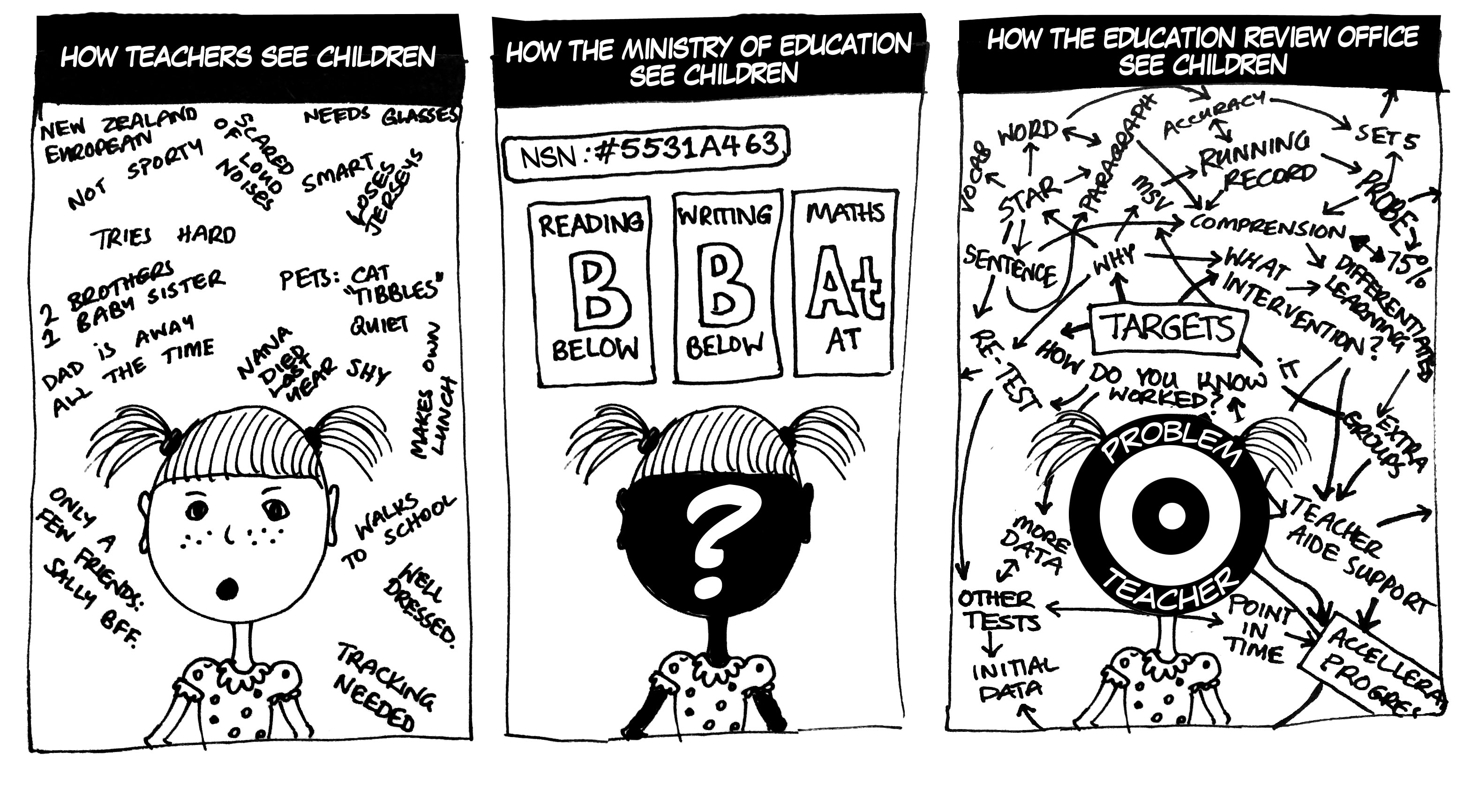
  • How Teachers See Children

    I was thinking today about the different professional views on how we should be seeing children, and how completely different that is from any kind of reality that actually faces us in the classroom.

    The only way to try and illustrate that, is in picture form.

  • Male teachers outnumber females at Hamilton school | Stuff.co.nz


    Male teachers outnumber females at Hamilton’s Rhode Street School, bucking the national trend.

    Source: Male teachers outnumber females at Hamilton’s Rhode Street School | Stuff.co.nz

    Those that have been with Unleash Education from the start know that this is an incredibly important topic for us. One of our earliest posts focussed around the number of male teachers in primary education, and quickly followed up by an in-depth investigation into the subject of males teaching males.

    It’s great to see other schools thriving in important male teachers.