Just 15% of first-time teachers are landing permanent posts after graduating.
Source: Big drop in teacher graduates getting a job prompting a return to bonding | Stuff.co.nz

Source: Big drop in teacher graduates getting a job prompting a return to bonding | Stuff.co.nz
Labour says “on the job” placements should be a bigger focus across all teacher training courses.
Source: Labour is keen for all teacher graduates to be bonded to schools | Stuff.co.nz
There is a certain degree of irony as we walked the uni halls going from drab lecture to drab lecture as the guiding lecturers encouraged us in the art of teaching and using different teaching styles, making it interesting, engaging our students, using cooperative groups, and yet maintained a ‘sit down, shut up, and listen’ teaching approach themselves.
Therefore, when we were unleashed into the real world of classrooms, with 30 sets of eyes all looking at us like we’d fallen in from a different planet, we were all too eager to get stuck in and learn as much as we could.
I still maintain, that the majority of learning that I did in my four year degree was largely, and even solely, from the practicums that were spread out over my time at teacher’s college. Nothing was more eye-opening, or realistic, than dealing with students, encouraging thinking, facilitating learning, and learning the ins and outs of actual schools, their rules, their expectations, and all that comes with them.
I’m not really sure what Labour is hoping to achieve with this. Firstly, most schools are fully staffed. Taking on a student teacher, not only to be training them, but then supplying a job for them later on, is a little too much for schools to commit to, especially for first time teachers.
Obviously there would need to be a generous amount of sorting this out, and will directly require universities to work a lot closer with the Ministry, and with the placement schools.
What do you think? Are the current systems good enough? Will ‘bonding’ student teachers to schools lead to an equal opportunity for all applicants to positions?

Newstalk ZB Article
Finally. Some worldwide recognition. Sick of not getting it from the NZ Government, we’ve thrown caution to the wind and worked tirelessly for our tamariki; our future. We’ve done what we know is best, despite a climate of data, testing, judgements, and dictatorship. It’s almost like we’ve just set the world record for the high jump, all whilst having a four poster bed strapped to our ankles.
And yet, as New Zealanders, we’ll humbly accept it, acknowledge it, forget about it, and resume normal life in about an hours time. After all, life doesn’t stop just because the world rates us highly. There’s still children to feed, hungry minds to teach, and the odd attention seeking kid to deal with as the class falls into chaos again on Monday.
Yet as the article suggests that there needs to be more done from the Government to “improve support for teaching research and professional networks.”
The Minister for education scrambles for cover, and quickly puts together a front and an excuse about Investing in Education Success, saying that their Community of Schools are already in the pipeline and will address these issues; despite the initial findings that all the Community of Schools will do is cause division among schools, and boards; principals and staff. Current principals all fighting for Lead principal roles, and schools not wanting to “take orders” from a Lead principal who does not know a school or its community. Some principals want nothing to do with it, sighting they don’t want to be the one to go into other schools, and weed out ‘poor’ teachers from that school. The additional workload does not match the addition in pay, especially for lead teachers, and so I struggle to see how this promotes “teaching research and professional networks”. Instead it creates competition, in-fighting, corruption and will create a climate where schools all end up teaching a very narrow curriculum in the same way as each other, which restricts any kind of teaching research.
Aside from this, it is quite interesting to see the initial responses to the news. It’s hard to determine if these are people from the sector, or general members of the public, but they sure are following a similar theme.

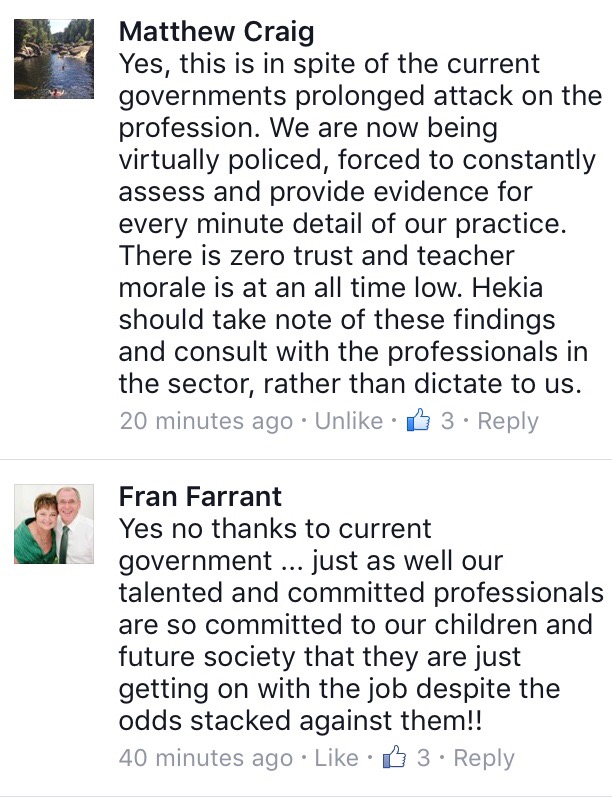
I don’t even care to know about what the Education Minister has to say about this. It has been quite clear through all of her speeches, her written letters, her policies and ideas, that teachers need to work harder. Yes, on the odd occasion she mentions what a good job teachers do, but always, ALWAYS, has followed that premise with “but they need to do more” statements to put the kaibosh on any feelings of accomplishment they might be having.
No, instead, let us celebrate that even if we’re not recognised by this country, we are seen as up with the world leaders in teaching internationally. Let’s face it, a World Record is worth much more than a National one anyway!

Firstly; I’m a teacher.
Secondly; I suffer from depression.
Thirdly; I’m a teacher with depression.
Yes; every part of my life is affected by my mental illness. That does not stop me from being a good teacher, nor does it make me an incompetent teacher – just as a broken arm wouldn’t stop me from being a good teacher, or an incompetent writer/journalist.
I don’t even know where to begin with yesterday’s article “Nearly 100 mentally-ill teachers investigated by the Education Council in the past six years“. Aside from having the longest headline in history there was stunned silence from my normal full of thoughts head. Shocked. Appalled. There are just so many false correlations and connections being made that simply fly in the face of all that is good and healthy for de-stigmatizing mental illness.
There is a complete and utter misconception here that mental illness correlates to teacher incompetence. It doesn’t.
Obviously there are choices people make; especially around drugs and alcohol, that have no place in the classroom. But this is teacher incompetence, and would be (hopefully) dealt with regardless of whether that teacher had mental health issues or not.
Taking your issues out on children in the classroom is teacher incompetence, not a mental illness.
Not all teachers with mental illnesses display any signs of incompetence. Not all incompetent teachers have mental illnesses.
The two are individually occurring instances.
Yes; there have been times where I have doubted my ability to teach with my depression. I have raised it with my Principal on more than one occasion. But that’s my depression speaking through my lack of self esteem. My Principal and colleagues assure me otherwise.
In a time where stigma around mental illness needs to be addressed, this type of article does nothing to help or even show some sense of understanding at all. It’s disappointing to have to stand up and speak out on two of my passions under attack; mental health awareness and teaching
The only piece of common sense in this article comes from a Masterton principal when he says:
School boards employed people “fit for the job in every sense”, and people with mental health problems could still be good teachers with the right support.
Furthermore, I can’t believe that someone would be so naive as to include aspergers and ADHD as ‘mental illnesses’. They are not. They are syndromes; disorders. They are not ’caused’ by anything but instead are pervasive developmental disorders. With illnesses, such as depression, there is always the sense that you can get better. From my understanding there’s no getting better from aspergers, autism, or ADHD. Sure; you learn to cope, with experience, medication, and other means, but it is always there.
I’m not sure what experience Caleb Harris (the writer of the article) with mental health, and I don’t like to presume anything, but the way in which this article is written is incredibly insensitive to those who currently suffer from mental illness, as well as those who are great teachers.
A message I received from a friend summed it up for me.
“To anyone suffering with Mental Illness; You are one badass mother f***** because nothing is more terrifying than battling with your own mind every single day.”
We keep on keeping on. Every day we already deal with our own thoughts, the last thing we need is more stigma attached by articles like this one, which make broad sweeping statements about the mental health of the profession
Those that have been investigated, have been investigated because their mental health has affected their ability to act rationally and suitably for a teacher. Their mental illness has taken its toll, and for some, it has been deemed necessary to terminate their ability to teach in a school.
Let us not also forget that the statistics expressed in the article are of the express minority. 100 teachers over six years, works out as 16 per year. 16 out of the 100,000 registered teachers is a very small percentage. 0.016% in fact.
To imply then that teachers with mental illness are a liability and should be investigated is antagonising to say the least, especially considering that, according to the Mental Health Foundation, as many as one in five New Zealanders have, or will experience, mental health issues each year.
Teacher’s are people too, and so if we apply this ratio to our 100,000 teachers, that is approximately 25,000 teachers. Of those 25,000 teachers, only 16 per year have been investigated.
When you look at that statistic, it amplifies the problem with this article. Instead of seeing the positive, Mr. Harris has gone about to vilify teachers suffering from mental health issues. Many have mentioned that it is a lot easier to de-professionalise teaching if the current workforce is seen as ‘unfit’ for the job. Even members of the public took to the comments section to try and tell teachers that there is stress in every job and to get over it (which is completely unrelated – besides; stress is not a mental illness, it is a factor that leads to mental illness).
Instead, the article should have focused on the 24,984 teachers who, though suffering with the demons inside their heads and battling them within themselves daily, still manage to hold down their job, working day in and day out, turning in long hours (especially during report writing season), being role models and mentors for the children in their class and their school, and have survived another year. Least of all it should congratulate the whole teaching profession for doing what very few can do; teach the next generation, be patient for the ones who struggle, be understanding to those that think differently. Day in and day out you have all worked hard for your student’s, to see them be the best that they can be, even when they’re at their worst, and you’ve seen them do better. You’ve laughed when they’ve laughed, and hit your head against a brick wall when you’ve had to tell them to put their hand up for the thousandth time, and yet for every single child you can see the potential, and tell them that they can be whatever they want to be, and encourage each of them to pursue their dreams no matter the cost.
Even if that dream is to be a Masterton based journalist.
See – it doesn’t feel very good, does it Mr. Harris?
If you know of anyone, or see symptoms that they may be struggling with mental illness, please encourage them to seek help. If you can; be a friend – sit and listen.
Lifeline – 0800 543 354 or (09) 5222 999 within Auckland
Suicide Crisis Helpline – 0508 828 865 (0508 TAUTOKO)
Healthline – 0800 611 116
Samaritans – 0800 726 666
Earlier this month, the Minister released a public document surrounding the public having their say on the updates this government are wanting to make to the Education Act. In it, they outline what they need to do to change the landscape of the education sector in this country. It is worded in an incredibly positive way, and they have been more than inclusive by ensuring the use of the word “may” throughout the document (which is at least an improvement on how they made changes with National Standards, Class Sizes, Christchurch School Closures, and Novopay!) However, there are some issues within it. Quite concerning things, that if passed, will allow for a lot of changes that we may or may not be interested in, but our chance to have a say will have gone. I’ve gone through and highlighted some of these things to hopefully shed some light on what is really being said. 
The Education Act changes all centre around supposed “child’s pathway” through school, and focuses on “raising their achievement”. While a growth mindset is healthy for every classroom, at some point, there is a ceiling on what can be achieved. By having a law written that says that raising achievement levels is paramount, it means that there could be issues if a child HAS achieved, or schools already raise the achievement levels beyond any reasonable expectation. As will be an issue that comes up all through this, there is the ongoing issue around how this is measured. No doubt the Government will rely on data gathered through National Standards reporting, yet we already know that this is clunky at the best of times. In the seventh paragraph, the changes suggest that it will outline in law ‘who is responsible for what’. This seeks to allow the government to lay blame on individuals should things not go to plan. This may be a board, a principal, or a teacher. Of course, they are also quite clear that any submissions that suggest changes that would increase government spending on education will not be considered. Quite clearly the government thinks that it is already doing enough in this regard.
Improvements can be made to the way school and kura boards plan and report on how they make sure the right things are being taught, how they are informing parents, whānau and communities about what they are doing, and how well children and young people are achieving.
Red tape around planning and reporting could be reduced so that boards are able to focus on what is important in promoting student achievement and wellbeing. There are some things that are a ‘must do’ for boards, such as developing a strategic plan, providing annual performance information, and meeting statutory reporting requirements. But there are other requirements that could be removed, and some complexity could be reduced. For example, high performing schools could move to a four-year planning cycle.
It may also be useful to let groups of schools and kura work together when they are planning and reporting. This would help a community plan more cohesively, share expertise and reduce administration. It could particularly benefit Communities of Learning and small or isolated schools and kura.
In this section, it mentions ‘red tape’ which is very vague in what it means. Essentially, I think, they want to get rid of some of the bureaucracy that gets in the way from making decision and making changes. But as always, they label this as a way for Boards to focus on other things, such as improving student achievement. In the example, they state that ‘high-performing schools could move to a four-year planning cycle’. By “high-performing”, we can assume that they mean “high-achieving”. In the following paragraph, it says that it ‘may also be useful to let groups of schools and kura work together…’ making reference to their Communities of Schools model. We can safely assume that the word ‘let’ could also be taken to mean “make”, especially when schools are ‘not achieving’.
With better and more timely information, parents, whānau and communities can have an active role in helping to improve achievement for their children and young people. The Act could allow for a set of indicators to be established so schools and kura know what areas they need to report on.
For example how well students are doing, and how the school or kura is managing its money.
The Update could enable schools, kura and Communities of Learning that are doing well to get more freedom and extra decision-making rights. This would be balanced by monitoring schools, kura and Communities of Learning carefully and clearly saying what will happen if things go off track.

Firstly, what does performance mean? No doubt, when the Ministry talks about performance, they mean achievement. Regardless of “better or more timely information”, parents, whanau, and the wider community can all have an active role in a child’s education. It does not have to be made into law through the Education act. It’s called parenting. It’s called raising children. It’s called childhood. A set of indicators that the change proposes are either National Standards, or a new set of KPI for schools. The suggested example of “how well students are doing” jumps up and screams “League Tables”, seeing as this is talking about reporting to parents and the community. This is public information that will be out there for everyone to see and compare, even though there is no doubt that these KPI will not show the value and worth of a school. This section goes on to include the Communities of Schools who do well will get more freedom – rewarding the “high achieving” schools once again, with more decision making rights. It then makes it clear that, in balance, poor performing schools would have such rights taken away and decisions would be made for you “if things go off track”. Which is exactly what we want as a school who’s students’ struggle, we definitely need an outsider coming in with a top down approach of “you will do better”; tongue firmly in cheek. 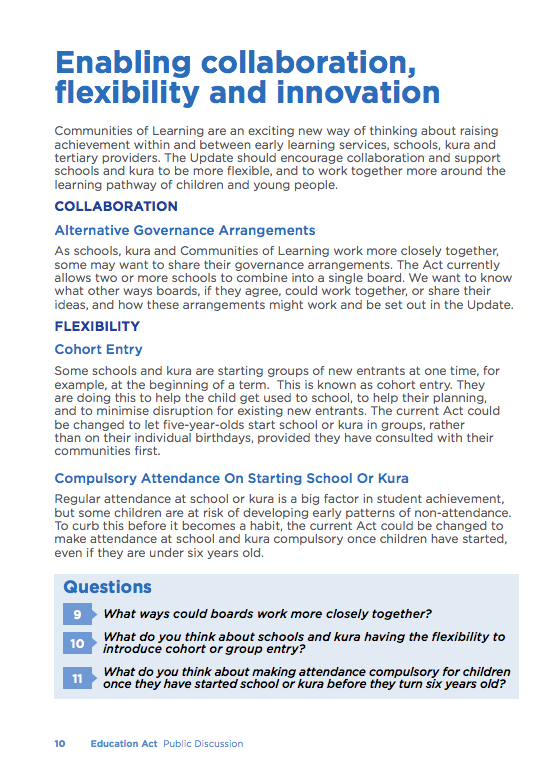
This pare of the document just looks at the idea of Communities of Schools that the government has brought about through the IES. Under Alternative Governance Arrangements, they state that some schools who are working in a Community of Schools, “…may want to share their governance arrangements”. This is already happening with the property side of funding in some areas. Also, as is with earlier parts of this document, where it says “may want to”, it is also saying that some schools “may be forced to” share their governance. In terms of flexibility, it is interesting that the only reason why schools would be wanting to have different intakes at different parts of the year is largely to make National Standards reporting easier in Years 1 to 3. Their anniversary reports would all be at once, rather than spotted throughout the year, and it would tie in with the senior reports a lot more often. The question really is, is if your child misses out by a few weeks for the intake, they might essentially miss out on 3-6 months of schooling. What’s more, if a school down the road isn’t having intakes at set times, that family may decide to take their child elsewhere. Isn’t it already compulsory for children to attend school? What’s more, how is the Ministry going to enforce this, especially when funding for truancy officers has been cut, and the Government doesn’t want to spend any more on education? No doubt it will be one more thing that schools will have to chase up on in their own time.
What makes a school great?
How is this measured?
There is no question, given the rest of this document, what the Minister sees as a “great school”. High achievement.
But the word “Great” or “Greatness” surely encompasses so much more than this?
Take for instance a local school in my area. A well recognised and renowned school, with parents and whanau driving from up to ten minutes away to send their child there. It is a decile 8 school and has about 330 students on its roll. 75% NZ/European and 17% Maori. Their ERO cycle is on a four to five year review. From the latest review it states that “Most students are achieving at or above the National Standards in reading, writing and mathematics.”
One would say this is a great school.
At the school I currently work at, the same can’t be said. We are about half the size, and fit in a decile 2 bracket. We have about 60% Maori students, 10% Pasifika and 20% NZ/European. We recently managed to scrape through and get a three year ERO review, which we celebrated like we just won the Rugby World Cup. Half of our students are below or well below the National Standard across all three areas.
However, this year, both these two schools had their 50th Jubilee. Both of them started in 1965, the same time that Porirua officially became a city.
At our school, we had close to 180 ex-students come and celebrate over the course of Labour Weekend, 2015. Old students came from all around the country, from Auckland to Timaru. We even had some fly in from overseas to come and visit their old primary school. We had a school gala which had cars parked along the street as far as the eye could see. The atmosphere was buzzing and our school was the centre of it all.
In stark comparison, the other school had to cancel it’s celebrations due to lack of interest.
I leave you with that question to ponder. Which is the greater school?
Every school and every kura has to be a great one, and while most are doing well, a small number need more help to get there. Some more options could be put in the Act to help schools and kura get back on track. These could include an improvement notice, or an audit of one part of a school or kura. At the more serious end, a board could be asked to have different people on it.
In this section, the Act turns its attention to the so-called ‘off track’ schools. The Ministry will help them get ‘back on track’, through the use of an “improvement notice” (similar to an infringement notice, I guess) or an audit (ERO visit). The serious end, the Ministry can remove a board if a school is REALLY ‘off track’, and no doubt choose (or appoint) the representatives on it.
What an interesting thing to amend within the Education Act. I wonder why this could have occurred? Maybe the Minister had too much trouble closing schools in Christchurch. Maybe she also had some difficulty merging some schools. And maybe they want to be able to open up new charter schools whenever they like. It has also made the provision for students to be forced to go to certain schools, and force certain schools to take certain students. 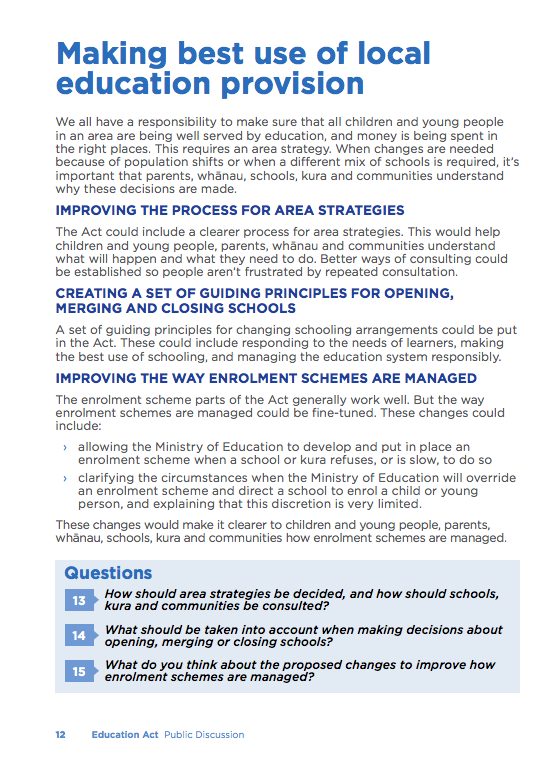
It is interesting the timing around this change. Reports are due, schools are winding down, half of the secondary schools are gone with exams, principals are drowned in end of year rollover for Novapay, and end of year activities. So it is unlikely that those who are working in the sector will have time or energy to fight the changes being proposed.
No doubt we need to though, if we are unhappy with the proposed changes.
Below are the details for how YOU can make a submission in answering the questions within the document.
You need to do this. Answer, respond, challenge, debate. Talk over your ideas. The more responses they get, the more they might listen.
An easy way to make your submission is online at consultation.education.govt.nz. Here you will find an introductory video from Education Minister Hon Hekia Parata. There are questions to get you started, or you can upload a submission from your computer. You can also email your submission to education.update@education.govt.nz or write to: Education Act Update Ministry of Education PO Box 1666 Wellington 6140 New Zealand Submissions close on Monday 14 December 2015.
Submissions and documents associated with the consultation process meet the definition of official information and are therefore subject to the Official Information Act 1982. Please clearly indicate in your submission if you do not want your name to be included in any summary of submissions that we may publish.
If you have any questions about making a submission, or would like more information about the update of the Education Act 1989, please email education.update@education.govt.nz
“Have we introduced league tables? No.” Hekia Parata said this in a meeting at a school as she rattled off a number of things ‘scaremongers’ had said would happen in regards to GERM. This included things like Performance Pay. This statement on league tables is also in addition to this article from 2012.
League tables: Hekia won’t take on teachers
Obviously however, John Key wants them; and so he gets the media to do the dirty work, even encouraging them to do so in the aforementioned article.
And respond they did. Whilst Fairfax’s “School Report” has been out for a while now, it is now being advertised, with words like ‘rate’, and ‘compare’ being bandied about like red paint on a fire engine.
Why are teachers and schools so against league tables?
David Shearer (Labour Leader at the time) touched on a few of the concerns in the earlier article. It goes further than just what he addressed though.
Take a small school. Decile 1 or 2. Even 3. Lots of poverty in its community. Health issues due to poor living conditions, damp houses and cold, harsh nights in the middle of winter. Families split, both parents working full time to break even. The kids love the school.
The teachers work hard. They’re trained. They undertake PLD. They genuinely care and want the best for the kids; not just the ones in their class, but all tamariki that come through their gates. There are major success stories, but are generally few and far between.
The teachers are good teachers. Children who have started life on the back foot and who are facing continual struggle in life are making amazing progress each year, but are still “below” the untrialled and untested National Standards that this government hangs its hat on. The children wouldn’t make the same progress if the teachers weren’t any good.
But along comes Fairfax media and their “School Report”. It shows that this school is ‘failing’ compared with School B down the road (who may or may not be inflating their National Standards results). Their teachers may be good, but also might have a community where students aren’t walking down struggle street, and achieving at school is the number one priority. The amount of progress that they have to make is minimal in comparison, and their teaching staff may be able to relax and not work as hard in order to maintain certain results.
Parents of the first school compare and begin to buy into the league table problem. They leave school A with its hard working teachers, whose progress and dedication to their students is unrivalled, yet don’t show up in the broad umbrella of “below”, and go to greener pastures.
School A loses students. The roll decreases. They lose a classroom and a teaching position. Eventually another leaves, and another. The school gets smaller, and the results don’t change, to the point where it is forced to merge or become one of the government’s heralded Charter Schools.
This is why league tables are dangerous. They compare apples with shackles, oranges with hairties. They force assumption that schools with poor results have bad teachers, when quite often the opposite is true. A lot of teachers would simple cave under pressure, give up, or be eaten alive in School A with the requirements of it’s akonga. They would equally struggle to not only raise the achievement level, but just maintain it.
 So when I see an advertisement to compare schools while I’m reading the latest news, I get annoyed. Frustrated. Because I am a good teacher. I work hard for my students and my students work hard for me. They are a challenge, but the hard work brings reward. They make phenomenal progress each year while they are in the shadows of elephants in the room that no one wants to acknowledge; but these improvements, no matter how amazing, fail to show up in a simple pie graph showing banded results. Some of these students will go from a reading age of 5 and a half, to a reading age of 7; yet because they are 8, are still below.
The public compares schools. School A must be rubbish, with dead-beat teachers. I don’t want my child going there.
Thanks Fairfax. I’m sure John Key appreciates the dirty work you’ve gone and done for him.

An ongoing glut of new teachers causes job search headaches – Dominion Post – 27 July 2015

Back in June I was made aware of an issue surrounding Copyright and teaching. Essentially, any resources created for teaching, by teachers, are actually the rightful property of the Board of Trustees of that school. For any teacher to share or use those resources outside of that school is breach of the copyright, and permission needs to be sought.
You can read the whole article here:
Copyright for New Zealand Teachers > Unleash Education
Now; being a creative with my own views on copyright, and my own works that hold copyrights, I am very interested in the whole process. To me, as I move through my teaching career, I often see ideas, or think of ideas, and then go about doing my best to make my own resources that are better; whether through advancing functionality or simply putting my own aesthetic improvements on existing ideas.
I also would want to be able to share these, and use these in any future teacher positions I might hold at other schools.
So I quickly went about searching for solutions. In the process, it also surprised me how many teachers have no idea that this was the law.
The solution as it turns out is actually relatively simple, but requires the board to make a deliberate policy change or addition. Creative Commons have made a ‘in schools’ page which outlines the issues quite well, but on top of that, they have developed a policy template for schools to use. I recommend using the ‘annotated’ version first, to get your head around the language of copyright, which can be relatively technical if you’re not used to it.
Our board is currently in the process of adopting this policy for our school. I hope that this makes the situation around copyright for teachers clear for you, and that you can encourage your school to check its policy around this.
This is a copy of the policy template that Creative Commons has provided. It includes the annotations, which I have tried to make a little clearer using fuller sentences than those provided by Creative Commons.
SCHOOL wishes to encourage the open and free exchange of information, knowledge and resources, and support the collaborative production of copyright works that are freely available to all. SCHOOL encourages both staff and students to support free and open access to copyright works.
The preamble gives the general purpose for the policy. It also states the school’s position that it will be using Creative Commons licences to share copyright works.
The Board of Trustees of SCHOOL:
1. Recognises that the Board of Trustees holds first ownership of copyright of works produced by the Board’s employees in the course of their employment.
This states that the default ownership settings for copyright works produced by teachers and employees of the school under section 21(2) of the Copyright Act 1994 (NZ) belongs to the school/Board of Trustees.
2. Applies by default a Creative Commons Attribution Licence to all teaching materials and policies in which the Board of Trustees of the school owns copyright.
This is the key part of the policy, as it is referred to throughout the rest of the document below.
It limits the default application of Creative Commons licensing to teaching materials and policies. While these are broad categories, the clause is intended to refer to those teaching or policy resources that would be of use to other schools, and is not intended to apply to every copyright work produced in the school.
Note also that ‘default’ means that the school can make exceptions to the policy at its discretion.
3. May apply a Creative Commons Attribution licence to other copyright works, aside from those described in (2), with the express agreement of the Principal.
This gives the school flexibility, should it decide to openly release works other than those outlined in the second (2) clause.
4. May make exceptions to 2) at the discretion of the Principal. Any such exceptions should be limited by a specific time period and should consider the application of other, more restrictive Creative Commons licences, as opposed to simply reserving all rights in a copyright work.
This will give the school some more flexibility, should it decide to be more restrictive than as outlined in the second (2) clause.
5. Will transfer to the original creator the copyright in created works licensed by the school under a Creative Commons Attribution or Creative Commons Share-Alike .licence
The Board of Trustees recognises the benefits of using the most open Creative Commons licences, and provides an incentive to employees to embrace the use of such licences.
6. Does not make any claim over the ownership of copyright works produced by students. The copyright to these works remains with the creator.
This simply clarifies that the school has no rights over copyright works produced by students, since they are not employed by the school.
7. Recognises that this policy only applies to copyright works, and not to any other forms of intellectual property.
This simply clarifies that Creative Commons licensing only applies to copyright works.
8. Recognises that the copyright in works produced by an employee other than in the course of their employment by the Board of Trustees of the school remains the property of that employee. Where this is unclear, the process for dispute resolution, outlined below, shall apply.
This is key for me and other creative type people. It recognises that there may be some uncertainty as to what constitutes a work produced in the course of one’s employment. It is intended to assure teachers that the policy only applies to works that are owned by the school, and to point to the dispute resolution process, below.
For example; a teacher who creates a drawing or artwork at school, but hasn’t been “employed” or asked to do this by the school, the teacher owns the copyright. This applies to creative works outside of school; such as works created at home as a hobby or secondary employment, such as musical pieces or photography works.
This also applies to written articles, such as those found on this website; which while are inspired and influenced by my teaching position, are not part of my employment, and so I retain the copyright.
Creative Commons: An international non-profit that provides free open licences that copyright holders can use to share their work.
Teaching Materials: Copyright works produced by employees of the school for the purposes of teaching.
Policies and Procedures: Copyright works that determine, and provide guidance around, a course of action adopted by the school.
The definitions around what is and is not covered by the policy should be adjusted by the school, as required.
Where the first ownership of copyright in a given work is disputed or unclear, the following process will apply:
This should be replaced with the school’s dispute resolution process, where appropriate.
Our best and brightest young teachers are leaving the profession because of frustrations over too much paperwork, insufficient pay and a lack of career options in front of classrooms. A Canterbury University…
Source: First in class: No gold star for top Kiwi teachers?
This is an ongoing problem in our schools. Retaining teachers needs to be a priority, however, because expert teachers and experienced teachers cost more money for the government to employ than beginning teachers do, there will be no intensives to stay on in education more than one can put up with.
Education certainly isn’t as it used to be, and I wouldn’t hesitate to say that even in the five years I have been teaching, there has been a heightened emphasis on assessment and data than ever before. And it’s not making teaching any better. It merely just takes up time and effort. Something that is becoming increasingly difficult to find these days.
It has come to the point where I don’t think I would go out of my way to encourage anyone to become a teacher today. It’s a pretty sorry state when those in the business can’t recommend it to others who could, or even should, become teachers.
So this week I was introduced to a concept that I was completely unaware of as a teacher.
And by concept, I mean law.
As a creative, I have different fingers in different creative exploits including art, photography, web design, and music. Needless to say I thought I was rather familiar with the rules around copyright. Especially in it’s purpose to protect the creator of the work in question. I’m very familiar with the understanding that anything created for a company or corporate, being paid for by the company or corporate, then the company or corporate hold the copyright for that work, unless otherwise agreed upon. However as a teacher, I feel it’s slightly different, especially since so much “personal” time is invested in creating resources, planning lessons, or creating avenues of learning.
However, I was completely unaware that under the 1994 New Zealand Copyright Act, schools fall into the same sort of category as a company or corporate; meaning that the copyright to works that teachers create is owned by the Board of Trustees. This means that, when teachers share, collaborate, and take resources they’ve made from one job to another without the Board’s express permission, they’re breaking the law.
This is slightly concerning. I know of many teachers who have moved around to different teaching positions. It happens all the time. I know of at least 7 teachers who have moved in and/or out of at my current school during my 6 years there. It is also concerning given the nature of teaching, and teacher willingness to share, collaborate, and work together to have a greater impact on the world around them, by influencing and helping other colleagues, whether they be at the same school, the school down the road, or the school at the other end of the country.
In different conversations around this, I received an email from Carolyn Stewart, who has been a principal for many years, and is now involved with Network 4 Learning. In it she explains the law very clearly and concisely in a way that if most laws were written like, the majority of us would have some chance of actually understanding them!
She says:
“The copyright for any teaching and learning resources, that is clearly linked to the daily employment of the resource creator, whether in school time or not belongs to the Board of Trustees who are their employer… A teacher should only share resources outside their school boundary with the permission of their Board of Trustees – this includes taking resources when they move from school to school. Practically this is quite difficult to manage as we all know that deep within NZ teachers’ DNA is the propensity to share with others to improve learning for all NZ children.”
Many schools and teachers do not realise this. I was one of them.
TKI outlines it very clearly for teachers – but obviously we are incredibly busy and don’t like to use our time trawling through every webpage on TKI. In the page about Teachers and contractors copyright, it says

As I did a little more investigating, it raised more and more questions.
So, the usual process when something like this comes up, is I hit Google and do a bit of a search to see what others are saying about this issue I previously knew nothing about.
Most interestingly, only a year ago, this article slipped through the news. In it, Matt McGreggor of Creative Commons in New Zealand says
“There’s a real absurdity in most schools at the moment where teachers don’t hold the copyright to their resources,” he said. “What that means is that teachers who share all the time are breaching the copyright of their board of trustees.
“Every school in New Zealand should fix that problem by passing a Creative Commons policy.”
So even those who work in the copyright industry say that the rule is stupid, but there is a very simple solution, similar – if not better – to the one I suggested earlier.
Covering all the aspects of this is a webpage created by Creative Commons that outlines all that I discovered in the course of this article. It outlines the issues, as well as advocates on behalf of teachers for all boards to make a policy change so that Teachers are able to legally share their resources or take them with them as they move to another school. They have even created a template, making it easy for boards to implement a new policy.
With it, they have made a couple of videos as well.
I know for me, I will have to add another item to the next Board of Trustees meeting agenda.

