Tag: teaching

  • Understanding the Teacher Crisis

    The Side Eye: Everything to Everyone – understanding the teacher crisis:

    A unique take on the Teacher Crisis put into a visual narrative succinctly and accurately by Toby Morris.

    Be sure to check it out over at The Spinoff – The Side Eye.

    For the rest of the story, please head over to the original article here.

    https://thespinoff.co.nz/society/the-side-eye/03-12-2018/the-side-eye-everything-to-everyone-understanding-the-teacher-crisis/?fbclid=IwAR04F0_Wj102NUYIFSY1Th7SJhbX99I83ZLJJwidKkSEwdKfAnvlkLkycqY

  • Trainee teachers share aspirations, apprehensions | Stuff.co.nz

    Alexia Cochrane has wanted to be a teacher since she was five years old.

    Dedication, numerous part-time jobs and a $65,000 student loan helped get her through years of study and within reach of teaching her own class of young minds.

    But like many aspiring teachers, the 22-year-old Waikato University master’s student says recent teacher strikes and talk of a crisis in education have her questioning her career path.

    “I’ve met people with such a passion and drive for teaching who, once they go teaching, say they may only last three or four years,” Cochrane said.

    “That’s devastating, because kids deserve people who are fully invested in them.”

    “Teaching as a profession seems to be undervalued and I keep asking myself how long can I keep defending my passion?”

    Source: Trainee teachers share aspirations, apprehensions | Stuff.co.nz

  • Over the Bridges and around the Roundabouts

    Hekia did a U-Turn on class sizes back in 2012 when she announced National would be increasing class sizes.

    John Key himself stated that he sent his children to private schools because of the smaller class sizes.

    Yesterday Simon Bridges sent National back down the road, but this time after heading around the round-about and back in the complete opposite direction to his former leaders. In fact, it appears that he’s even driving on the wrong side of the road.

    “In a fiery speech to the National Party annual conference on Sunday, Bridges promised National would increase the number of primary teachers to reduce class sizes and give kids “more teacher time”.

    “With the right education we can overcome the challenges that some children face purely because of the circumstances they were born into,” he said.”

    Stuff.co.nz – https://www.stuff.co.nz/national/politics/105832210/smaller-class-sizes-under-nats-says-simon-bridges-in-major-speech

    It has left many of us scratching our heads, dazed and confused. Isn’t this what Teacher’s all around the country were asking for back when National was in power?

    It would seem easy to make such promises when you’re not held to account, or when you’re not in driving seat or in charge of the books.

    Of course, this gives Labour the mandate to lower class sizes and not have any opposition to such a proposal – least of all from the teachers around the country, backed (I’m assuming) by Simon Bridges himself.

    It won’t happen though. And here’s why.

    To lower the class sizes there are several things that need to change.

    Either there needs to be more teachers. Or there needs to be less children.

    Let’s assume that infanticide won’t go down well in 21st Century New Zealand, the government is forced into the first option.

    Please be advised: There are a lot of links to news articles in this article. I encourage you to read each article in full to gain a better perspective on the issues at hand. There is more than just one factor in all of this, and having a full picture of it all will assist you in understanding the complex array of issues raised.

    As I write this article, NZEI have just released a damning report regarding student numbers and the teaching profession, saying a crisis will hit by 2030 – a date that I bring up later on in this article as well!

    Point one.

    We’re already losing teachers by the bucket load. Earlier this year it was reported that half… HALF of all high school teachers quit within the first five years. That means that every five years we have to replace half of all the high school teachers. And that’s just to maintain the current teaching workforce. Similarly, 17% of all new ECE and primary graduates EXPECTED to leave within the first five years into their careers.

    “They often leave because they are burnt out by the demands of teaching, an increasingly narrow and prescriptive curriculum, and by policy initiatives that promise much, deliver very little, and are quickly replaced by some “new” policy that is equally ineffective and short term.”

    – Stephen May, January 22 2018

    Point two.

    We’re losing not only good teachers, but experienced ones, by the bucket load. I’m not talking about teachers with 10 years of experience. We’re talking deputy principals with 30 years of experience. We’re talking teachers with 23 years of experience as a principal, and 40 years in teaching. That kind of experience doesn’t just grow on trees. Simon Bridges was two when this principal BEGAN teaching.

    Point three.

    To try and address the dwindling education workforce, the National government sent an ambulance to the bottom of the cliff. From the ambulance came the idea that we’d just train new teachers, rather than trying to stem the flow of valuable, dedicated, and experienced teachers jumping from the top of the cliff face.  We all know why they did this – paying beginning teachers is a lot cheaper than continuing to pay experienced ones. But needless to say, the results are as expected.

    The course was introduced and graduates rushed through in record time. I trained for four years to become a teacher, and I was nowhere near prepared enough for the daily rigors of school life. Furthermore, while the introduction of this was (in my opinion) a good one with a step in the right direction towards ongoing apprenticeship where teaching students are placed in a school and get used to “the grind” with some real-life practice, it only had room for 20 applicants in it’s first year in 2016.

    Nine MILLION dollars was injected into “a raft of new initiatives” to help address the shortage in 2016. Money well spent by Hekia and the National Government? I guess proof will be in the pudding.

    On top of this, the numbers getting trained are subsiding as well. I’m not at all surprised. The number going through education training at the moment is a third of what it was when I trained in 2010. Continuing that trend we will no longer be training any new teachers by 2034. Poor pay, high stress, and better career options in other professions are being blamed.

    In addition to this, we’re not even getting the brightest or best for the profession. Just read this article from 2016 which states that graduates accepted into teaching degrees were some of the lowest scores across ALL bachelor programmes. It also explains saying that “The number of entrants into teaching has dropped by 25 per cent in five years, putting pressure on universities to accept even lower entry grades to maintain numbers”.

    Point four.

    So as we can see, getting more teacher’s isn’t working. Why not?

    Well – as a teacher, I’m certainly not recommending that anyone choose the career over any other. I’ve heard it on good authority that at least one local principal discouraged his own children from becoming teachers, stating that it isn’t like it used to be when he was a teacher while raising them in the 90’s.

    As stated: Poor pay, high stress, and better career options exist out there for anyone wanting to earn a living in this world. We’ve already seen a teacher shortage in Auckland, not just because of the lack of teachers, but because of the cost of living, the cost of housing (renting or owning) in Auckland (and elsewhere around the country) is beyond their means. Even those that moved in to try and plug the gap are now looking at leaving.

    Put simply, Teaching is no longer valued as it once was. And it is a detriment to our society.

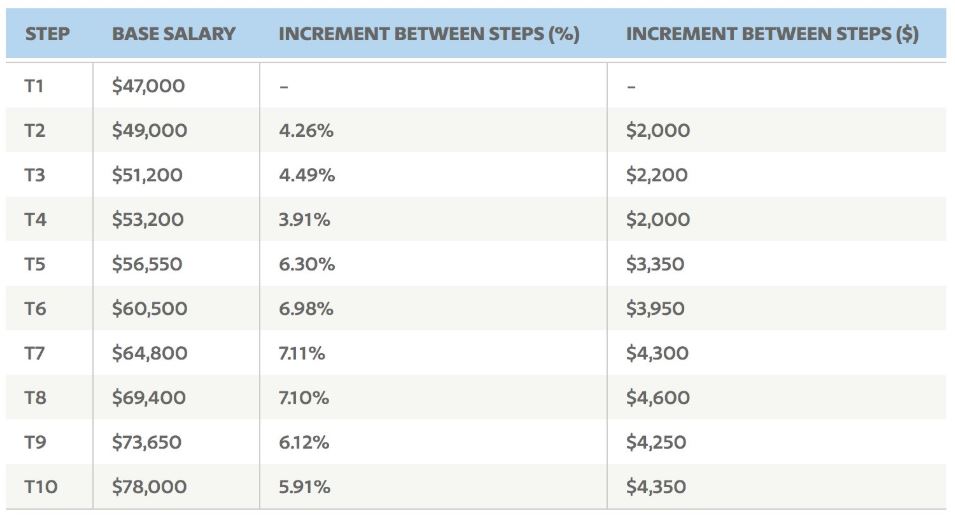
    So how do we show value in Teaching as a profession? Well. Pay is one way. If the job is paid well, there will naturally be more interest in it as it becomes a viable career on par with other options that are out there.

    Check out these stats from a bit of research a Twitter follower did:

    When a Corporal in the New Zealand Army can earn as much as the TOP tier experienced teachers (besides units, or senior management), then it speaks volumes. And don’t for a second think I am belittling Corporals in the New Zealand Military.

    Heck; just look at the salaries of members of parliament. You have to go back to 1979 since the pay for a back-bench MP was the same as a Teacher’s salary. Now, a Back-bench MP brings home $168K worth of bacon each year – and then vote to increase their wages which gets passed almost before the Yay’s can say ‘Y’.

    That’s a 40% difference, in nigh on 40 years. There’s no way that we’ll get back to where the pay scales will be anywhere near the same.

    It can’t happen, I hear you say…

    It did. Back in 1985, under a Lange led Labour government, a 40.17% pay hike was given to secondary teachers across the country.

    I’m not saying that it will happen again. But if the government (and the people the MP’s represent) are serious about the future of the country, then they need to get serious about making Teaching a viable career.

    You can come out and say that you want smaller class sizes, but to get to smaller class sizes, you need more teachers. And to get more teachers you have to make it a job worth staying in (less work pressure) and pay them more so that teaching is on par with other careers.

    Everyone knows, thanks to Whitney Houston, that children are our future, and we’ve all had a teacher who has inspired us to be more than we are, or more than we were. You put money into education, and you get it back in droves in the generations to come.


    The good news is, Minister Hipkins is aware of it and is doing something about it. Quite what it is that’s doing is largely unknown – given the latest purchase in the Defense force, but hey… at least it’s not a U-turn.


  • PTC Portfolio – Example Template

    So part of my job is providing PD for our staff on a variety of things, usually anything to do with ICT.

    I have been asked to run a workshop on online PTC portfolios, and so as part of that, I built an example PTC site, complete with How-To guide to get your own PTC Portfolio set up just like it.

    ptcportfolio.wordpress.com

    You can head on over to the site and use it if you’re looking at putting your PTC Portfolio up online. Don’t worry, you can keep it all private and make the most of being able to access your portfolio from anywhere.

    Of course, I used WordPress.com, one of the most widespread CMS’s available, and is what I use personally for my own PTC Portfolio.


  • Individual Testing is Killing Teaching

    When I was at school, I can’t remember ever doing a one on one test with my teacher.

    I’m not saying it didn’t happen. I’m saying I don’t remember it. I do remember being tested, in whole class tests, PAT mostly. Colouring in blank circles was fun.

    At some point, teachers or schools or ERO or MOE wanted to know more. They wanted to get more specific information on the learners, to track, to identify gaps, or simply to report against National Standards for.

    And it lead to each individual child in every class being tested individually. Each child’s strengths can be identified, and the gaps they have can then be specifically targeted. Teachers knew what each child needed, and could pass comment on this first hand to their parents or caregivers, through the wonderful National Standard reports that were sent home twice a year.

    Great.

    Except that it is unmanageable.

    28 kids in your class. That’s 28 tests, all carried out individually with the teacher. That’s 27 students who are left to quiet independent work while the teacher questions 1 child. Rinse and repeat. Let’s say that each test takes 5 minutes with the teacher, allowing for arrival, sit down, thinking time, and several correct questions that lead to more difficult ones (and therefore more thinking time) and then leaving time. At 5 minutes a test and 28 students, that’s 140 minutes of testing. 2 hours and 20 minutes to conduct one test for the whole class. 

    This of course does not account for the additional time of hushing students, interruptions, and maintaining a semblance of order over the class while trying to test one child at a time. The testing can take days, usually weeks to get through the whole class one at a time.

    This is the problem though. During those weeks, there is no teaching happening. It’s simply independent work while I test. It becomes too hard to switch between teacher and tester, and so constant switching between these two roles sends one spiralling into minor bouts of schizophrenia.

    Add in that this is one test, for one subject, say Maths. Add in Writing. Add in Reading.

    The stain of National Standards lingers on. While many schools have ditched them, the mindset of the assessments that have been left behind are still causing teachers to be testing, testing, testing – not because of the National Standards, but because of the style of assessment that schools are now using.

    There is no doubt that these tests produce a very accurate and specific picture of what each child knows and doesn’t know, and it becomes very hard to argue against. However, there needs to be some compromise, otherwise we will continue to fall into one of the two modes – teaching or testing – throughout the year.

    But why?

    Why do we test at all – in all honesty?

    In this article, there are numerous points made. Most poignantly is where it says “some countries have achieved better outcomes from their state systems by deliberately shunning standardised testing. In this informative Atlantic article, the Finnish journalist Aru Partanen cites the attributes of a Finnish school system that regularly outscores the US ( and New Zealand) in international rankings of student achievement. Among other things, Finland has no standardised testing, and no private schools at all.”

    In the opening paragraph, it raises exactly where we are at in New Zealand education right now. It says “Testing kids in the classroom sounds like a good idea. Surely that keeps tabs on how they’re doing, and identifies which kids might be falling through the cracks…and that’s all good, right? Well…except that most teachers have always done testing, have always sought to detect kids at risk, and have always managed to strike a healthy balance between teaching and testing. The issue is whether the demands to follow standardised testing procedures (and the practices and attitudes that go with them ) may now be poisoning the whole environment for learning.”

    This was written in 2013. Five years ago. I had been teaching for three years. Now five years later, and approaching a decade in the classroom, I am still teaching and then testing. Now, with the removal of national standards, we have the opportunity to make a change. Something has to change.

    I didn’t become a teacher to make kids sit tests, or even interview kids about what they know and if they can tell me different ways of solving the same problem. I didn’t become a teacher to spend hours on end analysing data and working out what kids don’t know and feel guilty for how much more I should be working.

    I became a teacher to teach. I became a teacher to help kids learn.


    Related Reading
  • Survey says teachers’ mental health declining

    Original article: Survey says teachers’ mental health declining

    A long list of anxieties — around school budget cuts, bullying, coarse political discourse and the shaky status of immigrant students — is taking a toll on teachers, a new survey shows, with more educators now saying their mental health is suffering than just two years earlier.

    More than half of the educators point out their mental health is an issue: 58% said their mental health was “not good” for seven or more of the previous 30 days. A similar survey in 2015 found just 34% of respondents felt the same.

    The findings are being released Monday by the American Federation of Teachers  and the Badass Teachers Association,   a national grass-roots organization focused on social justice.

    Randi Weingarten, president of the teachers’ federation, said that over the past few years, teachers have actually swapped one kind of stress — an intense national focus on standardized skills tests — for another.

    After President Obama signed the Every Student Succeeds Act in 2015, Weingarten said, many observers believed that educator stress would ease. “You would have expected the numbers to go down, not up,” she said.

    But stress over the coarseness of our political debate, she said, has become a big dilemma for schools, she said.

    “This notion that being coarse and tough and enabling hate is OK is highly, highly, highly disruptive and problematic in schools and goes completely against what parents and teachers know is absolutely important for kids, which is a safe and welcoming environment,” Weingarten said in an interview.

    The survey of nearly 5,000 educators, most of them responding online, found that the vast majority — 86% — did not feel respected by Education Secretary Betsy DeVos, who has made expanding private- and charter-school choice a centerpiece of her career.

    Read more here.

    Source: https://www.usatoday.com/story/news/2017/10/30/survey-teachers-mental-health-declining-amid-job-stress/811577001/

  • Writing Level Markers

    Over the last few months, I’ve found a way of grouping my student’s writing that makes it quick to moderate my own judgments of each sample.

    It started off as a quick few post-it notes, but me being me, decided it needed a bit more setup and design for it to be more meaningful.

    Below are photos of the labels having been set up on my floor, and the resulting samples placed within each sub-level. This allows you to read, place, and check that what you have at one level is roughly similar to other pieces of writing that are in that sub-level.


  • Hipkins says National Standards ‘will be gone very quickly’ | OneNews

    Original article: Hipkins says National Standards ‘will be gone very quickly’ to allow ‘a bit less testing and a bit more teaching’

    The controversial school testing method of National Standards is being scrapped by the new government for reasons that include them not being a “measure of progress”, says incoming Education Minister Chris Hipkins.

    Hipkins said on TVNZ1’s Breakfast this morning the standards that were introduced in 2010 “will be gone very quickly”.

    “That’s not to say parents won’t have quality information on how their kids are doing … but we want that to be good information not the very arbitrary information the National Standards gives.”

    The standards test children Year 1 to 8 in reading, writing and maths.

    “National Standards is not a measure of progress,” Mr Hipkins said.

    Other testing measures will still stand, but he said parents “want to know how their children are progressing rather than jumping through a particular hurdle at a particular time”.

    “We want to focus on quality teaching and learning rather than constant assessment.

    “A bit less testing and a bit more teaching.”

    See video here.

    Source: https://www.tvnz.co.nz/one-news/new-zealand/hipkins-says-national-standards-gone-very-quickly-allow-bit-less-testing-and-more-teaching

  • 4 teaching mistakes that drained my energy | The Cornerstone for Teachers

    Original article found here: The Cornerstone for Teachers.com

    I am always looking for ways to save energy. I shared in my book Unshakeable that energy is one of our most precious resources because unlike time, energy does not naturally replenish itself. We have to be intentional about how we use our energy. If we don’t pay attention to the things that drain it and do less of those things and pay attention to things that are energy-giving and do more of those things, we’ll find ourselves feeling depleted all the time.

    Today I’m going to share with you four habits and practices that drained my energy as a teacher for years, and I’ll share the solutions I uncovered that completely transformed the way I approached my work.

    1) I. Talked. Nonstop.

    I ran my mouth so much as a rookie teacher that I lost my voice every fall for the first five years I was in the classroom. I’d explain, re-explain, explain again in different words, and then recap with yet another explanation. The only time I’d stop talking was to give the evil eye and deadly silence to students who dared to steal my thunder by saying something themselves.

    In retrospect, I think I felt like my talking was the glue that held the classroom together and without my constant narration of everything happening, the momentum of student learning would somehow wane. I couldn’t just give a direction and let students follow it; I had to praise the students who were on task, redirect the ones who were off, and fill every moment of a transition with my voice so that students wouldn’t fill it with their own talking.

    If we had a class discussion, I’d feel the need to repeat and affirm everything the kids said to make sure everyone else heard it and was learning from it, instead of just letting students’ words stand on their own. It was as if I thought kids couldn’t learn from one another unless I was there to repeat it back more loudly and word things with a larger vocabulary and greater precision.

    It was all just too much: too much talking, too much information for kids, and too much effort on my part that left the kids with no role to play other than quiet passivity. With all the energy I expended prattling on and on, I would have probably collapsed in a heap by 3 pm every day if I hadn’t been 22 years old and had a 22-year old’s energy level. I’m amazed that my kids internalized anything I taught, considering how much filtering out they had to do while listening, and how few opportunities they had to ever discuss or process their learning.

    Solution: Sit with the discomfort of the silence and give kids the opportunity to talk more.

    I’m not sure if I would have ever changed in this area if I hadn’t ended every day utterly exhausted and with a sore throat. I wasn’t sure what to do differently at first, but I started experimenting.

    I spent less time standing at the front of the classroom, for example. It’s easy to get in an instructional rut when you stand at the same place near the board all day long. So I’d occasionally sit on the side of the classroom or in an absent student’s desk and say, “I need someone to go up and demonstrate ___ for us.” It was so nice to SIT and SAY NOTHING that I then tried staying there, sitting among the class once the student was done demonstrating and ask follow-up questions from other students instead of commenting on the students’ demo myself (“What do you all think? Is that an effective method — how do you know? Does anyone use a different strategy?”).

    I also forced myself to get comfortable with think time and pushed against the feeling that I would lose students’ attention if I didn’t jump in with follow-up questions because I knew providing wait time can actually increase the length and quality of their responses.

    Additionally, I looked for ways to turn my summaries and narrations into questions that would prompt students to think. Instead of saying to a group, “Nice work over here, I like the strategy you used for ___”, I’d ask the kids to reflect on their own work: “Tell me how your group has chosen to solve ___.” Instead of telling a kid, “Take a look at #3, that answer is incorrect,” I’d say, “Would you tell me how you got the answer for #3?”

    Slowly over time, I began guiding more instead of directing, and facilitating instead of instructing.

    When I started discovering active learning techniques, it felt like the heavens had opened up and the angels were singing. Finally, I had a different approach to teaching that would keep students engaged and make sure they were learning without doing all the work myself. And they were actually learning more than when I was in charge! I could walk quietly around the classroom as students talked to one another, listening in on conversations instead of lecturing.

    If I hadn’t changed the way I taught and shifted my perception of the teacher’s role in the classroom so that it was no longer necessary for me to talk constantly, I would have almost certainly burned myself out.

    2) I didn’t make time to really enjoy my students.

    As an introvert and serious person by nature, my definition of “having fun” just isn’t the same as many other people’s. I had a very hard time being fully present with kids and enjoying them because I was simultaneously focused on trying to manage the classroom, keep the noise level down, and make sure the whole show was running smoothly.

    During center time, a child would be telling me about something incredible she’d learned, her face all lit up with delight as she’s looking at up at me, and I wasn’t really focused on her. I’d smile and nod, while looking out of the corner of my eye to make sure that all the kids in the rest of the centers were on-task.

    Interestingly, I thought this was the right thing to do. I’d learned in college about with-it-ness, the ability of a teacher to be aware of everything that’s going on in the classroom and I thought that was somehow more important than actually connecting with the kids.

    When a student was experiencing a lightbulb moment, I couldn’t fully take in the joy of having all that hard work pay off because I was annoyed that on the other side of the room, one of the kids was flicking pencil shavings at another child. I felt like I couldn’t fully enjoy my students unless everyone was on task and the classroom was running smoothly. And so I was constantly slipping in and out of this state of presence, and one child misbehaving had the power to throw me off.

    Solution: Be present and actively look for small moments to enjoy the kids more.

    My thinking changed on the last day of school during my fourth year of teaching. The kids were playing Four Corners and begged me to play with them. Normally I felt like I couldn’t possibly join in, as I needed to make sure no one was cheating or running and everyone was following the rules appropriately. But since it was the last day of school, I figured, what the heck, and I joined in.

    I had so much fun that I remember that game to this day and it changed the way I taught forever. Giving up control was a long, slow process for me, but I never forgot how it felt to learn and play WITH my students and the memory of that fueled my motivation to improve and became my goal moving forward. I’d always known this was a weakness of mine, but it wasn’t until that day that I really saw the power of being fully present and enjoying my students.

    Another incident that made a big impression on me was several years later when I was attending the winter concert for our school at night. I sat next to one of my students and his family. It happened to be a kid who was super sweet, but incredibly unfocused in class — the type of child I devoted a lot of time and energy to nagging. I would tell him all day long, “Focus, get to work, pay attention.”

    That night at the concert, he couldn’t see the stage well and climbed up on his uncle’s lap to watch. I was stunned to see him sitting on a family member’s lap, giggling and pointing and looking every single bit like the eight-year-old he was. The learning standards and classroom expectations might have been incredibly demanding and grown up, but he was still a child….sweet, happy, fun-loving, and young. Once I saw him in that light, it changed my interactions with him and softened my attitude toward my students.

    I realized that even though I had a LOT on my plate as a teacher, I didn’t need to weigh my students down with that burden of responsibility all the time. I had to practice being in the present moment and actively looking for those opportunities to enjoy and appreciate my kids for who they were as individuals. This became easier and easier over time until it actually became my second nature. It was an intentional shift that I made with practice.

    Read more here.

    Source: https://thecornerstoneforteachers.com/truth-for-teachers-podcast/mistakes-drained-energy/