Tag: teaching

  • ‘Tired of trying to hold the system together when it’s broken’ – NZ teachers prepared to strike for pay hike | 1 NEWS NOW | TVNZ

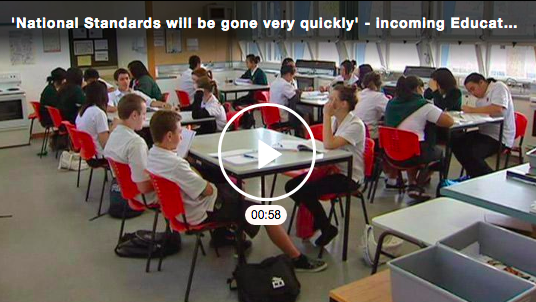
    Primary school teachers have today announced they are prepared to strike to get a significant pay hike.

    A pay deal with the government ends next year, but teachers say they aren’t prepared to accept a raise of between just one and two per cent.

    At a conference in Rotorua this morning, teacher representatives from the NZ Education Institute Te Riu Roa union voted to take action if they don’t get what they want.

    “Right now, children are missing out on some opportunities to learn because their teachers are bogged down in administration and testing, or are struggling to get support for children with additional needs,” NZEI president Lynda Stuart said.

    “To make matters worse, children are increasingly in doubled up classes because their school can’t find enough teachers.

    “Teachers and principals are fed up with seeing children miss out on the education they deserve and we’re tired of trying to hold the system together when it’s broken.”

    Collective agreements for primary principals and teachers are up for negotiation in the middle of next year.

    NZEI Te Riu Roa members will begin paid union meetings to form a claim from term from next year.

    View Video here.

    Source: https://www.tvnz.co.nz/one-news/new-zealand/tired-trying-hold-system-together-its-broken-nz-teachers-prepared-strike-pay-hike

  • Mouldy cheese and minibeasts: tips for teaching science in primary schools

    Research from the Wellcome Trust shows that science is losing out to other subjects at primary level. So what can teachers do to bring it into the classroom?

    Scientific investigation develops flexible thinking and problem-solving abilities, alongside more obvious science-specific skills and knowledge. Yet science is taught relatively little in UK primary schools (typically for one hour and 24 minutes a week compared with an international average of two hours a week for OECD countries).

    It also receives much less attention than English and maths. According to new research from the Wellcome Trust, part of the reason is that its perceived importance is comparatively low: more than eight in 10 teachers say that maths (84%) and English (83%) are “very important” to the senior leadership team of their school, compared to just three in ten (30%) when it comes to science. In addition, it may have something to do with the fact that schools are not held to account for science provision in the same way as they are for English and maths.

    Classroom teachers have a lot of freedom to teach investigative science frequently and creatively, and some do so beautifully. However, in general, there is not enough help for teachers in this area, with just under a third of primary school teachers saying they had no support for science in the past year, and a quarter saying they were concerned they might not be able to answer pupils’ science questions. So what can teachers do to increase the focus on science at primary level?

    Don’t get hung up on what you don’t know

    Science is often seen as content-heavy, and reliant on the understanding of complex ideas. It’s not surprising, then, that some teachers lack confidence in teaching some aspects of science, including enquiry.

    But you don’t need a science degree to be a brilliant primary science teacher– it’s about finding ways to engage pupils with the heart of the subject: curiosity, observation and discovery. At the Wellcome Trust, one of the ways we want to help teachers to do this is through our Explorify platform, which offers activities to spark pupils’ curiosity and develop their thinking skills.

    In general, teachers should look for activities that are inclusive and discursive, using conversation starters to spark curiosity. Crucially, it’s not about anyone (including the teacher) knowing the “right answers”.

    Ask your class questions

    Simple “What if?” activities are a brilliant way to inject creative thinking into lessons with minimal preparation. We spoke to a teacher who asked her class what would happen if plants could talk and was amazed that one child wondered whether plants would have their own language or pick it up from their surroundings – meaning forest trees might talk like a bird and playground trees might talk like children. The exercise brought out some fantastic imaginative ideas.

    Not being frightened to ask big questions – such as “Does colour affect how we taste food?” – is important and helps to prompt interesting discussions. This type of approach is also a great way to develop literacy; think of all the fantastic vocabulary around taste and colour.

    Ask yourself what your pupils already know, and how the class could approach the question. Could you work together to create a plan of action, and then decide how to share it with the rest of the school?

    Get stuck in

    Hands-on science might be viewed as messy, expensive and time-consuming, and teachers may be worried about things going wrong. But we must make sure that pupils learn about science by doing it themselves rather than by watching demonstrations. Without this element, pupils are likely to be less engaged and think that science is something for learning rather than doing. Our answer is to get out and make your own science.

    Use the world around you to inspire scientific discovery. Simple observations could be spotting the odd one out in a group of objects in a playground – perhaps learning about different materials – or peering into a pond to see the mini beasts congregating there, and taking a closer look at organisms and ecosystems.

    And if you are being more experimentally ambitious, don’t get frustrated if things don’t go as planned. Science is famous for significant events linked to mistakes or the unexpected, from mouldy cheese producing penicillin to how an attempt at inventing super-strong glue actually ended up creating the first sticky post-it notes, now used in offices.

    Read more here.

    Source: https://www.theguardian.com/teacher-network/2017/sep/19/mouldy-cheese-and-minibeasts-tips-for-teaching-science-in-primary-schools

  • How my school takes the stress off teachers

    My school has found ways to reduce the workload burden on teachers – while also helping us become more effective in the classroom.

    We all know that stress is a problem in teaching, with workloads and other pressures affecting the health of many across the UK. But I’ve experienced a variety of different approaches to teaching during my career, and I’ve seen that working long hours doesn’t necessarily equal better performance in the classroom.

    At my current school, Torquay Academy, I’ve noticed that staff are far more positive about the impact they’re having on their students than those in previous schools. While it’s difficult to measure staff wellbeing in a statistical sense, staff absence levels are at a record low, which suggests that stress levels are manageable. Our recent Ofsted inspection [pdf] noted that staff take pride in being part of the school and “overwhelmingly” support the principal’s leadership. Meanwhile, our results have improved for the third year running.

    A common approach to lessons gives teachers control

    Our teachers are allowed to talk, and our students are expected to listen. Influenced by Doug Lemov’s Teach Like a Champion strategies, there is a strong focus on teachers embedding structured routines into their lessons so students are clear about what is expected of them. Teachers are almost universally given their subject specialism to teach. Within the structure of the lesson, teachers are encouraged to allow their passion for the subject to drive the narrative of the lesson, instead of spending hours planning bite-sized activities.

    There is a strong correlation between the introduction of these methods in 2014 and the improved results. As teachers have gained increased confidence in their use, results have increased year-on-year, with significantly more students leaving school with five A*-C in 2017 (75%) than in 2014 (28%). Of course, there have been other factors, but placing what happens within the classroom at the centre of all we do has certainly been the most significant.

    We have an efficient whole-school behaviour policy

    We believe the most effective behaviour management tool in any teacher’s repertoire is praise. Success by students at our school is celebrated at every possible opportunity, and those who get it right are noticed and acknowledged.

    When a student’s behaviour impacts on others, the issue is dealt with swiftly. Crucially, it’s not down to individual teachers to set or follow up detentions; this is managed centrally by an assistant principal dedicated to behaviour. Teachers simply need to speak to the child after school, and make a phone call home to inform parents.

    Find out more here.

    Source: https://www.theguardian.com/teacher-network/teacher-blog/2017/sep/22/how-my-school-takes-the-stress-off-teachers

  • How can teachers support vulnerable children at school?

    In almost every class, there will also be those who find learning a challenge – the children who perhaps cause teachers to wake in the night, or to feel that they are having to manage certain behaviours beyond their usual areas of expertise.

    In my role working to improve the educational outcomes of vulnerable children and young people – specifically those in care and looked-after by the local authority – I have become aware that many will not be in a good place, emotionally, socially or developmentally, to learn. Although the children I work with represent the tip of the “vulnerable” iceberg, there are numerous other children who are on protection plans or identified as children in need. There will be those, too, who are not known to any service but come to school every day having faced significant hardships.

    Teachers I work with often report that schools’ more general behaviour policies don’t seem to work for these particular students – so what can we do to best support these children? Here are some pointers.

    Focus on why

    Behaviour is always a communication, even though we may not always realise it. Imagine a really bad day – you go home and within minutes you find yourself arguing with someone in your family. You probably didn’t plan to take out your frustration on those closest to you, but that’s effectively what happened.

    Many vulnerable students are likely to have had times when they haven’t felt safe – and end up reacting to all sorts of triggers in order to keep themselves safe or feel safe (which of course may be very different things). Similarly, they’ve often experienced multiple rejections.

    Many will have accompanying attachment issues and sometimes will “reject” before they can be rejected. They may push you away because this may be less painful than allowing you to reject them. Or it may be that certain behaviours give them access to a person they are developing an attachment to, so their message is “I need that person”. By acknowledging this, and recognising that what a student needs more than anything is to build relationships that help them feel safe, we may be able to adjust our reactions appropriately.

    Consider their age and stage

    Social and emotional levels of development and maturity in vulnerable children often won’t match their chronological age. In schools, we’re usually good at supporting children when they have gaps in their academic learning – and many of the vulnerable students will have these – but they will almost all have some gaps in their social and emotional development.

    They may not have developed the skills their peers have, and also by virtue of their experiences have developed certain “street-wise” skills that can lead a teacher to think they are much more mature than they are.

    Read more here.

    Source: https://www.theguardian.com/teacher-network/2017/sep/28/how-can-teachers-support-vulnerable-children-at-school

  • The right to read: My dyslexic daughter got the help she needed. All kids should.

    Original article here: Washington Post

    Before I was a dyslexia advocate, I was a mom sitting at the pool and complaining to a woman I will call Barbara about my daughter’s school. Barbara had four children — the youngest still in college, the others launched into different adulthoods — and was one of those moms who got her kids, who deftly described the job of being four different moms to four different children.

    I was speculating, I think, about how my daughter Phoebe, who has dyslexia, was being affected by attending her public middle school, and I asked for Barbara’s advice. “Oh,” she said, “I don’t know. My kids with no issues, I sent to public school. My kids with issues, I sent to private school. I thought that’s what you did.” She smiled at me as if it was a candid piece of guidance. Life hack! We don’t send kids with issues to the public schools.

    First, I felt poor (how do people survive sending multiple children to private school and then four children to college?), then I felt dumb (was the obvious solution right under my nose?). And then I felt angry. I said to Barbara, “Oh, and it’s all right with us if the public schools just don’t serve kids with learning problems?” After all, about one in five children has learning and attention problems, and don’t we need our public schools to help them become productive adults? Barbara gave me another smile, a kind one that seemed to say, “Of course you’re right, my dear.” Then she put on her goggles to do her laps.

    Conversations such as this one, as well as my experience with Phoebe, sparked an interest in dyslexia and advocacy, and I ended up serving two years on a task forceestablished by Maryland’s governor and General Assembly to make recommendations about dyslexia education. (Much of what follows was influenced by the experts I met while on the task force, but the opinions expressed are my own.)

    Through this experience, I’ve come to understand that reading is critical to a safe and productive adulthood, and a prerequisite to participation in civic life. A lawsuit filed this year against the state of Michigan contends that the opportunity to learn to read should be seen as a constitutional right — and a right that is being violated in Detroit, where only 6 percent of fourth-graders and 7 percent of eighth-graders read proficiently, according to National Assessment of Educational Progress scores. Whether this argument moves you or not (yes, the opportunity to learn to read is not spelled out by the Constitution), we should all become more aware of dyslexia and the policy changes needed to improve millions of lives.

    The arc of Phoebe’s treatment, I later realized, was typical of many students with dyslexia who need significant one-on-one help to obtain a good outcome. When she struggled with reading in kindergarten and first grade a decade ago, we tried not to fret too much, because her teachers told us that late bloomers often “take off” and read fluently by third grade. In second grade, we found her a private, after-school tutor. Yet even after two years of one-on-one instruction, the information wasn’t “sticking” from one session to the next. “I know this is hard to hear,” one of her tutors told me, looking at my face and recognizing my skepticism. But the tutor understood that Phoebe fit the best definition we have for a dyslexic: She couldn’t read even after having been provided with very adequate instruction.

    It was now time to pay for outstanding instruction — and word in my neighborhood was that I could find it at the Speech-Language Department of the Lab School of Washington. Phoebe did an intensive summer program before fourth grade, then was tutored twice a week there during the school years from fourth through sixth grades, and more sporadically elsewhere for a couple of years thereafter. Conservatively, we spent more than $35,000 on tutoring; the going rate for speech and language pathologists is more than $100 an hour. Every six months or so, I would eagerly ask her tutor, “How’s it going?” and hope to hear, “We’ve turned the corner.” Instead, I would be told that Phoebe was making steady progress at holding on to more letter combinations and sounds, and that her speed was not as slow as it used to be. This went on for years.

    While not thrilled about the tutoring, Phoebe recognized that the sessions at the Lab School were “better” than the help she was getting at public school, even from reading specialists and special educators. Why was this? I believe it was because her tutor was using an Orton-Gillingham-based approach to help her remember phonics — the word sounds that “normal” readers can’t recall learning to recognize in print because their brains held on to that information like flypaper in first grade. Developed in the early 20th century, Orton-Gillingham emphasized explicit, sequential, multisensory instruction (hearing, saying, tracing and writing). For example, Phoebe and her tutor might spend a session on the letter combination “ow” and the different sounds it makes, then review letter combinations Phoebe had mastered earlier. The training and materials for programs based on Orton-Gillingham tend to be expensive and work best one-on-one or in small groups, which may explain why this particular intervention wasn’t available at her school.

    During the summer before eighth grade, Phoebe’s tutor reported that her grasp of phonics was now in the average range, which meant she could decode nonsense words (like a line from “Jabberwocky”) about as well as her peers. But her fluency, the speed at which she read, was too slow for good comprehension or enjoyment. The fix for fluency was not more expensive tutoring in phonics (hallelujah!) but simply more time spent reading. Unsurprisingly, Phoebe thought books were “boring.” “If only she could find something that captured her interest,” her tutor said. During the school year, Phoebe came across that something: a smartphone app called Wattpad, where she read self-published stories, many of them by teen authors. She sweet-talked her teachers into accepting Wattpad as her free-reading book.

    Read more here.

    Source: https://www.washingtonpost.com/lifestyle/magazine/years-of-tutoring-helped-my-dyslexic-daughter-read-all-kids-deserve-such-support

  • 10 Things I Wish I Knew My First Year Of Teaching

    Original article by Terry Heick on TeachThought

    My first year of teaching was a blur.

    At the time, it didn’t feel like a blur. It felt a joyous, adrenaline-fueled rush of lessons, meetings, and new relationships. But in hindsight, it was definitely a blur. And now, years later, I can see a few simple tweaks would’ve gone a long way.

    1. Prioritize—and then prioritize again.

    You can’t do it all. You can’t save everyone. You can’t change the world, your school, department, or even (the entirety of) your classroom in one year.

    If I’d have known that, I’d have started with what I absolutely had to get done, and worked backwards from there.

    2. It’s not your classroom.

    It felt like my classroom. Name on the doorway, students coming to my room, my name on the rotation for bus duty, district walkthroughs holding me accountable.

    Philosophically, it was really more the classroom for the students, but even that isn’t entirely correct. It’s really the state or district’s classroom. At the end of the day, in lieu of all of your training, development, and instincts, your job—or my job, rather—was to implement the school and district’s policies to the best of my ability while leading the students to mastery of the national standards.

    Not endearing, but true.

    That doesn’t mean you can’t–or aren’t expected to–do all that you can to provide a compelling and progressive learning experience for your students, but if pursuit of that started to collide with school and district “non-negotiables”–as it often did–that perspective would’ve helped.

    It wouldn’t have dismissed me from personal or professional accountability, but it’d have helped me internalize that friction much more fluidly.

    3. Students won’t always remember the content, but many will never forget how you made them feel.

    One day, you’ll just be the blurry face in an adult’s memory. They’ll likely not remember how a poet used symbolism to establish a harsh tone in a poem, and they may not remember you, but they’ll never forget how you made them feel about themselves.

    4. Get cozy with the school custodians, secretary, librarian.

    You’ll need them.

    5. Longer hours isn’t sustainable.

    Change your habits and workflow instead. But you couldn’t have convinced me. All the teachers I saw lugged papers and gradebooks with them everywhere, so I thought I had to as well. Silly me.

    6. Student behavior is a product.

    Classroom management is more about the design of learning experiences than it is behavior. I was given several trainings in the school “classroom management system,” but didn’t understand that “behavior” was almost always a product of the way I designed learning experiences mixed with my relationship with the students.

    That’d have been nice to know.

    7. Don’t get sucked into doing too much outside of your class.

    But if you feel the need to be involved, do so with both feet. I did the best I could with Academic Team my first year of teaching, but in reality, the students deserved ten times the support I gave them.

    8. Help other teachers.

    Because you’re going to need them. So much is beyond your control, and it is your relationship with your colleagues that will sustain you when you’re behind or confused. I focused so much on curriculum, instruction, and the students themselves that I neglected this part.

    If you want to go fast, go alone; if you want to go far, go together.

    9. Reaching students emotionally matters. A lot.

    Relationships start with being authentic to students and helping them to feel understood–not respect, clear rules, and seating arrangements. Yay for having things completely backwards!

    10. Literacy is everything for academic performance.

    If students struggle reading and writing, everything else is a challenge.

    Read original article here.

    Source: https://www.teachthought.com/pedagogy/10-things-i-wish-i-knew-my-first-year-of-teaching/

  • 5 ways teachers can challenge inequality in the classroom

    Research shows that everyday teaching practices exclude already marginalised groups of students, but teachers can take steps to redress the balance.

    Schools produce inequality. Work carried out by educational sociologists such as Kalwant Bhopal, David Gillborn and Deborah Youdell shows that the everyday practices of teaching and learning exclude already marginalised groups of students while guaranteeing success for others.

    My own research found that in a climate where teachers are under extreme pressure to produce results, practices such as ability setting, continual student assessments, shaming behaviour management approaches and short-hand descriptors of students – such as “low ability” or “SEN” – are commonplace. Students who are already part of minority groups in society – for instance, due to race, class, gender or a disability – are disproportionately represented in so-called low ability groups; often score below average in tests (because of the system rather than the students); and are frequently misrepresented or underrepresented in curriculum material presented in class.

    So how can we address educational inequalities from inside the classroom? I spent a year working as a class teacher to find out – observing and recording what happened when I attempted to intervene in the production of inequalities in my primary school classroom. Here are some different approaches I explored, which teachers could try in their own schools.

    Rethink ability grouping

    Is ability grouping necessary? Try different ways of organising groups of students in the classroom. Rather than creating separate activities based on a preconceived idea of ability, students could work through tasks with differing levels of challenge. This allows them to think about what they can achieve and does not label anyone incapable.

    Try providing more open-ended activities that require the students to problem-solve and draw on a range of skills. For example, see if they can make a tower strong enough to hold a marble with a given set of materials, or invite students to plan a class party that needs invitations, decorations and food.

    Allow them to work together – one student may be good at writing while another may be more creative. Students can support each other and surprise themselves and you. Sometimes they will all be given the same task and will produce something different from it (writing stories of different lengths and complexities, for example). The important thing is not to predetermine what students can achieve before they have started.

    Check your language

    Interrogate the language you use to describe your pupils and the language used by students themselves in the classroom. Nobody is inherently low ability, discourses of “boys will be boys” or “hardworking, helpful girls” limit everyone in the class, as do ideas about “lads” and “bitchy girls” – such double standards need challenging.

    Some students still use the term “gay” to describe something negative, which can cause those exploring their own sexuality or who come from queer families to feel unsafe. Using labels such as “naughty” or “silly” to describe pupils, even if not used in front of the students themselves, can quickly stick and alter how students are perceived.

    Make the curriculum relevant

    Who decides the curriculum? Is it representative of the students in the class, reflecting their experiences, histories and questions? It isn’t possible to make the curriculum relevant to all of the students all the time, but consider asking them what they would like to learn about. When I did this with the class of six- and seven-year-olds, we planned out a whole term of activities around the topic of babies, through film, writing and other activities – linking together subjects across the curriculum, and reflecting some of the students’ own experiences.

    Where it’s not possible to alter curriculum material, critical conversations could be started around the points of view represented in lessons from history, science or literature. I’ve changed my questioning to encourage students to think about whose point of view we are hearing. For example, drawing children’s attention to the gender of scientists and suggesting they find out about female scientists; or when we learn about kings and queens, who are we not learning about? – if school resources show only white people in Tudor times, for instance, encourage students to ask questions about why people of colour are not represented.

    Avoid quick-fix punishments

    Many behaviour management systems in schools are incredibly shaming for students. Having your name written under a sad face, being made to stand up during assembly, or being asked to sit on the floor in another classroom, are publicly humiliating practices that would seem shocking if carried out in an adult place of work.

    Such practices are a quick fix in a busy school day but, in the long run, rarely result in behavioural changes from a student. Consider where space could be opened up for conversation rather than punishment. Can the language around bad behaviour be challenged to make room for more compassionate understanding of students who don’t so easily conform?

    Nurture relationships

    Ultimately, all of these methods aim to help prioritise teacher-student relationships and the relationships between students in the classroom. It’s these relationships that allow the student to be seen as a person, as opposed to, for instance, a middle-ability child.

    When we connect with the students in front of us by respecting them as people, listening to their point of view, acknowledging their difficulties and acting from a place of compassion, we end up being able to critique the assessments the students take, rather than the students themselves. It is from here that we build a classroom, a school and an education system that is more inclusive of everyone.

  • Vane Sopoaga teaches money literacy to 100,000 children | Stuff.co.nz

    Having had Vane in my class on numerous occasions, I’m delighted he is getting recognition. Incredibly energetic, engaging, and makes connections with the kids almost immediately. A true example of Engage, Inspire, Unleash!

    Vane Sopoaga knows money matters.

    The ASB GetWise facilitator spends his days teaching money literacy to pupils, largely in the Wellington region, and has just reached a big milestone.

    On Thursday, at Rangikura School in Porirua, Sopoaga delivered one of his workshops to his 100,000th pupil.

    It’s a huge number, he says, achieved over six years of “just preaching the good word of financial literacy”.

    In total, he has delivered more than 4000 workshops to more than 257 schools.

    With a background in dance, performing arts and social work, Sopoaga – and his personas of Captain Cashtastic and P.T, a personal trainer – brings energy and fun to the classroom as a way of teaching kids valuable lessons.

    “Think of this age, right now, and where they are. If we can have the ability to just nudge them, just gently, into a positive direction where they’re going to make some better financial decisions, it can have a huge impact on their lives.

    “Obviously knowledge is key and then trying to motivate them to have better decisions, it’s got to be a positive thing.”

    Teaching money literacy in schools is a relatively new concept. ASB began its GetWise programme in 2009.

    Sopoaga says he didn’t learn anything he teaches during his school years.

    “I never had that growing up … I saved up my whole primary and intermediate years and I ended up saving $8.80,” he says.

    Read full article here.

  • Four in five Christchurch primary schoolers exhibit PTSD symptoms, study finds | Stuff.co.nz

    Up to 80 per cent of Christchurch 5-year-olds are showing post-traumatic stress disorder symptoms, research shows.

    Source: Four in five Christchurch primary schoolers exhibit PTSD symptoms, study finds

    As many as four in five Christchurch primary schoolers are exhibiting symptoms of post-traumatic stress disorder (PTSD), a local study has found.

    Children who started school in the years after the Canterbury earthquakes were “neurologically different” – and a city-wide focus on resilience has only deepened the crisis, researchers Kathleen Liberty and Maureen Allan found.

    The 300 children in the study were five times more likely to exhibit symptoms of PTSD than other Kiwi children. Eighty per cent had at least one symptom and a third exhibited at least six of 12 symptoms. About a third had eight or more behavioural problems.

    Strategies to address the problem suggested by Liberty and Allan have achieved a 27 per cent decrease in behavioural issues since February 2016, sparking “an explosion of interest” in their five-year project, the pair said. Since May, 11 schools and kindergartens had signed up for a duplicate study.

    University of Canterbury associate professor Liberty and Resource Teacher Learning and Behaviour (RTLB) manager Allan teamed up for the study after noticing differences in 2012’s new entrants.

    Read more…

  • Ken Robinson – Creative Schools – Chapter 1

    Last year I purchased Ken Robinson’s ‘Creative Schools’ book after viewing his highly popular TED talk video in which he made quite a lot of sense. 

    To be honest, I’m not much of a reader. I tend to stick to picture books. So I’m even less into writing about reading a book, and the idea of writing a book review is far from the forefront of my to do list. However, I was immediately blown away by how much sense Ken makes within his first chapter, that I probably could have highlighted every word as reference material.

    So as a means of collecting the best parts of his book, I’ve decided to write down and paraphrase some of the key quotes Sir Ken makes. While he writes regarding the UK and US education policies, it is quite evident that these models are being dishearteningly enforced and entrenched into New Zealand’s current education direction. At times, you could be mistaken that Robinson was in fact writing a historical account of the reform that Aotearoa is currently undertaking.

    Chapter 1

    The Standards Movement
    • “Reform isn’t new in education. There have always been debates about what education is for and what should be taught and how. But now it’s different. The modern standards movement is global… National education policies used to be mainly domestic affairs. These days, governments scrutinize each others’ education systems as earnestly as their defense policies.” – p6
    • “Since 2000, the standards movement has been turbocharged by the league tables of the… (PISA). These tables are based on student performance in standardized tests… The political impact of PISA has grown… Ministers of education now compare their respective rankings like bodybuilders flexing their biceps.” – p7
    • “Governments everywhere are now yanking firmly on the reins of public education, telling schools what to teach, imposing systems of testing to hold them accountable, and levying penalties if they don’t make the grade.” – p9
    National Curriculums
    • “Most national curricula are based on the idea of discrete subjects. In most systems there is a hierarchy to these subjects. At the top are literacy, mathematics, and now the STEM disciplines. Next come the humanities, including history, geography, and social studies. Be cause the standards movement emphasizes academic study, it places less value on practical disciplines like art, drama, dance, music, design, and physical education and on ‘soft subjects’ like communications and media studies, which are all thought to be nonacademic. Within the arts, visual arts and music are usually given higher priority than drama and dance. Often these last two are not taught at all.” – p12
    • “When it comes to assessment, the standards movement emphasizes formal, written examinations and extensive use of multiple choice tests so that students’ answers can be easily codified and processed. It is skeptical too of course work, portfolios, open book tests, teacher evaluation, peer assessment and other approaches that are not so easily quantifiable.” – p12
    • “One of the aims of testing is to increase competition between students, teachers, and schools…Students compete with each other, teachers are judged mainly on their students’ test results, and schools and districts go head-to-head to win resources. Standards-based tests influence funding allocations, staff promotions, an whether or not schools stay open or are placed under different leadership.” – p13.
    Charter Schools
    • “Some governments are now encouraging investment in education by private corporations and entrepreneurs. Their involvement ranges from selling products and services to schools to running their own schools for commercial profit. Governments are promoting different categories of public school – such as academies, charters, and free schools – in which some strictures of the standards movement are deliberately relaxed. There are several motives here. One is to intensify competition; a second is to promote diversity of provision; a third is to ease the burden on the public purse; and a fourth is profit. As I said, education is one of the world’s biggest businesses” – p13
    • “If the standards movement were working as intended, there would be nothing more to say. But it isn’t. Take the three R’s. In spite of the billions of dollars spent, the standards movement has been at best a partial success. Countries like the United States and England have sacrificed much in a desperate drive to raise standards in literacy and numeracy. Yet test scores in the targeted disciplines have hardly improved.” p13-14.

    • “The standards movement is not meeting the economic challenges we face. One of the declared priorities is to prepare young people for work. And yet, youth unemployment around the world is at record levels…
      The blight of unemployment is even affecting young people who’ve done everything that was expected of them and graduated from college. Between 1950 and 1980, a college degree was pretty much a guarantee of a good job… They don’t now. The essential problem is not the quality of degrees, but the quantity… A college degree used to be so valuable because relatively few people had one. In a world bristling with graduates, a college degree is no longer the distinction it once was.” p14-15
    Education & the Economy
    • “Yong Zhao… calculates that in the twenty-eight years from 1977 and 2005 more than a million jobs annually disappeared from existing firms in the United States. During that same time, new firms created more than three million jobs a year. Many of these new jobs needed significantly different skill sets from the old, lost jobs – and there was very little advance warning over what those skill sets might be. The work went to employees who had refined those talents already and to people with the creative and entrepreneurial ability to make career and training adjustments.” p16-17
    • “In 2008, IBM published a survey of what characteristics organization leaders need most in their staff. They spoke with fifteen hundred leaders in eighty countries. The two priorities were adaptability to change and creativity in generating new ideas.  They found these qualities lacking in many otherwise highly qualified graduates… On the contrary, standardized education can crush creativity and innovation, the very qualities on which today’s economies depend.” p18-19.
    • “The standards movement is not achieving the objectives it has set for itself. Meanwhile, it is having catastrophic consequences on student engagement and teacher morale…the teacher attrition rate is alarmingly high. In the United States, more than a quarter of a million teachers leave the profession every year, and it is estimated that more than 40 percent of new teachers leave the profession within the first five years. Thi scenario is especially bleak in high-poverty schools, where turnover is approximately 20 percent every year.” p20-21
    Achievement
    • “The standards movement came about because of legitimate concerns  about standards in schools. There are many factors that affect students’ achievement in schools. They may include student motivation, poverty, social disadvantage, home and family circumstances, poor facilities and funding in schools, the pressures of testing and assessment, and myriad others. These factors cannot be ignored, and any attempt to raise achievement in schools has to take them fully into account.” p24
    • “The best ways to raise (achievement) are to improve the quality of teaching, have a rich and balanced curriculum, and have supportive, informative systems of assessment. The political response has been the opposite: to narrow the curriculum and wherever possible to standardize content, teaching, and assessment. It has proved to be the wrong response.” p24-25
    • “The evidence is everywhere that the standards movement is largely failing by its own terms and creating more problems than it is solving.” p24
    • “The fact is that our children and our communities need a different sort of education, based on different principles from those that are driving the standards movement.” – p24.

    And that’s pretty much the highlights from Chapter 1; and only Chapter 1! So many more to go, so I will continue making posts when I come across more in the pages that follow.