Category: Archived

All the old posts from years gone by.

  • Getting started with Genius Hour

    So this week I was intrigued by the concept of “Genius Hour” or “Passion Projects”. It just so happened that there seems to be a spare hour on Friday where students have finished their handwriting and spelling, and have got some “finishing off time”. Being that we get most things finished each week, this usually means a class full of students with nothing by mischief to get up to.

    Background

    The origins of “Genius Hour” actually links to a Google policy introduced by it’s owners, where employees were encouraged to use one day a week to pursue personal projects. It actually brought about the birth of GMail, which effectively launched Google’s Apps that we are now familiar with. It has since been abandoned by Google, but the ethos behind the policy has enlightened educators as they look for ways to extend their students into finding passions, and developing valuable skills, and motivating them through their interests.

    In simple terms, the idea effectively promotes students to be engaged, inspired, and unleashed.


    Getting Started

    I set about finding out all about Genius Hour and how other teachers have introduced it. I looked for worksheets and Powerpoint presentations, videos, and rubrics. My class is a Year 5/6 class, but obviously this can be made easier, or harder, depending on the level of your students, as it is about them and what they are interested in, and are able to complete.

    Essentially from this I came up with how I wanted to structure the project for the class.

    1. Firstly, I got them to watch Kid President and accept the challenge and become engaged. I also gave them a brief outline of what they would get up to.
    2. The next morning I set them up to brainstorm different things they were passionate about. I gave them a list of different projects that other classes had done. The students all went and brainstormed a range of different ideas that they were passionate about.
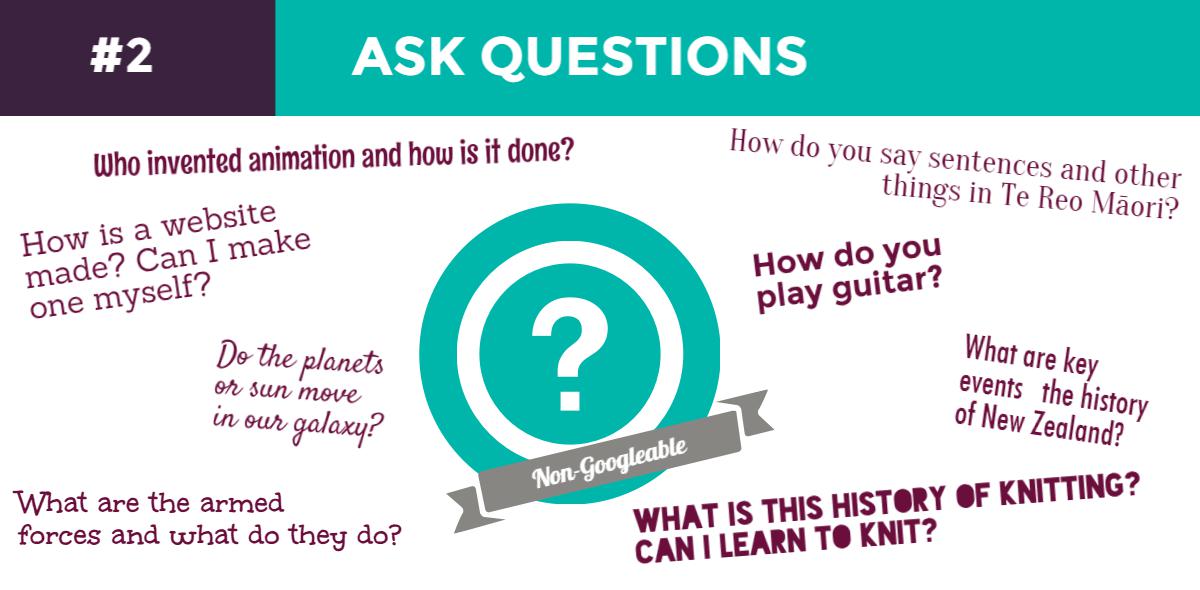
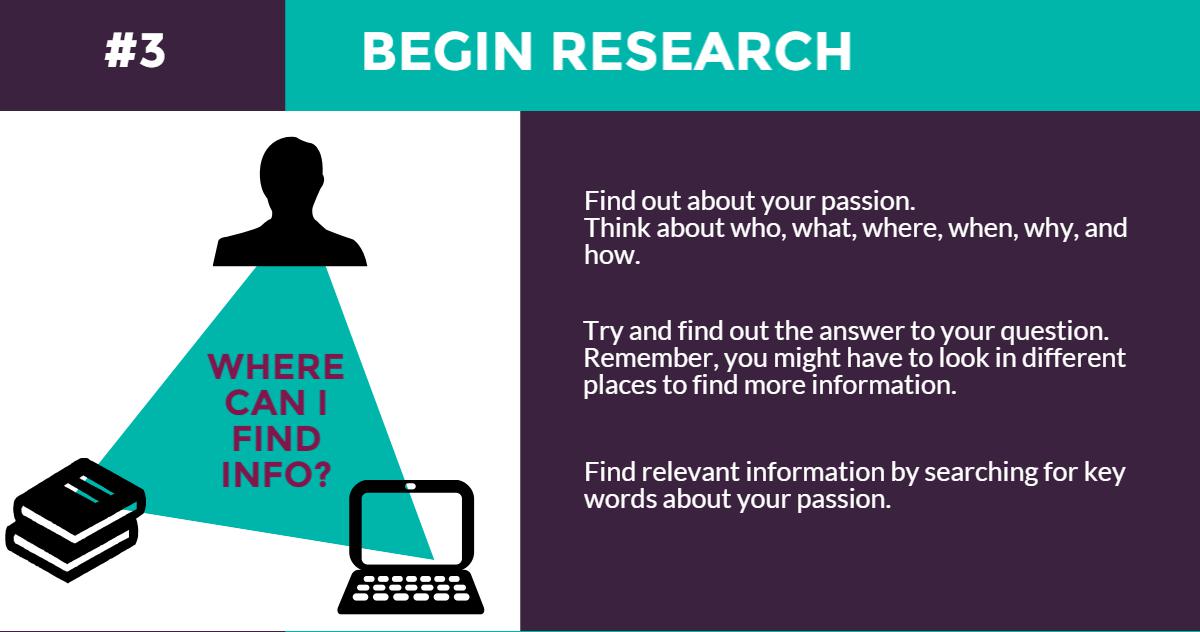
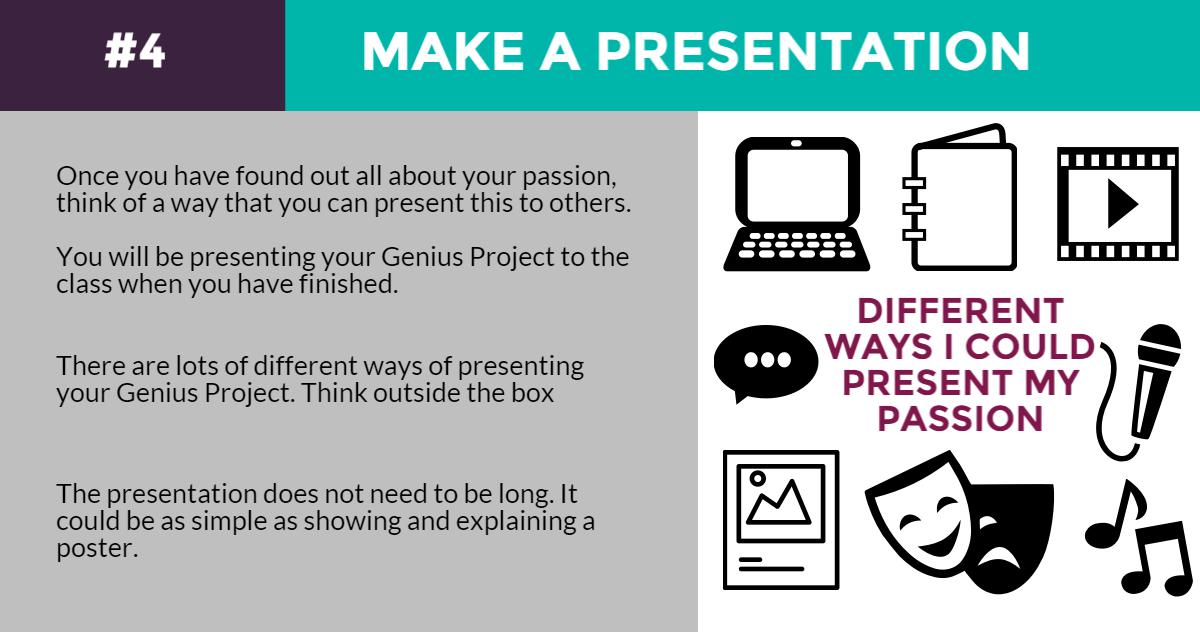
    3. I created a presentation / infographic that illustrate the guidelines I was expecting for each Genius Hour project. This is loosely based on a myriad of different flow charts I had seen from my research.
    4. The next step was to get students thinking about the questions that would guide their project, and some of the surrounding information. There is a very simple and straightforward project page available here. This, of course, can be adapted for your own needs.
    5. Check off each of these sheets to ensure that the students know what they are doing, and let them at it. 
    6. Set time: 60 minutes / 1 hour. Let Genius Hour begin!

    I will let you know how we get on soon!


    Related Links & Resources

    Pinterest Search

    Creative Classroom Tools

  • Discovery and Inquiry

    Last week I was introduced to the idea of encouraging discovery rather than instruction in terms of the way that content is delivered.

    You see, back when I was at school, the teacher was the fount of knowledge and learning took place by listening then doing. This is largely because the sources of information were bound between covers of encyclopaedia, and was largely inaccessible for the entire class to access at the same time. For whatever reason, when I fall back to my ‘default’ teaching style, I resort to instructing and then allowing students to do as instructed.

    But these days, when the source of knowledge is readily available on a multitude of devices, and accessible these days by all students through out the school day, the idea of enabling students to discover the lesson content completely changed my role as the teacher.

    Instead of talking, instructing, modelling, I’m needed more as a guide, to question, to enable, to give students the tools to find out for themselves, and to provide the support and opportunity for this to happen.

    Inquiry

    Lots has been made of the inquiry model of learning, where students have a big question and dig deeper into it through a variety of sources to gain a better understanding of the topic raised by that question.

    This model works well when students are able to define the question that they actually need in order to find out what they want to find out.

    However, not every student is able to do this, especially at primary school.

    In addition to this, if we were to launch an “inquiry” into something, it raises certain connotations with criminal activities and sinister behaviour. For example; “There’s going to be an inquiry into the Charter Schools.”

    Discovery

    Discovery, however, has with it a sense of adventure. There’s an excitement of the unknown and the journey to find out more. It takes a student from not knowing, to thinking, finding, expressing, processing, collating, and combining information for themselves to gain an understanding of that unknown.

    An example I am using this week has come about while I was thinking what students will need to know to complete some science based experiments. One of the key ideas around these experiments is testing and looking at constants and different variables. Knowing my class (as much as one can after 4 weeks), I suspect that most students will have little or no understanding of the terms “constant” and “variable”.

    Now, I could just tell the kids what they are. I could get the dictionary and then get students to write down the definition of both terms.

    But how much more active would the students be in this type of activity of they worked with a buddy (which as Year 5 and 6 students they need to given the neurological changes going on for them behind the scenes) to look up two different definitions of the terms, and construct their own definition of “constant” and “variable”?

    For one, they get to explore. They get to engage with the learning on a new level. They get to do the learning themselves. And in the long run, because of the hands on experience, might retain the information, as well as learn research and information finding skills that will help them in the future.

  • F01 – Voracious Reading

    https://youtu.be/3s_JHjvw6hk

  • A01 – Cross Checking

    https://www.youtube.com/watch?v=0ihKhziPyWg

  • C02 – Back Up and Re-read

    https://www.youtube.com/watch?v=LvRD8czcf6g

  • C01 – Check for Understanding

    https://www.youtube.com/watch?v=iJk_VHAQjmQ

  • Deathstar

    After another Ministry of Education hui for principals, a comment was made that the whole fiasco of the Community of Schools / Community of Learning negotiations with NZEI, have left teachers “…with the Deathstar, but we get to choose what colour lasers they use!”. I found it quite comical, and certainly falls inline with my views on the IES which can be found here.

  • Community of Learning Mincer

    In relation to Ministry comments at a recent Community of Learning hui for Board of Trustees.

    “The Community of Learning… is a pathway… to move a student through the pipeline…”

  • Reading Recovery Outdated?

    Reading Recovery outdated

    Change seems to be addictive in today’s culture. We always want the latest and greatest, and tend to shun anything that is deemed too old. We strip back perfectly good wallpaper, desire the latest iDevice even though our current one is more than adequate, and as for the latest fashion trends – well we all know they go in circles.

    It’s somewhat controversial news that Reading Recovery is supposedly outdated; though I’m not sure why.

    Maybe it’s because it’s a well established teaching programme in our country now.

    Maybe it’s because so much money is poured into it.

    Maybe it’s because one to one teaching is the most ideal scenario.

    Maybe it’s because our reading recovery teacher is bordering on the perfect definition of “legendary” and “awesome” combined in one.

    I therefore am not going to debate the issue of whether reading recovery is outdated, or whether groups of five or six is better, as is outlined in the Quick60 programme.

    It’s a Numbers game

    When we look at these two programmes, they have one thing in common.
    They both have a small teacher to student ratio, allowing the teacher to offer quality, focussed, and individualised teaching for the students.

    They allow for targeted learning, often to address specific needs of each child.

    As we move further into the 21st Century, there seems to be an ever increasing demand to address all the different needs in the class, to meet each individual need, and to provide differentiated learning based on all of those needs. National Standards has all centred around where the individual child lines up against the whole country, and individualised testing and assessment has proven to be far more accurate, or understanding, about each child.

    Yet at the same time, teachers (and some parents) continue to fight the direction of the government to raise class sizes up to phenomenal levels based on whatever research they can get their hands on that supports their agenda.

    Add to this the ever increasing number of special needs requirements within the class, and you start to get the picture of a classroom teacher who is going to find it hard to individually meet the needs of their class.

    And so this is why programmes like Reading Recovery and Quick60 thrive. It’s learning at its most ideal level. It addresses the needs in front of them. It’s focussed. It’s individualised. It’s differentiated.

    And that is why it works; regardless of how much progress is made by those students. A teacher can only do so much; at some point the student will reach the point where their potential and their obstacles meet. They will require more than just a teacher, and more than just 6 hours a day, for some of those obstacles to be removed. It takes a concerted effort of all involved; the school, the parents, and the child, to overcome these and continue to make progress.

    I don’t believe we can label and programme a failure or “outdated” purely based on any kind of results or lack of achievement when they’re are obviously so many factors which contribute to it.

    Edit: Some background information

    I did some “on-the-ground” research of my own.

    Turns out, Massey do this at nearly every opportunity. You see; back in the late 70’s, early 80’s, when applying to the Government for the tender of a nationwide literacy programme from the Government for funding, the powers that be decided to go with University of Auckland’s “Reading Recovery” programme by Marie Clay.

    You see, another university also applied for the funding for a nationwide programme. You guessed it: Massey University.

    The bitter rivalry continues through to today; some thirty years later. Take a look at these recent articles, all quoting comments, research, and articles by Massey University professors, in particular Professor James Chapman, who is cited on numerous occasions.

    When pieces of research are conducted under such circumstances, it is hard not to see that they are under the duress of bias, and need to be somewhat disregarded, given that they are looking for the failings of Reading Recovery, rather than conducting independent and unbiased research.

  • Kiwi Teachers among best in the world

    Newstalk ZB Article
    Finally. Some worldwide recognition. Sick of not getting it from the NZ Government, we’ve thrown caution to the wind and worked tirelessly for our tamariki; our future. We’ve done what we know is best, despite a climate of data, testing, judgements, and dictatorship. It’s almost like we’ve just set the world record for the high jump, all whilst having a four poster bed strapped to our ankles.

    And yet, as New Zealanders, we’ll humbly accept it, acknowledge it, forget about it, and resume normal life in about an hours time. After all, life doesn’t stop just because the world rates us highly. There’s still children to feed, hungry minds to teach, and the odd attention seeking kid to deal with as the class falls into chaos again on Monday.

    Yet as the article suggests that there needs to be more done from the Government to “improve support for teaching research and professional networks.”

    The Minister for education scrambles for cover, and quickly puts together a front and an excuse about Investing in Education Success, saying that their Community of Schools are already in the pipeline and will address these issues; despite the initial findings that all the Community of Schools will do is cause division among schools, and boards; principals and staff. Current principals all fighting for Lead principal roles, and schools not wanting to “take orders” from a Lead principal who does not know a school or its community. Some principals want nothing to do with it, sighting they don’t want to be the one to go into other schools, and weed out ‘poor’ teachers from that school. The additional workload does not match the addition in pay, especially for lead teachers, and so I struggle to see how this promotes “teaching research and professional networks”. Instead it creates competition, in-fighting, corruption and will create a climate where schools all end up teaching a very narrow curriculum in the same way as each other, which restricts any kind of teaching research.

    Aside from this, it is quite interesting to see the initial responses to the news. It’s hard to determine if these are people from the sector, or general members of the public, but they sure are following a similar theme.


    I don’t even care to know about what the Education Minister has to say about this. It has been quite clear through all of her speeches, her written letters, her policies and ideas, that teachers need to work harder. Yes, on the odd occasion she mentions what a good job teachers do, but always, ALWAYS, has followed that premise with “but they need to do more” statements to put the kaibosh on any feelings of accomplishment they might be having.

    No, instead, let us celebrate that even if we’re not recognised by this country, we are seen as up with the world leaders in teaching internationally. Let’s face it, a World Record is worth much more than a National one anyway!