Category: Archived

All the old posts from years gone by.

  • The Foundation: Relationships Matter

    The reality of it is, building without a foundation is somewhat pointless. If you start with the finished product without laying the groundwork, you will ultimately fail.

    The same can happen with teaching.

    You can have all the best learning intentions with well paced lesson plans and resources developed and prepared, but if you don’t put in the hard work first, all of it will be for nothing.

    So what is the groundwork for teaching? What is the foundation from which to build everything else from in your classroom?

    Relationships.

    Relationships.

    Relationships.

    The relationship between the teacher and the student is vital in making a difference in that student’s ability to focus, to trust, to experience, and ultimately to learn. Some students thrive on this more than others, but that does not make it any less important that you build a relationship and rapport with each and every student.

    Without it is pointless.

    The Māori proverb is often bandied about around many schools, and yet many overlook it.

    “He aha te mea nui o te ao. He tāngata, he tāngata, he tāngata”

    What is the most important thing in the world? It is people, it is people, it is people.

    And although we often refer to them as students, pupil, or children, it is important to remember that these are all young and growing people. They each have heartbeats. They each have spirit. They each have fears. They each have strengths. They each have backgrounds. They each have futures.

    Students who can trust you will follow you. Students that feel valued will value what you say. Students that have a place to belong will do anything to be a part of that. Students who feel they are a part of something will welcome in new ideas and new learning. Students who feel relaxed also feel comfortable. Students who are comfortable become confident, and confidence leads to taking risks. Learning new things always requires a big risk.

    Relationships do not happen overnight. They take time. Little moments can go a long way over the course of a year. Do not give up on them and just jump into the curriculum, all the lessons, assessments and the “learning”. Instead, focus on the relationship building each morning, each afternoon, and use each lesson as not only a learning experience but an opportunity to share time with your students. Get to know them. Get to know what makes them tick and what ticks them off. Get to know what their fears and dreams are. Get to know what they find funny and what upsets them. Understanding these things is like mixing and laying the concrete foundation for your building.

    By building relationship we can engage. By building relationship we can inspire. And by building relationship we can unleash.

    Next Part:

    The Foundation: Building Relationships

  • The Foundation: An Introduction

    A man began building a multi-storey high rise in the centre of the city. He worked furiously away at his dream building. He wanted a glorious penthouse at the top, with panoramic views overlooking the city. Luxurious furnishings and fittings, the gold standard in design and comfort. He began at the top, laying tiles over the top of each other and then raising them up on a slope so the rain could run off. He built the penthouse ceiling under it, before constructing the walls, windows and doors. Before long he was carpeting the floor and installing the plumbing for the grand en-suite. The patio decking stretched out from the large living area. He furnished the penthouse with expansive sofas and designer tables. The kitchenette had the latest in appliances and the reflection off the white marble was near blinding. It was a perfect example of a presidential penthouse.

    Then came the moment to build the floor below. He hired cranes to get the penthouse lifted, and began building the walls down. Each additional floor was the same, lifting the top higher and building the floor below. Eventually he had the desired number of floors and was able to start laying down the foundation.

    Something tells me that this is a slightly more difficult way of building. Needless to say that by the time he had finished, repairs and damages to the existing penthouse were extensive. The marble slabs each had a large winding crack through the middle of them, and many of the windows had long become shards. Several roof tiles fell to the ground with each subsequent level of the build.


    A teacher walked into the classroom on the first day of the year and stood at the front. He began teaching his dream lesson that was designed to fill his students with knowledge, awe, and excitement. It was engaging, collaborative and included everything a perfect lesson for learning needs…

    Next Part:

    The Foundation: Relationships Matter


  • A New Direction

    Hi All,

    After several personal attacks, I’ve come to realise two things:

    1. People are happy to dish things out but can’t take it (myself included)
    2. I’ve become far to critical, cynical, and political in my posts.

    Because of this I’m re-focussing my efforts as to what Unleash Education is about.

    I realise that there are a number of people who agree with my posts and political views, and with that, there are probably a few who disagree as well. In addition to that, I have been encouraged in the past to keep going, because those that follow my posts generally support the posts and are following for that reason.

    However, the reason behind setting up Unleash Education was for a completely different reason than for what it has become.

    Ultimately, it was to engage and encourage people in becoming better teachers through providing thoughts, ideas, pedagogy and resources. This also included being a part of the Twitter PLN that I’ve come to know and love and receive ongoing support and encourage from myself.

    Lately I have been posting solely on the political landscape that Education in this country has become, and the negativity that can happen when you begin to complain about all the things that don’t go your way.

    Instead, what I’ve come to realise is that what I should be doing instead is changing it from within; showing the positivity that can be a career in teaching, helpful pointers and suggestions from my own classroom experience, and encouragement to all teachers to be the best. I should be sharing the things that have worked for me, the resources I’ve made to engage and inspire students, and begin to be something to strive for, rather than as a vehicle for slander and criticism.

    To those I’ve offended, I apologise.

    To those that have found my political views great and have followed me because of it, I hope that you’ll continue to follow and support me as I shift the direction of it all.

  • A Twitter Conversation: May 2019

    A Twitter Conversation: May 2019

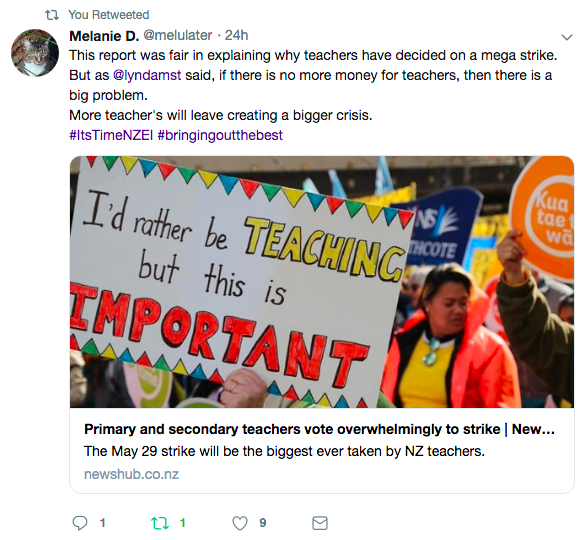
    ​School teachers and principals across the country have agreed to stage New Zealand’s largest-ever strike as negotiations with the Ministry of Education continue to stall.

    The Post Primary Teachers’ Association (PPTA) and New Zealand Educational Institute (NZEI) Te Rui Roa announced the move on Sunday, and said rolling strike action was also possible.

    Ths strike, on May 29, will involve almost 50,000 primary and secondary teachers and primary principals, and will affect hundreds of thousands of students in more than 2000 schools.

    https://www.stuff.co.nz/national/education/112655087/teachers-have-voted-to-strike-on-may-29


    The Conversation

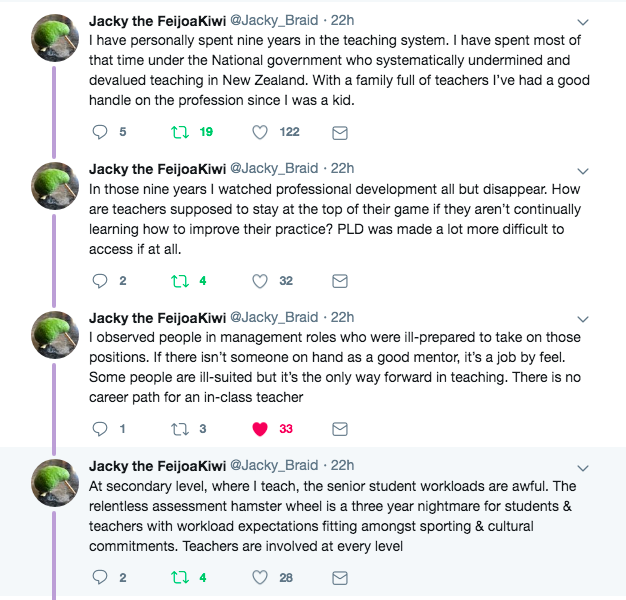
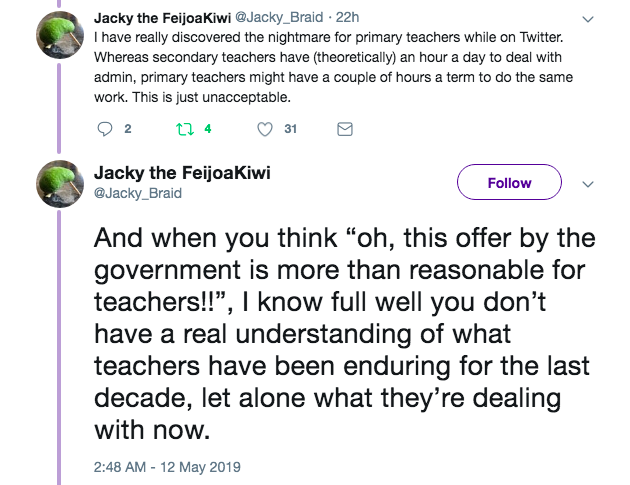
    Obviously there has been a lot of reaction to the recent vote to hold a mega strike, and a lot of this reaction has been documented on Twitter. I wanted to collect this reaction and keep a record of it in our blog. I have come to realise that I value the posts on this site, but often a lot of conversation happens on Twitter and then falls off into the Twittersphere.


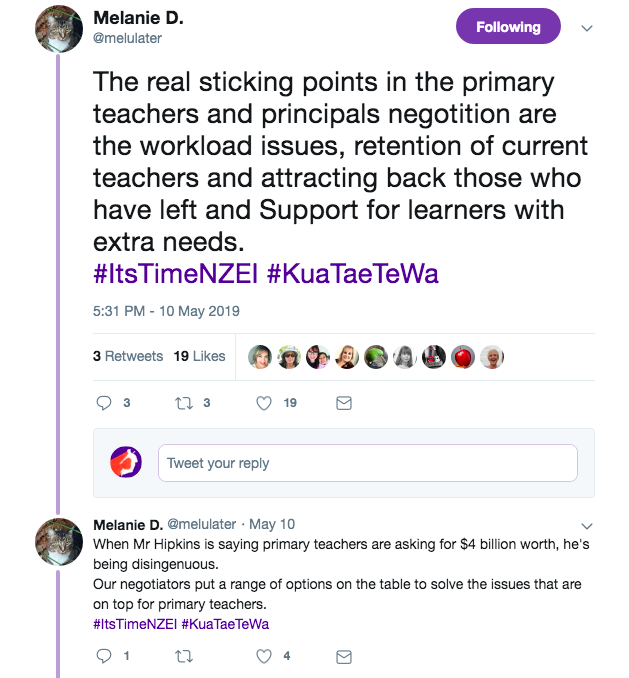
    • The crisis is real, and it’s spreading. And the more who leave, the more work has to be picked up by other all-ready-stressed teachers. And thus the crisis is exponentially growing. And all the government is prepared to do is start training replacements!?
    • In all of these pay negotiations, not once have teachers been asking for anything that is unreasonable… It’s not like we’re asking for a slushy machine in every school!
    • Come on … Make history. Be the one MP to stand up for teachers and get them what they deserve. Show the public the importance of education in this country. Go on. I dare you!
    • So it’s not that the government CAN’T meet what we’re asking for…. it’s that they WON’T.
    • Kinda think that the Teacher Unions need to start playing hardball. Indefinite strike would soon get some results. Look at the bus drivers….

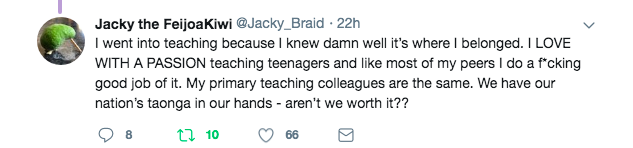
    • Started putting my thoughts down about teacher workload into a tweet…. ran out of characters and lost all energy and enthusiasm for continuing. A story all too common for lots of teachers at the moment!
    • Essentially here’s what would solve a lot of problems: • Pay Teachers more, because we’re worth it and we deserve it. • Shrink class sizes, because with less students comes less work but more teaching. • More SENCO resourcing, because there are more needs than ever before.
    • Shrinking class sizes is key. Less reports to write, less assessments to do, less paperwork to compile. More time for each student. More genuine relationships. More teaching. More jobs available for the additional teachers that come back into the workforce!
    • For me; class size plays a huge role on the teacher. For the last few years I’ve consistently had over 31 students in my class. Believe me; when there are 6 away and the class is only 25; it makes a HUGE difference in the way the classroom feels, acts, and learns.
    • For me, having more time in itself doesn’t sort anything out; it means time out of class if anything. What I need is less students in front of me which will in turn give me more time for each one. It also lessens the time I need for assessments, reports, planning etc…. win win!

    • I left the union at the end of last year. Not regretting it. They should be doing a LOT more given the circumstances, and a clear plan seems to be lacking. Seem to be floundering in too many ideas rather than laying out a “game” plan for teachers and the government to follow!
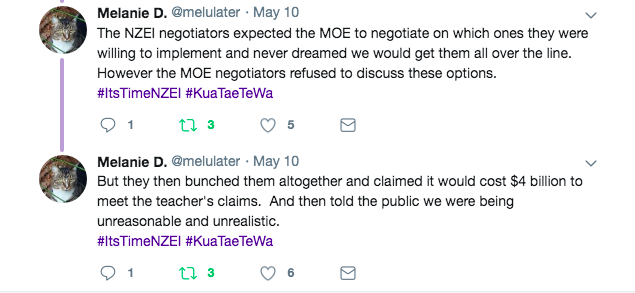
    • So why did the Ministry turn up to the last round of negotiations with NZEI with no new offer? Took active teachers and leaders out of their classrooms, made them organise relievers, sort out transport… for what!? No new offer!? How disrespectful.

    • Let’s face it. I am a teacher. No government is ever going to be able to pay me what I’m worth. I knew this going into the profession. But come on… at least you could try and show me I’m valued
    • Quick question … Why has class size not been a major negotiating point as a way of reducing workload? Teachers are definitely asking for this!!!

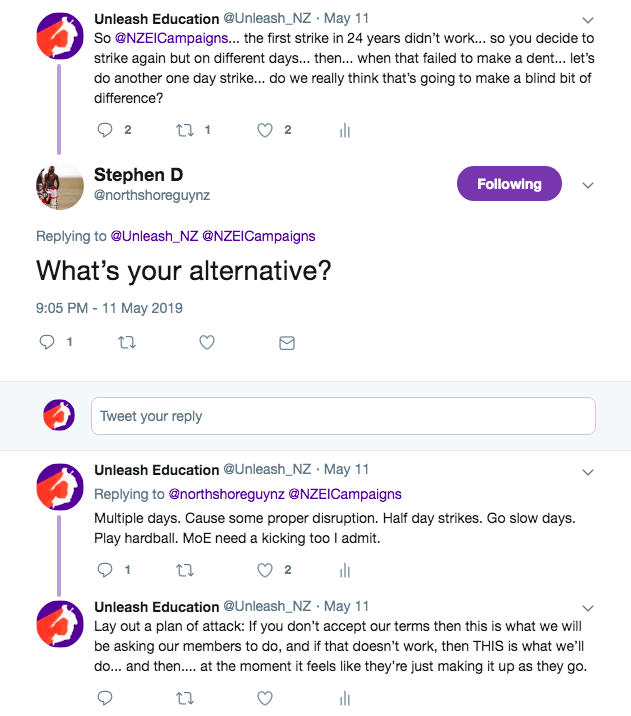
    • So … the first strike in 24 years didn’t work… so you decide to strike again but on different days… then… when that failed to make a dent… let’s do another one day strike… do we really think that’s going to make a blind bit of difference?
    • Multiple days. Cause some proper disruption. Half day strikes. Go slow days. Play hardball. MoE need a kicking too I admit.
    • Lay out a plan of attack: If you don’t accept our terms then this is what we will be asking our members to do, and if that doesn’t work, then THIS is what we’ll do… and then…. at the moment it feels like they’re just making it up as they go.


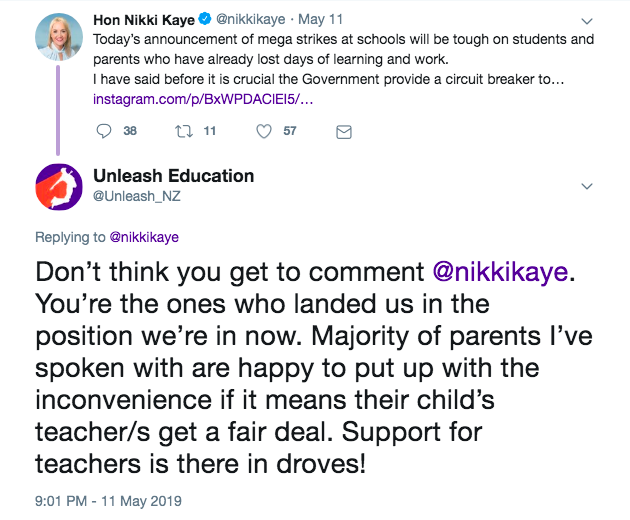
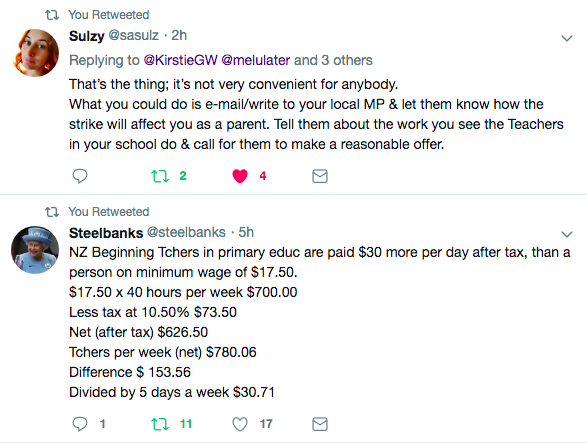
    • Don’t think you get to comment . You’re the ones who landed us in the position we’re in now. Majority of parents I’ve spoken with are happy to put up with the inconvenience if it means their child’s teacher/s get a fair deal. Support for teachers is there in droves!
    • But seeing as you do get to comment; what would National’s offer be if you were still in Govt?
    • I also find your teacher ratio comments hard to believe, given Hekia wanted to raise them through the roof. If I were you I’d be offering apologies and then begin making things right rather than trying to blame the ones who came after you for the monster you created.

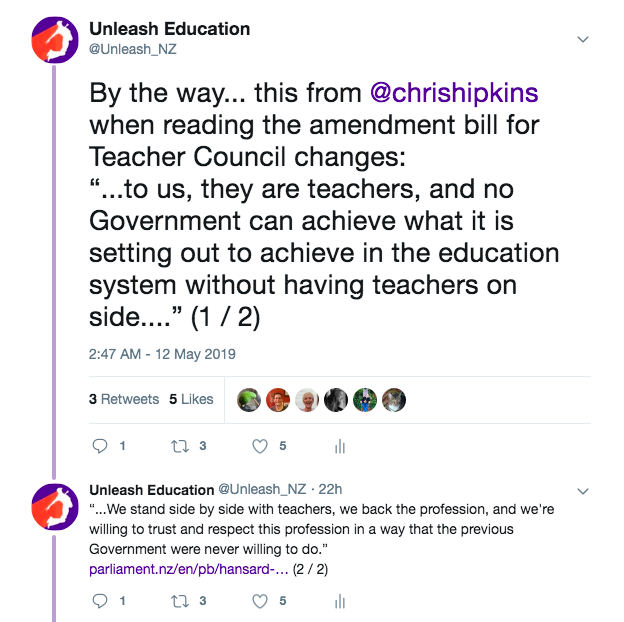
    • By the way… this from when reading the amendment bill for Teacher Council changes: “…to us, they are teachers, and no Government can achieve what it is setting out to achieve in the education system without having teachers on side….” (1 / 2)
    • “…We stand side by side with teachers, we back the profession, and we’re willing to trust and respect this profession in a way that the previous Government were never willing to do.” (2 / 2)


  • Secondary School Teachers to Strike

    Secondary teachers will go on strike next month after “running out of patience” with collective contract negotiations, their union’s president says.

    Thousands of teachers will walk off the job in a national day of action on April 3.

    At a Post Primary Teachers’ Association (PPTA) meeting in Rotorua on Saturday, president Jack Boyle said teachers hoped to receive “a realistic offer” from the Government before then. More talks are planned for March 7 and 8.

    “If we don’t, we will use the day to publicly protest the lack of progress,” Boyle said.

    “We have been negotiating with Government for a settlement to our collective agreement since August last year and our members are running out of patience.”

    In November, PPTA members voted against the Ministry of Education’s second offer of a 9 per cent pay rise over three years.

    Members authorised a one-day strike at that time, but were willing to call off the strike if they received a better offer.

    Read Full Article: https://www.stuff.co.nz/national/110979827/secondary-school-teachers-to-strike


  • Tomorrow Schools and the Equity Gap

    It’s interesting to see that word “review” and “reform” getting bandied about.

    At one point, reform was an issue as we fought off “GERM”…

    Now, a review is taking place of our school system, and some suggestions being made, and suddenly those that may have been encouraging GERM are now questioning this review.

    The main objection to the review is stemming from the education elite; those sizeable schools who have clawed in students and money and status through whatever means possible. The bigger the school, the more influence you’re seen to have, as the more students you have, the more parents you have, and usually, the more chances of having very rich or important parents. The sphere of influence grows and it becomes all about who you know, not what you know.

    Take the article They’ve Seen the Future for instance; Martin Thrupp has some very good points that he makes in the article. He says…

    “It is a kind of view that runs through New Zealand society; this great concern about inequality, poverty and so on, but at the same time people who are on the advantaged side of it don’t necessarily want to share their resources.

    “Because of that, we do see principals of high socio-economic schools not particularly supportive of redistribution efforts and greater equity funding for low socio-economic schools.”

    He goes on to say that parents are the same, clustering together to improve their status, keeping up with the joneses, purchasing houses in specific zones (Look at the marketing done in the season of the Block where one house was in zone for a particular Auckland school). They work together to all jostle for position, and not only demand, but provide resources to ensure, that their child gets the best possible education. This carries on at home.
    Thrupp says that this doesn’t always happen in low-socio economic communities.

    We see what money means to those schools as well.

    Wellington College Principal says that with the donations his school receives, he is able… “to make decisions around overstaffing, to pay for a teacher’s salary beyond the [roll-related] staffing. It’s enabled us to sometimes have smaller classes, start new subjects, retain high-quality staff.”

    Now, that’s all well and good, and a great luxury to have. But there is always another side of the coin.

    This kind of luxury is simply not available to schools in low socio-economic  areas – places where smaller classes and decisions on overstaffing would be very much beneficial. These schools have high-quality staff, but they often get burnt out managing classes of 30+ pupils, or leave for greener pastures at schools that might be able to offer smaller classes, better resourcing, or other incentives for them. Needless to say, this also means that any high quality staff these schools have, won’t have the same effectiveness due to their larger class sizes. I don’t really care for what Hattie’s research (however bogus or biased it is) says about class size; if you take a great teacher and put them in front of 30 students, and then put them in front of 20 students, they are going to have better success (not to mention overall better well-being) in the class of 20 students.

    Okay. Time for some maths.

    In the article, it states that Wellington College received $5.7 million in donations in 2017, the most for any school. It’s roll is around 1750 students.

    So taking that $5.7million, and calculating how much that amounts per student, we end up with a figure of $3,257 per student. PER STUDENT.

    I can guarantee, that is more for one student than most schools receive in donations for their whole school. Add to that the notion that the Government suggested during their election run that they would subsidise schools $150 per student if they dropped their school donations for parents. This has yet to happen, but I know of several schools that have waived asking for school donations from their communities, because of this, but also because they know the burden it puts on some of their families.

    Three and a quarter thousand dollars per student is a long way from a mythical $150.

    No wonder these schools don’t want the review suggestions to be implemented.

    I wonder what would happen if, just for a week, those principals in the lofty heights of the wealth and famous, got to see the otherside of the coin, and got to see that we are all here for one reason – to educate our young people, and begin seeing this as a New Zealand wide system rather than just from their ivory insulated tower. Maybe, just maybe, they’d see things in a different light, and hopefully be able to see the disparity that exists and that this taskforce are trying to address.

    How can education in New Zealand provide the same opportunities for every child when there is such a massive gap between the rich and privileged and the rest who are doing the best they can with what they’ve got?


    Original Article: https://www.stuff.co.nz/national/education/110421061/theyve-seen-future–its-not-tomorrows-schools


  • Teacher Back to School Bingo – 2019 Edition

    Hi all! It’s that time of year where you put down your book, find the school keys, dust off your TELA laptop and cruise back to school.

    No one finds it fun.

    Unless they have the latest edition of Teacher’s Back to School Bingo!

    Here is the latest edition for 2019. Print it off, hand it out to your colleagues, or simply keep the fun for yourself!

    Of course, you could always play last year’s version, or head on back to the very first Teacher’s Back to School Bingo.

  • Automatic Google Drive student notifications

    As a teacher, I’m constantly looking for ways to make my life easier. The computer is but a tool to use, and it can be used to do many menial tasks that we often end up doing manually or doing ourselves. Because of this, I’m a huge proponent of the saying “Work smarter, not harder”. We can free up additional time and systems by simply handing these over to the computer to do.

    One of the great things that Google Suite has is the ability for students to share their work with the teacher. At first I was hesitant to hand out my teacher’s email address, but since doing so, I have students sharing their latest work with me almost automatically, and providing feedback in this way is really valuable. Further to this is their ability to collaborate together, and this year I am wanting to utilise the function of shared folders more.


    To do this, I wish for students to put any file or creation into a shared folder. This then becomes easier to keep track of all of their work. The main problem with doing this of course is that you never know when a student has added a file to the folder or not, meaning you have to keep visiting the folder and checking it yourself.

    Welcome to Zapier.

    With Zapier, I can set it up so that when a file is added to a particular folder (i.e. classroom Shared folder) it will email a notification to me.

    With Zapier you can set up automate processes between different services.

    One of those is between Google Drive and Gmail.

    Simply connect up your accounts, then select which folder you want to “watch” and which email you’d like to be notified.

    Then, whenever that folder gets a file added to it, you will receive an email. Share this folder with your class and wait for students to start dropping their files into it.

    Done!

  • BYOD: It’s not as compulsory as you think

    As a bit of a tech guru, it saddens me to see parents trapped in the psyche that they need to not only “Keep up with the Joneses”, but need to provide their child with a $300+ device to use at school. Let alone stationery, let alone uniforms.

    The reality is that schools should be providing the devices for the students, but this runs into many issues. One is the ongoing costs to the school which many simply don’t want to budget for or have other priorities and are not funded adequately enough to provide for one-to-one devices in their school. Then there’s the requirement to maintain these devices and issues surrounding damages and repairs and whose responsibility that is, along with many others. So instead of dealing with this, schools have been farming this cost off onto their community and expectations land on the parents to provide these.

    Here’s the other reality though. If you can’t provide one, because of whatever reason (including any moralistic ones), then you do not have to. Schools cannot enforce it, and it says so in the following article. It’s against the law. Schools can’t even demand a particular kind of device – they can’t demand any device. These are only recommendations so that they have devices that are all similar and therefore easier to manage within the classroom so that unskilled teachers don’t have to learn how to use a range of device types in order to assist and help with any technological problems.
    But, as we’ve come to know, most devices are usable by the general population and are rarely so dissimilar that they become problematic. Add to this the fact most schools are running Google Apps, which operate on the big cloud in the sky and runs off the internet – therefore look, run, and work all the same regardless of the device being used (allowing for differences between tablet apps and browser based versions).
    Simply put, any device will do. Shop around, and select one that matches your budget, and then your needs, not the other way around.

    Parents who aren’t in the position to splash out for a device that will likely only last 3 years and then you’re up for another one,  should swallow their pride and go and talk to the school. If the school is worth their weight, they’ll explain, discuss, and come to some arrangement for you. It is more than likely some compensation can be made, and in most cases, schools will have a (albeit limited) supply of devices available for student use.

    If not, then it’s more a reflection on the school than you as a parent.

    Don’t just accept it and remortgage your house or go without food for a week to pay for it. It sickens me that this happens because parents don’t want to go to the school.
    Go and talk to the school. Yes they are closed at the moment, but they’ll be open soon enough. Go and have a chat and explain your position. Yes, there may be shame, but it’s not worth just going along with the list of demands, complaining about it later, and missing out on other more important things. Like school lunches.

    I’ve always said schools need to sort out BYOL before they sort out BYOD. If every student is a “Bring Your Own Lunch” student, THEN, and only then, should you start thinking about becoming a “Bring Your Own Device” school.

    Original Article: https://www.stuff.co.nz/business/money/88562690/schools-byod-or-bring-your-own-device-demands-are-a-rising-cost-to-parents?rm=m

    For many parents, preparing their children for the school year means finding ways to cope with the costs of BYOD.

    BYOD stands for “bring your own device”, and refers to pupils owning devices like laptops, iPads and Chromebooks for use in the classroom, and for homework.

    Prices quoted by electronics retailer PB Tech, which has built a “shop by school” search tool, show the costs of devices expected at schools vary from Chromebooks starting at just over $300 up laptops costing $2000 or more.

    In both cases there can be extra costs for shock-proof, waterproof cases, and accidental damage insurance.

    Schools have worked hard to negotiate deals, and affordable payment plans for families, knowing the extra pressure BYOD policies can put on hard-pressed families.

    But parents without ready cash can find themselves being steered by schools towards finance companies, or even Work and Income.

    It’s not clear exactly how many people do get government help to cope with BYOD costs, but the first three months of last year, covering the back-to-school period, saw 24,278 instances of “hardship assistance” made by Work and Income, adding up to just under $5.3 million in payments.

    DEBATE OVER

    The debate over whether devices have a place is the classroom is largely settled at intermediate and high school level.

    But some primary schools have introduced BYOD for their older pupils, and retailers like PB Tech sometimes pictures of primary-age children on their website.

    The Ministry of Education says ultrafast broadband is transforming education, and has invested heavily in helping schools and teachers to “equip students with the necessary digital skills to take part, create and thrive in a fast-evolving world”.

    Schools cannot legally force families to buy their children devices, but it’s now common practice for them to use words like “require” and “expect” in their BYOD policies and menus of devices.

    Intermediate and high school parents may feel they have no choice but to fund BYOD, and there’s even signs of pressure on some parents of primary school children.

    Primary schools often own a number of devices, but as Buckland Beach Primary School tells parents: “Parents are now offered the chance to improve the access their child has to ipads. This is offered through BYOD where students bring an ipad from home.”

    Other Articles: https://www.stuff.co.nz/business/money/88562690/schools-byod-or-bring-your-own-device-demands-are-a-rising-cost-to-parents?rm=m